Crude oil
Học bằng cách chơi
Trả lời những câu hỏi này để kiếm năng lượng, rồi câu cá và khám phá. Không cần tài khoản.
Ghi chú bài học
Formation of Crude Oil
- Crude oil is a liquid found deep under the Earth's surface.
- It is made from the remains of organisms like algae and plankton.
- These remains were deposited on the sea floor and covered by sediments.
- Over millions of years, heat and pressure turned the remains into crude oil.
Composition of Crude Oil
- Crude oil is a mixture of many different substances.
- Most of these substances are hydrocarbons – compounds made of hydrogen and carbon.
Fractional Distillation Process
- Crude oil is separated into different parts by fractional distillation.
- In a refinery, crude oil is heated until it turns into a gas.
- The gas enters a tall tower called a fractionating column.
- The column is hotter at the bottom and cooler at the top.
- As the gas rises, different substances cool and condense at different temperatures (different boiling points).
- Liquids are collected at various levels, each collecting a different fraction.
The process separates the fractions according to their boiling point
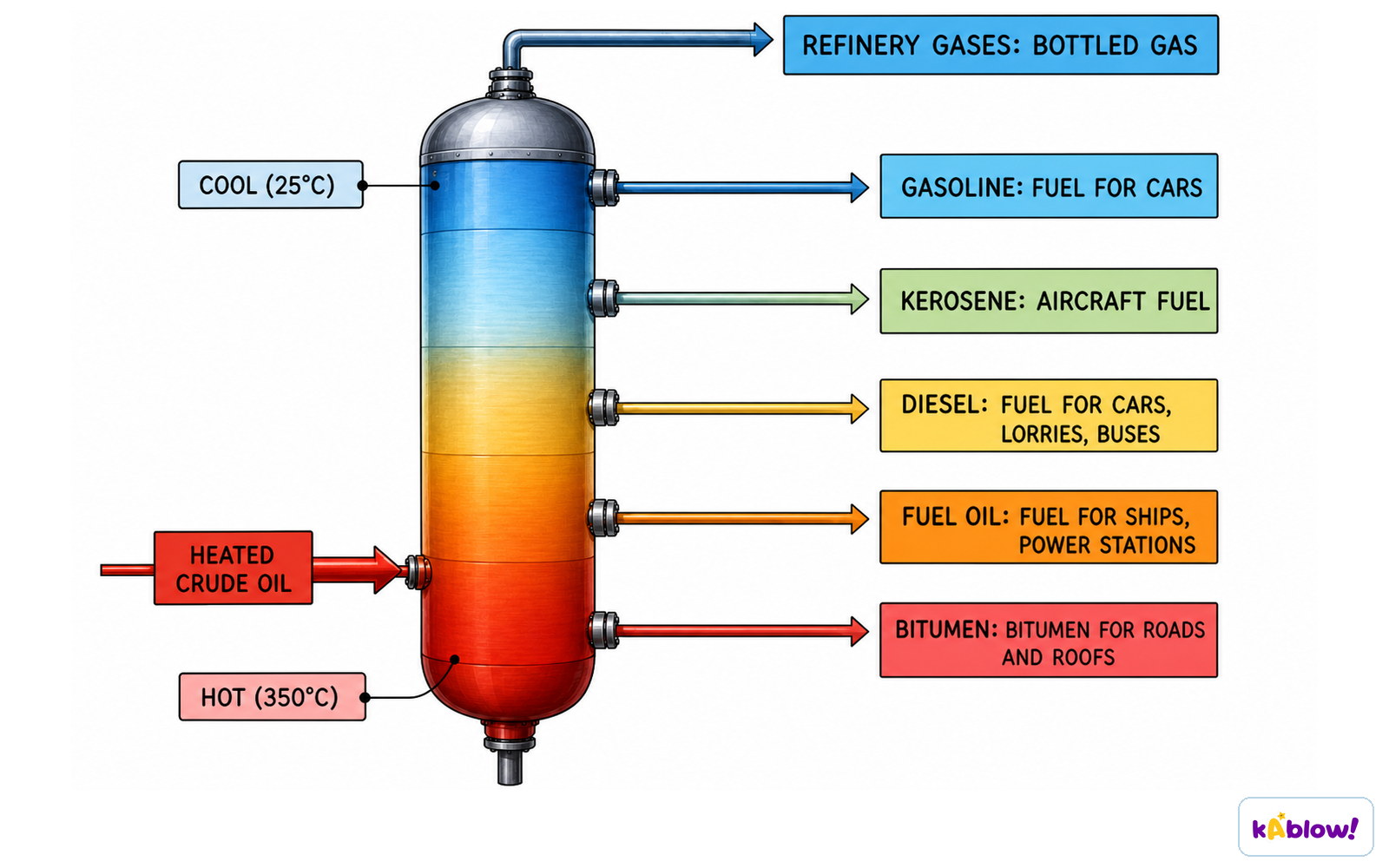
Products and Their Uses
- Petrol: Fuel for cars.
- Diesel: Fuel for trucks, buses, and some cars.
- Kerosene: Fuel for jet engines and heaters.
- Fuel Oil: Used in ships and large industrial plants.
- Butane and Propane: Fuel for cooking, heating, and lighters.
- Lubricating oils: Reduce friction in engines and machines.
Environmental Impact
- Burning fuels from crude oil releases carbon dioxide (CO₂).
- CO₂ is a greenhouse gas that contributes to global warming.
States of matter: solid, liquid, gas. Crude oil is a liquid; fractional distillation involves heating to gas and cooling to liquid.
Slide
Sign up free to view the lesson slides
Step through every slide for this topic — plus flashcards and revision notes — with a free account.
Câu hỏi luyện tập
Xem trước miễn phí — 8 trên 39 câu hỏi. Đăng ký để xem tất cả.
1.What is crude oil mostly made of?
Easy- AHydrocarbons
- BCarbohydrates
- CProteins
- DFats
2.Which of the following is NOT a product obtained from fractional distillation of crude oil?
Easy- APetrol
- BDiesel
- CKerosene
- DEthanol
3.In a fractionating column, where is the temperature highest?
Medium- AAt the top
- BAt the bottom
- CIn the middle
- DIt is the same everywhere
4.Why does fractional distillation separate crude oil into fractions?
Medium- ADifferent substances have different boiling points
- BDifferent substances have different densities
- CDifferent substances have different colors
- DDifferent substances have different viscosities
5.Which of the following correctly lists the fractions in order of increasing boiling point?
Hard- APetrol, kerosene, diesel, fuel oil
- BFuel oil, diesel, kerosene, petrol
- CPetrol, diesel, kerosene, fuel oil
- DKerosene, petrol, diesel, fuel oil
6.What is a hydrocarbon?
Medium- AA compound made of hydrogen and carbon only
- BA compound made of hydrogen and oxygen only
- CA compound made of carbon and oxygen only
- DA compound made of hydrogen, carbon, and oxygen
7.Which gas is released when fuels from crude oil are burned?
Easy- ACarbon dioxide
- BOxygen
- CNitrogen
- DHydrogen
8.Why is crude oil described as a non-renewable resource?
Medium- AIt is made from remains of organisms that lived millions of years ago and takes millions of years to form
- BIt can be made quickly in a laboratory
- CIt is found in unlimited quantities
- DIt is not used up when burned
Unlock all 39 questions, flashcards & more
Tạo tài khoản miễn phí để xem mọi câu hỏi, slide, thẻ ghi nhớ và ghi chú ôn tập cho chủ đề này.