Group 7 elements
Học bằng cách chơi
Trả lời những câu hỏi này để kiếm năng lượng, rồi câu cá và khám phá. Không cần tài khoản.
Ghi chú bài học
What are the halogens?
- Group 7 elements are called the halogens.
- They are all non-metals.
- They do not conduct electricity or heat well.
- They have low melting and boiling points.
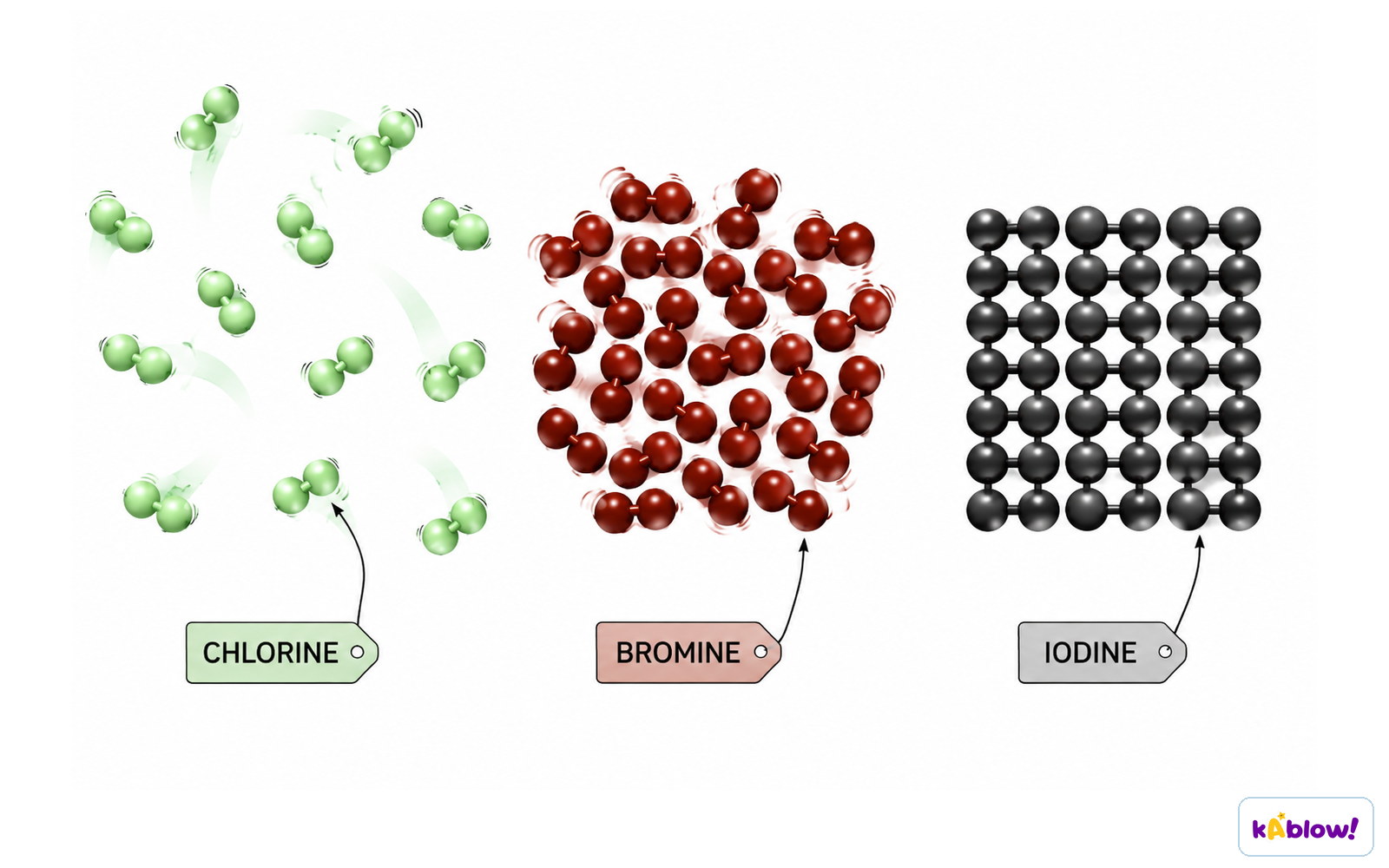
Chlorine is gaseous, bromine liquid, and iodine solid at room temperature; every particle is shown as a diatomic molecule.
Trends in group 7
- As you go down group 7, melting and boiling points increase.
- This is because larger molecules have larger intermolecular forces.
- As you go down group 7, reactivity decreases.
- Halogens are very reactive and toxic.
Uses of halogens
- Chlorine gas was used as a weapon in World War One.
- In low concentrations, chlorine is used to limit bacteria growth in swimming pools.
Displacement reactions
- A displacement reaction occurs when a more reactive element replaces a less reactive element in a compound.
- Both metals and halogens can undergo displacement reactions.
- If fluorine is in a compound, it ends with 'fluoride'; chlorine → 'chloride'; bromine → 'bromide'; iodine → 'iodide'; astatine → 'astatide'.
- These compounds are collectively called halides.
- Example: sodium bromide + chlorine → sodium chloride + bromine (chlorine is more reactive than bromine).
- No reaction occurs if the displacing element is less reactive: sodium bromide + iodine → no reaction.
- Another example: potassium iodide + chlorine → potassium chloride + iodine (colour change from colourless to brown).
Bohr model of a chlorine atom, showing electron configuration 2,8,7 (7 valence electrons).
Slide
Sign up free to view the lesson slides
Step through every slide for this topic — plus flashcards and revision notes — with a free account.
Câu hỏi luyện tập
Xem trước miễn phí — 8 trên 58 câu hỏi. Đăng ký để xem tất cả.
1.Which of the following is a halogen?
Easy- AChlorine
- BSodium
- CCarbon
- DOxygen
2.Which halogen has the highest melting point?
Easy- AFluorine
- BChlorine
- CBromine
- DIodine
3.Which property is true for all halogens?
Easy- AThey are all gases at room temperature
- BThey are all reactive and toxic
- CThey are all good conductors of electricity
- DThey all have high melting points
4.What is a displacement reaction?
Easy- AA reaction where a more reactive element replaces a less reactive element in a compound
- BA reaction where two elements swap places in a compound
- CA reaction where an element combines with oxygen
- DA reaction that releases heat
5.Why does a displacement reaction occur between potassium bromide and chlorine?
Easy- AChlorine is more reactive than bromine
- BBromine is more reactive than chlorine
- CPotassium is more reactive than chlorine
- DThe reaction produces a gas
6.Balance the equation: ___ KBr + Cl2 → ___ KCl + Br2
Medium- A2, 2
- B1, 2
- C2, 1
- D1, 1
7.Which of the following is a sign that a chemical reaction has taken place?
Easy- AA change in colour
- BAn increase in temperature
- CFormation of a gas
- DAll of the above
8.Complete the word equation: potassium iodide + bromine → ?
Medium- Apotassium bromide + iodine
- Bpotassium iodide + bromine (no reaction)
- Cpotassium bromine + iodine
- Dpotassium + iodine bromide
Unlock all 58 questions, flashcards & more
Tạo tài khoản miễn phí để xem mọi câu hỏi, slide, thẻ ghi nhớ và ghi chú ôn tập cho chủ đề này.