Beyond the solar system
Học bằng cách chơi
Trả lời những câu hỏi này để kiếm năng lượng, rồi câu cá và khám phá. Không cần tài khoản.
Ghi chú bài học
The Universe and Galaxies
- The universe contains billions of galaxies.
- A galaxy contains billions of stars.
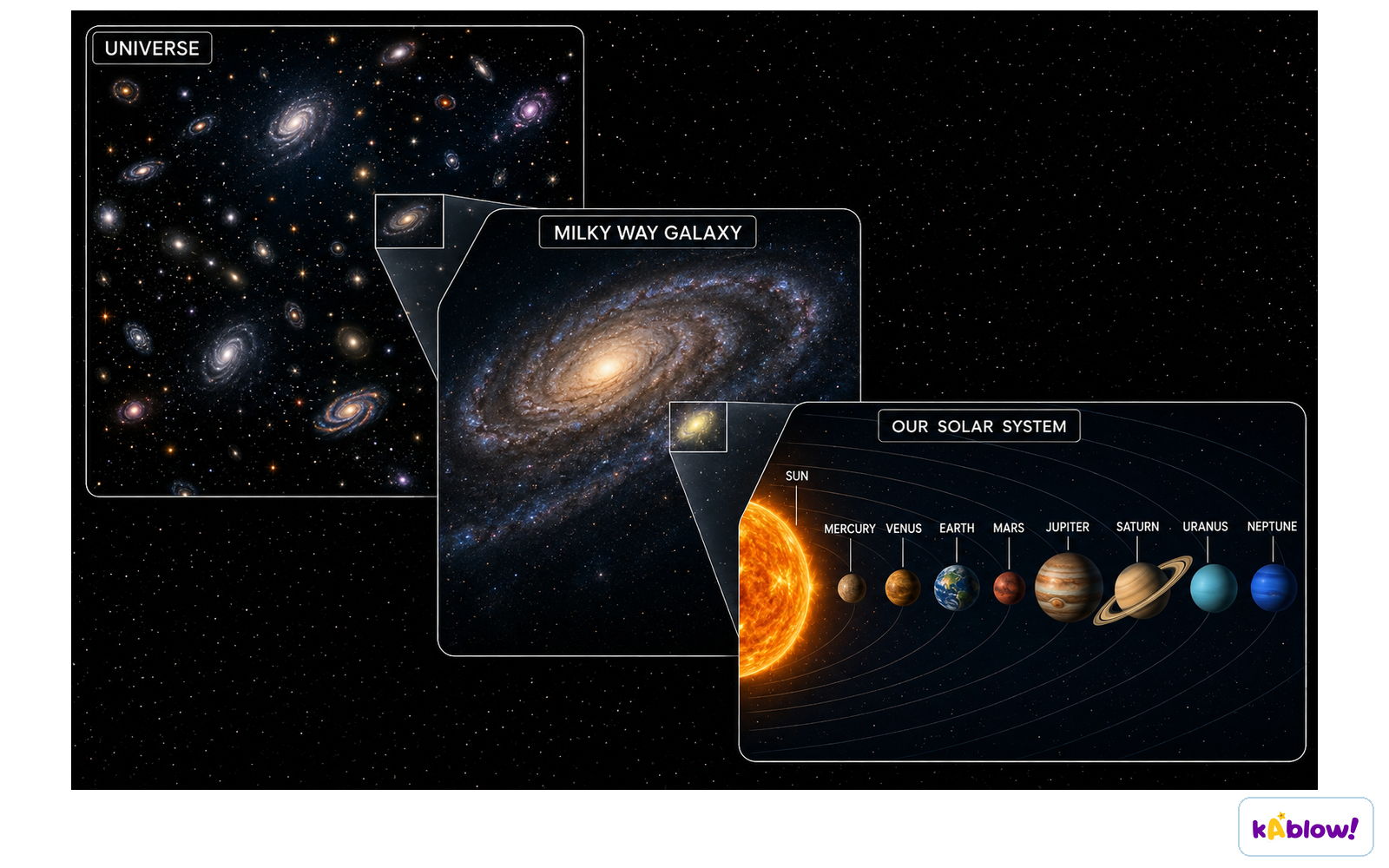
- Our solar system is part of the Milky Way galaxy.
- The universe formed 13.8 billion years ago in the Big Bang.
- Distances to galaxies are measured in light years.
Universe, Milky Way galaxy and Solar System, from largest to smallest scale.
Light Years
- The speed of light is 300,000,000 m/s.
- A light year is the distance light travels in one year.
- One light year equals 9.5 × 10¹⁵ m.
- The Andromeda galaxy is 2.5 million light years away.
Black Holes
- At the centre of the Milky Way is a black hole.
- A black hole forms from the death of a very massive star.
Star Life Cycle: Nebula to Main Sequence
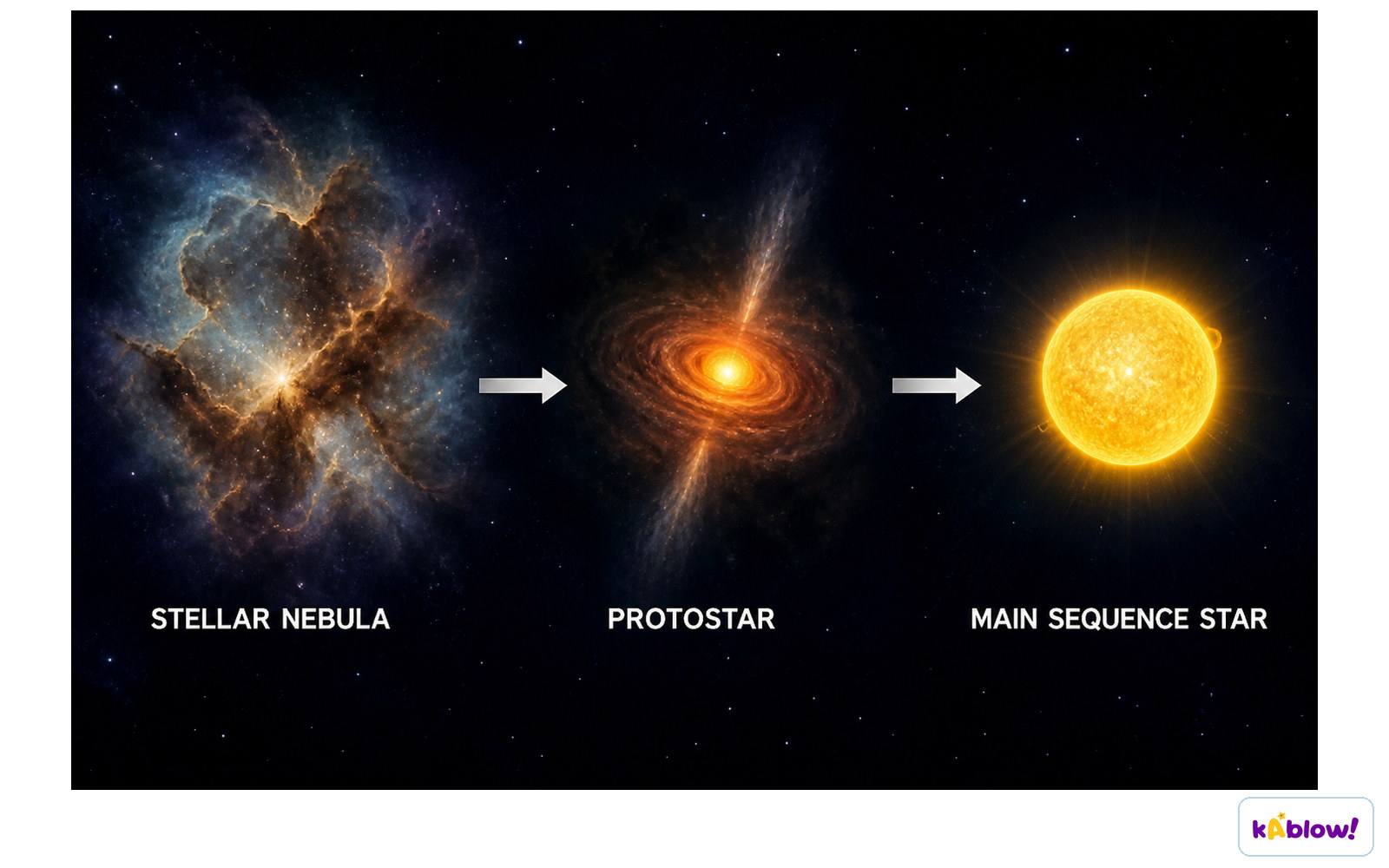
- All stars begin as a cloud of dust and gas called a nebula (mostly hydrogen).
- Gravitational attraction pulls the dust and gas together.
- Pressure and friction cause the temperature to rise greatly.
- A main sequence star is formed.
A nebula contracts into a protostar, which becomes a main sequence (stable) star.
Star Life Cycle: Later Stages
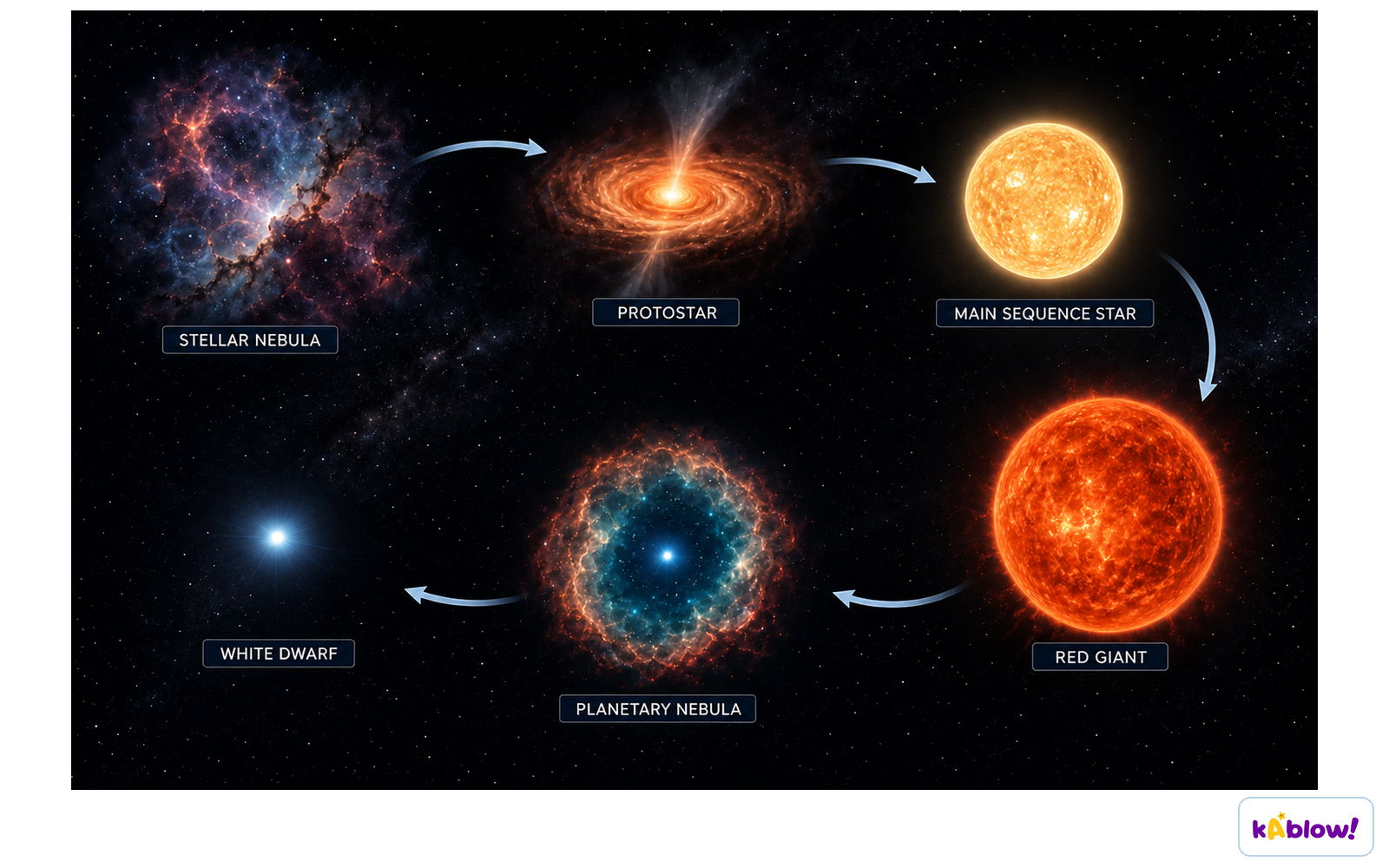
- When hydrogen runs out, stars expand.
- Stars like the Sun become red giants; much bigger stars become red supergiants.
- Red giants leave behind a white dwarf that cools to a black dwarf.
- Red supergiants explode in a supernova.
- The biggest stars leave a black hole; less massive ones leave a neutron star.
Flow diagram showing the life cycle of a star with a mass similar to the Sun.
Slide
Sign up free to view the lesson slides
Step through every slide for this topic — plus flashcards and revision notes — with a free account.
Câu hỏi luyện tập
Xem trước miễn phí — 8 trên 63 câu hỏi. Đăng ký để xem tất cả.
1.How many galaxies does the universe contain?
Easy- ABillions
- BThousands
- COne (the Milky Way)
- DMillions
2.What is the name of the galaxy that contains our solar system?
Easy- AMilky Way
- BAndromeda
- CSolar System Galaxy
- DBig Bang Galaxy
3.Approximately how long ago did the Big Bang occur?
Easy- A13.8 billion years ago
- B5000 years ago
- C4.5 billion years ago
- D2.5 million years ago
4.What is the speed of light?
Easy- A300,000,000 m/s
- B300,000 m/s
- C3,000,000 m/s
- D30,000,000 m/s
5.A light year is the distance light travels in one year. Which of the following is the correct value of one light year in metres?
Medium- A9.5 × 1015 m
- B9.5 × 1012 m
- C9.5 × 1018 m
- D9.5 × 109 m
6.The Andromeda galaxy is 2.5 million light years away. What does this distance mean?
Easy- ALight from Andromeda takes 2.5 million years to reach us
- BAndromeda is 2.5 million metres away
- CLight from Andromeda takes 2.5 million seconds to reach us
- DAndromeda is 2.5 million times the size of the Milky Way
7.What is at the centre of the Milky Way galaxy?
Easy- AA black hole
- BA neutron star
- CA white dwarf
- DThe Sun
8.What is a nebula?
Easy- AA cloud of dust and gas (mostly hydrogen)
- BAn explosion of a star
- CA small, hot star
- DThe centre of a galaxy
Unlock all 63 questions, flashcards & more
Tạo tài khoản miễn phí để xem mọi câu hỏi, slide, thẻ ghi nhớ và ghi chú ôn tập cho chủ đề này.