Energy transfers
Học bằng cách chơi
Trả lời những câu hỏi này để kiếm năng lượng, rồi câu cá và khám phá. Không cần tài khoản.
Ghi chú bài học
Conservation of Energy
- Energy is never created or destroyed; it is only transferred between stores.
- The principle of conservation of energy states that total energy in a closed system remains constant.
- Energy is measured in Joules (J).
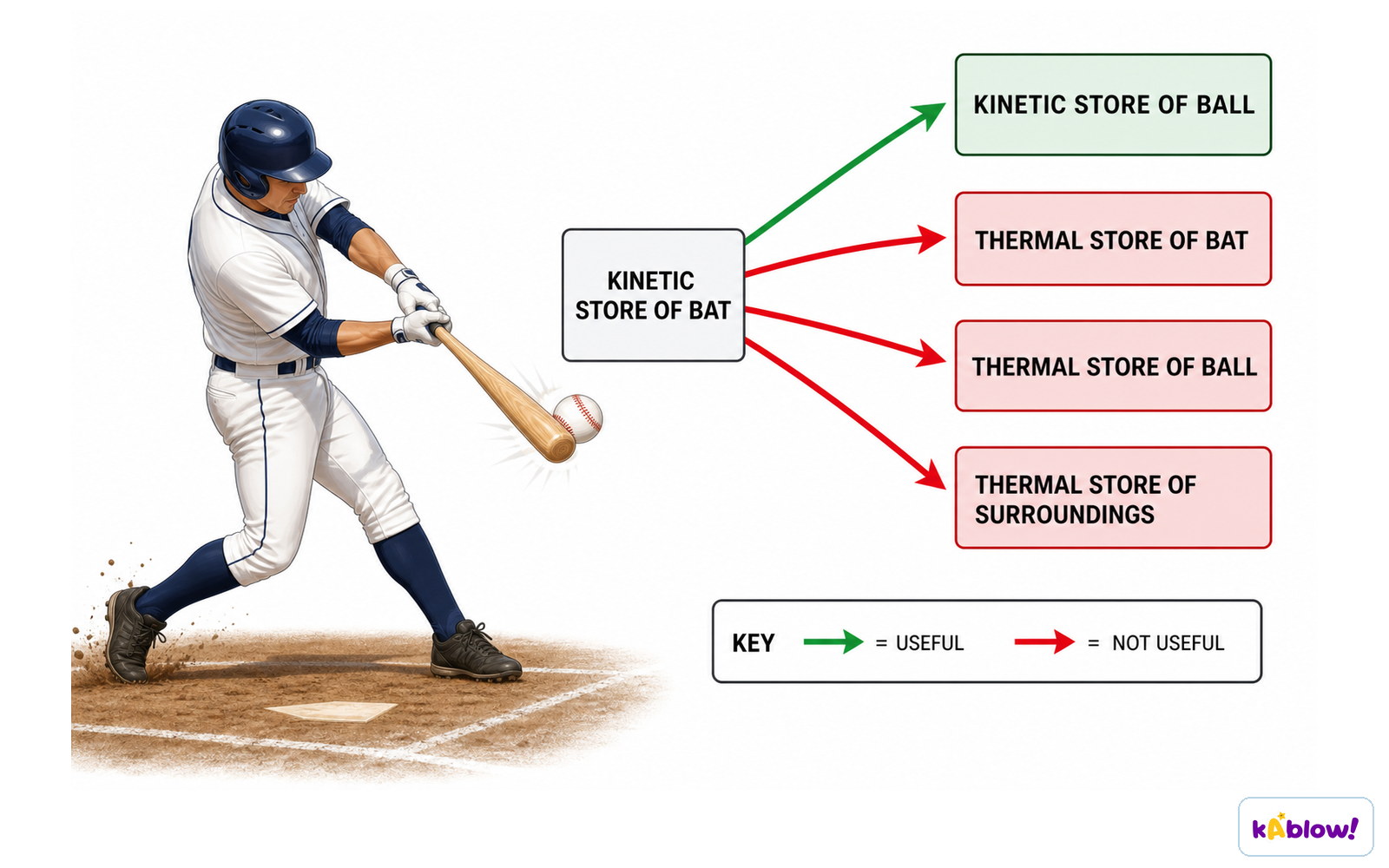
Energy is transferred usefully from the kinetic store of the bat to the kinetic store of the ball; the rest is dissipated to thermal stores
Energy Pathways
- Energy can be transferred via four pathways: mechanically, electrically, by heating, and by radiation.
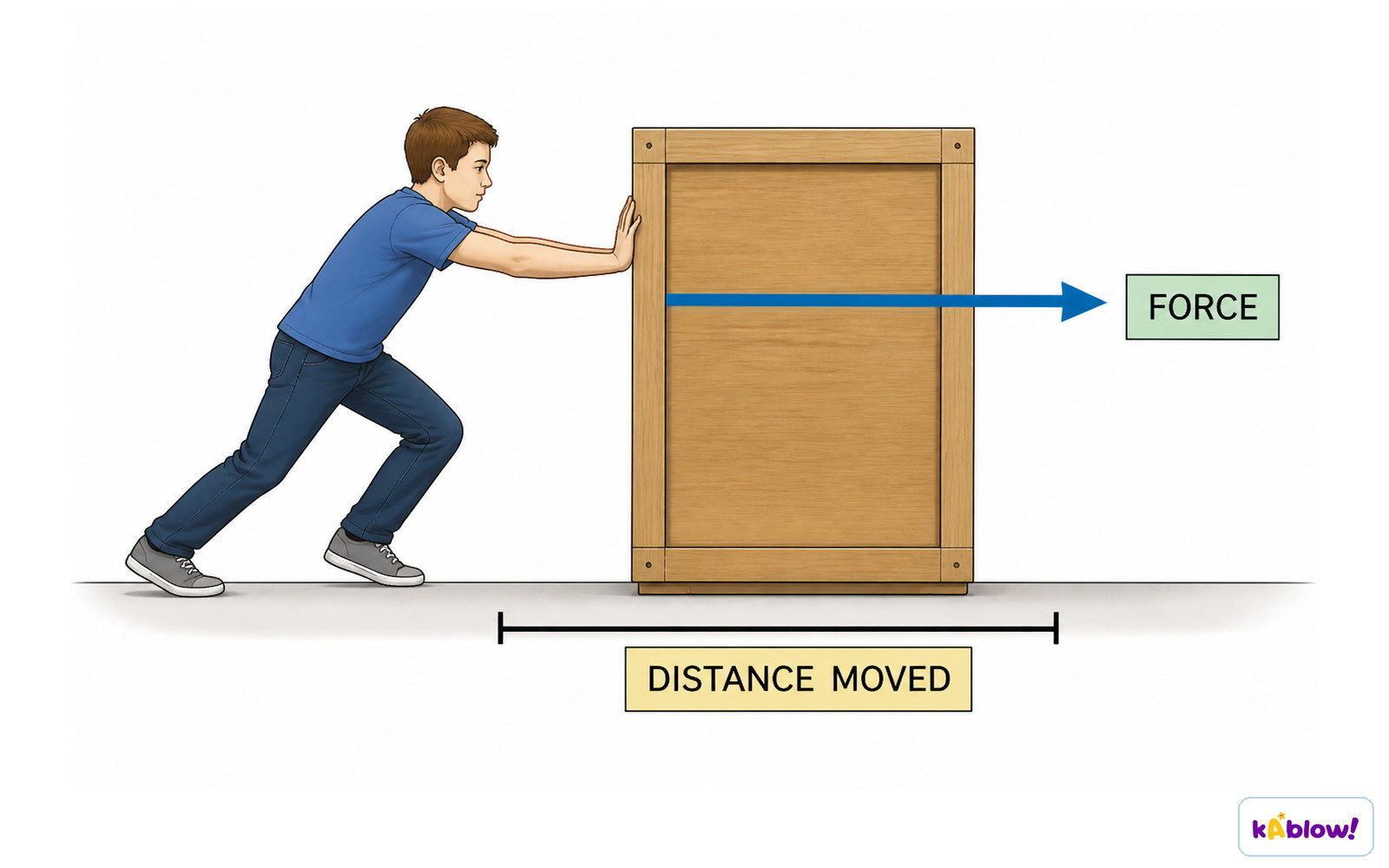
- Mechanical transfer: work done by a force moving an object over a distance.
- Electrical transfer: work done when charges move through a circuit.
- Heating: energy moves from a hotter object to a cooler object.
- Radiation: energy transferred by light, sound, or other electromagnetic waves.
Work Done
- Work done is another term for energy transferred from one store to another.
- Work is done when a force causes an object to move.
Work is done when a force moves an object over a distance: W = Fd
Energy Stores and Pendulum Example
- A pendulum has gravitational potential energy (GPE) at its highest point (e.g., 10 J).
- As it falls, mechanical work transfers GPE to kinetic energy (KE); total energy remains 10 J.
- At the lowest point, GPE is minimum and KE is maximum (10 J).
- As it rises again, KE transfers back to GPE; at the opposite highest point, GPE = 10 J, KE = 0 J.
- Energy is conserved throughout the swing.
Efficiency and Wasted Energy
- Energy transfers are not 100% efficient; some energy is wasted.
- Wasted energy often ends up in the thermal energy store of the surroundings (e.g., air, pendulum).
- Air resistance causes the pendulum to eventually stop, transferring KE to thermal energy.
Energy-transfer pathways and pendulum motion
Slide
Sign up free to view the lesson slides
Step through every slide for this topic — plus flashcards and revision notes — with a free account.
Câu hỏi luyện tập
Xem trước miễn phí — 8 trên 63 câu hỏi. Đăng ký để xem tất cả.
1.Which of the following is the principle of conservation of energy?
Easy- AEnergy can be created but not destroyed.
- BEnergy can be destroyed but not created.
- CEnergy cannot be created or destroyed; it can only be transferred from one store to another.
- DEnergy can be created and destroyed.
2.What is the unit of energy?
Easy- AWatt (W)
- BJoule (J)
- CNewton (N)
- DPascal (Pa)
3.A pendulum at its maximum height has 10 J of gravitational potential energy. As it swings down, what happens to the total energy of the pendulum?
Medium- AIt increases to more than 10 J.
- BIt decreases to less than 10 J.
- CIt remains constant at 10 J.
- DIt becomes 0 J at the lowest point.
4.A book on a shelf has 30 J of gravitational potential energy. When it falls to the ground, what is the maximum kinetic energy it can have just before hitting the ground?
Medium- A0 J
- B15 J
- C30 J
- D60 J
5.In practice, the kinetic energy of a falling object just before it hits the ground is less than the initial gravitational potential energy. Why?
Medium- ABecause energy is destroyed during the fall.
- BBecause some energy is transferred to the thermal energy store of the surroundings due to air resistance.
- CBecause the object loses mass as it falls.
- DBecause gravitational potential energy cannot be fully converted to kinetic energy.
6.Which of the following is NOT a pathway for energy transfer?
Easy- AMechanically
- BElectrically
- CChemically
- DBy radiation
7.Energy transferred by light or sound is an example of which pathway?
Easy- AMechanically
- BElectrically
- CBy heating
- DBy radiation
8.What is meant by 'work done' in physics?
Easy- AThe total energy stored in an object
- BEnergy transferred from one store to another when a force moves an object
- CThe force applied to an object
- DThe power used by a machine
Unlock all 63 questions, flashcards & more
Tạo tài khoản miễn phí để xem mọi câu hỏi, slide, thẻ ghi nhớ và ghi chú ôn tập cho chủ đề này.