Hooke's law
Học bằng cách chơi
Trả lời những câu hỏi này để kiếm năng lượng, rồi câu cá và khám phá. Không cần tài khoản.
Ghi chú bài học
Hooke's Law
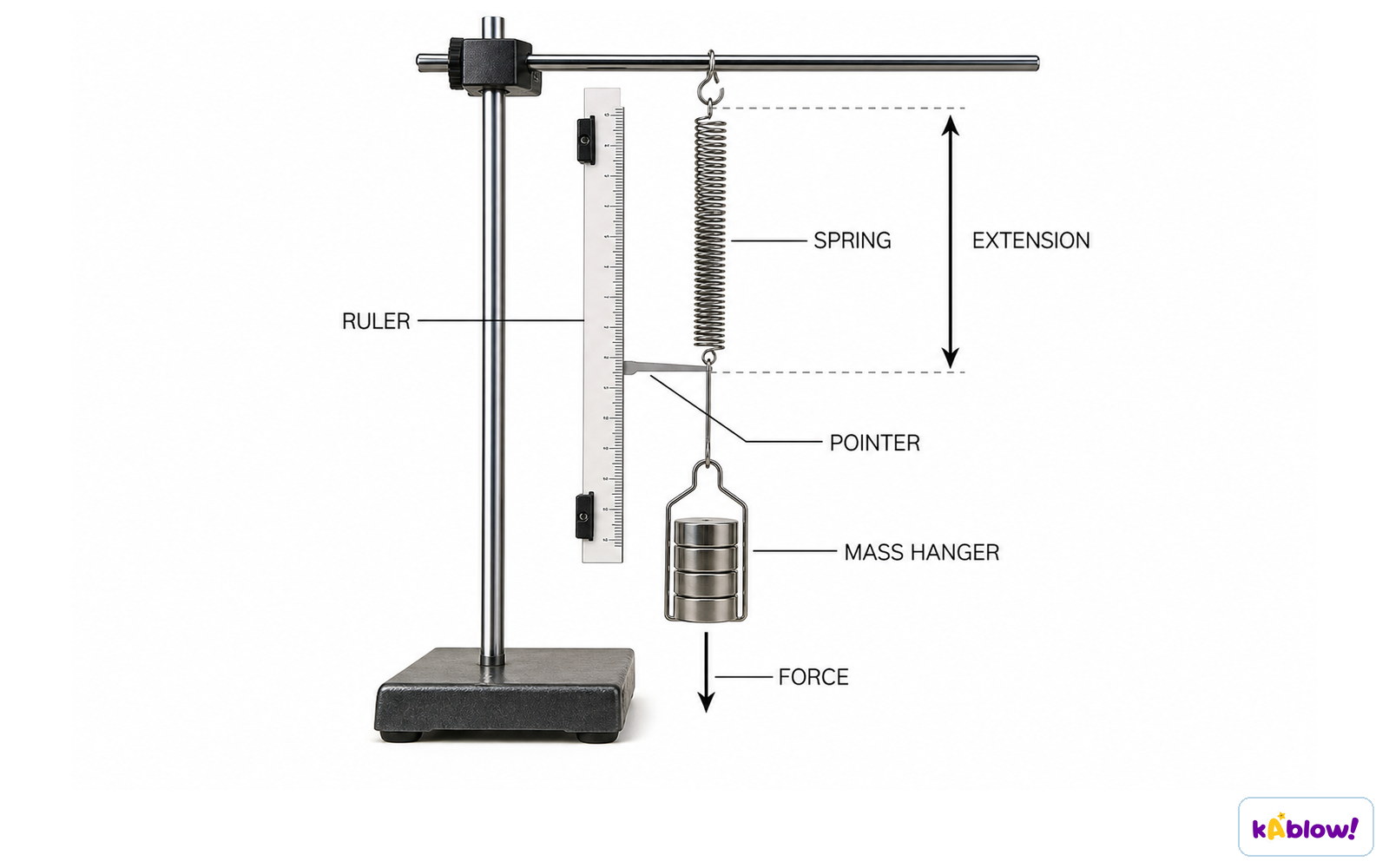
- Hooke's law states that the extension of a spring is directly proportional to the force applied to it.
- This means doubling the force doubles the extension, provided the limit of proportionality is not exceeded.
- The law applies to both extension (stretching) and compression (squeezing) of a spring.
Masses are added to the spring and the extension is measured against a fixed ruler.
Key Equation
- The equation is: Force = Spring constant × Extension or F = k × e.
- F is force in newtons (N).
- k is the spring constant in newtons per metre (N/m).
- e is extension in metres (m).
Spring Constant
- The spring constant measures how stiff the spring is.
- A higher spring constant means more force is needed to stretch the spring by the same amount.
- A lower spring constant means the spring is easier to stretch.
Calculations
- To find force: F = k × e.
- To find extension: e = F ÷ k.
- To find spring constant: k = F ÷ e.
- Always use consistent units: N, N/m, m.
Example Calculation
- A spring with k = 4 N/m is extended by 0.1 m. Force = 4 × 0.1 = 0.4 N.
- A spring with k = 200 N/m is compressed by 0.04 m. Force = 200 × 0.04 = 8 N.
- A rubber band with k = 60 N/m is pulled with 15 N. Extension = 15 ÷ 60 = 0.25 m.
Graph of Force vs Extension
- A graph of force against extension is a straight line through the origin.
- The gradient of the line equals the spring constant.
- If the force is too large, the line curves (the spring is permanently deformed).
Slide
Sign up free to view the lesson slides
Step through every slide for this topic — plus flashcards and revision notes — with a free account.
Câu hỏi luyện tập
Xem trước miễn phí — 8 trên 55 câu hỏi. Đăng ký để xem tất cả.
1.What is the unit of force?
Easy- ANewton (N)
- BMetre (m)
- CNewton per metre (N/m)
- DJoule (J)
2.What is the unit of the spring constant?
Easy- ANewton (N)
- BMetre (m)
- CNewton per metre (N/m)
- DMetre per newton (m/N)
3.What is the unit of extension?
Easy- ANewton (N)
- BMetre (m)
- CNewton per metre (N/m)
- DCentimetre (cm)
4.According to Hooke's law, how is the extension of a spring related to the force applied to it?
Easy- AExtension is inversely proportional to force
- BExtension is directly proportional to force
- CExtension is equal to force
- DExtension is independent of force
5.A spring with a spring constant of 4 N/m is extended by 0.1 m. What force is applied?
Easy- A0.4 N
- B4 N
- C40 N
- D0.04 N
6.A rubber band with a spring constant of 10 N/m is extended by 0.2 m. What force is applied?
Easy- A2 N
- B0.5 N
- C50 N
- D20 N
7.A spring with a spring constant of 20 N/m is compressed by 0.05 m. What force is applied?
Easy- A1 N
- B4 N
- C0.25 N
- D400 N
8.The same force is applied to two springs. Spring X has a high spring constant, Spring Y a low spring constant. Which spring has the larger extension?
Medium- ASpring X
- BSpring Y
- CBoth have same extension
- DCannot tell
Unlock all 55 questions, flashcards & more
Tạo tài khoản miễn phí để xem mọi câu hỏi, slide, thẻ ghi nhớ và ghi chú ôn tập cho chủ đề này.