Introduction to waves
Học bằng cách chơi
Trả lời những câu hỏi này để kiếm năng lượng, rồi câu cá và khám phá. Không cần tài khoản.
Ghi chú bài học
What are waves?
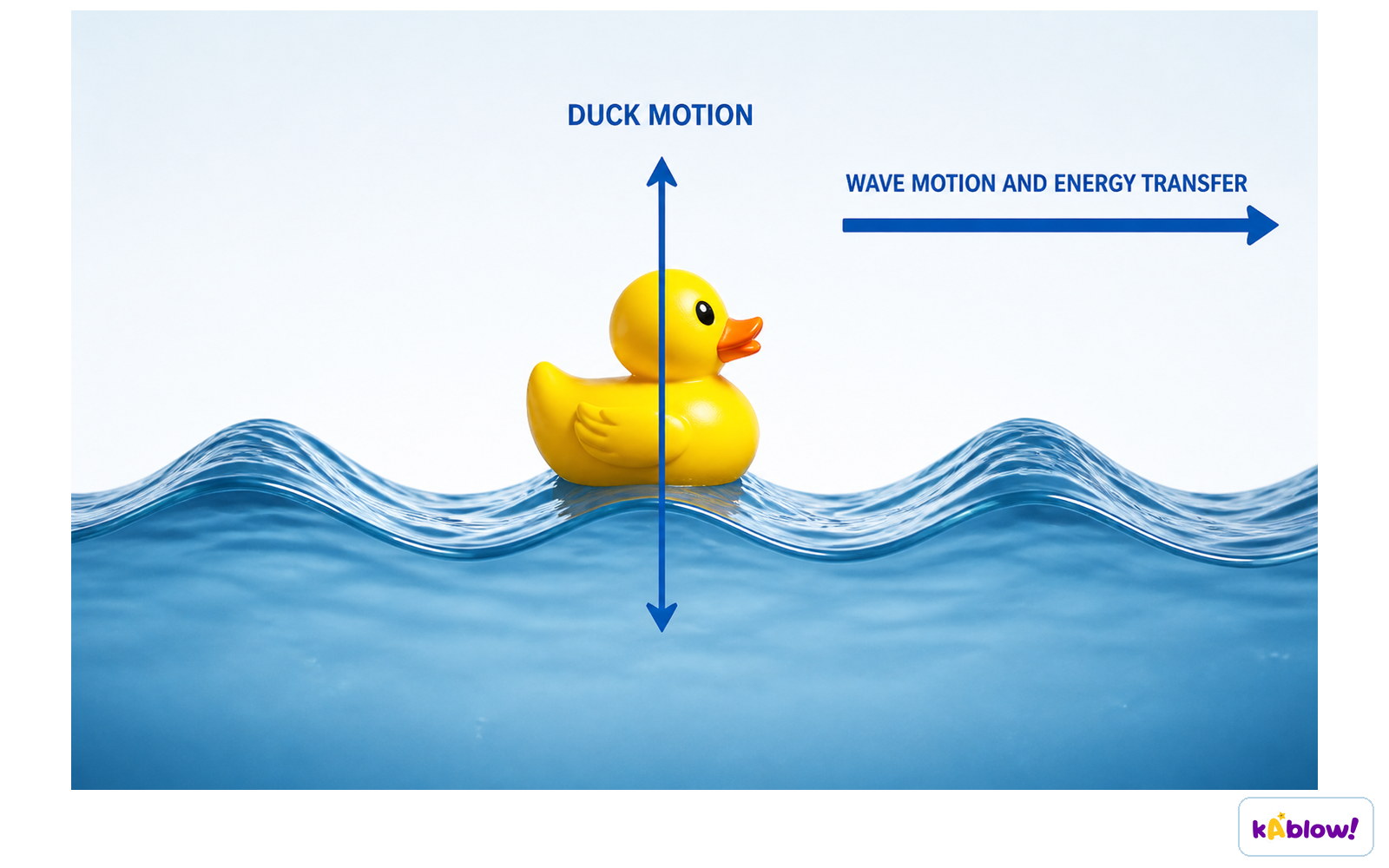
- Waves transfer energy from one place to another.
- Waves do not transfer matter – the particles vibrate but stay in position.
A toy duck bobbing up and down on water waves, illustrating that waves transfer energy but not matter.
Types of wave
- There are two types: longitudinal and transverse.
- Both types are caused by vibrations.
Transverse waves
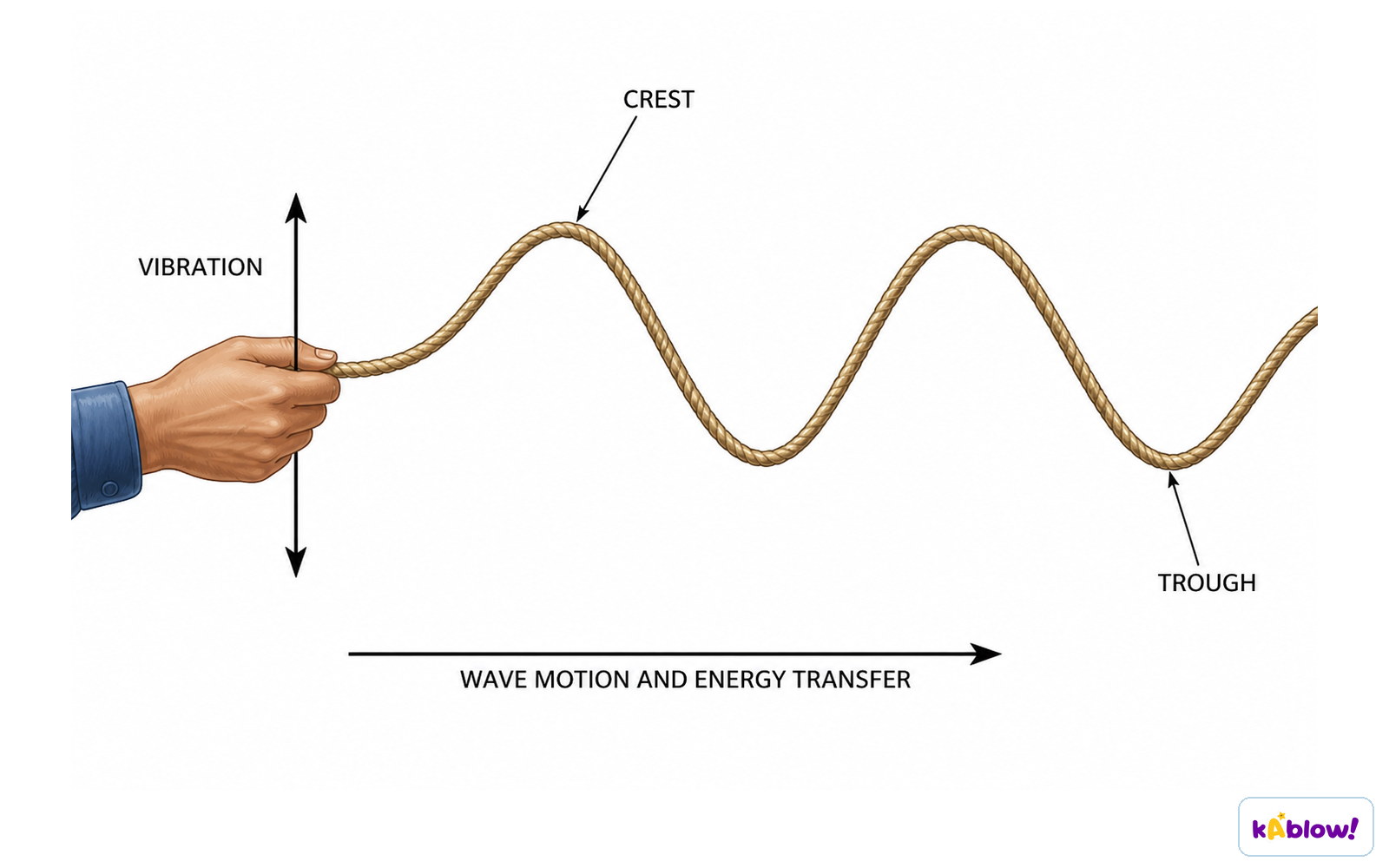
- The vibration is perpendicular to the direction of wave travel.
- Example: waves on a slinky moved side-to-side.
- Key terms: displacement (distance from rest), wavelength (peak to peak), amplitude (maximum displacement).
Transverse wave motion in a rope: the vibration is at 90 degrees to the direction of wave motion and energy transfer, with the crest and trough labelled.
Longitudinal waves
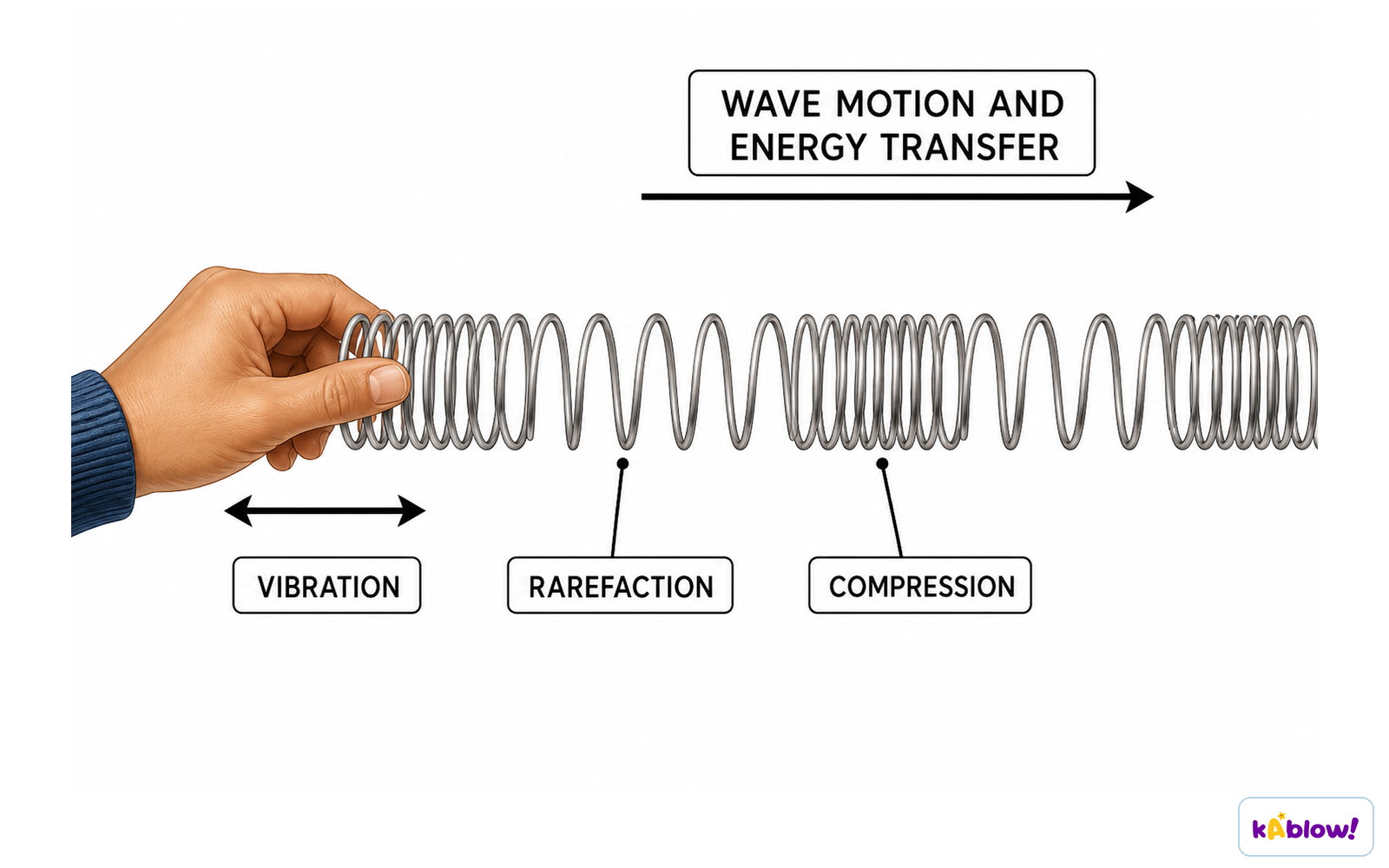
- The vibration is parallel to the direction of wave travel.
- Example: waves on a slinky moved back-and-forth.
- A compression is where particles are closest together.
- A rarefaction is where particles are furthest apart.
Longitudinal wave motion in a spring, showing compression and rarefaction relative to the direction of wave motion and energy transfer.
Similarities and differences
- Similarity: Both transfer energy and are caused by vibrations.
- Difference: In transverse waves, vibration is perpendicular; in longitudinal, vibration is parallel.
Slide
Sign up free to view the lesson slides
Step through every slide for this topic — plus flashcards and revision notes — with a free account.
Câu hỏi luyện tập
Xem trước miễn phí — 8 trên 53 câu hỏi. Đăng ký để xem tất cả.
1.Which of the following best describes what a wave transfers?
Easy- AEnergy
- BMatter
- CBoth energy and matter
- DNeither energy nor matter
2.In a transverse wave, the direction of vibration is:
Easy- Aperpendicular to the direction of wave travel
- Bparallel to the direction of wave travel
- Cthe same as the direction of wave travel
- Dopposite to the direction of wave travel
3.Which of the following is true about longitudinal waves?
Easy- AThey transfer matter along the wave.
- BThe vibration is parallel to the direction of wave travel.
- CThey cannot travel through a medium.
- DThey have crests and troughs.
4.In a longitudinal wave, the region where particles are closest together is called a:
Easy- Ararefaction
- Bcompression
- Ccrest
- Dtrough
5.In a longitudinal wave, the region where particles are furthest apart is called a:
Easy- Acompression
- Brarefaction
- Camplitude
- Dwavelength
6.Which labelled part on a transverse wave diagram represents the maximum displacement from the rest position?
Easy- AWavelength
- BAmplitude
- CCrest
- DTrough
7.The distance between two consecutive peaks on a transverse wave is called the:
Easy- Aamplitude
- Bfrequency
- Cwavelength
- Dspeed
8.Both longitudinal and transverse waves are caused by:
Easy- Avibrations
- Belectric fields
- Cmagnetic fields
- Dparticle movement
Unlock all 53 questions, flashcards & more
Tạo tài khoản miễn phí để xem mọi câu hỏi, slide, thẻ ghi nhớ và ghi chú ôn tập cho chủ đề này.