Resistance
Học bằng cách chơi
Trả lời những câu hỏi này để kiếm năng lượng, rồi câu cá và khám phá. Không cần tài khoản.
Ghi chú bài học
What is Resistance?
- Resistance is a measure of how hard it is for current to flow through a component.
- Resistance is measured in ohms (Ω).
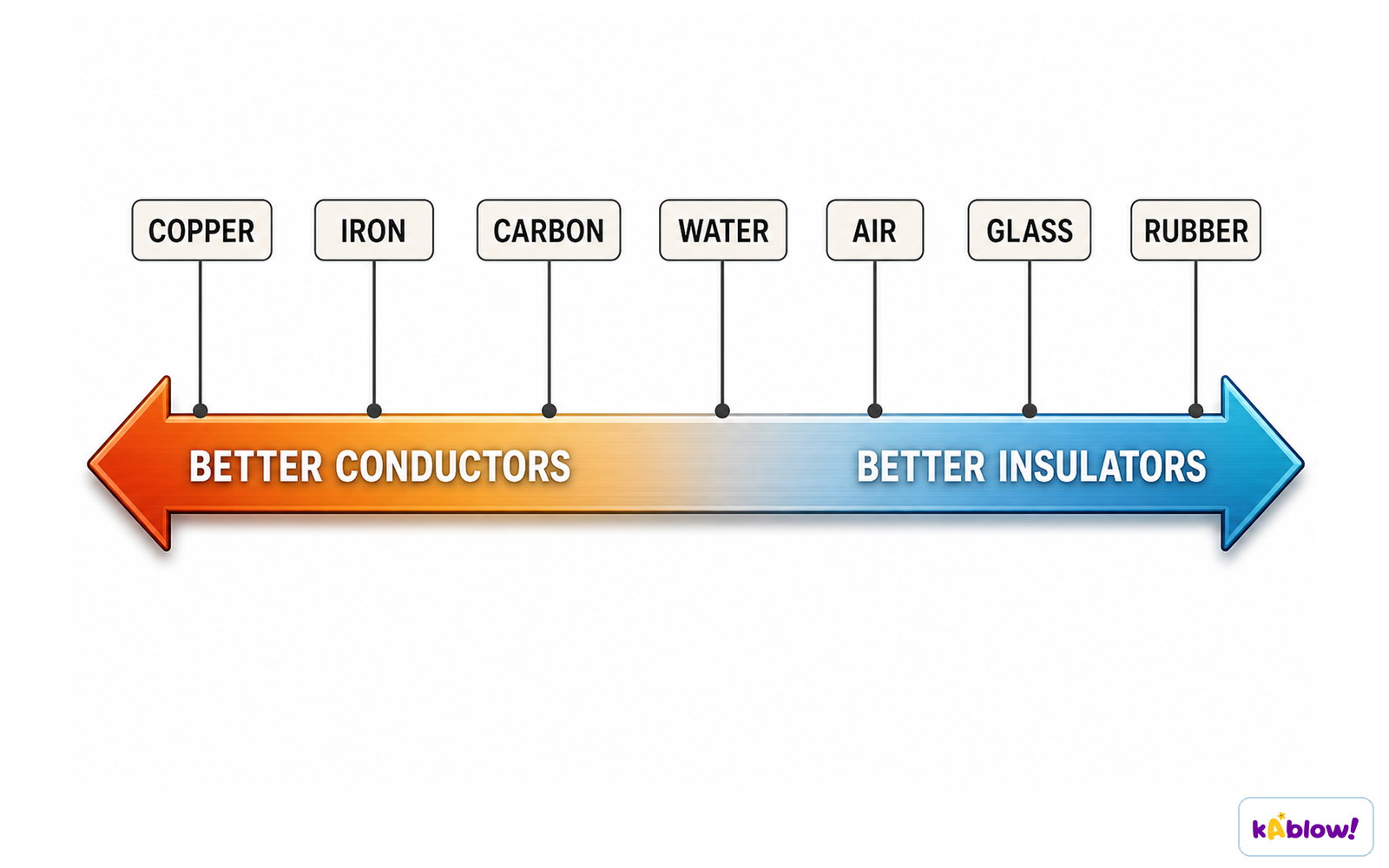
- Conductors (e.g. metals) have low resistance; insulators (e.g. plastic) have high resistance.
Materials form a range from good conductors like copper and iron to good insulators like glass and rubber.
The Resistance Equation
- The equation linking potential difference (V), current (I) and resistance (R) is: V = I × R.
- Rearranged: R = V ÷ I and I = V ÷ R.
- Resistance is the ratio of potential difference to current.
Using the Equation
- To find potential difference: V = I × R (units: V = A × Ω).
- To find resistance: R = V ÷ I (units: Ω = V ÷ A).
- Always write the equation, substitute values, then calculate with units.
Example Calculations
- Example 1: A lamp with R = 20 Ω and I = 0.5 A → V = 0.5 × 20 = 10 V.
- Example 2: A resistor with V = 5 V and I = 2 A → R = 5 ÷ 2 = 2.5 Ω.
Converting Kiloohms
- Resistance can be given in kiloohms (kΩ).
- 1 kΩ = 1000 Ω.
- To convert kΩ to Ω: multiply by 1000.
A series circuit showing a cell, resistor, ammeter and lamp. The ammeter measures current.
Slide
Sign up free to view the lesson slides
Step through every slide for this topic — plus flashcards and revision notes — with a free account.
Câu hỏi luyện tập
Xem trước miễn phí — 8 trên 40 câu hỏi. Đăng ký để xem tất cả.
1.State the equation that links potential difference, current and resistance.
Easy- AV = I × R
- BV = I ÷ R
- CV = R ÷ I
- DV = I + R
2.State the unit of resistance.
Easy- AOhms (Ω)
- BVolts (V)
- CAmps (A)
- DWatts (W)
3.Which of the following best describes the difference between an electrical conductor and an insulator?
Easy- AA conductor has low resistance; an insulator has high resistance.
- BA conductor has high resistance; an insulator has low resistance.
- CA conductor allows current to flow easily; an insulator does not allow current to flow at all.
- DA conductor is made of plastic; an insulator is made of metal.
4.A lamp has a resistance of 15 Ω and a current of 2.0 A flowing through it. Calculate the potential difference across the lamp.
Medium- A30 V
- B7.5 V
- C0.13 V
- D17 V
5.A resistor has a resistance of 500 Ω and a current of 0.10 A flowing through it. Calculate the potential difference across the resistor.
Medium- A50 V
- B5000 V
- C0.0002 V
- D5 V
6.Using the information in the diagram (a series circuit with a cell, switch, lamp, and ammeter), calculate the resistance of the lamp if the voltmeter across the lamp reads 6 V and the ammeter reads 2 A.
Medium- A3 Ω
- B12 Ω
- C0.33 Ω
- D8 Ω
7.A resistor has a resistance of 100 Ω and a current of 0.8 A flowing through it. Calculate the potential difference across the resistor.
Medium- A80 V
- B125 V
- C0.008 V
- D100.8 V
8.A light dependent resistor (LDR) has a potential difference of 6 V across it and a current of 0.02 A flowing through it. Calculate the resistance of the LDR.
Hard- A300 Ω
- B0.12 Ω
- C120 Ω
- D0.0033 Ω
Unlock all 40 questions, flashcards & more
Tạo tài khoản miễn phí để xem mọi câu hỏi, slide, thẻ ghi nhớ và ghi chú ôn tập cho chủ đề này.