Sound
Học bằng cách chơi
Trả lời những câu hỏi này để kiếm năng lượng, rồi câu cá và khám phá. Không cần tài khoản.
Ghi chú bài học
What is Sound?
- Sound is produced by a vibrating object.
- The vibration transfers energy by making air particles collide.
- Sound is a longitudinal wave: vibrations are parallel to the direction of wave travel.
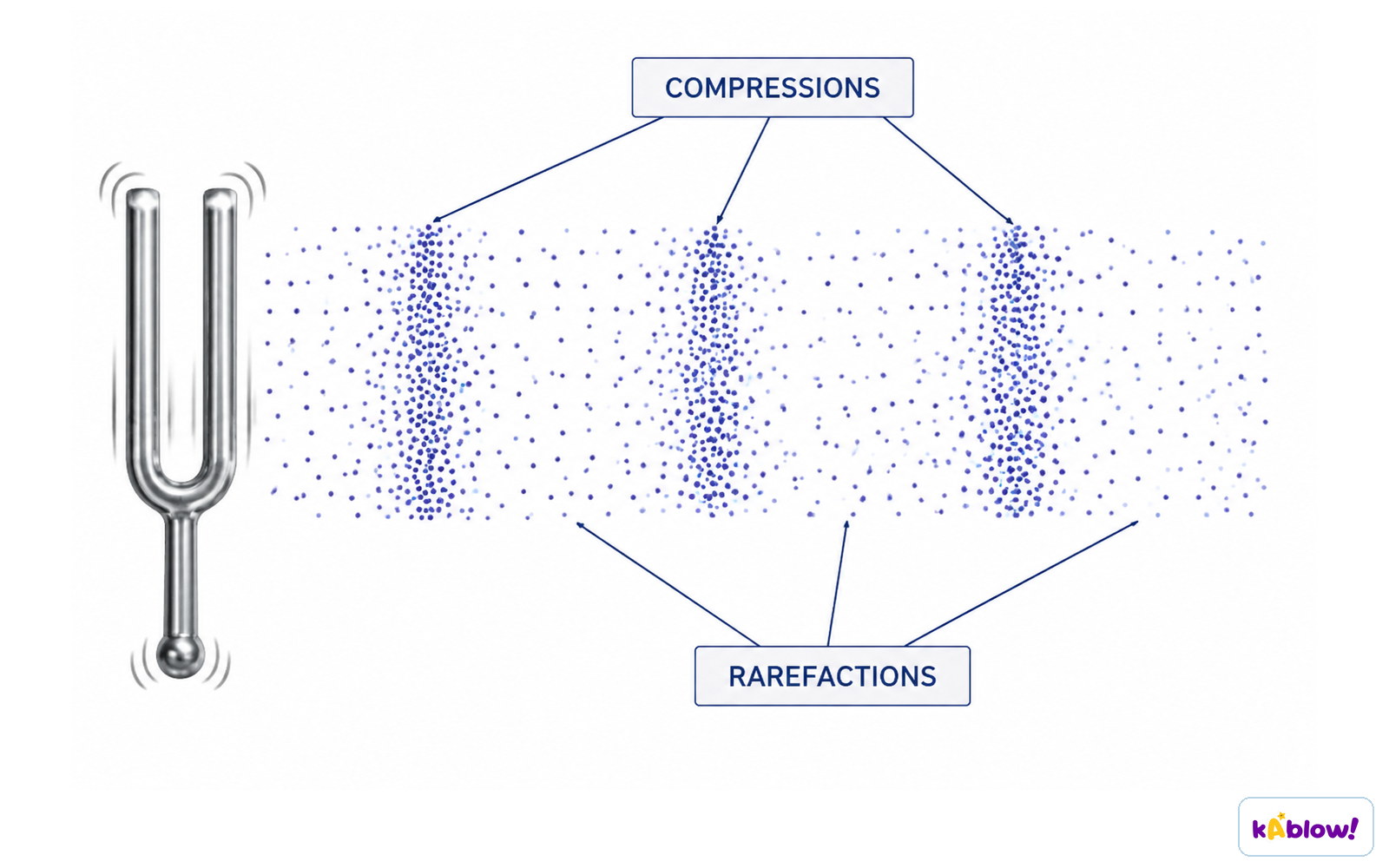
Compressions and Rarefactions
- Compressions are regions where air particles are close together.
- Rarefactions are regions where air particles are further apart.
- The wavelength is the distance between two consecutive compressions (or two rarefactions).
A vibrating tuning fork produces compressions and rarefactions in the air as a sound wave.
Frequency and Pitch
- Frequency is the number of waves passing a point per second, measured in Hertz (Hz).
- The higher the frequency, the higher the pitch.
- Human auditory range: 20 Hz to 20,000 Hz.
- Sound above 20,000 Hz is called ultrasound.
Amplitude and Volume
- Amplitude is the maximum displacement of particles from their rest position.
- The larger the amplitude, the louder the sound.
Detecting Sound
- A microphone converts sound waves into electrical signals.
- The electrical signal can be displayed on an oscilloscope.
- The human ear works similarly: sound vibrates the eardrum, which sends electrical signals to the brain.
Diagram showing reflection of a sound wave (not to scale; sound reflects similarly to light).
Slide
Sign up free to view the lesson slides
Step through every slide for this topic — plus flashcards and revision notes — with a free account.
Câu hỏi luyện tập
Xem trước miễn phí — 8 trên 55 câu hỏi. Đăng ký để xem tất cả.
1.What causes a sound wave?
Easy- AA vibrating object
- BA stationary object
- CLight energy
- DHeat energy
2.Which type of wave is a sound wave?
Easy- ALongitudinal
- BTransverse
- CElectromagnetic
- DStationary
3.What is the frequency of a sound wave measured in?
Easy- AHertz (Hz)
- BDecibels (dB)
- CMetres (m)
- DSeconds (s)
4.The human auditory range is 20 Hz to 20 000 Hz. How many waves pass a point every second for a sound wave with a frequency of 20 000 Hz?
Easy- A20 000
- B20
- C200
- D2 000
5.Which statement about compressions and rarefactions is correct?
Easy- AA compression is where air particles are close together; a rarefaction is where they are further apart.
- BA compression is where air particles are further apart; a rarefaction is where they are close together.
- CA compression and rarefaction are the same.
- DA compression is a region of low pressure; a rarefaction is a region of high pressure.
6.Which of the following statements is true?
Easy- AA microphone turns a sound wave into an electrical signal.
- BA microphone turns an electrical signal into a sound wave.
- CA microphone amplifies a sound wave.
- DA microphone increases the frequency of a sound wave.
7.The wavelength of a sound wave is the distance between:
Easy- AOne compression and the next compression
- BA compression and a rarefaction
- CThe source and the observer
- DThe highest and lowest point of the wave
8.A sound wave has a frequency of 440 Hz. How many complete waves pass a point in 0.5 seconds?
Medium- A220
- B440
- C880
- D110
Unlock all 55 questions, flashcards & more
Tạo tài khoản miễn phí để xem mọi câu hỏi, slide, thẻ ghi nhớ và ghi chú ôn tập cho chủ đề này.