Terminal velocity
Học bằng cách chơi
Trả lời những câu hỏi này để kiếm năng lượng, rồi câu cá và khám phá. Không cần tài khoản.
Ghi chú bài học
Key Concepts
- Newton's first law: An object's speed stays constant unless a resultant force acts on it.
- Newton's second law: Acceleration is proportional to the resultant force; larger force → larger acceleration.
- Newton's third law: Forces between two objects are equal in size and opposite in direction.
- Terminal velocity is the maximum constant speed reached when forces are balanced.
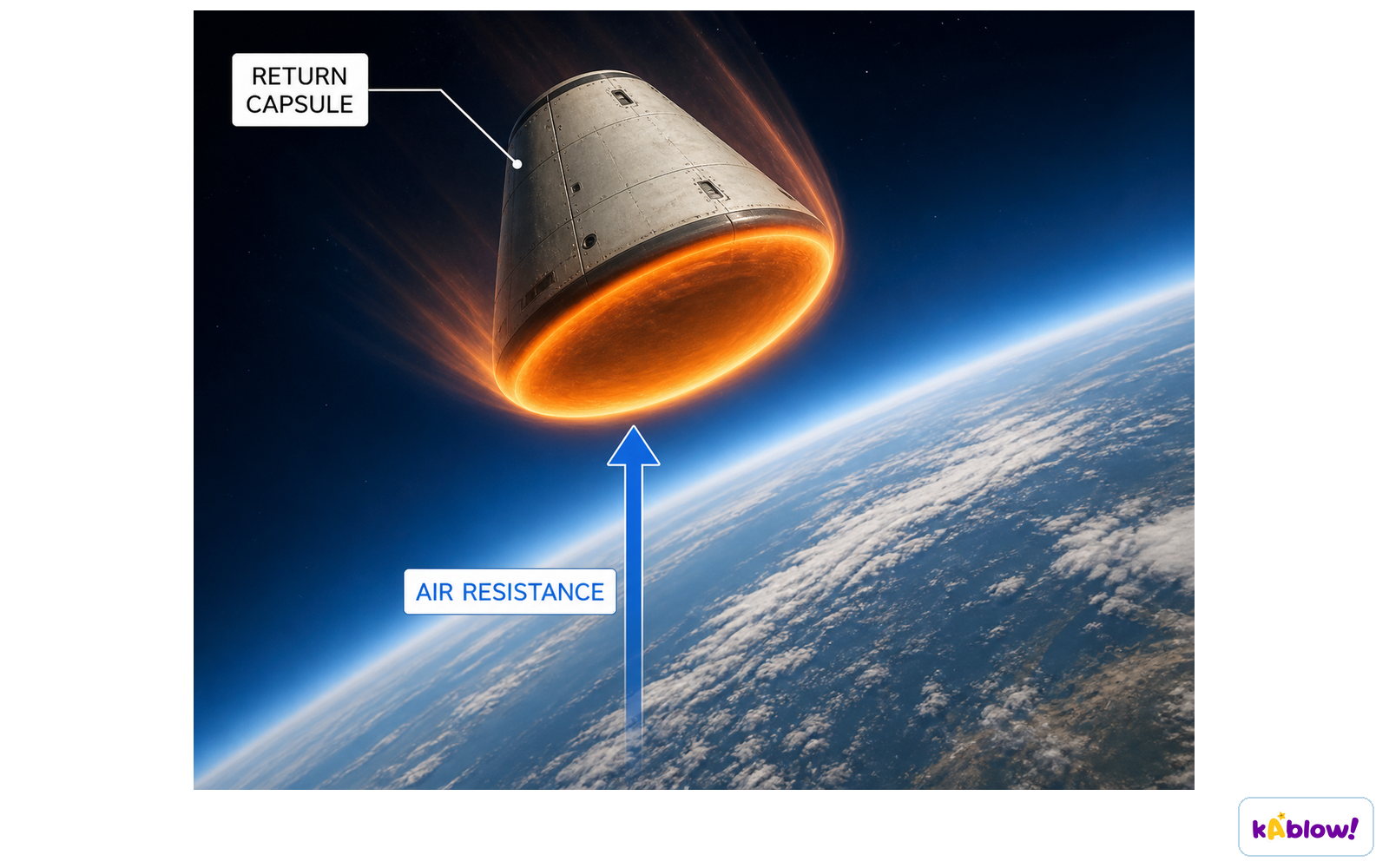
Air resistance is a type of drag: it opposes motion through a fluid and heats the object.
Stages of a Skydive
- 1. Just jumped: Only weight acts → skydiver accelerates downwards.
- 2. Speeding up: Air resistance increases with speed; resultant force decreases → acceleration decreases.
- 3. Terminal velocity: Air resistance = weight → balanced forces, no resultant force → constant speed (terminal velocity).
- 4. Parachute opens: Larger surface area → air resistance increases greatly → resultant force upwards → deceleration.
- 5. Second terminal velocity: Slower speed reduces air resistance until it equals weight again → new, slower constant speed.
Graph of a Skydive
- A speed–time graph shows speed increasing then levelling off at terminal velocity.
- After parachute opens, speed drops rapidly then becomes constant at a lower terminal velocity.
- The gradient of the graph represents acceleration (positive gradient = accelerating, negative = decelerating, flat = constant speed).
Factors Affecting Terminal Velocity
- Weight: Heavier objects have a higher terminal velocity (larger weight requires larger air resistance to balance).
- Surface area: Larger surface area increases air resistance, reducing terminal velocity (e.g., parachute).
- Shape: Streamlined shapes reduce air resistance, allowing higher terminal velocity.
Examples and Applications
- A car travelling at constant speed on a motorway has balanced forces (driving force = resistive forces).
- If a resultant forward force acts on a car, it accelerates (speeds up).
- Sky divers reach terminal velocity twice: first without parachute (fast), then with parachute (slow).
Particle arrangement in solids, liquids, and gases. In a solid, particles are closely packed in a regular pattern; in a liquid, they are close but irregular; in a gas, they are far apart and random. This model helps explain density and state changes.
Slide
Sign up free to view the lesson slides
Step through every slide for this topic — plus flashcards and revision notes — with a free account.
Câu hỏi luyện tập
Xem trước miễn phí — 8 trên 57 câu hỏi. Đăng ký để xem tất cả.
1.What happens to air resistance as the speed of an object increases?
Easy- AIt increases
- BIt decreases
- CIt stays the same
- DIt becomes zero
2.A car is travelling at a constant speed. All the forces on the car are balanced. What happens to the speed of the car?
Easy- AIt stays the same
- BIt increases
- CIt decreases
- DIt becomes zero
3.A car has a resultant force forwards. What happens to the speed of the car?
Easy- AIt increases
- BIt decreases
- CIt stays the same
- DIt becomes zero
4.A skydiver has just jumped out of an aeroplane. The only force acting is their weight. What is the motion of the skydiver?
Medium- AAccelerating downwards
- BConstant speed downwards
- CDecelerating downwards
- DStationary
5.A skydiver has reached terminal velocity. Which statement about the forces is correct?
Medium- AWeight equals air resistance
- BWeight is greater than air resistance
- CWeight is less than air resistance
- DThere is no weight
6.A skydiver opens their parachute. What happens to the air resistance immediately after opening?
Easy- AIt increases dramatically
- BIt decreases dramatically
- CIt stays the same
- DIt becomes zero
7.After opening the parachute, the skydiver decelerates. What is the direction of the resultant force?
Medium- AUpwards
- BDownwards
- CHorizontal
- DZero
8.A skydiver reaches a second terminal velocity after opening the parachute. How does this second terminal velocity compare to the first?
Medium- AIt is slower
- BIt is faster
- CIt is the same
- DIt is zero
Unlock all 57 questions, flashcards & more
Tạo tài khoản miễn phí để xem mọi câu hỏi, slide, thẻ ghi nhớ và ghi chú ôn tập cho chủ đề này.