Water waves and superposition
Học bằng cách chơi
Trả lời những câu hỏi này để kiếm năng lượng, rồi câu cá và khám phá. Không cần tài khoản.
Ghi chú bài học
Water Waves
- Water waves are formed in a ripple tank using a motor-driven dipper that vibrates up and down.
- Each vibration of the dipper creates a water wave that travels outward.
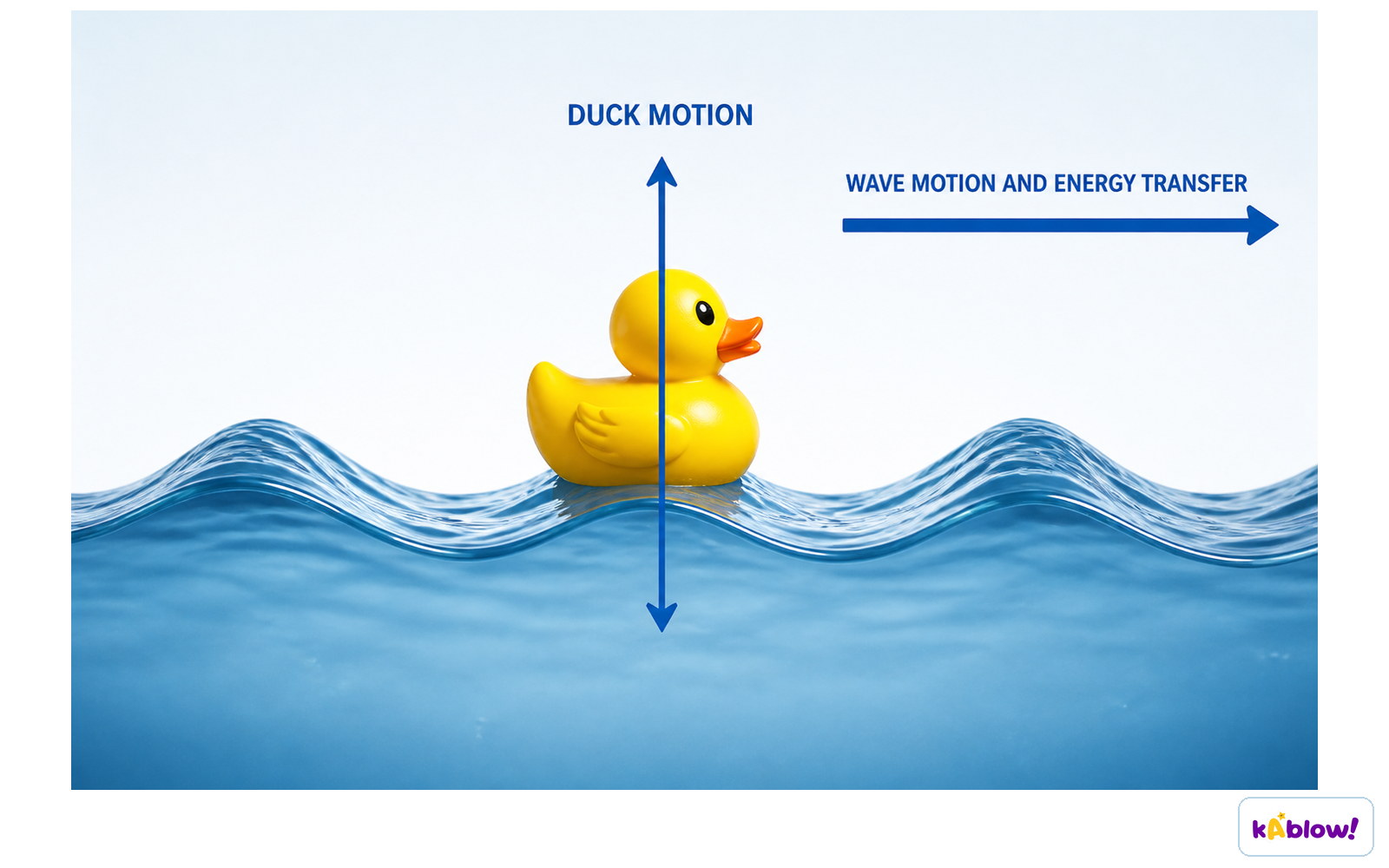
- Waves transfer energy without transferring matter.
- Water waves are a type of transverse wave.
A toy duck bobbing up and down on water waves, illustrating that waves transfer energy but not matter.
Transverse Waves
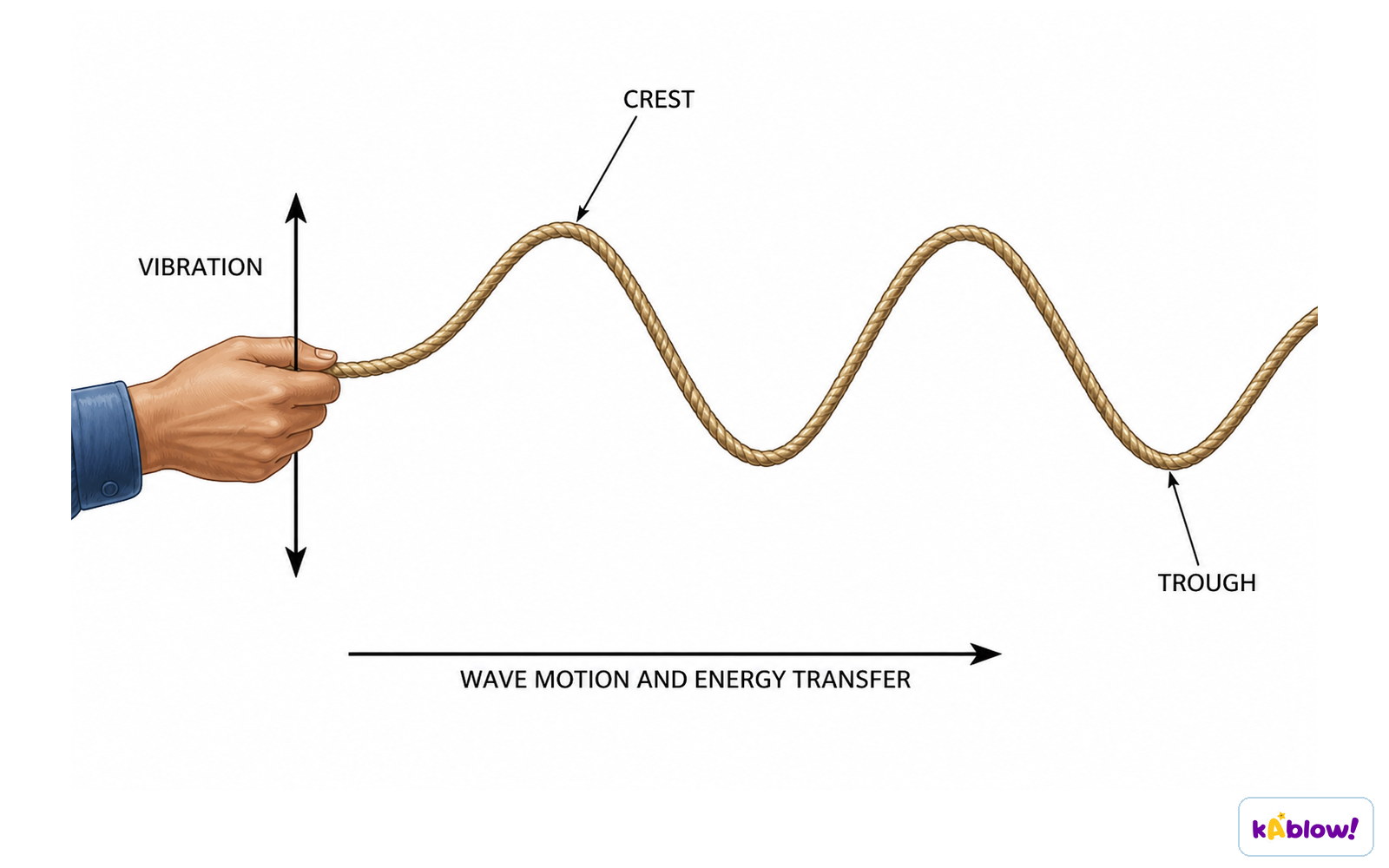
- In a transverse wave, the vibration is perpendicular to the direction of wave travel.
- For water waves, the dipper moves up and down while the wave moves outward horizontally.
- Examples of transverse waves include water waves, light waves, and waves on a string.
Transverse wave motion in a rope: the vibration is at 90 degrees to the direction of wave motion and energy transfer, with the crest and trough labelled.
Superposition
- Superposition occurs when two waves pass through each other and overlap.
- The displacement of a particle in a wave is its distance from the rest position.
- During superposition, the displacements of the individual waves add together.
Constructive Interference
- When two peaks (crests) arrive at the same place at the same time, they add together.
- The amplitude of the combined wave is greater than each individual wave.
- This is called constructive interference.
Destructive Interference
- When a peak and a trough arrive at the same place at the same time, they cancel out.
- The amplitude of the combined wave is less than each individual wave.
- This is called destructive interference.
General Rule for Superposition
- If displacements have the same sign (both positive or both negative), they add.
- If displacements have opposite signs, they subtract.
- The result is the net displacement at each point.
Slide
Sign up free to view the lesson slides
Step through every slide for this topic — plus flashcards and revision notes — with a free account.
Câu hỏi luyện tập
Xem trước miễn phí — 8 trên 56 câu hỏi. Đăng ký để xem tất cả.
1.Which of the following is a transverse wave?
Easy- AWater wave
- BSound wave
- CLongitudinal wave
- DP-wave
2.Water waves transfer energy without transferring what?
Easy- AMatter
- BAmplitude
- CFrequency
- DWavelength
3.In a transverse wave, the vibration is ________ to the direction of wave travel.
Easy- Aperpendicular
- Bparallel
- Copposite
- Dat 45°
4.What is superposition?
Easy- AWhen two waves pass through each other and their displacements add
- BWhen a wave reflects off a barrier
- CWhen a wave changes speed
- DWhen a wave diffracts
5.When a peak of one wave meets a peak of another wave at the same place and time, what happens to the amplitude?
Easy- AIt increases
- BIt decreases
- CIt stays the same
- DIt becomes zero
6.When a peak of one wave meets a trough of another wave at the same place and time, what happens to the amplitude?
Easy- AIt decreases
- BIt increases
- CIt stays the same
- DIt doubles
7.In the ripple tank, what causes the water waves to form?
Easy- AA motor connected to a dipper vibrating up and down
- BA fan blowing across the water surface
- CHeating the water
- DPouring water slowly
8.If two waves have displacements of +3 cm and -3 cm at the same point, what is the resultant displacement?
Medium- A0 cm
- B6 cm
- C-6 cm
- D3 cm
Unlock all 56 questions, flashcards & more
Tạo tài khoản miễn phí để xem mọi câu hỏi, slide, thẻ ghi nhớ và ghi chú ôn tập cho chủ đề này.