Properties of substances
Học bằng cách chơi
Trả lời những câu hỏi này để kiếm năng lượng, rồi câu cá và khám phá. Không cần tài khoản.
Ghi chú bài học
Physical vs. Chemical Changes
- Physical changes do not change the chemical properties of a substance; examples include cutting, boiling, melting, dissolving, and whipping.
- Chemical changes (chemical reactions) transform one or more substances into new substances with different properties.
- Examples of chemical changes: burning gas, milk turning sour, iron rusting, frying eggs.
- Physical changes are often reversible, while chemical changes are usually not (e.g., you can't unbake a cake).
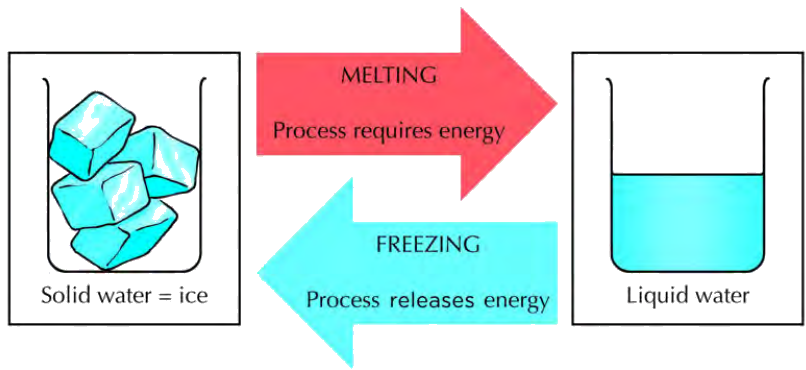
Melting and freezing of water
Signs of a Chemical Reaction
- Color change occurs (not just mixing colors).
- Gas formation – often seen as bubbles (not boiling).
- Formation of a solid – a precipitate or crystals appear in a liquid.
- Odor change – a new smell is produced.
- Energy change – heat, light, sound, or cold is produced or absorbed.
- Extreme property changes – e.g., changes in density, flammability, or state.
- The only definitive sign is the formation of a new substance.
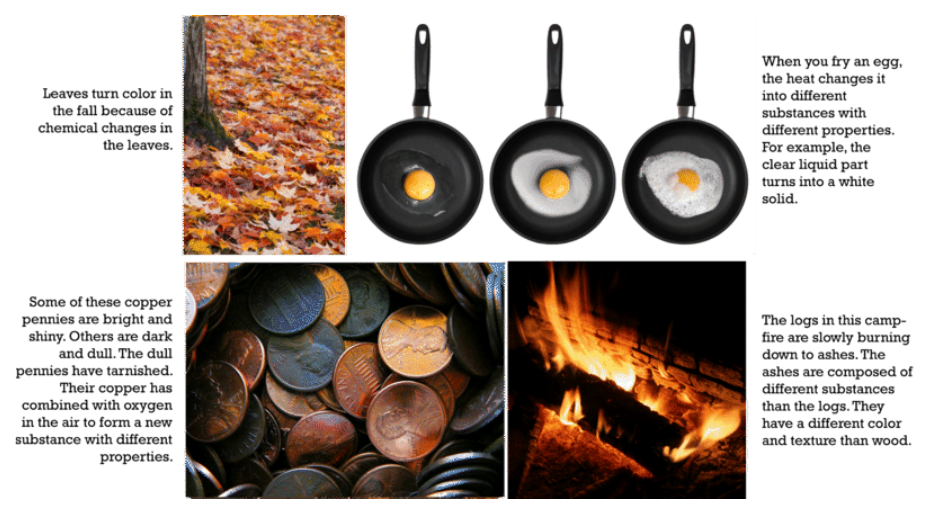
Everyday chemical reactions show new substances with different properties
Reactants and Products
- Reactants are the starting substances in a chemical reaction.
- Products are the new substances formed by the reaction.
- Comparing the properties of the reactants and products (colour, state, odor, and so on) is how we tell that a reaction has taken place.
Properties of Materials
- Properties are distinctive characteristics that describe a material.
- Important properties include: strength, durability, flexibility, malleability, ductility, electrical conductivity, heat conductivity, hardness, solubility, density, color, odor, state, melting point, boiling point, and flammability.
- Materials are chosen for specific uses based on their properties.
- Advantages are desirable properties; disadvantages are unfavorable features (e.g., plastic bags are strong but cause pollution).
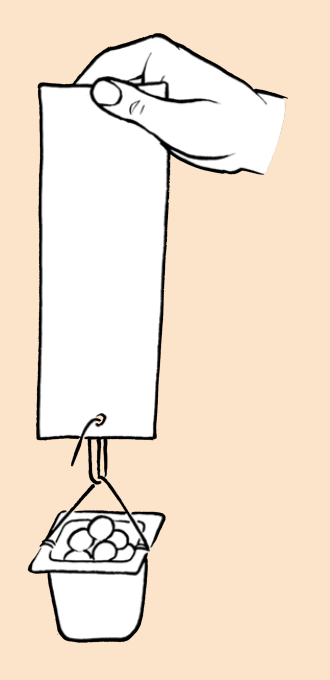
- Strength can be measured by testing how much force is needed to break a material (e.g., tearing paper with marbles).
Testing paper strength with marbles in a yoghurt tub
Heat and Temperature
- Heat is the transfer of energy between objects due to a temperature difference.
- Temperature measures how hot or cold something is; it is measured with a thermometer.
- Adding heat usually raises temperature, but during a phase change, temperature stays constant.
- Heat and temperature are related but not the same.
Melting and Boiling Points
- Melting point is the temperature at which a solid changes to a liquid.
- Boiling point is the temperature at which a liquid changes to a gas (bubbles form).
- For pure water, melting point is 0°C and boiling point is 100°C at sea level.
- Boiling point depends on atmospheric pressure (lower at high altitudes) and purity (impurities raise it).
- Different substances have different melting and boiling points (e.g., nitrogen boils at -200°C, ethanol at 78°C).
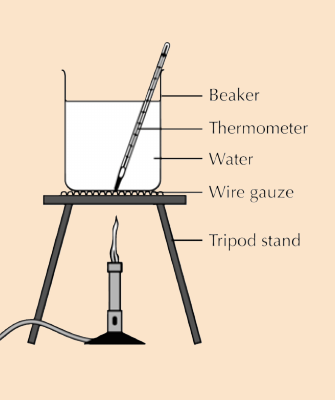
Apparatus for determining the boiling point of water
Matter and Classification
- Matter is anything that has mass and volume.
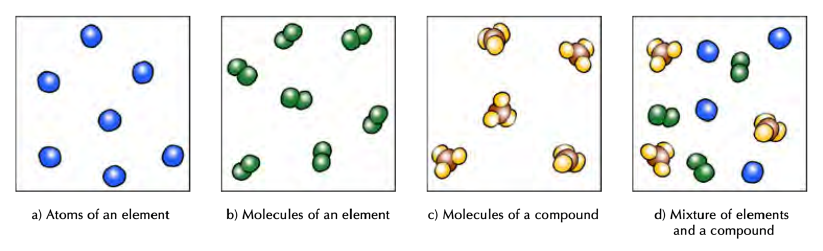
- Matter can be classified as pure substances (elements or compounds) or mixtures.
- Elements consist of one kind of atom; compounds consist of two or more kinds of atoms chemically bonded in a fixed ratio.
- Mixtures contain more than one kind of particle and can be separated by physical methods.
- Physical separation methods (e.g., filtering, evaporation) cannot break chemical bonds.
Diagrams to show the difference between elements, compounds and mixtures
Chemical Reactions in Everyday Life
- Cooking involves chemical reactions (e.g., baking bread changes ingredients into a new substance).
- Burning (combustion) is a chemical reaction (e.g., burning gas, logs).
- Rusting is a chemical reaction between iron and oxygen.
- Digestion and photosynthesis are examples of chemical reactions in living organisms.
- Indigenous practices often use chemical reactions, such as making dyes or preserving food.
Slide
Sign up free to view the lesson slides
Step through every slide for this topic — plus flashcards and revision notes — with a free account.
Câu hỏi luyện tập
Xem trước miễn phí — 8 trên 56 câu hỏi. Đăng ký để xem tất cả.
1.What is a chemical substance?
Easy- AA unique form of matter with constant chemical composition and characteristic properties
- BAny material that can be found on Earth
- CA mixture of two or more elements
- DA substance that can only exist as a solid
2.Which of the following is an example of a chemical substance?
Easy- APure water (H2O)
- BAir
- CSeawater
- DGranite
3.The law of constant composition states that:
Easy- AAll samples of a compound have the same proportions by mass of the elements present
- BAll mixtures have variable composition
- CElements always combine in the same physical state
- DThe composition of a compound changes with temperature
4.Which of the following is a characteristic property of pure water?
Easy- AIt boils at 100°C at standard pressure
- BIt is always a liquid
- CIt conducts electricity well
- DIt has a variable boiling point
5.What is the atomic ratio of hydrogen to oxygen in every molecule of pure water?
Easy- A2:1
- B1:2
- C1:1
- D2:2
6.Which of the following is NOT a chemical substance?
Easy- ASeawater
- BDiamond
- CTable salt (NaCl)
- DRefined sugar (C12H22O11)
7.Why are isomers considered distinct chemical substances even though they have the same composition?
Hard- AThey have different arrangements of atoms, leading to different properties
- BThey have different numbers of atoms
- CThey are mixtures of different elements
- DThey exist only in different phases
8.In geology, a mineral is defined as:
Easy- AAn inorganic solid substance of uniform composition
- BA mixture of two or more rocks
- CAny naturally occurring liquid
- DAn organic compound found underground
Unlock all 56 questions, flashcards & more
Tạo tài khoản miễn phí để xem mọi câu hỏi, slide, thẻ ghi nhớ và ghi chú ôn tập cho chủ đề này.