Kinetic energy
Học bằng cách chơi
Trả lời những câu hỏi này để kiếm năng lượng, rồi câu cá và khám phá. Không cần tài khoản.
Ghi chú bài học
Definition of Kinetic Energy
- Kinetic energy is the energy an object or system has because it is moving.
- It is often called the energy of motion.
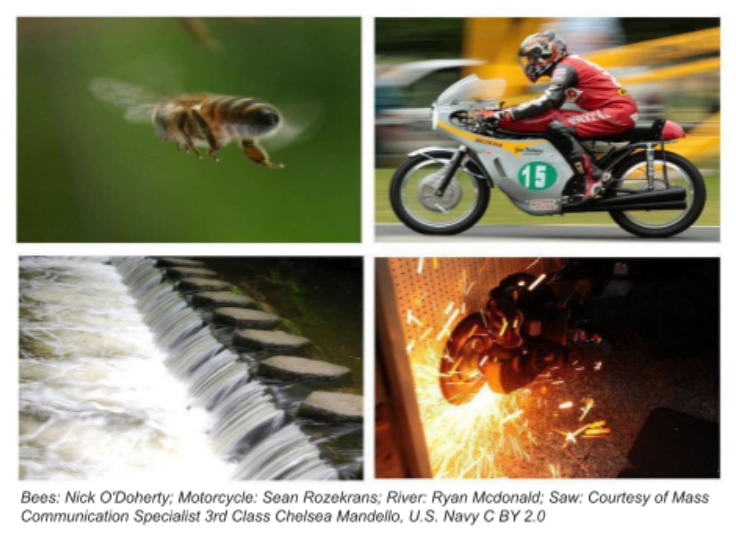
- A flying bee, a racing motorcycle, flowing water, and a spinning saw blade are all moving, so they all have kinetic energy — mass and material do not matter, only motion does.
- A stop street sign, two chairs, and an apple (at rest) do not have kinetic energy because they are not moving.
A flying bee, a racing motorcycle, flowing water, and a spinning saw blade
Factors Affecting Kinetic Energy
- An object's kinetic energy depends on two factors: mass and speed.
- The greater the mass, the more kinetic energy the object has.
- The greater the speed, the greater the kinetic energy.
- Kinetic energy is proportional to mass and grows with the square of speed.
- A car travelling at 200 km/h has more kinetic energy than at 100 km/h.
Mass and Kinetic Energy Investigation
- Rolling balls of different masses down a ramp into a paper cup shows how mass affects kinetic energy.
- In the experiment, a glass marble (20.4 g) moved the cup 208 cm, a plastic marble (9.5 g) moved it 107 cm, and a styrofoam ball (0.2 g) moved it 0 cm.
- The pattern: as mass increases, the distance the cup moves increases, indicating more kinetic energy.
- This evidence supports that moving objects with more mass have more kinetic energy.
Marble mass vs. distance moved
Speed and Kinetic Energy Investigation
- Rolling a toy car at different speeds and measuring how far it travels shows how speed affects kinetic energy.
- In the experiment, a slow car moved 250 cm, a medium car moved 882 cm, and a fast car moved 1450 cm.
- The pattern: as speed increases, the distance the car travels increases, indicating more kinetic energy.
- This evidence supports that objects with more speed have more kinetic energy.
Toy car speed vs. distance travelled
Kinetic vs. Potential Energy
- Potential energy is stored energy, such as a ball at the top of a ladder or petrol in a tank.
- Kinetic energy is the energy of motion, such as a moving car or flowing water.
- Some systems have both types, like a high jumper at the peak of a jump (has potential energy and some kinetic energy).
- A mountain biker at the top of a mountain has potential energy; a race-car at maximum speed has kinetic energy.
- A spring in a pinball machine before release has potential energy; a running refrigerator motor has kinetic energy.
A high jumper going over the bar

Energy Transfers and Conservation
- The Law of Conservation of Energy states that energy cannot be created or destroyed, only transferred or transformed.
- Energy transfers occur between systems, e.g., a kettle plugged in transfers electrical energy to thermal energy to heat water.
- In a high jumper's jump, as she rises, kinetic energy is converted to potential energy; at the top, she has maximum potential energy and minimum kinetic energy.
- When she falls, potential energy converts back to kinetic energy.
Real-World Applications
- Wind is moving air particles, so they have kinetic energy.
- Food contains stored potential energy that our bodies use for movement and functions.
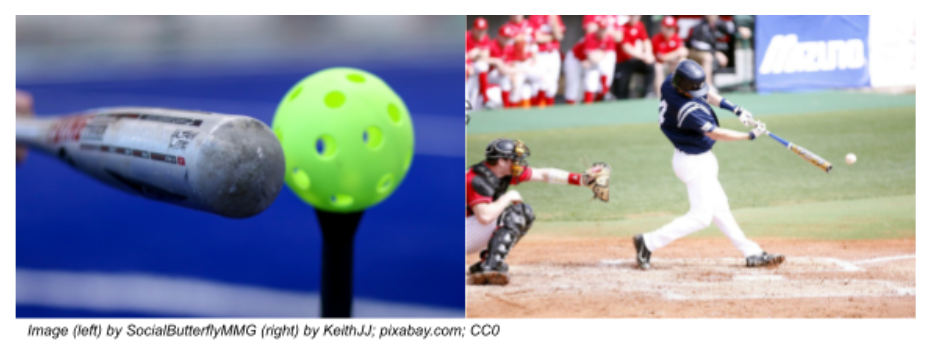
- A baseball has more kinetic energy than a wiffle ball when hit with the same force because it has more mass.
- A full cart has more kinetic energy than an empty cart moving at the same speed due to greater mass.
A baseball bat about to hit a wiffle ball, and a baseball bat hitting a baseball
Slide
Sign up free to view the lesson slides
Step through every slide for this topic — plus flashcards and revision notes — with a free account.
Câu hỏi luyện tập
Xem trước miễn phí — 8 trên 38 câu hỏi. Đăng ký để xem tất cả.
1.What is kinetic energy?
Easy- AEnergy stored in an object due to its position
- BEnergy of an object due to its motion
- CEnergy released during chemical reactions
- DEnergy transferred by heat
2.Which factor does kinetic energy depend on?
Easy- AMass and speed
- BMass and height
- CSpeed and temperature
- DHeight and temperature
3.A car and a bicycle are moving at the same speed. Which has more kinetic energy?
Medium- AThe car
- BThe bicycle
- CBoth have the same kinetic energy
- DIt depends on the direction of motion
4.If the speed of an object doubles, its kinetic energy becomes:
Medium- ATwice as much
- BFour times as much
- CHalf as much
- DThe same
5.A 2 kg ball is moving at 3 m/s. What is its kinetic energy?
Hard- A3 J
- B6 J
- C9 J
- D18 J
6.The SI unit of kinetic energy is the:
Easy- ANewton
- BJoule
- CWatt
- DPascal
7.A moving object has kinetic energy. When it comes to a stop, the kinetic energy is:
Medium- ADestroyed
- BConverted to other forms of energy
- CStored as potential energy
- DIncreased
8.Two objects have the same kinetic energy. Object A has twice the mass of object B. How do their speeds compare?
Hard- ASpeed of A is half that of B
- BSpeed of A is √2 times that of B
- CSpeed of A is 1/√2 times that of B
- DSpeed of A is twice that of B
Unlock all 38 questions, flashcards & more
Tạo tài khoản miễn phí để xem mọi câu hỏi, slide, thẻ ghi nhớ và ghi chú ôn tập cho chủ đề này.