Reactivity of metals
边玩边学
回答这些题目来赚取能量,然后钓鱼探索。无需账号。
给教育者: 面向 Reactivity of metals(Science,Chemistry)的即用型课程幻灯片, 复习笔记——用在你的课堂上,或将该知识点作为学习者可实时游玩的互动课堂活动来运行。
课程笔记
Metal Oxides and Redox
- Metals react with oxygen in the air to produce metal oxides.
- Oxidation is the addition of oxygen to a substance; reduction is the removal of oxygen from a substance.
- These reactions are called redox reactions because oxidation and reduction occur simultaneously.
- Example: copper reacts with oxygen to form black copper oxide: 2Cu + O₂ → 2CuO. Copper has been oxidised.
- Example: zinc oxide reacts with carbon: ZnO + C → Zn + CO. Zinc oxide is reduced (loses oxygen) and carbon is oxidised (gains oxygen).
The Reactivity Series
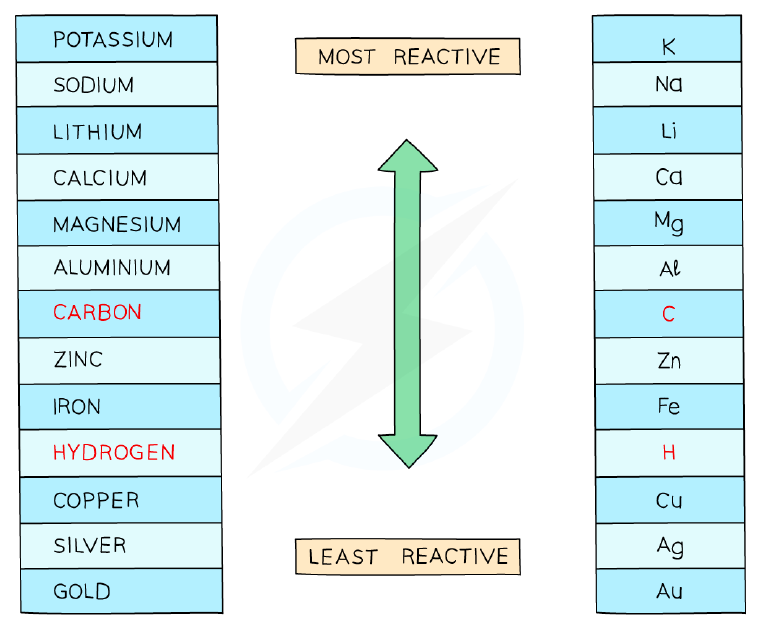
- The reactivity series arranges metals in order of their reactivity, from most reactive to least reactive.
- Order of reactivity: potassium, sodium, lithium, calcium, magnesium, aluminium, carbon, zinc, iron, hydrogen, copper, silver, gold.
- Metal atoms form positive ions by losing electrons when they react.
- The more reactive a metal, the more easily it loses electrons to form a positive ion.
- Non-metals carbon and hydrogen are included in the series because they help predict how metals are extracted.
The reactivity series of metals including hydrogen and carbon
Reactions of Metals with Water
- Metals above hydrogen in the reactivity series react with water.
- General equation: metal + water → metal hydroxide + hydrogen.
- Potassium reacts violently, sodium reacts quickly, lithium and calcium react less strongly.
- Magnesium, zinc and iron react very slowly with cold water; copper does not react.
- Example: calcium + water → calcium hydroxide + hydrogen: Ca + 2H₂O → Ca(OH)₂ + H₂.
Reactions of Metals with Dilute Acids
- Metals above hydrogen in the reactivity series react with dilute acids.
- General equation: metal + acid → salt + hydrogen.
- The more reactive the metal, the more vigorous the reaction.
- Potassium and sodium react violently; magnesium, zinc and iron react less strongly; copper does not react.
- Example: magnesium + hydrochloric acid → magnesium chloride + hydrogen: Mg + 2HCl → MgCl₂ + H₂.
Displacement Reactions
- A more reactive metal can displace a less reactive metal from its compound.
- Displacement can occur between a metal and a metal oxide (by heating) or a metal and an aqueous solution of a metal salt.
- Example: zinc + copper oxide → zinc oxide + copper: Zn + CuO → ZnO + Cu. Zinc is the reducing agent.
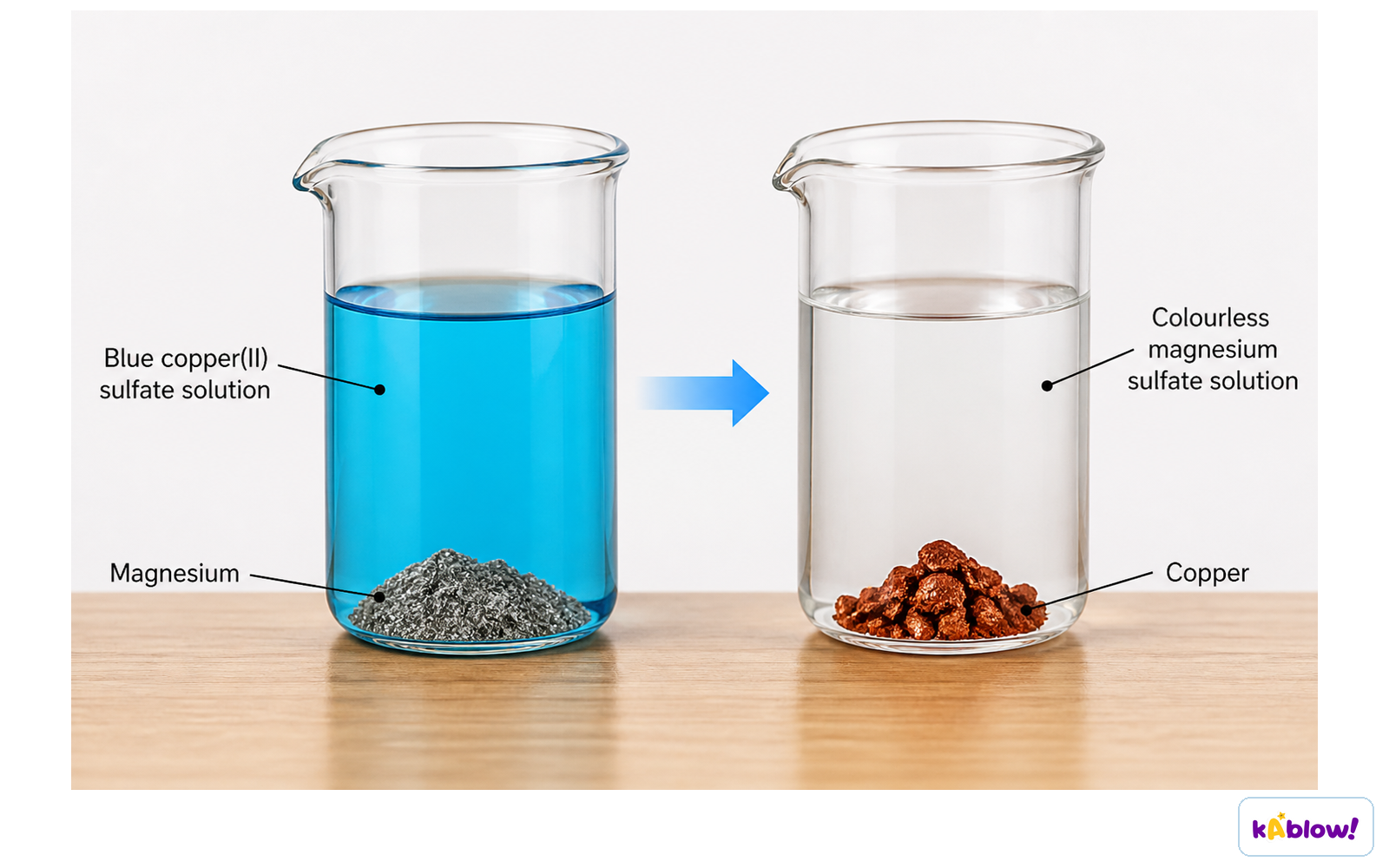
- Example: magnesium + copper sulfate → magnesium sulfate + copper: Mg + CuSO₄ → MgSO₄ + Cu. The blue colour of copper sulfate fades.
- The thermite reaction: iron(III) oxide + aluminium → iron + aluminium oxide: Fe₂O₃ + 2Al → 2Fe + Al₂O₃. Aluminium is more reactive than iron.
Displacement of copper by magnesium
Extraction of Metals and Reduction
- Most metals are found in ores; a metal ore is a rock containing enough metal to make extraction worthwhile.
- Unreactive metals like gold and platinum are found as native metals (uncombined elements).
- Metals above carbon in the reactivity series are extracted by electrolysis (e.g., aluminium).
- Metals below carbon can be extracted by heating with carbon (reduction), e.g., zinc, iron, copper.
- Extraction of a metal from its oxide is a reduction process because oxygen is removed.
- Example: zinc oxide + carbon → zinc + carbon dioxide: ZnO + C → Zn + CO.
Oxidation and Reduction in Terms of Electrons
- Oxidation is the loss of electrons; reduction is the gain of electrons (OIL RIG).
- In a redox reaction, one species is oxidised and another is reduced.
- Example: iron + copper sulfate → iron(II) sulfate + copper: Fe + CuSO₄ → FeSO₄ + Cu.
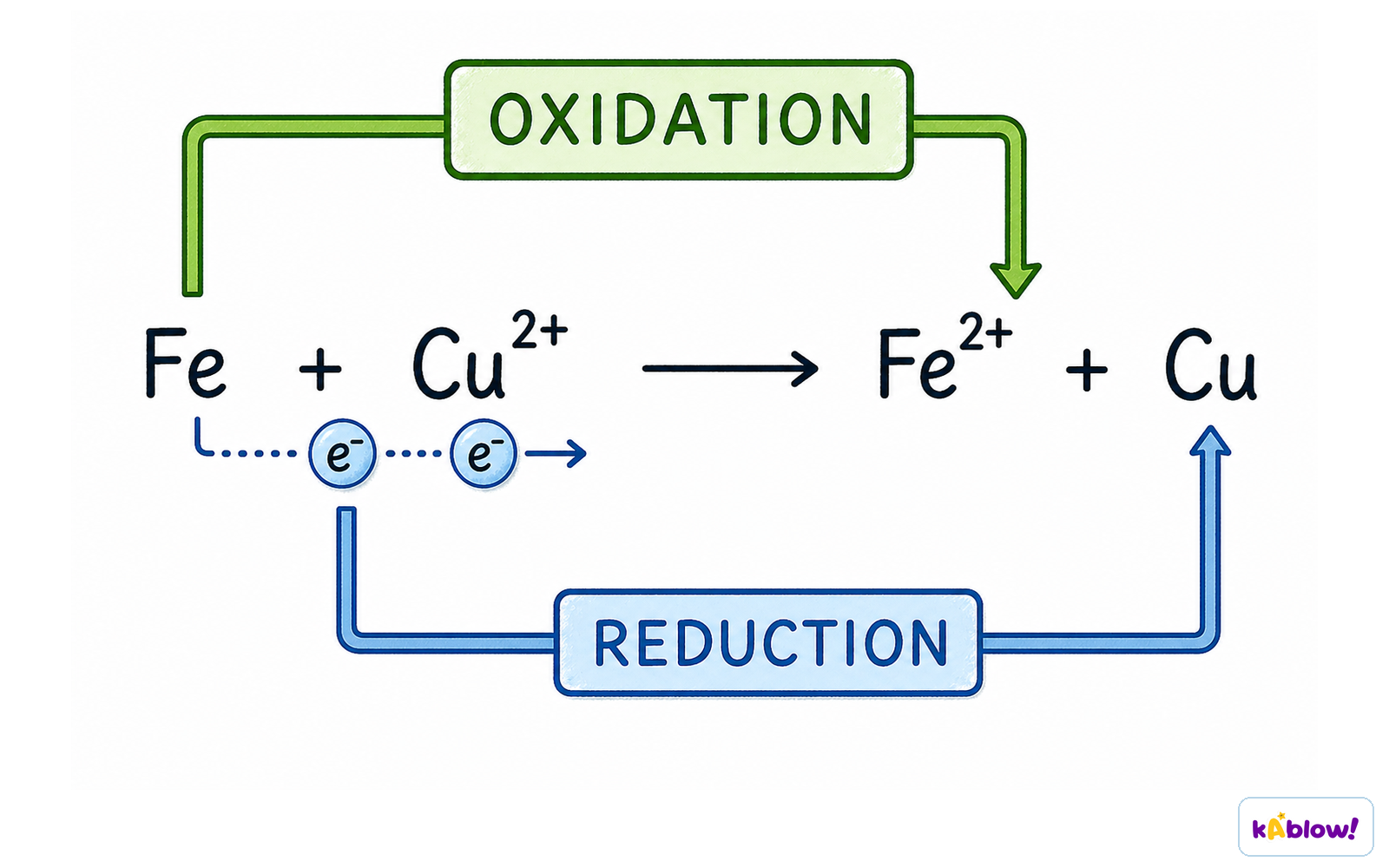
- Ionic equation: Fe + Cu²⁺ → Fe²⁺ + Cu. Sulfate ions are spectator ions.
- Half equations: Fe → Fe²⁺ + 2e⁻ (oxidation); Cu²⁺ + 2e⁻ → Cu (reduction).
Redox reaction between Fe and Cu²⁺ shown by electron transfer
Electrolysis and Redox
- During electrolysis, oxidation and reduction occur at the electrodes.
- At the cathode (negative electrode), positive ions gain electrons (reduction).
- At the anode (positive electrode), negative ions lose electrons (oxidation).
- Example at cathode: Pb²⁺ + 2e⁻ → Pb (reduction).
- Example at anode: 2Br⁻ → Br₂ + 2e⁻ (oxidation).
幻灯片
练习题
免费预览——59 题中的 8 题。注册即可查看全部。
1.In terms of oxygen, what name is given to the loss of oxygen from a substance?
Easy- AOxidation
- BReduction
- CNeutralisation
- DDisplacement
2.In terms of oxygen, what name is given to the gain of oxygen by a substance?
Easy- AReduction
- BOxidation
- CElectrolysis
- DDisplacement
3.The reaction of nickel(II) oxide with carbon is a redox reaction. Which statement explains whether carbon is oxidised or reduced?
Medium- ACarbon is oxidised because it gains oxygen
- BCarbon is reduced because it gains oxygen
- CCarbon is oxidised because it loses oxygen
- DCarbon is reduced because it loses oxygen
4.Which two non-metals commonly appear in the reactivity series? (select all that apply)
Medium- ACarbon
- BHydrogen
- COxygen
- DNitrogen
- EChlorine
5.Place these metals in order from most reactive to least reactive.
Medium- gold
- iron
- lithium
- magnesium
6.Sodium is above copper in the reactivity series. What type of reaction is: 2Na + CuO → Cu + Na₂O?
Medium- AReduction
- BOxidation
- CNeutralisation
- DDisplacement
7.Which metals can give a coloured flame when they react with cold water?
Medium- AAluminium and zinc
- BCopper and zinc
- CPotassium and sodium
- DMagnesium and iron
8.Which statement about displacement reactions is correct?
Easy- AA less reactive metal displaces a more reactive metal from its compounds
- BA more reactive metal displaces a less reactive metal from its compounds
- CDisplacement reactions require heating
- DDisplacement reactions are easier to see when they are in solution
历年真题
该知识点的历年真题练习即将推出。
即将推出