Induced potential, transformers and the National Grid
边玩边学
回答这些题目来赚取能量,然后钓鱼探索。无需账号。
课程笔记
Electromagnetic Induction and the Generator Effect
- Electromagnetic induction is when a potential difference is induced in a conductor or coil when it moves through a magnetic field, or when a magnetic field changes through it.
- This happens because the conductor or coil cuts through the magnetic field lines.
- The generator effect is the opposite of the motor effect: in the motor effect, a current-carrying conductor experiences a force; in the generator effect, motion through a magnetic field induces a potential difference.
- If the conductor is part of a complete circuit, the induced potential difference causes an induced current to flow.
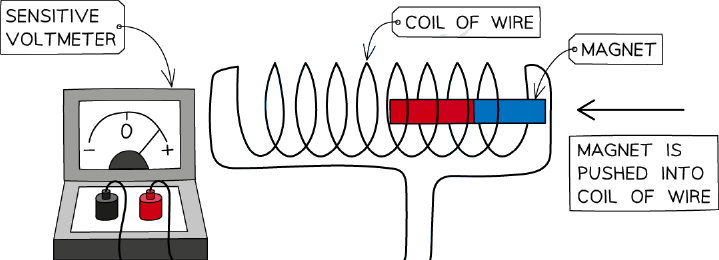
- A sensitive voltmeter can measure the induced potential difference; an ammeter can detect the induced current.
Setup for demonstrating electromagnetic induction with a coil, magnet, and sensitive voltmeter.
Factors Affecting the Induced Potential Difference
- The size of the induced potential difference is increased by: moving the wire, coil or magnet faster.
- Increasing the number of turns on the coil increases the induced potential difference.
- Increasing the area of the coil (size of the coils) increases the induced potential difference.
- Using a stronger magnetic field increases the induced potential difference.
- The direction of the induced potential difference is reversed by reversing the direction of movement or the orientation of the magnet's poles.
Lenz's Law
- Lenz's Law states that the direction of an induced potential difference always opposes the change that produces it.
- This means the induced magnetic field acts to try to stop the wire or magnet from moving.
- If a magnet is pushed north pole first into a coil, the end of the coil nearest the magnet becomes a north pole, repelling the magnet.
- If the magnet is pulled away, the end of the coil nearest the magnet becomes a south pole, attracting the magnet.
Alternators and Dynamos
- An alternator generates alternating current (a.c.) using a rotating coil in a magnetic field, connected via slip rings and carbon brushes.
- A dynamo generates direct current (d.c.) using a rotating coil in a magnetic field, connected via a split-ring commutator and carbon brushes.
- In an alternator, the induced potential difference reverses direction every half turn, producing an alternating output.
- In a dynamo, the split-ring commutator reverses the connections every half turn so the output current stays in the same direction.
- A bicycle dynamo produces alternating current because a magnet rotates inside a coil, constantly changing the magnetic field direction.
Graphs of Potential Difference in the Coil
- For an alternator, the graph of potential difference against time or angle is a sine or cosine curve, depending on the starting position of the coil.
- When the coil is vertical (moving parallel to the field), the induced potential difference is zero.
- When the coil is horizontal (moving perpendicular to the field), the induced potential difference is at a maximum.
- For a dynamo, the graph is a sine curve but always in the same direction (never negative).
- The magnitude of the induced potential difference can be increased by increasing the frequency of rotation, the number of turns, the strength of the magnet, or by inserting a soft iron core.
Microphones
- A moving-coil microphone converts sound waves into variations in electrical current using the generator effect.
- Sound waves cause the diaphragm to vibrate, which moves the coil back and forth through the magnetic field.
- As the coil cuts through the magnetic field lines, a potential difference is induced in the coil.
- Because the coil vibrates back and forth, the induced potential difference is alternating.
Transformers
- A transformer changes the value of an alternating potential difference or current using the generator effect.
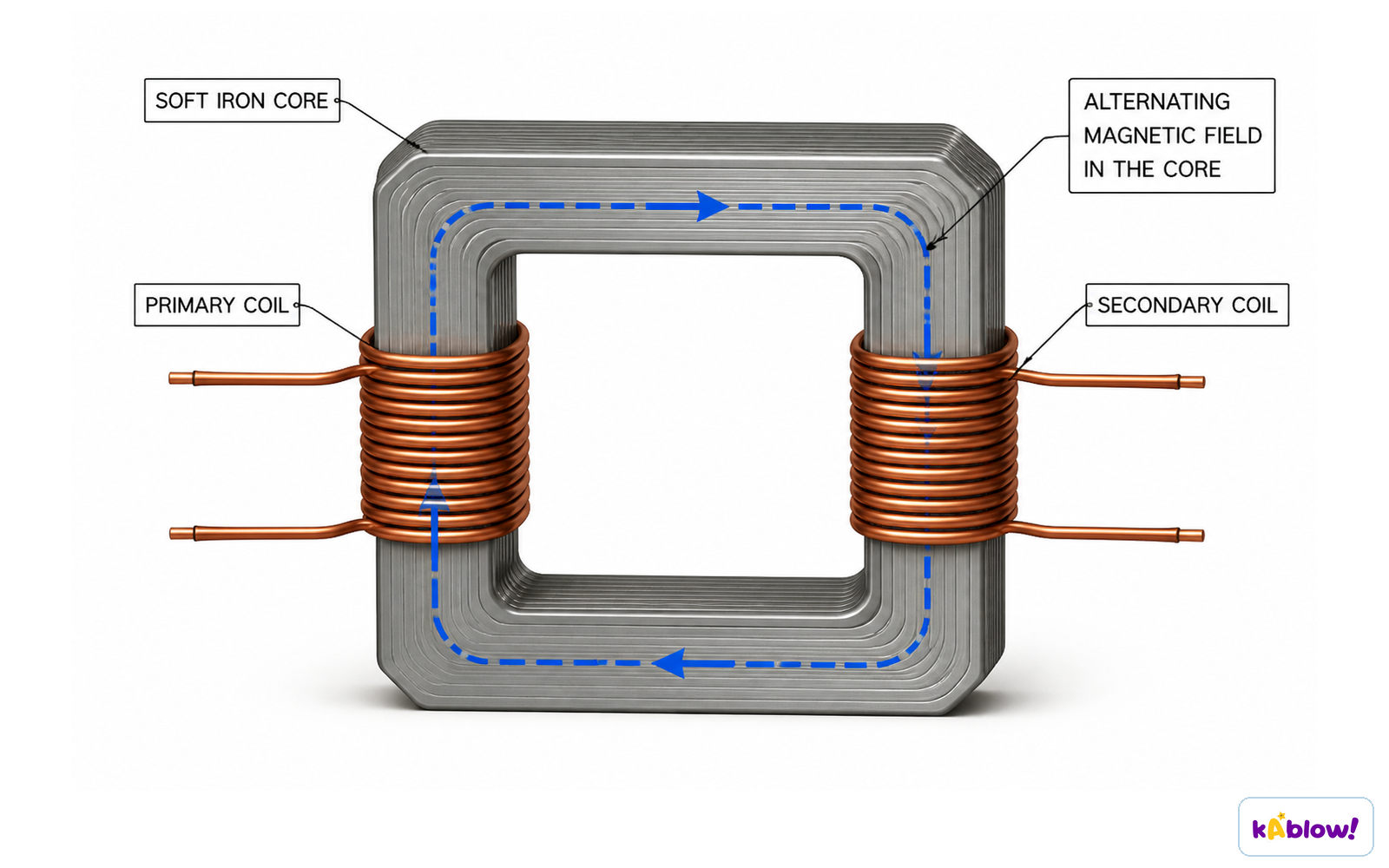
- A basic transformer consists of a primary coil, a secondary coil, and an iron core.
- Iron is used because it is easily magnetised, allowing the changing magnetic field to pass through the core.
- An alternating current in the primary coil creates a changing magnetic field in the iron core, which induces an alternating potential difference in the secondary coil.
- Transformers only work with alternating current because a changing magnetic field is required to induce a potential difference.
Structure of a simple transformer: primary coil and secondary coil wound on a soft iron core.
Transformer Equations
- The transformer equation is: \frac{Vp}{Vs} = \frac{Np}{Ns}, where Vp and Vs are the potential differences across the primary and secondary coils, and Np and Ns are the numbers of turns.
- A step-up transformer increases the potential difference: Vs > Vp and Ns > Np.
- A step-down transformer decreases the potential difference: Vs < Vp and Ns < Np.
- For an ideal transformer (100% efficient), input power equals output power: Vp \times Ip = Vs \times Is.
- Transformers cannot increase power; they trade potential difference for current.
The National Grid and High Voltage Transmission
- The National Grid uses transformers to increase the potential difference of electricity before transmission, and to decrease it to safe levels for homes and devices.
- Transmitting electricity at high voltage reduces the current in the power lines.
- A smaller current means less heat is produced in the wires, reducing energy loss.
- This is because P = IV, so for a given power, increasing voltage decreases current.
- Step-up transformers are used to increase voltage for transmission, and step-down transformers reduce it for domestic use.
幻灯片
练习题
免费预览——64 题中的 8 题。注册即可查看全部。
1.What is the name of the effect in which a potential difference is induced across a conductor when it moves relative to a magnetic field?
Easy- AThe motor effect
- BThe generator effect
- CThe transformer effect
- DThe heating effect
2.A potential difference is induced in a conductor only if there is relative movement between the conductor and the magnetic field.
EasyTrue or false?
3.Which of the following factors does NOT affect the size of the induced potential difference in a coil?
Easy- AThe speed of movement of the magnet
- BThe number of turns on the coil
- CThe resistance of the coil
- DThe strength of the magnetic field
4.A magnet is pushed north pole first into a coil of wire. Which end of the coil becomes a north pole?
Medium- AThe end closest to the magnet
- BThe end furthest from the magnet
- CBoth ends become north poles
- DNeither end becomes a north pole
5.Lenz's law states that the direction of an induced potential difference always opposes the change that produces it.
EasyTrue or false?
6.Which device uses slip rings to connect a rotating coil to an external circuit?
Medium- AA dynamo
- BAn alternator
- CA transformer
- DA microphone
7.What is the function of the split-ring commutator in a dynamo?
Medium- ATo increase the magnetic field strength
- BTo change the connections every half turn so the current stays in the same direction
- CTo convert alternating current to direct current
- DTo reduce the size of the induced potential difference
8.A bicycle dynamo produces direct current (d.c.) like a normal dynamo.
EasyTrue or false?