Moments, levers and gears
边玩边学
回答这些题目来赚取能量,然后钓鱼探索。无需账号。
课程笔记
Forces and Rotation
- Forces can cause objects to speed up, slow down, change direction, deform, or rotate.
- A pivot (or fulcrum) is a fixed point that an object can rotate around.
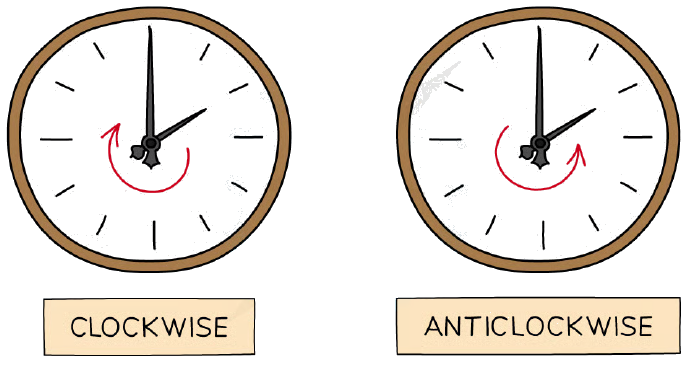
- Rotation caused by a force can be clockwise or anticlockwise.
- Examples of rotation caused by a force include a child on a see-saw, turning the handle of a spanner, and a door opening and closing.
- If two forces act on an object without passing through the same point, the object can still rotate.
- If the two forces are equal and opposite, this is known as a couple.
- Balanced forces that do not act through a common point will still cause the object to rotate.
Clockwise and anticlockwise rotation illustrated by clock faces
The Moment of a Force
- A moment is the turning effect of a force about a pivot.
- The size of a moment is given by the equation: M = F × d.
- M = moment in newton metres (Nm).
- F = force in newtons (N).
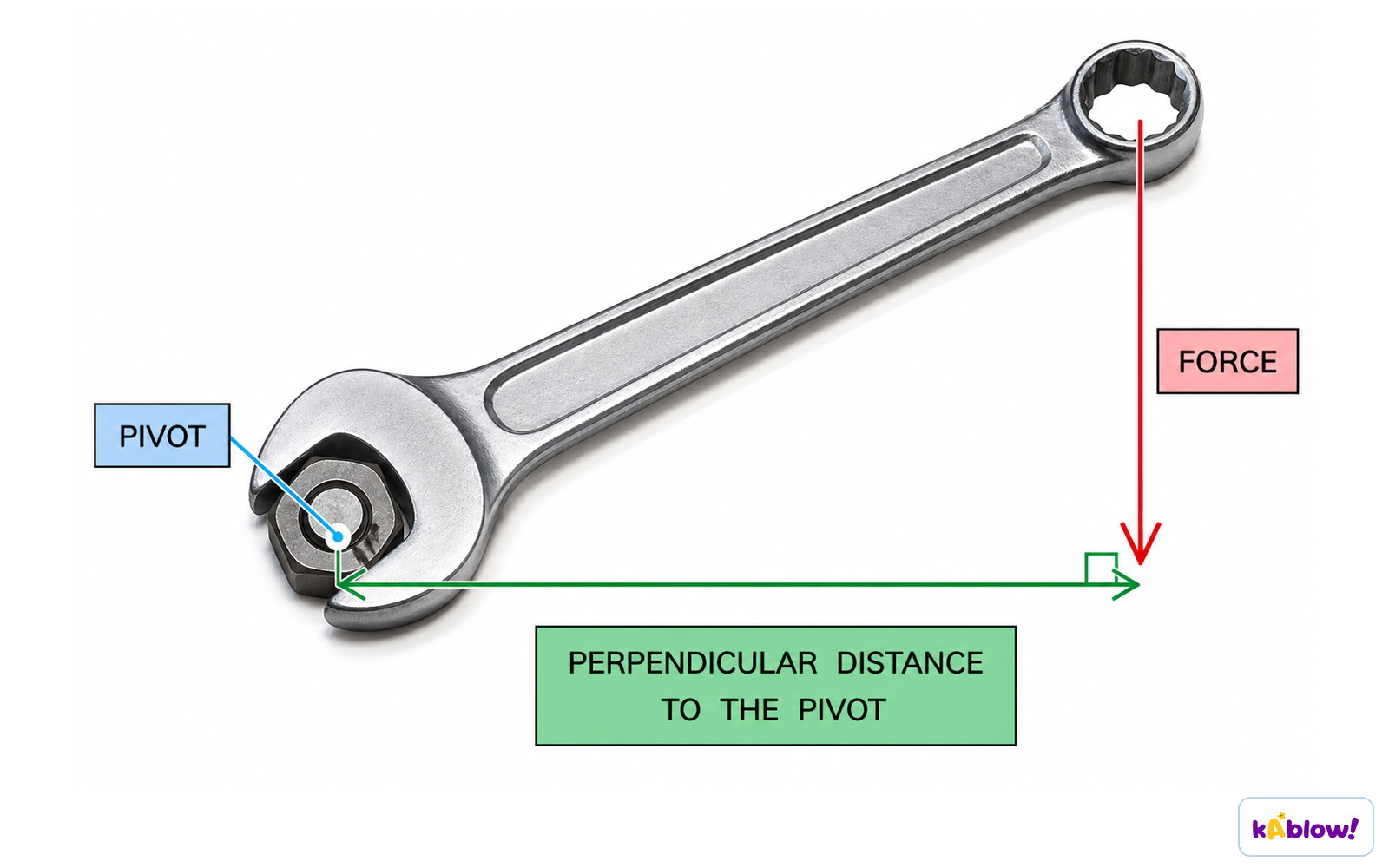
- d = perpendicular distance from the pivot to the line of action of the force, in metres (m).
- The moment depends on both the force and the perpendicular distance to the pivot.
- A door handle is placed on the opposite side to the hinge so that the perpendicular distance from the pivot is larger, creating a larger moment for the same force.
- Opening a door with a handle close to the pivot would be much harder and would require a lot more force.
A spanner turning a bolt, labelled with the pivot, the force, and the perpendicular distance from the force to the pivot.
Units and Conversions
- The unit of a moment is the newton metre (N m).
- If the distance is measured in centimetres, the moment can be in newton centimetres (N cm).
- If the exam question doesn't ask for a specific unit, always convert the distance into metres.
- Make sure all distances are in the same units before calculating.
The Principle of Moments
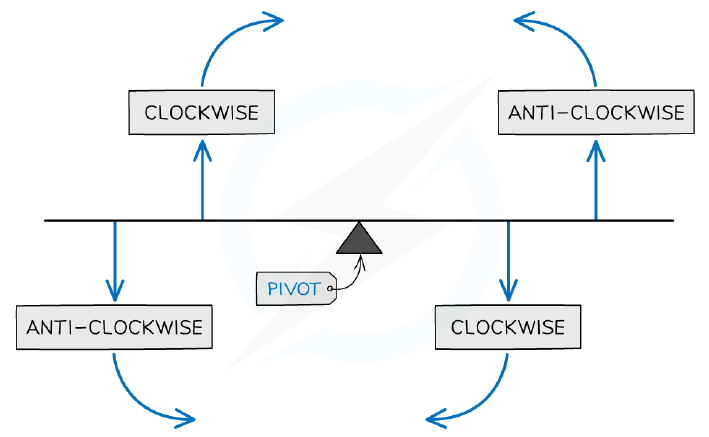
- The principle of moments states that if an object is balanced, the total clockwise moment about a pivot equals the total anticlockwise moment about that pivot.
- For a balanced horizontal beam: F₂ × d₂ = (F₁ × d₁) + (F₃ × d₃).
- The forces should be perpendicular to the distance from the pivot.
- On a horizontal beam, the forces that cause a moment are those directed upwards or downwards.
- Clockwise is defined as the direction the hands of a clock move; anticlockwise is the opposite.
Principle of moments: a beam balanced on a pivot, with the clockwise and anticlockwise turning directions labelled on each side.
Balancing Moments: Worked Example
- A parent weighing 690 N sits 0.3 m from the pivot of a see-saw; a child weighing 140 N sits on the other side.
- The anticlockwise moment from the adult is 690 × 0.3 = 207 Nm.
- For balance, the clockwise moment from the child must also be 207 Nm.
- Using 140 × d = 207, the child must sit 1.48 m from the pivot.
Levers
- Levers increase the size of a force acting on an object to make the object turn more easily.
- The force applied to a lever must act further from the pivot than the force it has to overcome.
- To make a lever work better, increase the size of the force applied or increase the distance of the force from the pivot.
- A bottle opener is an example of a lever: a small force applied far from the pivot creates a large force at the bottle cap.
- A crowbar is another type of lever used to lift heavy objects; a small downward force far from the pivot creates a large upward force on the load.
- A small force applied at a large distance from a pivot can create a large moment.
- Levers act as force multipliers by using moments.
Gears
- Gears multiply the effect of a turning force using moments.
- Gears consist of wheels with toothed edges that rotate on an axle or shaft, which acts as the pivot.
- The teeth of one gear fit into the teeth of another gear, letting one gear turn the other.
- As one gear turns, the other must also turn; where the gears meet, the teeth move in the same direction.
- One gear moves clockwise and the other anticlockwise — they rotate in opposite directions.
- Although the force is the same on both gears, the moment is not; it depends on the size of the gear, which changes the distance of the teeth to the pivot.
- If a larger gear is driven by a smaller gear, the large gear rotates slower but has a greater moment (e.g. a low gear on a bike or car).
- If a smaller gear is driven by a larger gear, the smaller gear rotates quicker but has a smaller moment (e.g. a high gear on a bike or car).
Key Terminology and Exam Tips
- Key terms: moment, pivot, fulcrum, lever, gear, principle of moments, clockwise, anticlockwise, perpendicular distance, equilibrium.
- Common error: using the distance along the object rather than the perpendicular distance from the pivot.
- Common error: forgetting to convert cm to m.
- Common error: believing a larger gear always turns faster — it actually turns slower but with a greater moment.
- Common error: omitting one of the moments when balancing.
- Common error: confusing force multiplication with energy gain — levers and gears do not create energy.
幻灯片
练习题
免费预览——62 题中的 8 题。注册即可查看全部。
1.What is the unit of the moment of a force?
Easy- Anewton metre (N m)
- Bnewton (N)
- Cjoule (J)
- Dnewton per metre (N/m)
2.The turning effect of a force about a pivot is called the moment of the force.
EasyTrue or false?
3.Which of these is the correct statement of the principle of moments?
Easy- AIf an object is balanced, the total clockwise moment about a pivot equals the total anticlockwise moment about that pivot.
- BIf an object is balanced, the total clockwise moment about a pivot is greater than the total anticlockwise moment about that pivot.
- CIf an object is balanced, the total clockwise moment about a pivot is less than the total anticlockwise moment about that pivot.
- DIf an object is balanced, the total clockwise force about a pivot equals the total anticlockwise force about that pivot.
4.Two gears are interlocked. Gear B rotates clockwise. In which direction does gear A rotate?
Easy- Aanticlockwise
- Bclockwise
- Cit does not rotate
- Ddepends on the number of teeth
5.A force of 500 N acts at right angles to a plank, 4.1 m from a pivot. Calculate the moment of the force about the pivot.
Medium- A2050 N m
- B205 N m
- C20.5 N m
- D0.0082 N m
6.Which of the following are examples of a force causing rotation? (select all that apply)
Medium- AA child on a see-saw
- BTurning the handle of a spanner
- CA door opening and closing
- DA book resting on a table
- EA car moving at constant speed in a straight line
7.A student investigates moments using a rod balanced on a pivot. A magnet is fixed to one end and modelling clay to the other. The system is in equilibrium. What is the relationship between the moment of the weight of the magnet and the moment of the weight of the modelling clay about the pivot?
Medium- AThe moment of the weight of the magnet equals the moment of the weight of the modelling clay.
- BThe moment of the weight of the magnet is greater than the moment of the weight of the modelling clay.
- CThe moment of the weight of the magnet is less than the moment of the weight of the modelling clay.
- DThe moment of the weight of the magnet is twice the moment of the weight of the modelling clay.
8.Match each term with its correct definition.
Medium- moment
- pivot
- principle of moments
- lever
- the turning effect of a force about a pivot
- a fixed point that an object can rotate around
- if an object is balanced, total clockwise moment equals total anticlockwise moment
- a simple machine that increases the size of a force to make an object turn more easily