Classifying living things
边玩边学
回答这些题目来赚取能量,然后钓鱼探索。无需账号。
给教育者: 面向 Classifying living things(MYP Biology,Year 1)的即用型课程幻灯片, 复习笔记——用在你的课堂上,或将该知识点作为学习者可实时游玩的互动课堂活动来运行。
课程笔记
Why do we classify?
- Big idea: Relationships. Classification shows how living things are related to one another.
- Related concept: Evidence. Scientists group organisms using evidence: the features we can observe, and more recently their DNA.
- Global context: Scientific and technical innovation. New tools, such as microscopes and DNA sequencing, have changed how we classify life.
- There are millions of different species (types of organism). Sorting them into groups makes them easier to study, name and identify, and lets scientists in different countries use the same names.
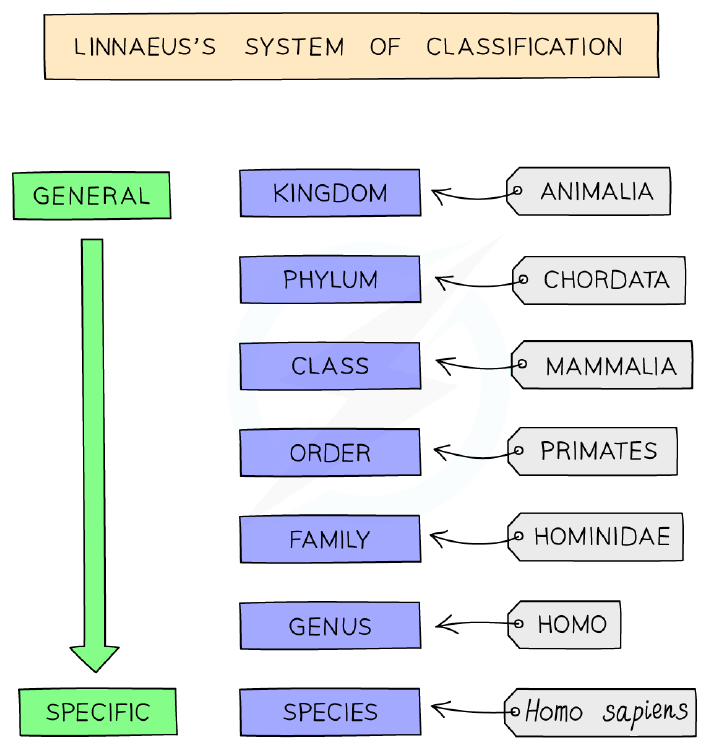
- Classification means sorting living things into groups based on shared features. The groups get smaller as you go down: kingdom, phylum, class, order, family, genus, species.
- A species is a group of organisms that can breed together and produce fertile offspring. Each species has a two-part scientific name, such as×Homo sapiens×for humans: the genus first, then the species.
Linnaean classification hierarchy
The five kingdoms
- The biggest groups are kingdoms. A simple system uses five: animals, plants, fungi, protists and bacteria.
- Animals: many cells, no cell walls, and they take in food. Examples: a fish, an insect, a human.
- Plants: many cells with cell walls and chloroplasts; they make food by photosynthesis. Examples: a fern, a moss, an oak tree.
- Fungi: cell walls but no chloroplasts, so they cannot photosynthesise. They absorb food from dead or living things. Examples: mushrooms, moulds and yeast.
- Protists: mostly single-celled organisms with a nucleus, such as×Amoeba×. Some, like algae, can photosynthesise.
- Bacteria: tiny single-celled organisms with no nucleus. Viruses are in none of the kingdoms because they are not cells.
Vertebrates: animals with a backbone
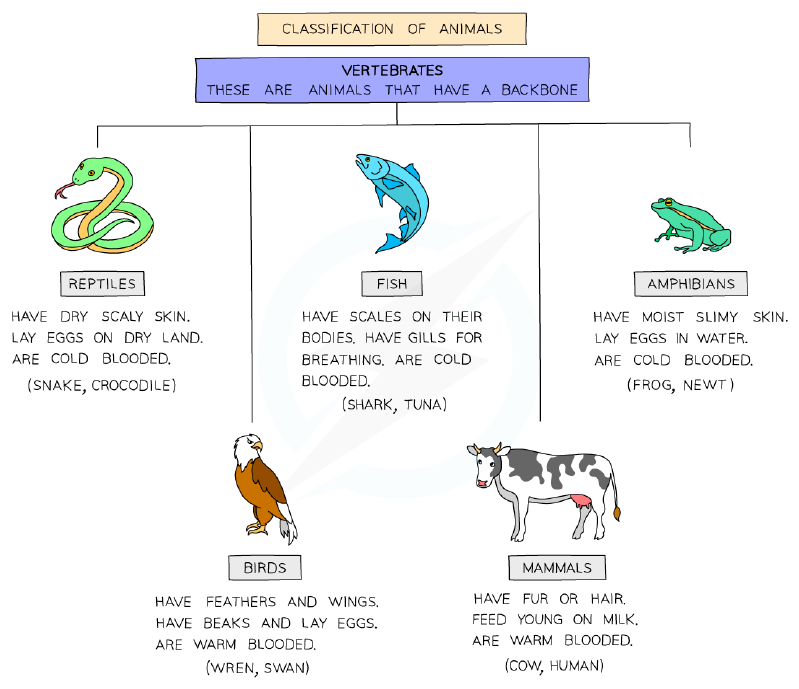
- Vertebrates have a backbone. There are five main groups: fish, amphibians, reptiles, birds and mammals.
- Fish: live in water, breathe with gills, have fins and wet scales, and lay eggs in water.
- Amphibians: moist skin with no scales. They lay jelly-covered eggs in water; many live in water when young and on land as adults (frogs, newts).
- Reptiles: dry, scaly skin. They lay leathery-shelled eggs on land (snakes, lizards, crocodiles).
- Birds: feathers, wings and a beak. They lay hard-shelled eggs and are warm-blooded.
- Mammals: hair or fur, and the females make milk to feed their young. Most give birth to live young. Bats and whales are mammals, too.
- Warm-blooded animals (birds, mammals) keep a steady body temperature. Cold-blooded animals (fish, amphibians, reptiles) take their temperature from their surroundings.
Classification across vertebrates
Invertebrates: animals with no backbone
- Invertebrates have no backbone. Over 95% of animal species are invertebrates.
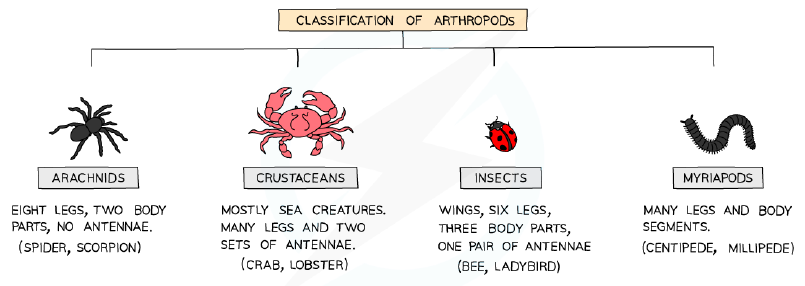
- Arthropods are the biggest group. They have jointed legs, a hard outer skeleton (an exoskeleton) and a body made of sections.
- Insects have six legs and three body sections (head, thorax, abdomen), usually with wings. Examples: ant, beetle, butterfly.
- Arachnids have eight legs and two body sections. Examples: spiders, scorpions, ticks.
- Crustaceans have many jointed legs and two pairs of antennae; most live in water. Examples: crabs, shrimps, woodlice.
- Myriapods have long bodies with many pairs of legs: centipedes and millipedes.
- Other invertebrate groups include molluscs (snails, mussels, octopuses) and annelids (segmented worms such as earthworms).
Using a dichotomous key
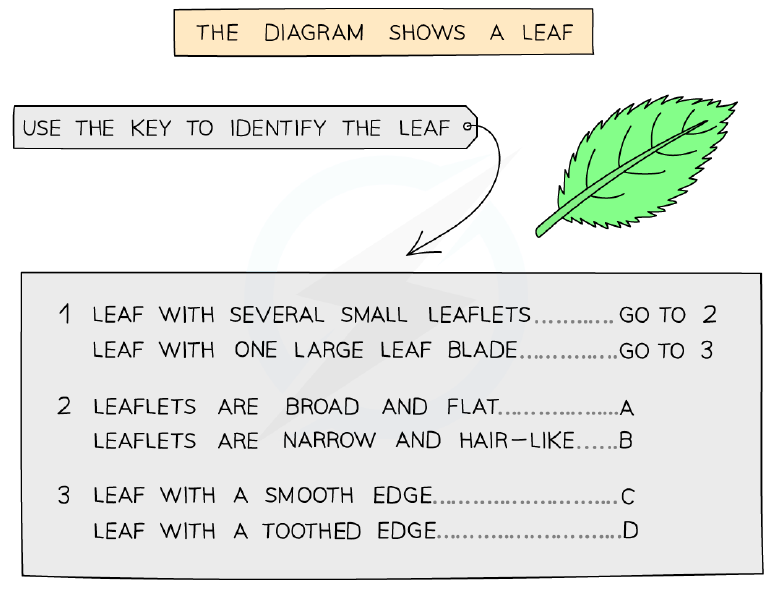
- A dichotomous key is a set of numbered steps. Dichotomous means "divided into two": each step gives two choices.
- You look at the specimen, choose the statement that matches, and follow the instruction to the next step or to a name.
- Example key: 1a has feathers: bird. 1b no feathers: go to 2. 2a has hair or fur: mammal. 2b no hair: go to 3.
- To build a key, pick features you can observe and everyone would agree on, such as number of legs or having a shell. Avoid opinions such as "pretty" and features that change, such as size.
- Each step should split the remaining group into two parts, so every organism ends at a different name.
Using a dichotomous key
Think like a scientist: evidence and claims
- Early scientists classified by observable features. Now they also compare DNA: organisms with more similar DNA are usually more closely related.
- Looking alike can be misleading. A dolphin has fins and lives in water, but it breathes air and feeds its young on milk, so it is a mammal, not a fish.
- Classification changes when new evidence turns up. It is a model, not a fixed truth.
- Good evidence comes from fair samples. If you say "all birds can fly" after seeing only sparrows, you have ignored penguins and ostriches.
- Inquiry task: a student wants to know whether woodlice prefer a damp place or a dry place. Name the independent variable, the dependent variable and two control variables. Then describe how you would make the results reliable, and how you would decide which group of arthropods a woodlouse belongs to.
From visible features to molecular evidence
幻灯片
练习题
免费预览——51 题中的 8 题。注册即可查看全部。
1.Why do scientists classify living things?
Easy- ATo make living things easier to study, compare and identify
- BTo decide which organisms are the most important
- CTo stop new species being found
- DTo give every animal a pet name
2.How many kingdoms are there in the simple classification system used in this lesson?
Easy- AThree
- BFive
- CSeven
- DTen
3.Which kingdom do mushrooms belong to?
Easy- APlants
- BAnimals
- CProtists
- DFungi
4.What is a vertebrate?
Easy- AAn animal with a hard outer skeleton
- BAn animal that lives in water
- CAn animal with a backbone
- DAn animal with six legs
5.Which group of vertebrates has feathers?
Easy- ABirds
- BReptiles
- CMammals
- DAmphibians
6.What is an invertebrate?
Easy- AAn animal with no backbone
- BAn animal with a very small backbone
- CAn animal that can live on land and in water
- DAn animal with no legs
7.Which of these is a mammal?
Medium- AA shark
- BA crocodile
- CA frog
- DA bat
8.Which feature do all mammals share?
Medium- AThey lay eggs in water
- BThe females make milk to feed their young
- CThey have dry scaly skin
- DThey breathe through gills
历年真题
该知识点的历年真题练习即将推出。
即将推出