The digestive system
边玩边学
回答这些题目来赚取能量,然后钓鱼探索。无需账号。
给教育者: 面向 The digestive system(MYP Biology,Year 1)的即用型课程幻灯片, 复习笔记——用在你的课堂上,或将该知识点作为学习者可实时游玩的互动课堂活动来运行。
课程笔记
Big idea: a system that transforms food
- Big idea (key concept): Systems. The digestive system is a set of organs that work together, each with its own job, to do something none of them could do alone.
- Related concept: Transformation. Food is changed in size and in chemistry: big pieces become small pieces, and big molecules become small molecules.
- Global context: Identities and relationships. Every person depends on this system to turn the food they eat into the energy and materials that make them who they are.
- The food we eat contains large molecules such as starch, protein and fat. They are insoluble and far too big to pass through the wall of the gut into the blood.
- Digestion is the breakdown of large, insoluble food molecules into small, soluble molecules that can be absorbed and carried around the body.
- A group of organs working together is an organ system. The digestive system is one of several organ systems in your body.
The organs of the digestive system and their jobs
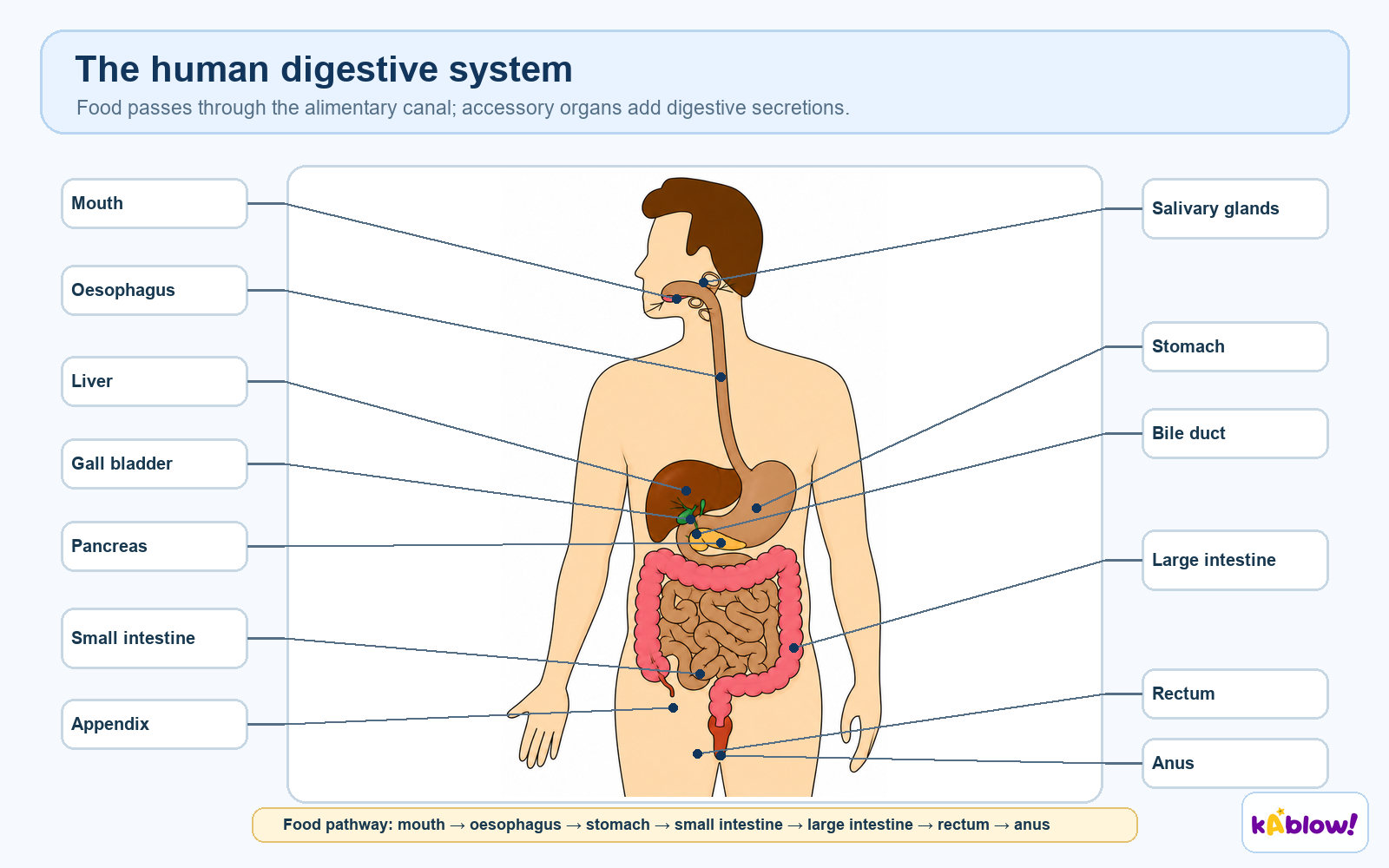
- Food travels through a long tube called the alimentary canal (or gut): mouth → oesophagus → stomach → small intestine → large intestine → rectum → anus.
- The mouth has teeth that chew food and salivary glands that make saliva. Saliva wets the food and contains the enzyme amylase.
- The oesophagus is a muscular tube. Its muscles squeeze in waves, called peristalsis, to push food down to the stomach.
- The stomach churns food with its muscular wall and adds hydrochloric acid and the enzyme protease.
- The small intestine finishes digestion and absorbs the digested food into the blood.
- The large intestine absorbs water from the leftovers. The rest is stored in the rectum as faeces and leaves through the anus.
- Three more organs help but food never passes through them: the liver makes bile, the gall bladder stores it, and the pancreas makes enzymes. All three release their juices into the small intestine.
The organs of the digestive system
Mechanical digestion: making pieces smaller
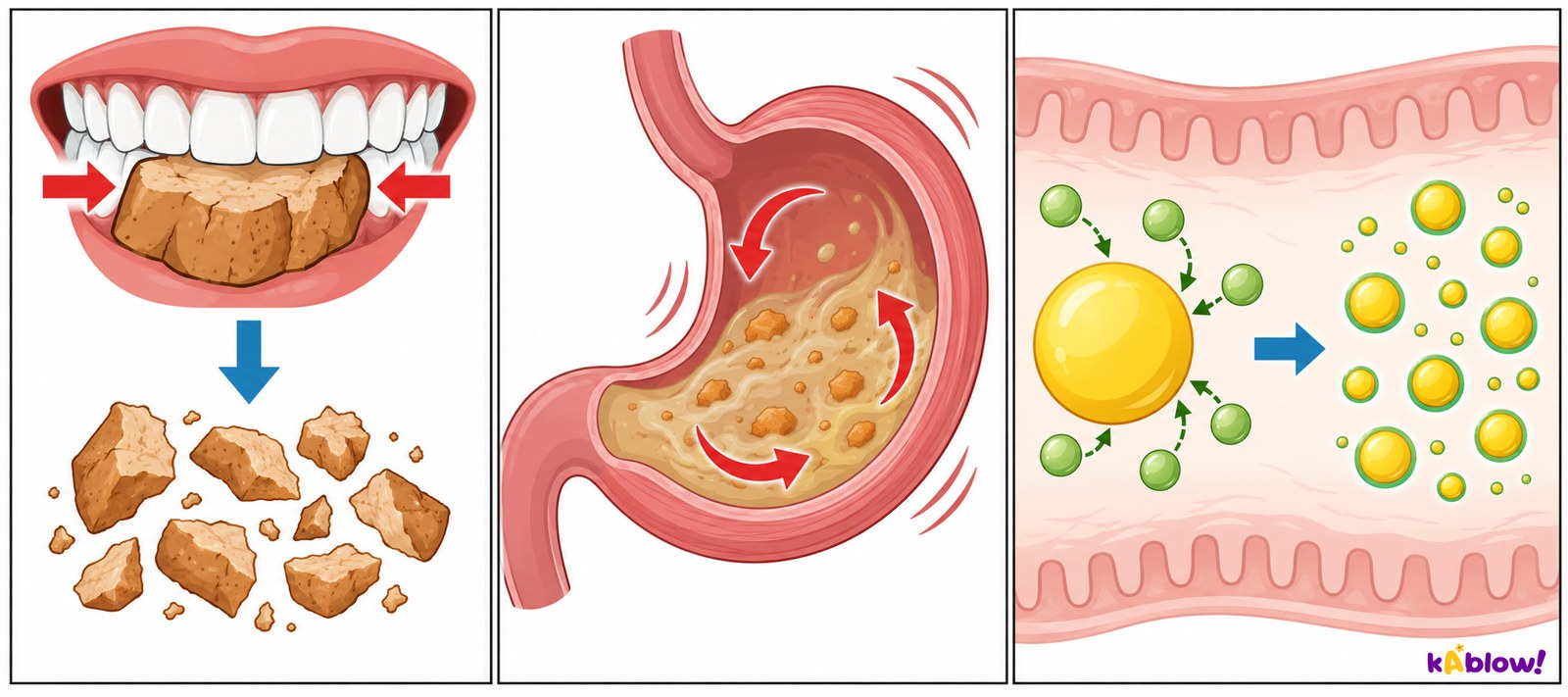
- Mechanical digestion breaks food into smaller pieces without changing the food molecules. No new substances are made.
- Teeth cut, tear and grind food. Different teeth have different shapes for different jobs.
- The stomach wall has strong muscles that churn the food and mix it with stomach juices.
- Bile breaks big drops of fat into many tiny droplets. This is called emulsification, and it is mechanical because the fat molecules themselves are not changed.
- Smaller pieces have a larger surface area, so enzymes have more places to work and digestion is faster.
Physical digestion and fat emulsification
Chemical digestion and enzymes
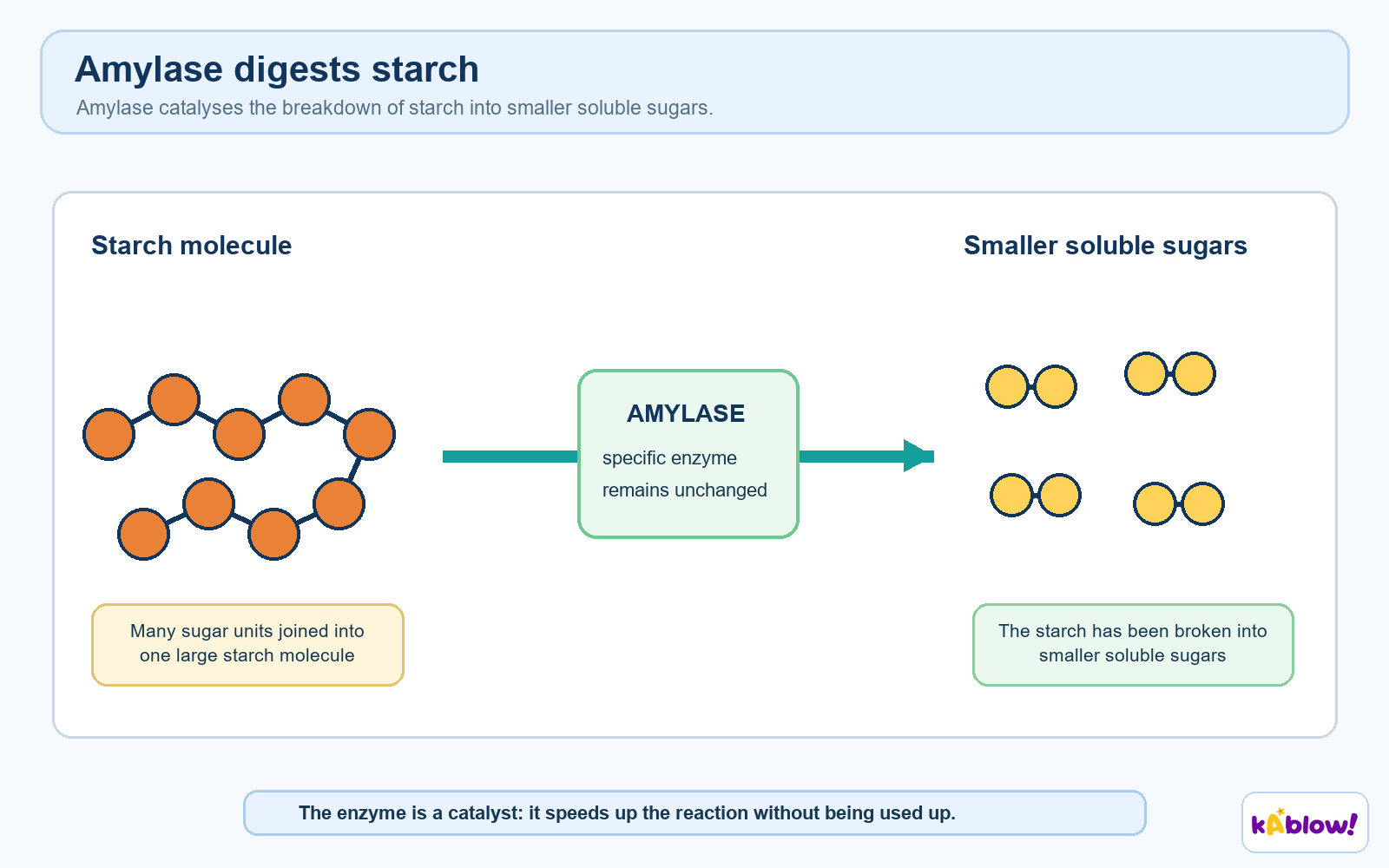
- Chemical digestion uses enzymes to break large molecules into small ones. New, smaller substances are made.
- An enzyme is a protein that speeds up a chemical reaction. Each enzyme works on one type of food molecule, like a key that fits one lock.
- Amylase digests starch into simple sugars. It is made in the salivary glands and the pancreas.
- Protease digests protein into amino acids. It is made in the stomach, the pancreas and the small intestine.
- Lipase digests fats into fatty acids and glycerol. It is made in the pancreas and the small intestine.
- Hydrochloric acid in the stomach kills many bacteria and gives protease the right conditions to work. Bile is alkaline and helps neutralise the acid when food reaches the small intestine.
- Enzymes work best at the right temperature. At body temperature (about 37 °C) they work well, but if they get too hot they stop working.
Amylase breaks down starch
Absorption and the large intestine
- Absorption is when digested food molecules pass through the wall of the gut into the blood.
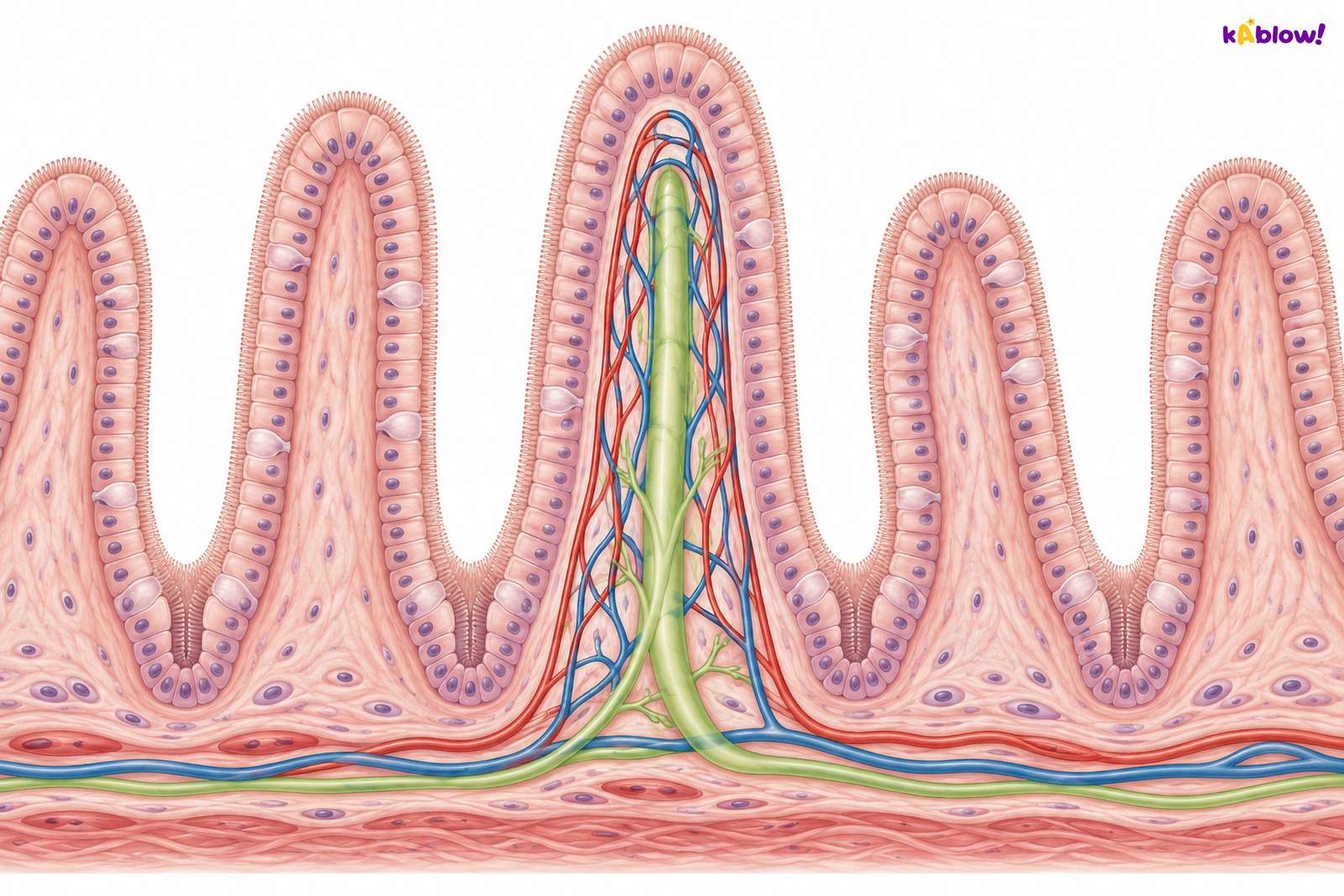
- Most absorption happens in the small intestine. Its lining is covered in tiny finger-like folds called villi.
- Villi give the small intestine a huge surface area. Each villus has a very thin lining and a rich supply of blood capillaries, so digested food passes into the blood quickly.
- The blood carries the absorbed sugars, amino acids, fatty acids and glycerol to all the cells of the body, where they are used for energy, growth and repair.
- Food that cannot be digested, such as fibre, moves on to the large intestine. There, most of the water is absorbed.
- The solid waste left over is faeces. Getting rid of it is called egestion. It is food that was never absorbed into the body's cells.
The small intestine
Think like a scientist: does temperature change how fast amylase works?
- A scientist can test amylase by mixing it with starch and dropping samples onto iodine solution. Iodine turns blue-black when starch is present and stays orange-brown when it is gone.
- The independent variable is the one you change on purpose (here, the temperature of the water bath). The dependent variable is the one you measure (here, the time until the iodine stays orange-brown).
- For a fair test, keep every other variable the same: volume of amylase, volume and concentration of starch, and the pH.
- Repeat the experiment at each temperature and take a mean, because one result could be a mistake.
- Inquiry task: plan an investigation to find the best temperature for amylase. Choose five temperatures, say what you will measure, list three variables you will control, and explain how you will decide whether your results are reliable.
幻灯片
练习题
免费预览——53 题中的 8 题。注册即可查看全部。
1.Which organ stores bile until it is needed?
Easy- AThe liver
- BThe gall bladder
- CThe pancreas
- DThe stomach
2.Where does digestion begin?
Easy- AIn the mouth
- BIn the stomach
- CIn the small intestine
- DIn the oesophagus
3.What is the muscular tube that carries food from the mouth to the stomach called?
Easy- AThe rectum
- BThe trachea
- CThe duodenum
- DThe oesophagus
4.Which part of the gut absorbs most digested food into the blood?
Easy- AThe large intestine
- BThe oesophagus
- CThe small intestine
- DThe stomach
5.What is the main job of the large intestine?
Easy- AMaking bile to help digest fats
- BAbsorbing water from the leftover food
- CDigesting protein using strong acid
- DChurning food into a thick paste
6.What is an enzyme?
Easy- AA protein that speeds up a reaction
- BA muscle that squeezes food along
- CA vitamin that helps us to grow
- DAn acid that kills germs
7.Which enzyme digests starch?
Easy- ALipase
- BProtease
- CCatalase
- DAmylase
8.Which enzyme digests protein?
Easy- ALipase
- BAmylase
- CProtease
- DCatalase
历年真题
该知识点的历年真题练习即将推出。
即将推出