Enzymes and digestion chemistry
边玩边学
回答这些题目来赚取能量,然后钓鱼探索。无需账号。
给教育者: 面向 Enzymes and digestion chemistry(MYP Biology,Year 4)的即用型课程幻灯片, 复习笔记——用在你的课堂上,或将该知识点作为学习者可实时游玩的互动课堂活动来运行。
课程笔记
Big idea: enzymes change how fast reactions happen
- Big idea (key concept): Change. Every second your cells carry out thousands of chemical reactions. Enzymes change the speed of those reactions, and conditions such as temperature and pH change the enzymes.
- Related concept: Function. An enzyme's shape decides what it can do. Its function depends on its structure.
- Global context: Scientific and technical innovation. Biological washing powders use proteases and lipases to remove stains, and lactase is used to make lactose-free milk. Both use the rules in this lesson.
- Enzymes are proteins that act as biological catalysts. A catalyst speeds up a reaction but is not used up, so one enzyme molecule can be used again and again.
- Without enzymes most reactions in the body would be far too slow at body temperature. Every enzyme is specific: it catalyses only one type of reaction.
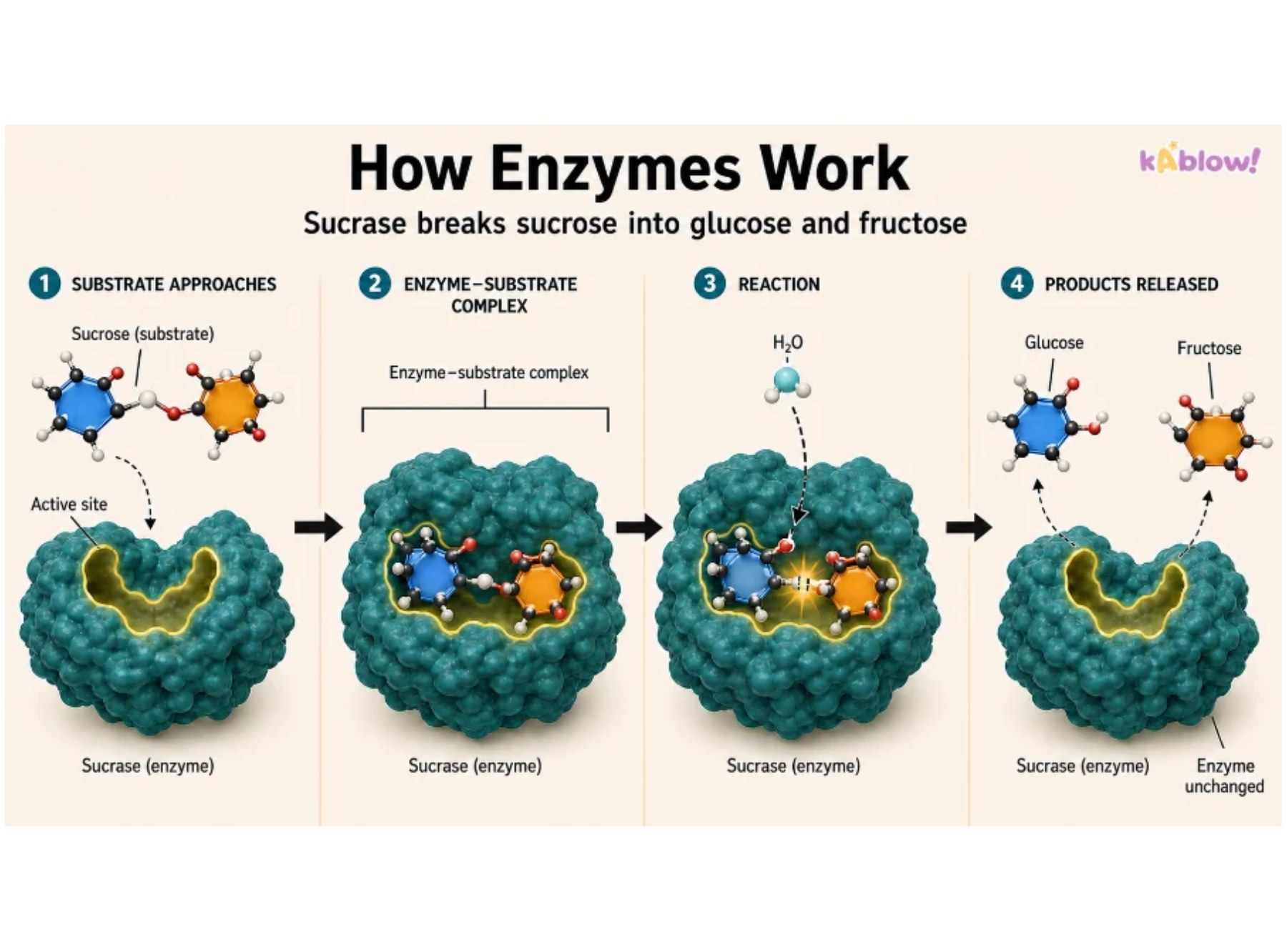
- Lock and key model: the molecule that the enzyme acts on is the substrate. It fits into a small region called the active site, which has a complementary shape. The enzyme and substrate form an enzyme-substrate complex, the reaction happens, the products leave, and the enzyme is unchanged.
How an enzyme breaks down a substrate
Temperature, pH and denaturation
- Temperature: as temperature rises towards the optimum, the particles move faster and collide with active sites more often and with more energy, so the rate increases. For most human enzymes the optimum is about 37 °C.
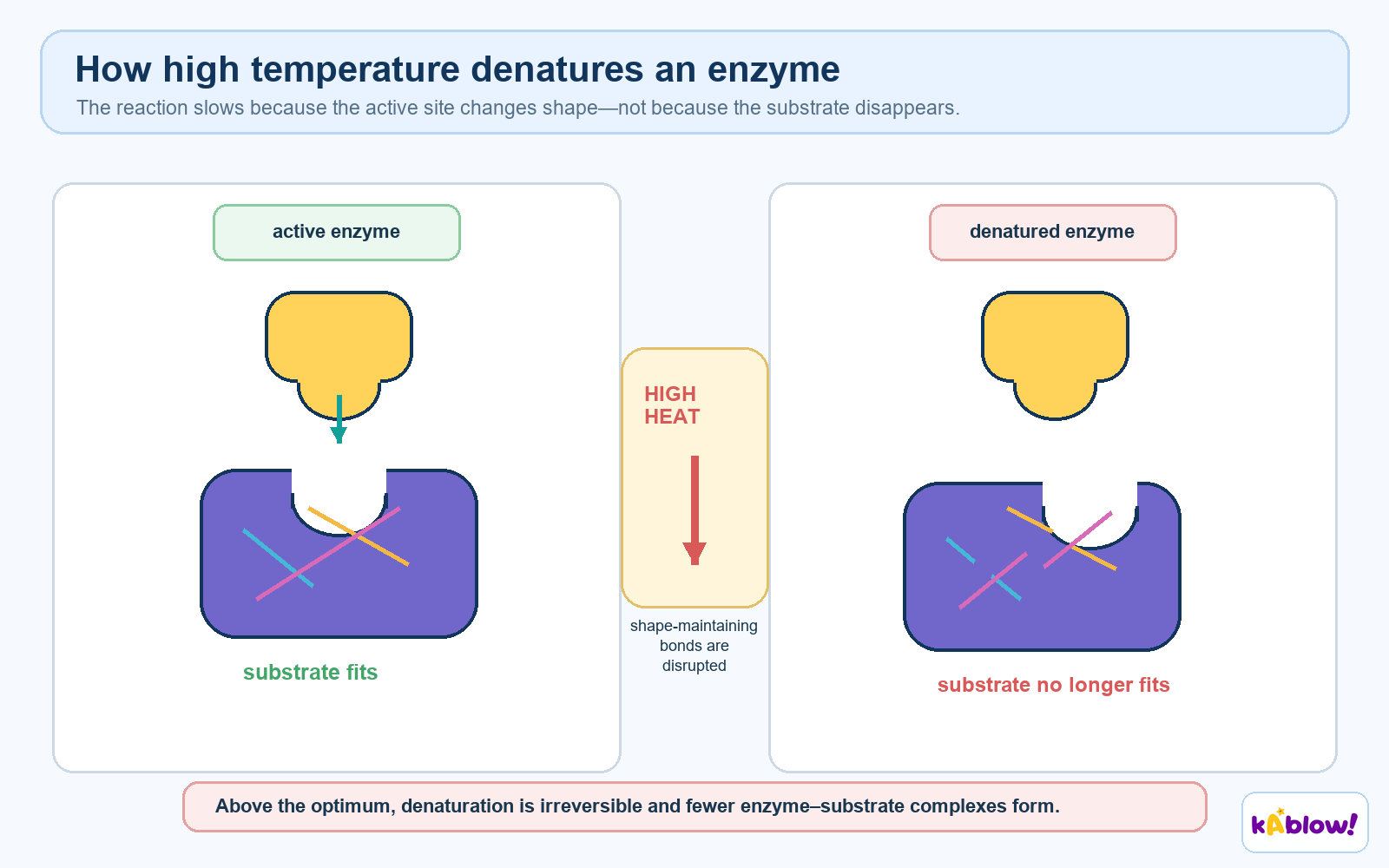
- Above the optimum the rate falls quickly. The bonds that hold the enzyme in its 3D shape break and the active site changes shape. The substrate no longer fits. The enzyme is denatured, and this change is permanent.
- Cold does not denature enzymes. At 0 °C the particles move slowly, so there are few collisions and the rate is very low, but the enzyme works again when it is warmed.
- pH: each enzyme has an optimum pH. Pepsin in the stomach works best at about pH 2, but amylase and lipase work best at about pH 7 to 8. A pH far from the optimum also breaks the bonds that hold the shape of the active site, so the enzyme is denatured.
- Substrate concentration: if the amount of enzyme is fixed, a higher concentration of substrate increases the rate at first. Then all the active sites are busy and the rate stops rising, because the enzyme is now the limiting factor.
- Two-step reasoning: a rate that falls above 40 °C is not because particles slow down (they move faster). It falls because more and more enzyme molecules are denatured, so fewer active sites can bind the substrate.
Heat changes the shape of an enzyme's active site
Calculating the rate of a reaction
- The rate tells you how fast a reaction goes. If you measure how long a reaction takes, a shorter time means a faster rate. A simple measure is rate = 1000 / time. Worked example: starch disappears in 25 s, so the rate is 1000 / 25 = 40 (arbitrary units).
- If you measure how much product forms, rate = amount of product / time. Worked example: 8 cm³ of oxygen in 10 s gives 8 / 10 = 0.8 cm³ per second.
- A rate can change during a reaction. Worked example: the total oxygen collected at 0, 10, 20, 30 and 40 s is 0, 8, 14, 18 and 20 cm³. The volume added in each 10 s is 8, 6, 4 and 2 cm³, so the rate falls as the substrate is used up. The mean rate over 40 s is 20 / 40 = 0.5 cm³ per second.
- Repeats and means: repeating an experiment makes the result more reliable. A result far from the others is anomalous and is left out of the mean. Times of 28, 31, 52 and 29 s give a mean (without 52 s) of (28 + 31 + 29) / 3 = 29.3 s.
- Reading a table: in one experiment the starch disappeared in 240, 120, 60, 30 and 100 s at 10, 20, 30, 40 and 50 °C, and not at all at 60 °C. The rates (1000 / time) are 4.2, 8.3, 16.7, 33.3 and 10. The rate is highest at 40 °C and is zero at 60 °C, where the amylase is denatured.
- Comparing rates: the time fell from 120 s to 30 s between 20 °C and 40 °C, so the reaction was 120 / 30 = 4 times faster.
Digestive enzymes: amylase, protease and lipase
- Food molecules such as starch, protein and fat are large and insoluble. They are too big to pass through the wall of the small intestine into the blood. Digestion breaks them into small soluble molecules, and digestive enzymes speed this up.
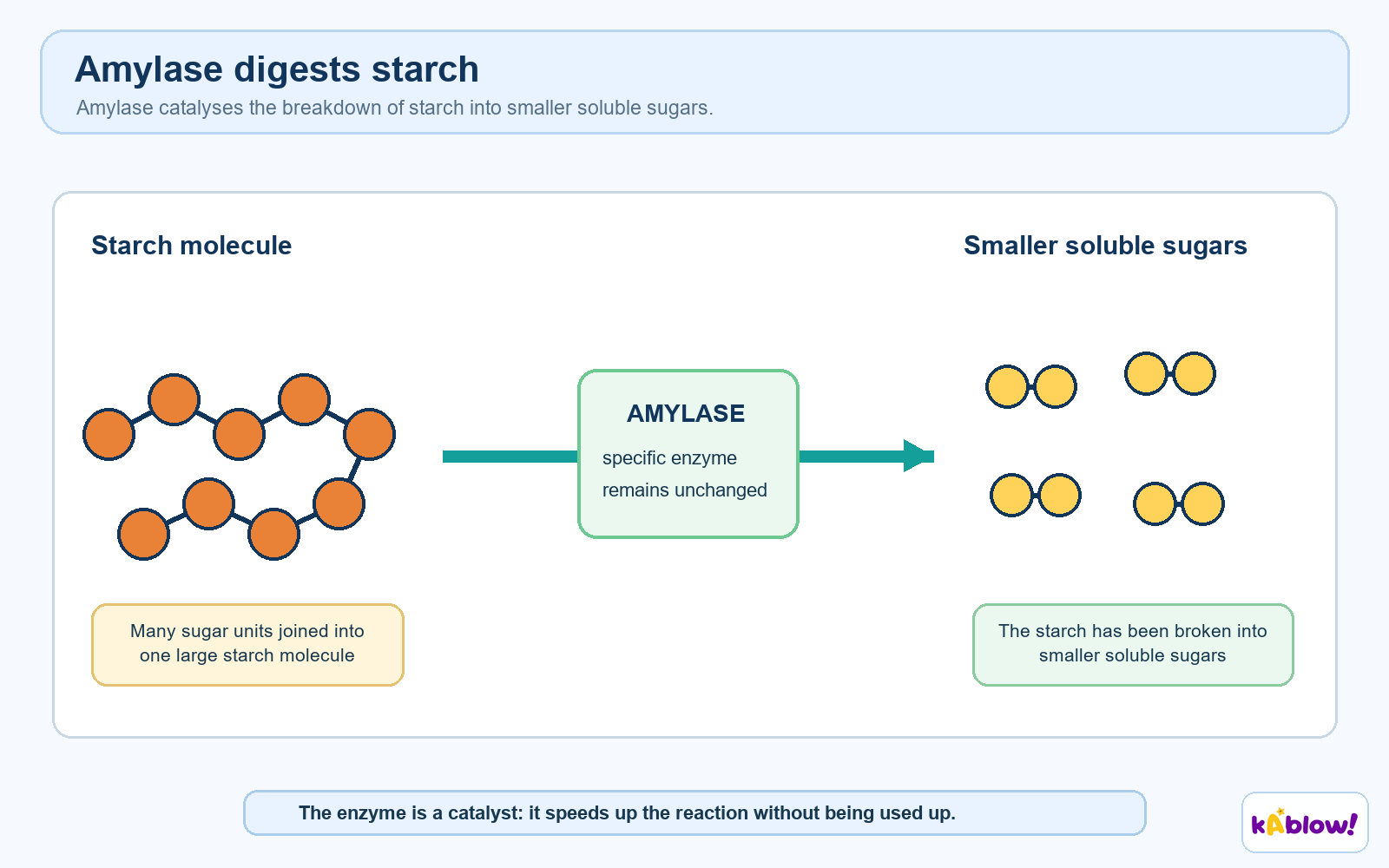
- Amylase is a carbohydrase. It breaks down starch into sugar (maltose). It is made in the salivary glands and the pancreas and works in the mouth and the small intestine.
- Maltase is made in the lining of the small intestine and breaks maltose into glucose, which is small enough to be absorbed.
- Protease enzymes break down proteins into amino acids. They are made in the stomach (pepsin), the pancreas and the small intestine.
- Lipase breaks down fats (lipids) into fatty acids and glycerol. It is made in the pancreas and the small intestine and works in the small intestine.
- Food tests: iodine turns blue-black with starch, Benedict's solution (heated) turns orange-red with reducing sugars such as maltose and glucose, and the biuret test turns purple with protein.
Amylase breaks starch into smaller sugars
Stomach acid, bile and the digestion of fat
- The stomach makes hydrochloric acid and the protease pepsin. The acid gives a pH of about 2, which kills many bacteria and is the optimum pH for pepsin. The low pH denatures salivary amylase, so starch digestion pauses until pancreatic amylase is released into the small intestine.
- The mixture leaving the stomach is very acidic, but the enzymes of the small intestine work best at about pH 7 to 8. Bile is alkaline and neutralises the acid.
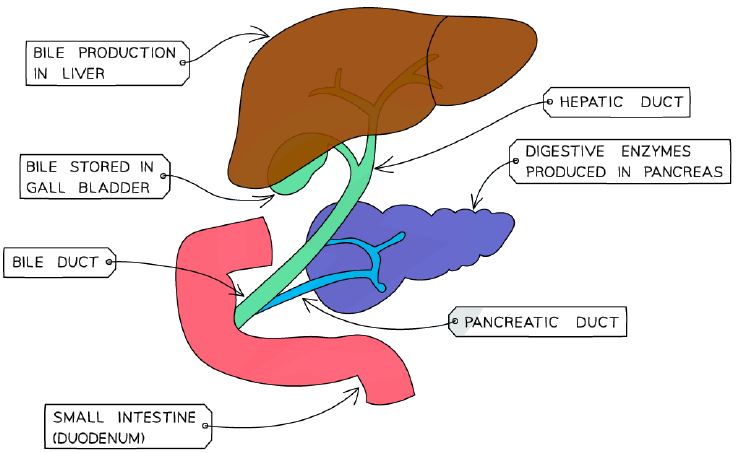
- Bile is made in the liver, stored in the gall bladder and flows along the bile duct into the first part of the small intestine, the duodenum.
- Bile also emulsifies fat: it breaks large fat droplets into many tiny droplets. This is a physical change, not chemical digestion. Bile contains no enzymes.
- Why emulsification helps: smaller droplets have a larger total surface area. Worked example: a 1 cm cube has a surface area of 6 cm². Cut into eight 0.5 cm cubes it has 8 x 1.5 = 12 cm², which is twice as much. Lipase can reach more fat at once, so the fat is digested faster.
- Summary of digestion: amylase makes sugars from starch, protease makes amino acids from protein, lipase makes fatty acids and glycerol from fat, and bile prepares the conditions for lipase.
Where bile and pancreatic enzymes enter the small intestine
Think like a scientist: investigating amylase
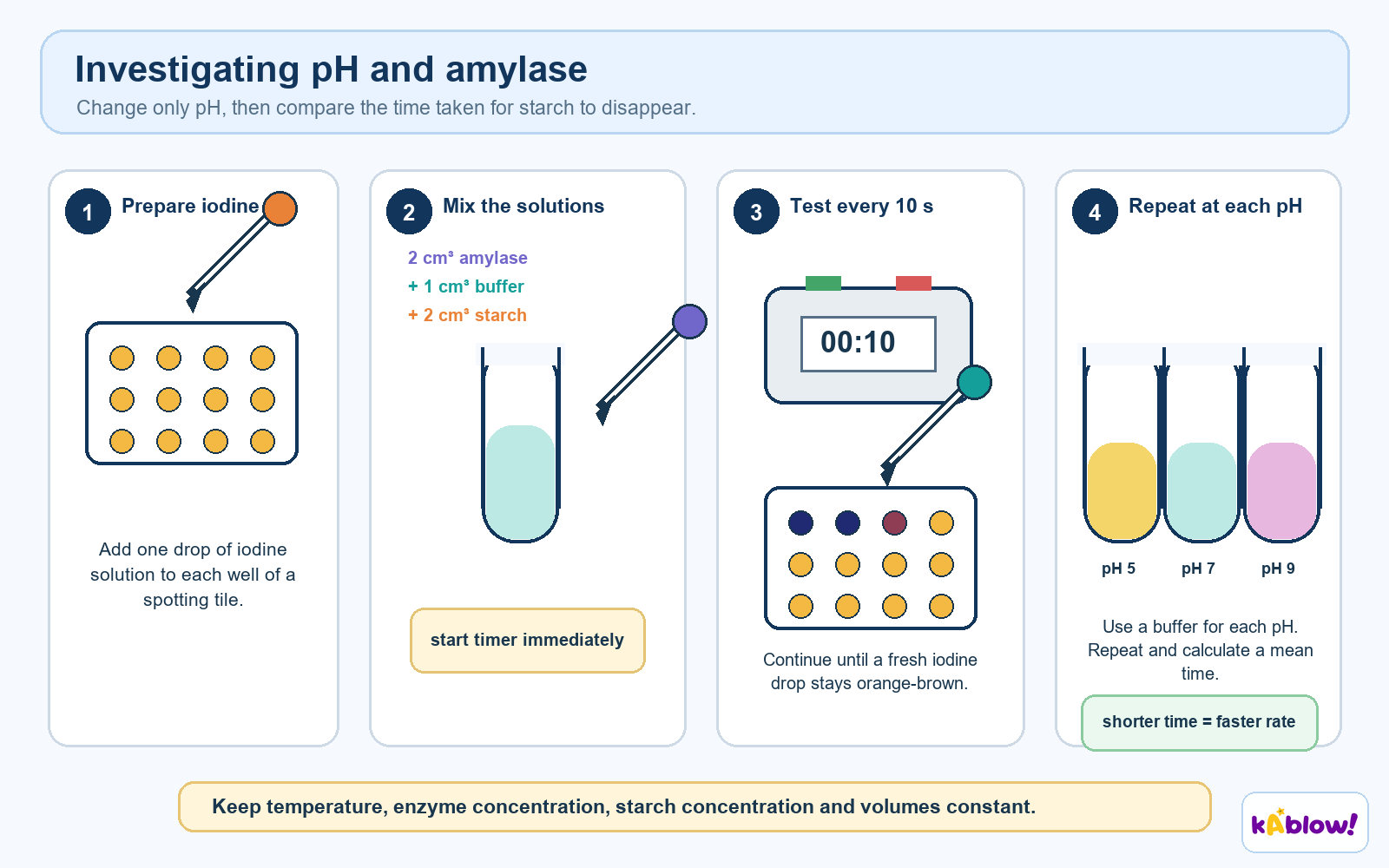
- Question: how does pH affect how fast amylase digests starch? Put drops of iodine in the wells of a spotting tile. Mix 2 cm³ of amylase, 1 cm³ of buffer and 2 cm³ of starch solution in a test tube and start a timer. Every 10 s add a drop of the mixture to a well of iodine.
- Reading the test: blue-black means starch is still present. When the drop stays orange-brown, all the starch has gone. Record the time. Repeat at pH 3, 5, 7, 9 and 11, using a buffer solution for each pH.
- Variables: the independent variable is the pH. The dependent variable is the time for the starch to disappear (use rate = 1000 / time). Control variables: the temperature (use a water bath), the volume and concentration of amylase, the volume and concentration of starch, and the volume of buffer.
- Safety: iodine stains skin and clothes, and glassware can break. Wear eye protection and wipe up spills. Keep water baths away from electrical sockets.
- Results (one experiment): the times at pH 3, 5, 7, 9 and 11 were 300, 60, 25, 75 s and no change after 600 s. The rates are 3.3, 16.7, 40, 13.3 and 0. The optimum pH is about 7.
- Inquiry task: explain why the rate is zero at pH 11. Evaluate the method: say why you would repeat each pH three times and calculate a mean, why the buffer is needed, and design a follow-up using pH 6, 7 and 8 to find the optimum more precisely.
Method for testing the effect of pH on amylase
幻灯片
练习题
免费预览——55 题中的 8 题。注册即可查看全部。
1.What is an enzyme?
Easy- AA protein that acts as a biological catalyst
- BA chemical that is used up to make a reaction happen
- CA type of carbohydrate that stores energy in cells
- DA hormone that carries messages in the blood
2.An enzyme is used up in the reaction that it catalyses.
EasyTrue or false?
3.Why do the reactions in your body need enzymes?
Easy- AThey supply all of the energy that the reactions need to happen quickly
- BWithout them the reactions would be too slow at body temperature to keep you alive
- CThey change the elements in the substances that react into new elements
- DThey make the reactions happen only if the body is heated to a high temperature
4.Complete the sentence about enzymes.
EasyA ____ speeds up a chemical reaction without being used up.
5.Match each term to its meaning.
Easy- Enzyme
- Substrate
- Product
- Active site
- The part of the enzyme where the substrate binds
- The molecule that the enzyme acts on
- A protein that speeds up a reaction
- A molecule made by the reaction
6.In the lock and key model, which part of the enzyme does the substrate fit into?
Easy- AThe cell membrane
- BThe nucleus
- CThe active site
- DThe product
7.Put the steps of an enzyme-catalysed reaction in order.
Medium- The enzyme is free to catalyse another reaction
- The substrate binds to the active site, forming an enzyme-substrate complex
- The products are released from the active site
- The substrate collides with the enzyme
- The substrate is changed into the products
8.Why can amylase digest starch but not protein?
Medium- AProtein molecules are too large to ever meet the amylase in the gut
- BAmylase is only made in the mouth, where there is no protein to digest
- CStarch is the only food substance that can dissolve in water or saliva
- DThe shape of a protein is not complementary to the shape of the amylase active site
历年真题
该知识点的历年真题练习即将推出。
即将推出