Formulae and equations
边玩边学
回答这些题目来赚取能量,然后钓鱼探索。无需账号。
给教育者: 面向 Formulae and equations(MYP Chemistry,Year 2)的即用型课程幻灯片, 复习笔记——用在你的课堂上,或将该知识点作为学习者可实时游玩的互动课堂活动来运行。
课程笔记
Big idea: formulae and equations
- Big idea (key concept): Systems. A chemical reaction is a system. The atoms inside it are rearranged, but none are lost or made, so we can keep track of every one.
- Related concept: Patterns. Formulae and equations follow patterns. Once you spot them, you can write the formula of thousands of compounds and balance equations for reactions you have never seen.
- Global context: Scientific and technical innovation. Chemists and engineers use balanced equations to work out how much fertiliser, medicine or fuel a factory can make from a given amount of raw materials.
- Every element has a symbol of one or two letters. The first letter is always a capital and the second is always lower case: C for carbon, Na for sodium, Cl for chlorine.
- A formula uses symbols and small numbers to show which atoms are in a substance and how many of each. A formula is a short way of describing a substance.
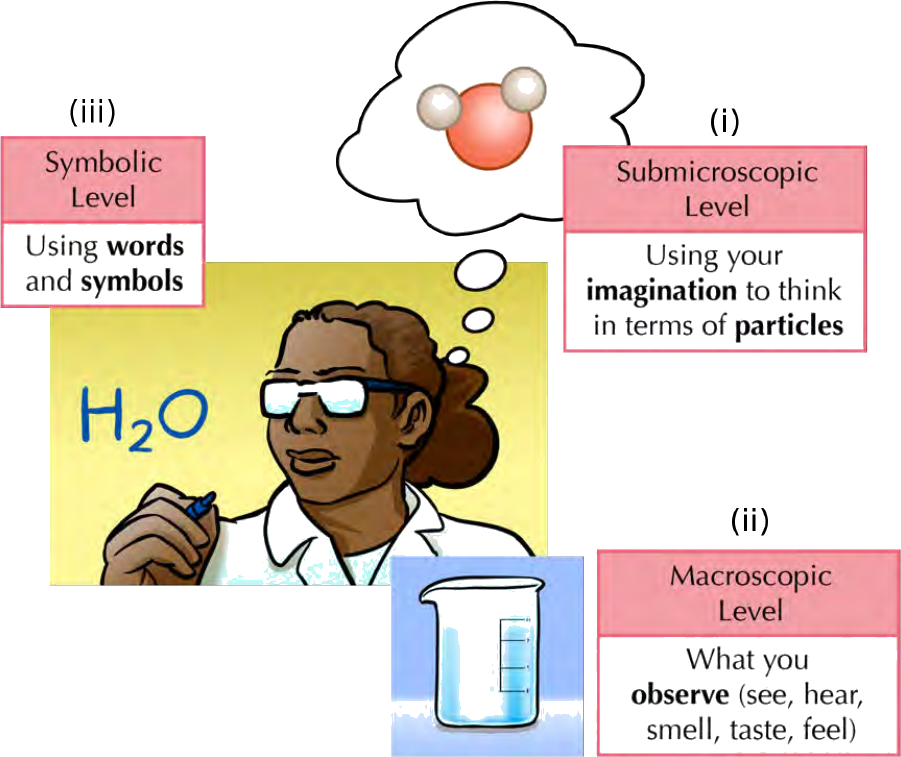
- Chemists think about a substance in three ways: what you can observe, the particles it is made of, and the symbols used to write it. Equations belong to the symbol level.
Three ways to think about a substance
Reading formulae
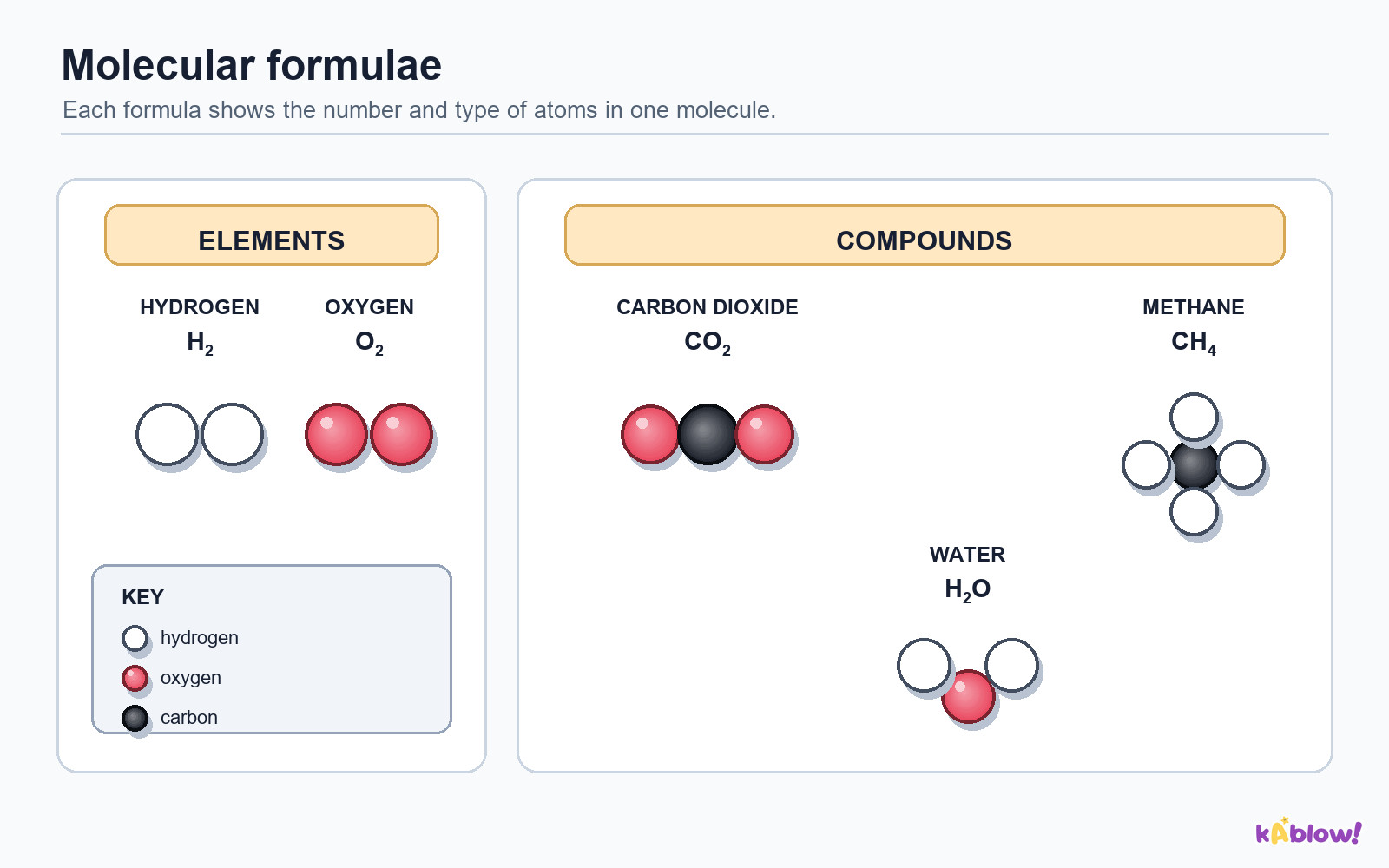
- A small number after a symbol is a subscript. It tells you how many atoms of that element there are. H₂O has 2 hydrogen atoms and 1 oxygen atom. If there is no number, there is one atom.
- CO₂ has 1 carbon atom and 2 oxygen atoms, so there are 3 atoms in each molecule. CH₄ has 1 carbon and 4 hydrogen, so 5 atoms in total.
- Brackets multiply everything inside them. Ca(OH)₂ has 1 calcium, 2 oxygen and 2 hydrogen atoms. Mg(NO₃)₂ has 1 magnesium, 2 nitrogen and 6 oxygen atoms.
- A big number in front of a formula is a coefficient. It multiplies the whole formula. 3H₂O means 3 molecules of water, which contain 6 hydrogen atoms and 3 oxygen atoms.
- An element contains one kind of atom, such as O₂ or Cl₂. A compound contains two or more kinds of atom joined together, such as CO₂ or NaCl. Seven elements form diatomic molecules, pairs of identical atoms: H₂, N₂, O₂, F₂, Cl₂, Br₂ and I₂.
- The relative atomic mass, Ar, of an element is on the Periodic Table. Add the Ar values of every atom in a formula to get the relative formula mass, Mr. For water, Mr = 1 + 1 + 16 = 18. Mr has no unit.
Formulae of simple elements and compounds
Writing formulae
- A compound is neutral overall, so the charges on its ions must add up to zero. Metals form positive ions and non-metals form negative ions.
- Some common ions: Na⁺, K⁺ and H⁺ (charge 1+); Mg²⁺ and Ca²⁺ (charge 2+); Al³⁺ (charge 3+); Cl⁻, OH⁻ and NO₃⁻ (charge 1−); O²⁻, SO₄²⁻ and CO₃²⁻ (charge 2−).
- Sodium chloride: Na⁺ and Cl⁻ cancel one to one, so the formula is NaCl. Magnesium chloride: one Mg²⁺ needs two Cl⁻, so the formula is MgCl₂.
- Aluminium oxide: two Al³⁺ (total 6+) balance three O²⁻ (total 6−), so the formula is Al₂O₃. Sodium oxide needs two Na⁺ for one O²⁻, so it is Na₂O. Calcium oxide is CaO.
- When more than one of a group of atoms is needed, put the group in brackets: calcium hydroxide is Ca(OH)₂ and magnesium nitrate is Mg(NO₃)₂. Sodium sulfate needs no brackets: Na₂SO₄.
- Names help: -ide means just those elements (sodium chloride, calcium oxide). -ate means oxygen is also present in the negative ion (sulfate, nitrate, carbonate). Compounds of non-metals use prefixes: carbon monoxide is CO and carbon dioxide is CO₂.
Conservation of mass
- In a chemical reaction the atoms of the reactants are rearranged into the products. No atoms are created or destroyed, so the total mass stays the same. This is the conservation of mass.
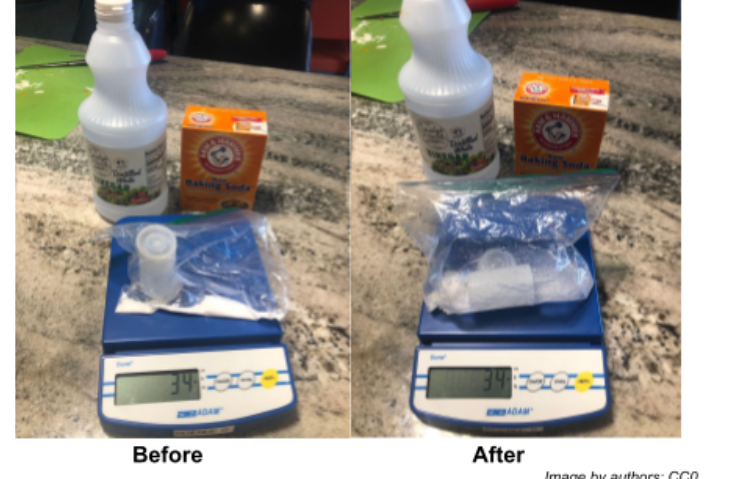
- In a closed (sealed) system nothing can enter or leave, so the mass before and after the reaction is the same. A sealed bag of vinegar and baking soda inflates but its mass does not change.
- In an open system a gas can escape or join in. When an acid reacts with a carbonate in an open flask, carbon dioxide leaves and the reading on the balance falls. No atoms have vanished: they have drifted away in the gas.
- When a teacher burns magnesium in air, the white solid has a greater mass than the magnesium, because it has gained oxygen from the air. Looking straight at the bright flame can damage eyes, so this is always a teacher demonstration.
- Example: 12 g of magnesium burns and makes 20 g of magnesium oxide. By conservation of mass, 20 g − 12 g = 8 g of oxygen joined the magnesium.
- Equations give the pattern behind this. Mass of reactants = mass of products, so we can use equations and Mr to predict how much product a reaction will make.
A sealed bag keeps the same mass
Balancing equations and state symbols
- A word equation names the reactants and products: hydrogen + oxygen → water. A symbol equation uses formulae. Always write the word equation first, then the formulae: H₂ + O₂ → H₂O.
- That symbol equation is not balanced: there are 2 oxygen atoms on the left but only 1 on the right. Atoms cannot disappear, so we change the coefficients (big numbers in front). The balanced equation is 2H₂ + O₂ → 2H₂O.
- Never change a subscript to balance an equation. Changing H₂O to H₂O₂ would make a different substance (hydrogen peroxide). Only change the numbers in front.
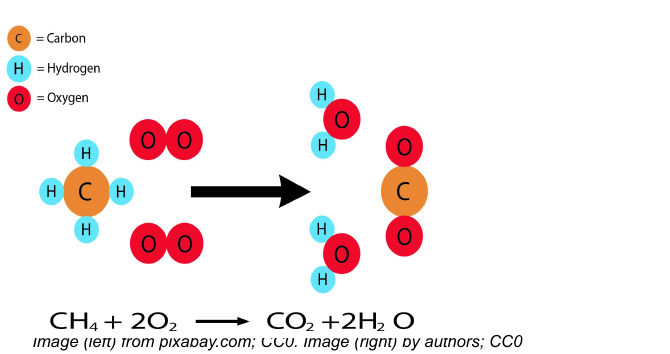
- Method: count the atoms of each element on both sides, pick an element that is unbalanced, change a coefficient, then recount. Repeat until every element matches. Example: CH₄ + 2O₂ → CO₂ + 2H₂O (methane burning). Another: Mg + 2HCl → MgCl₂ + H₂.
- State symbols show the physical state: (s) solid, (l) liquid, (g) gas and (aq) aqueous, which means dissolved in water. For example Mg(s) + 2HCl(aq) → MgCl₂(aq) + H₂(g).
- Check by counting every atom once more at the end. The word equation and the symbol equation must always say the same thing.
Balancing methane burning in oxygen
Think like a scientist: does the mass change?
- Question: does the total mass change when baking soda reacts with vinegar? A teacher runs this with small amounts and everyone wears eye protection.
- The independent variable is whether the container is open or sealed. The dependent variable is the mass shown on the balance before and after mixing.
- For a fair test use the same masses of baking soda, the same volume of vinegar, the same type of container and the same balance each time.
- A balance has a resolution: a reading of 34.0 g could really be anything from 33.95 g to 34.05 g. A change smaller than the resolution cannot be trusted. Repeat the test and compare.
- In an open flask the mass falls because carbon dioxide escapes. In a sealed bag the gas stays in, so the mass is unchanged. Both results fit the conservation of mass.
- Inquiry task: plan a safe investigation to show that no mass is lost when an effervescent tablet reacts in water. State your independent and dependent variables, three variables to control, how you will stop gas escaping, and how you will decide whether any small difference is real.
幻灯片
练习题
免费预览——54 题中的 8 题。注册即可查看全部。
1.How many atoms are there in one molecule of water, H₂O?
Easy- A2
- B3
- C1
- D18
2.What does the formula CO₂ tell us about one molecule of carbon dioxide?
Easy- AIt has 2 carbon atoms and 1 oxygen atom
- BIt has 1 carbon atom and 1 oxygen atom
- CIt has 12 carbon atoms
- DIt has 1 carbon atom and 2 oxygen atoms
3.In the formula H₂SO₄, which element has 4 atoms?
Easy- AOxygen
- BHydrogen
- CSulfur
- DNone of them
4.Which of these is the correct chemical symbol for sodium?
Easy- ASo
- BS
- CNa
- DN
5.O₂ is a compound.
EasyTrue or false?
6.Which of these substances is an element?
Easy- ACO₂
- BH₂O
- CCl₂
- DNaCl
7.Match each formula to the name of the substance.
Easy- H₂O
- CO₂
- CH₄
- NaCl
- Methane
- Sodium chloride
- Water
- Carbon dioxide
8.A reaction happens in a sealed container. How does the total mass of the products compare with the total mass of the reactants?
Easy- AIt is the same
- BIt is bigger, because new substances form
- CIt is smaller, because atoms are used up
- DIt depends on the colour of the products
历年真题
该知识点的历年真题练习即将推出。
即将推出