Air pollution, climate and evidence
边玩边学
回答这些题目来赚取能量,然后钓鱼探索。无需账号。
给教育者: 面向 Air pollution, climate and evidence(MYP Chemistry,Year 5)的即用型课程幻灯片, 复习笔记——用在你的课堂上,或将该知识点作为学习者可实时游玩的互动课堂活动来运行。
课程笔记
Big idea: air pollution, climate and evidence
- Key concept: Change. Combustion can produce greenhouse gases and air pollutants. Carbon dioxide contributes to warming through absorption and emission of infrared radiation; particulates affect air quality.
- Related concepts: Models and evidence. Use a scientific explanation to make predictions, then test it against observations.
- Global context: Scientific and technical innovation. Monitoring evidence informs decisions about transport and energy sources.
Composition of Air
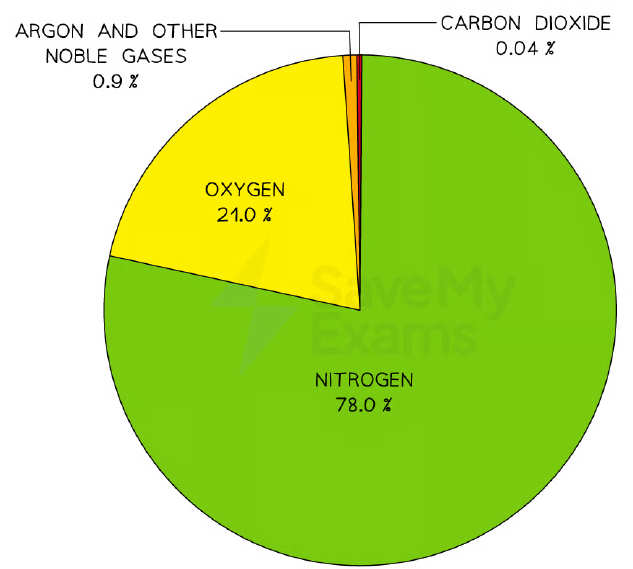
- Clean, dry air is approximately 78% nitrogen and 21% oxygen.
- The remaining 1% includes carbon dioxide and noble gases (e.g., argon).
- Atmospheric composition has changed over Earth's history; modern dry-air proportions are approximate and trace-gas concentrations vary.
Pie chart of the current atmosphere
Air Pollutants: Sources & Effects
- Carbon dioxide (CO₂): from complete combustion of fossil fuels; causes global warming.
- Carbon monoxide (CO): from incomplete combustion; toxic – binds to haemoglobin, preventing oxygen transport.
- Particulates (soot): from incomplete combustion; cause respiratory problems and cancer.
- Methane (CH₄): from animal digestion, decomposition, and landfill; a potent greenhouse gas.
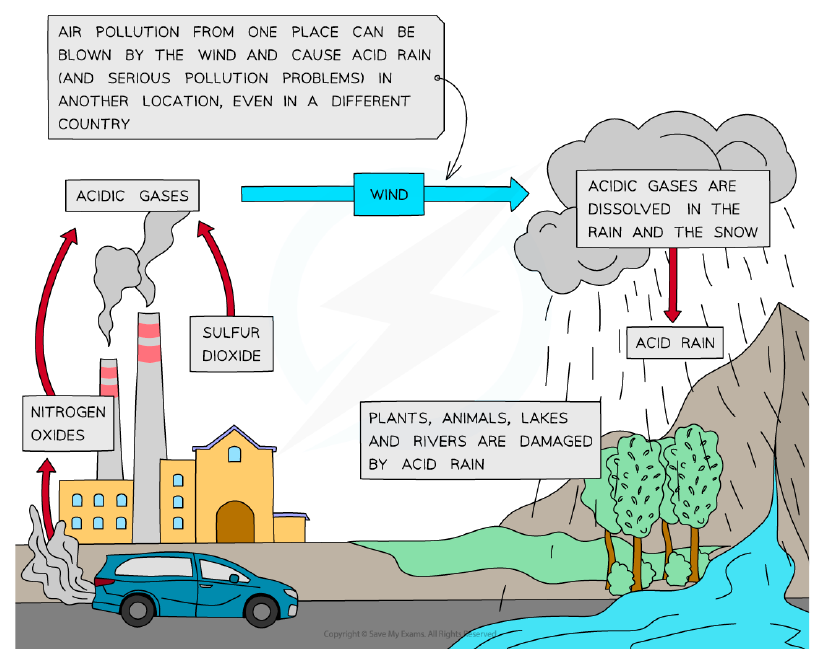
- Oxides of nitrogen (NOₓ): formed at high temperatures in car engines; cause acid rain and photochemical smog.
- Sulfur dioxide (SO₂): from burning sulfur-containing fossil fuels; causes acid rain.
How acid rain is produced
Complete vs Incomplete Combustion
- Complete combustion (excess O₂): produces CO₂ and H₂O only.
- Incomplete combustion (limited O₂): produces CO, H₂O, and sometimes carbon (soot).
- Example (complete): CH₄ + 2O₂ → CO₂ + 2H₂O.
- Example (incomplete): 2CH₄ + 3O₂ → 2CO + 4H₂O.
Greenhouse Effect & Global Warming
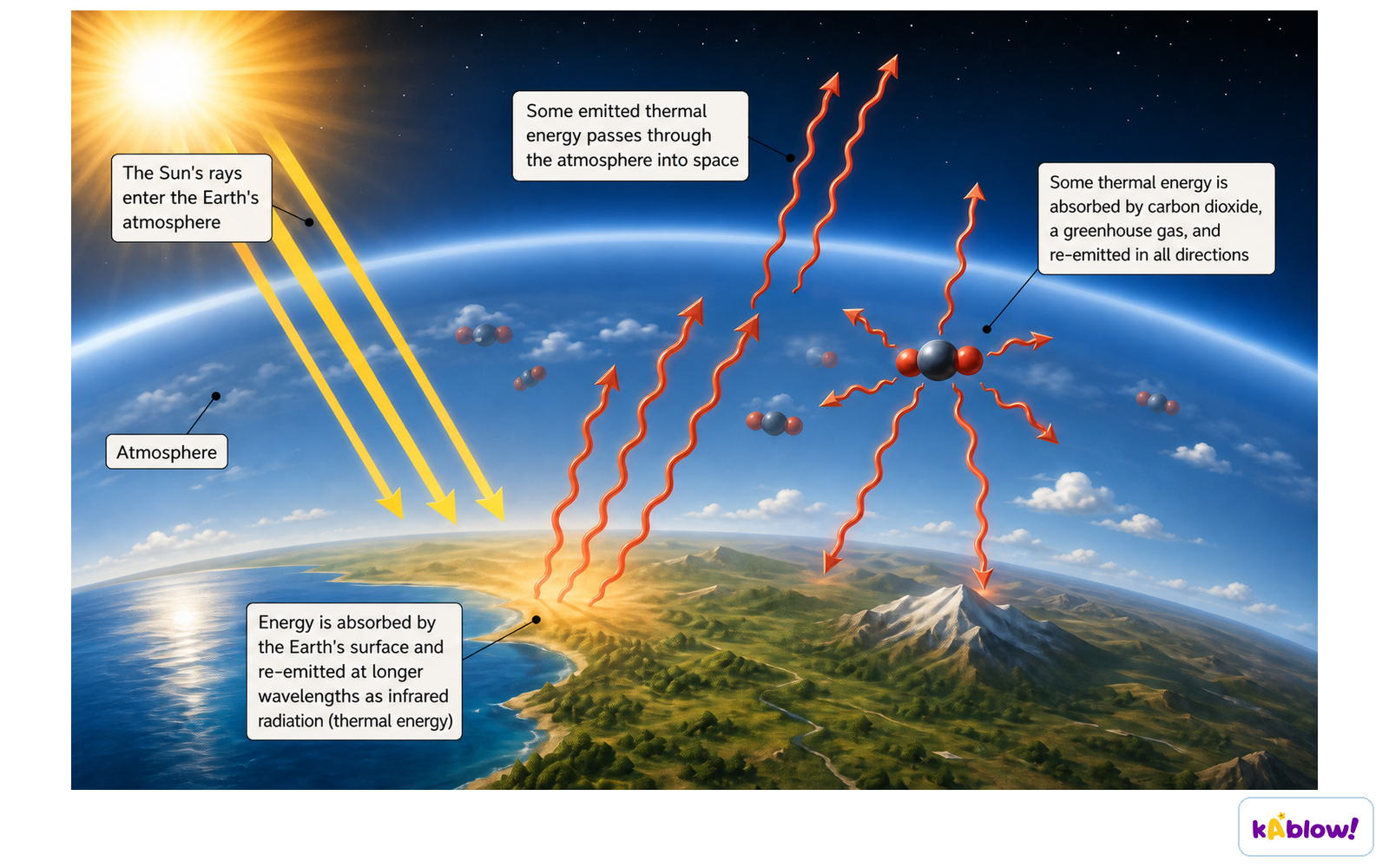
- The greenhouse effect is natural: greenhouse gases (CO₂, CH₄) trap thermal energy, keeping Earth warm.
- Enhanced greenhouse effect: increased greenhouse gas concentrations trap more heat, causing global warming.
- Consequences: climate change, rising sea levels (glacier melt), species extinction, habitat loss, disease spread.
Diagram showing how the greenhouse effect occurs
Reducing Climate Change
- Reduce CO₂ emissions: use renewable energy (solar, wind), fuel-efficient vehicles, public transport, recycling, and plant trees.
- Reduce methane emissions: reduce livestock farming (methane from digestion).
- Reduce deforestation and promote reforestation to absorb CO₂ via photosynthesis.
Reducing Acid Rain
- Acid rain is caused by SO₂ and NOₓ dissolving in rainwater.
- Use low-sulfur fuels to reduce SO₂ emissions.
- Flue gas desulfurisation: spray waste gases with lime slurry (CaO/CaCO₃) to remove 90–95% SO₂.
- Catalytic converters in vehicles remove NOₓ by reducing them to N₂.
Catalytic Converters
- Contain platinum and rhodium catalysts in a honeycomb to increase surface area.
- Oxidise CO to CO₂: 2CO + O₂ → 2CO₂.
- Reduce NOₓ to N₂: 2NO → N₂ + O₂; 2NO₂ → N₂ + 2O₂.
- Overall reaction: 2NO + 2CO → N₂ + 2CO₂.
- Unburned hydrocarbons are oxidised to CO₂ and H₂O.
Photosynthesis
- Endothermic reaction using light energy absorbed by chlorophyll.
- Reactants: carbon dioxide + water → Products: glucose + oxygen.
- Word equation: carbon dioxide + water → glucose + oxygen.
- Symbol equation: 6CO₂ + 6H₂O → C₆H₁₂O₆ + 6O₂.
- Conditions: light and chlorophyll.
Think like a scientist
- Use an existing monitoring dataset to compare particulate concentrations at two sites over the same dates.
- Comparison: the monitoring site. Outcome: particulate concentration in micrograms per cubic metre.
- Control: compare the same sampling periods and instrument method. Explain why this makes the comparison fairer.
- Evidence: Use a consistent method, repeated observations where appropriate and a table with labelled quantities and units. Keep unexpected results and investigate their cause.
- Safety: Practical activities need teacher supervision and an appropriate risk assessment. Use the provided data or simulation where the investigation specifies it.
- Inquiry task: State a testable question, predict the outcome using the science, then explain how your observations would support or challenge the prediction.
Evaluate the science
- Monitoring evidence informs decisions about transport and energy sources.
- A difference between sites does not alone identify its cause; traffic, weather and instrument placement may differ.
- Evaluation task: Link your conclusion to evidence, identify a limitation and suggest a specific improvement. Distinguish a measured result from an explanation of its cause.
幻灯片
练习题
免费预览——52 题中的 8 题。注册即可查看全部。
1.What is the approximate percentage of nitrogen in clean, dry air?
Easy- A78%
- B21%
- C50%
- D1%
2.Which gas is produced by the complete combustion of methane?
Easy- ACarbon dioxide
- BCarbon monoxide
- CSulfur dioxide
- DNitrogen dioxide
3.Which of the following is a greenhouse gas?
Easy- AMethane
- BOxygen
- CNitrogen
- DArgon
4.What is the main cause of acid rain?
Easy- AOxides of nitrogen and sulfur dioxide
- BCarbon dioxide and methane
- CCarbon monoxide and particulates
- DOzone and water vapor
5.In a catalytic converter, what is the function of the honeycomb structure?
Easy- ATo increase the surface area for catalytic reactions
- BTo filter out particulates
- CTo cool the exhaust gases
- DTo store unburnt fuel
6.Which of the following is a product of photosynthesis?
Easy- AGlucose
- BCarbon dioxide
- CWater
- DChlorophyll
7.Which process produces carbon monoxide?
Easy- AIncomplete combustion of fuels
- BComplete combustion of fuels
- CPhotosynthesis
- DRespiration
8.What is the main strategy to reduce sulfur dioxide emissions from power stations?
Easy- AFlue gas desulfurisation
- BUsing catalytic converters
- CPlanting more trees
- DReducing livestock farming
历年真题
该知识点的历年真题练习即将推出。
即将推出