Current, voltage and resistance
边玩边学
回答这些题目来赚取能量,然后钓鱼探索。无需账号。
给教育者: 面向 Current, voltage and resistance(MYP Physics,Year 2)的即用型课程幻灯片, 复习笔记——用在你的课堂上,或将该知识点作为学习者可实时游玩的互动课堂活动来运行。
课程笔记
Big idea: a system that moves energy
- Big idea. Key concept: Systems. A circuit is a system in which a cell, wires and components work together to move energy.
- Related concept: Function. Each part has a job: the cell gives energy, the wires carry the charge, a resistor or lamp transfers the energy, and meters measure what is happening.
- Global context: Scientific and technical innovation. Phones, torches and hospital equipment all depend on people understanding current, voltage and resistance.
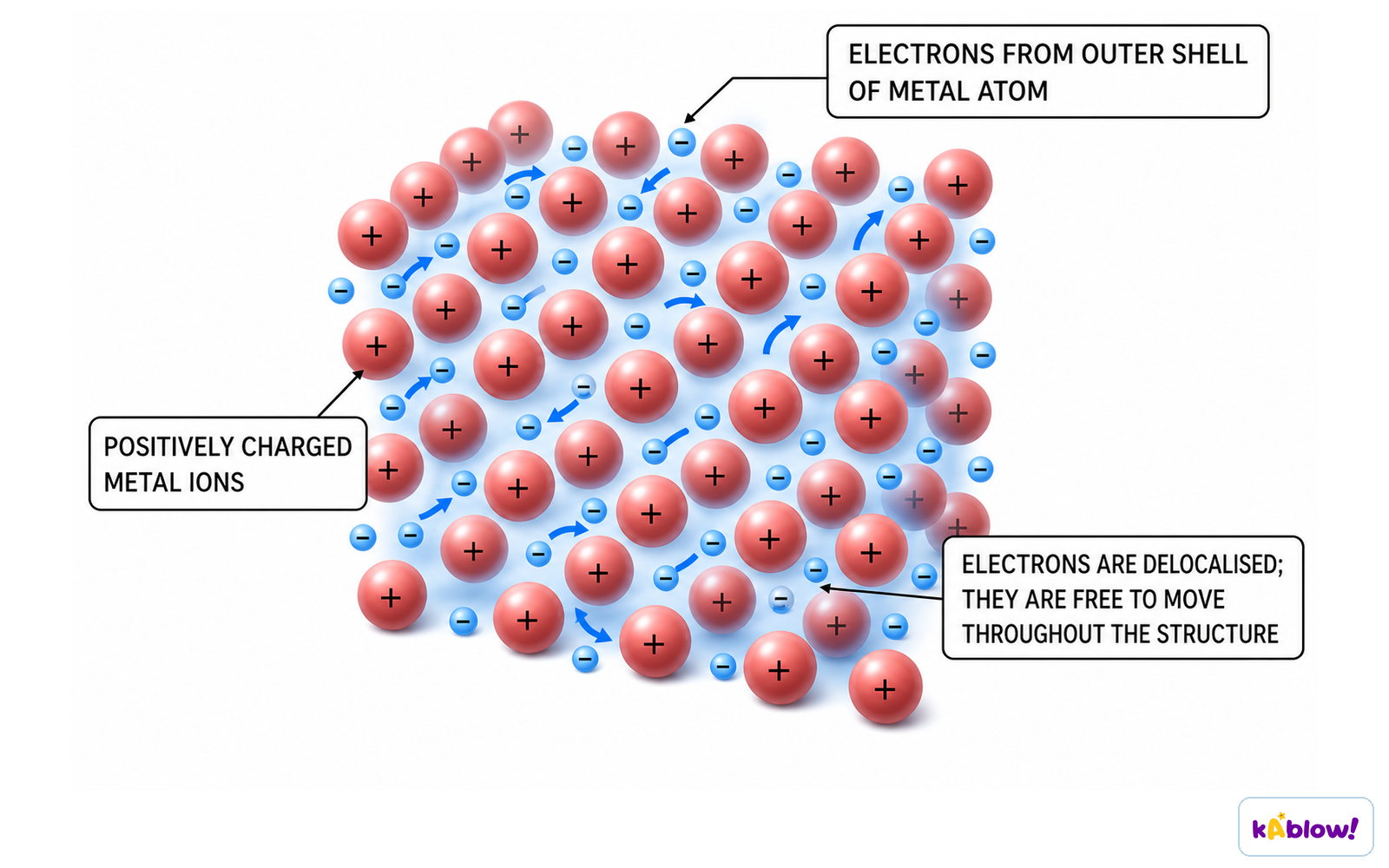
- Electric current is the flow of electric charge. In a metal the charge is carried by free electrons that drift round the circuit. Current is measured in amperes (A).
- Charge is measured in coulombs (C). The link is: charge = current × time, or Q = I \times t. A current of 2.0 A for 30 s moves 2.0 A × 30 s = 60 C of charge.
- Current is not used up. The same current flows out of a cell and back into it. What the components use up is energy.
Free electrons in a metal
Potential difference, meters and safety
- Potential difference (p.d.), often called voltage, tells us how much energy each coulomb of charge gets from the cell or gives to a component. It is measured in volts (V).
- A cell gives energy to the charge. A lamp or resistor transfers that energy to the surroundings as light and heat, so there is a p.d. across it.
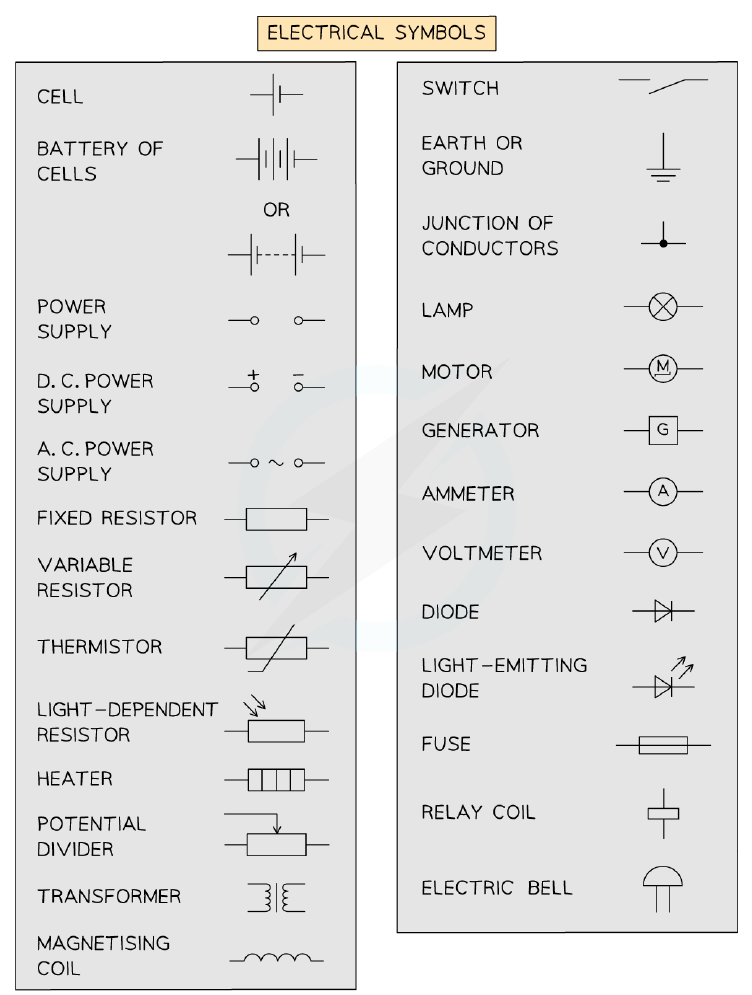
- An ammeter measures current. It is connected in series, so all the current flows through it. Its symbol is a circle with an A.
- A voltmeter measures p.d. It is connected in parallel, across the component. Its symbol is a circle with a V.
- Other symbols to know: a fixed resistor is a rectangle, a variable resistor is a rectangle with an arrow through it, and a fuse is a rectangle with a line through the middle.
- Stay safe. In school we use low-voltage cells and bulbs. Never touch mains sockets or plugs, never push anything into a socket, and keep water away from electricity.
Circuit symbols
Resistance and what changes it
- Resistance is how much a component opposes the flow of current. It is measured in ohms (Ω).
- In a metal, the moving electrons keep colliding with the ions in the lattice. The more collisions, the higher the resistance, and the more energy is transferred to the wire as heat.
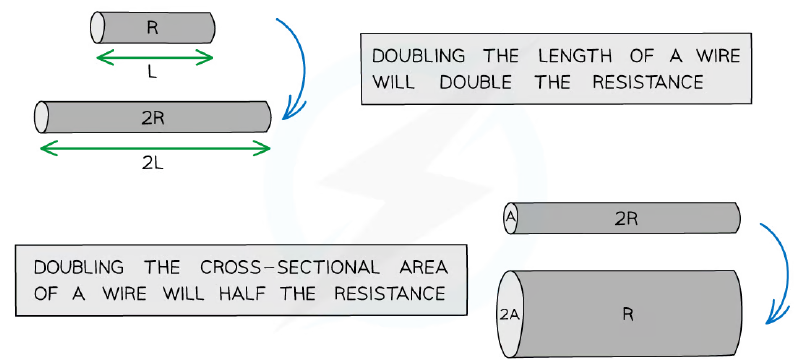
- A longer wire has a higher resistance. Doubling the length doubles the resistance.
- A thicker wire (larger cross-sectional area) has a lower resistance. Doubling the area halves the resistance.
- Heating a metal wire makes its ions vibrate more, so its resistance goes up.
- For the same cell, a bigger resistance means a smaller current. That is why a long thin wire gives a dim lamp.
How length and thickness change resistance
Ohm's law
- The three quantities are linked by Ohm's law: potential difference = current × resistance, or V = I \times R.
- Rearranged: current = potential difference ÷ resistance (I = V / R) and resistance = potential difference ÷ current (R = V / I).
- Worked example: a 12 V cell is joined to a 24 Ω resistor. The current is I = V ÷ R = 12 V ÷ 24 Ω = 0.50 A.
- Always write the unit with every answer, and check that p.d. is in volts, current in amperes and resistance in ohms before you calculate.
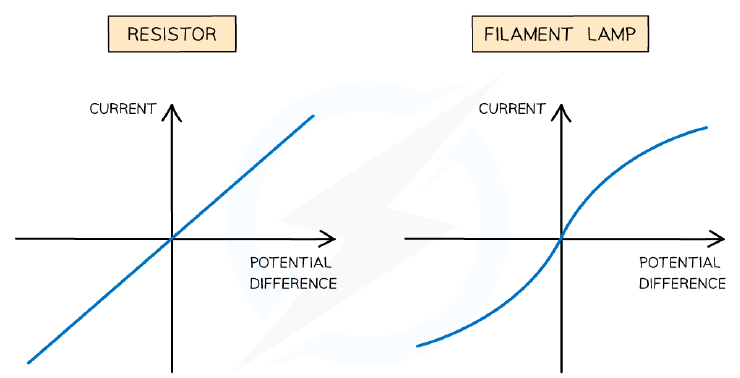
- For a fixed resistor at constant temperature, current is proportional to p.d.: doubling the p.d. doubles the current. Its current-voltage graph is a straight line through the origin.
- A filament lamp gives a curve. As the filament gets hotter its resistance rises, so the current rises more slowly than the p.d.
Current-voltage graphs: resistor and filament lamp
Series and parallel circuits
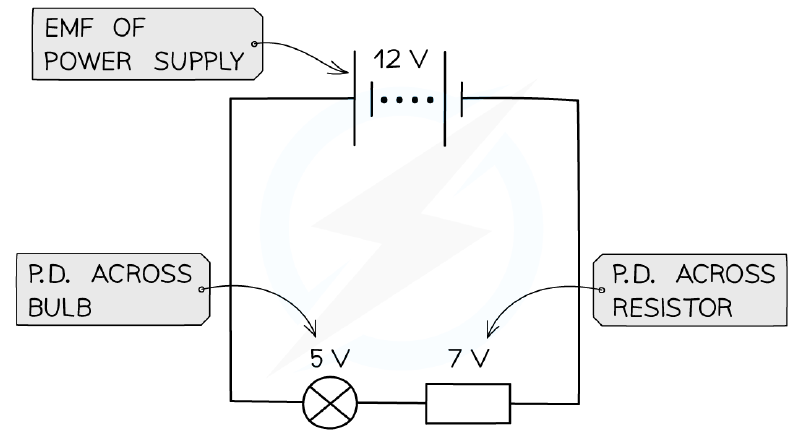
- In a series circuit there is one loop. The current is the same at every point. The cell's p.d. is shared: the p.d.s across the components add up to the cell's p.d. The total resistance is the sum of the resistances.
- Example: in a series circuit a 12 V cell gives 5 V across a lamp, so the other component has 12 V − 5 V = 7 V across it.
- Example: a 10 Ω and a 20 Ω resistor in series have a total resistance of 10 Ω + 20 Ω = 30 Ω. With a 6.0 V cell the current is 6.0 V ÷ 30 Ω = 0.20 A.
- In a parallel circuit the current splits into branches. Each branch has the same p.d. as the cell. The branch currents add up to the current from the cell: 0.50 A + 0.25 A = 0.75 A.
- Adding another branch gives the charge one more path, so the total current from the cell rises, but the lamps already there keep the same p.d. and stay just as bright.
- If one lamp fails in a parallel circuit the other branches keep working. That is why the lights in a house are wired in parallel.
A series circuit with p.d.s that add to the supply
Think like a scientist: how does wire length change resistance?
- Question: how does the length of a resistance wire affect its resistance?
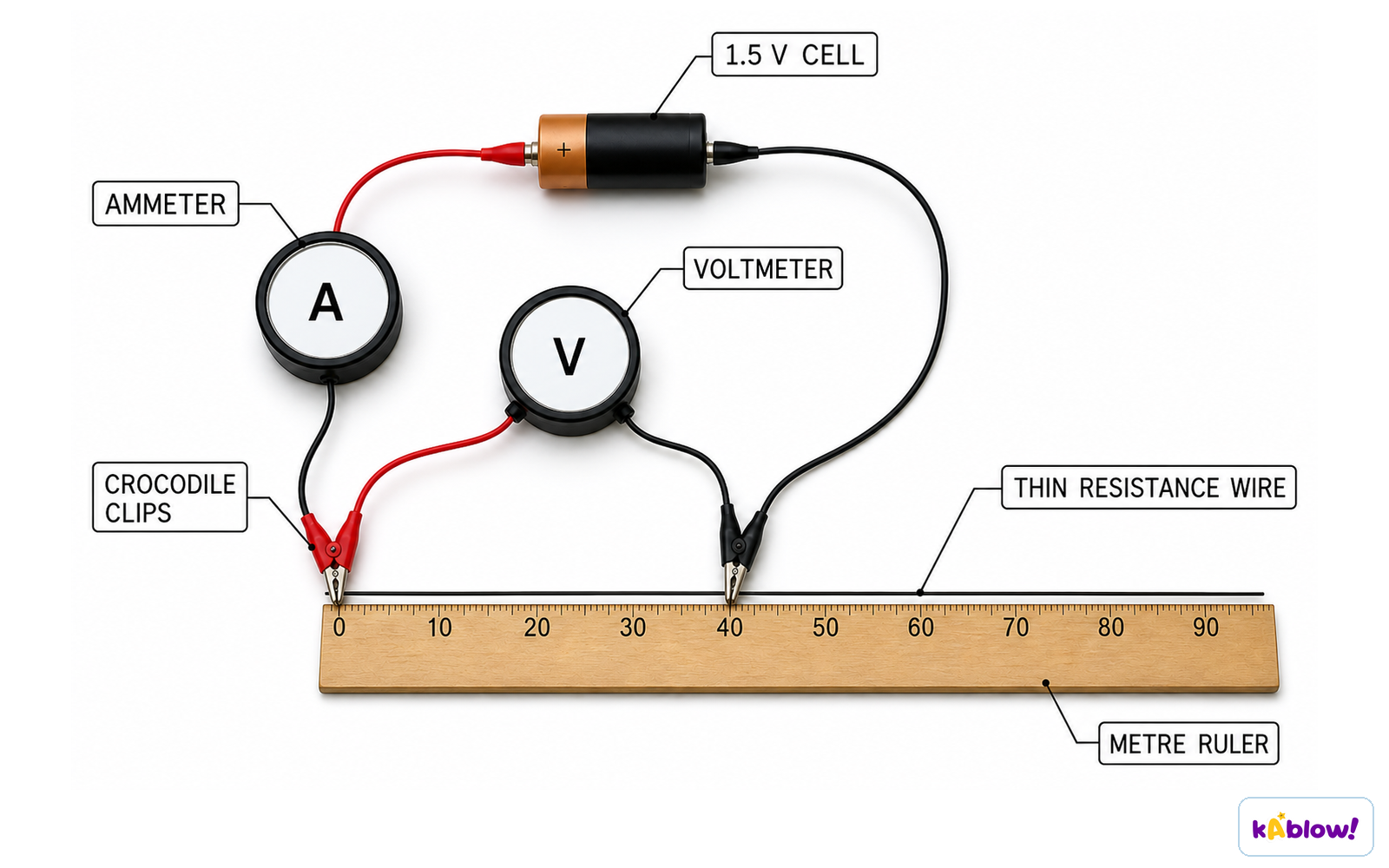
- Set up a 1.5 V cell, an ammeter in series and a voltmeter in parallel across the part of the wire you are testing. Move a crocodile clip to change the length. Use low-voltage cells only, and switch off between readings so the wire does not get hot.
- The independent variable is the length of wire. The dependent variable is the resistance, worked out from R = V / I. Control variables include the same wire, the same cell and the same temperature.
- Repeat each length and find a mean. Then plot resistance against length. A straight line through the origin means resistance is proportional to length.
- Evaluate your method. Did the wire warm up and change its resistance? Were the clips making good contact? How could you make the readings more reliable?
- Inquiry task: plan a fair test to find out whether the thickness of a wire changes its resistance. List the independent, dependent and control variables, say which meters you will use and how, and explain how you will keep the test safe.
Apparatus to measure the resistance of a wire
幻灯片
练习题
免费预览——52 题中的 8 题。注册即可查看全部。
1.What is electric current?
Easy- AThe energy stored inside a cell
- BThe push a cell gives to the charge
- CA flow of electric charge round a circuit
- DHow hard it is for charge to flow
2.Which unit is used to measure potential difference?
Easy- AVolt (V)
- BAmpere (A)
- COhm (Ω)
- DCoulomb (C)
3.Which unit is used to measure resistance?
Easy- AVolt (V)
- BAmpere (A)
- CWatt (W)
- DOhm (Ω)
4.Which meter measures the potential difference across a lamp?
Easy- AAn ammeter
- BA voltmeter
- CA newton meter
- DA thermometer
5.An ammeter is connected in series with the component it measures.
EasyTrue or false?
6.Match each quantity to its unit.
Easy- Current
- Potential difference
- Resistance
- Charge
- Coulomb (C)
- Volt (V)
- Ampere (A)
- Ohm (Ω)
7.In a series circuit, how does the current at one point compare with the current at another point?
Easy- AIt is biggest next to the cell
- BIt is the same at every point
- CIt is used up by each lamp in turn
- DIt splits into equal parts
8.Complete the sentence about units.
EasyPotential difference is measured in ____.
历年真题
该知识点的历年真题练习即将推出。
即将推出