Work, energy and power
边玩边学
回答这些题目来赚取能量,然后钓鱼探索。无需账号。
给教育者: 面向 Work, energy and power(MYP Physics,Year 2)的即用型课程幻灯片, 复习笔记——用在你的课堂上,或将该知识点作为学习者可实时游玩的互动课堂活动来运行。
课程笔记
Big idea: work is energy being transferred
- Big idea (key concept): Change. Whenever something speeds up, is lifted or heats up, energy has been transferred. Work and power let us measure how much changes and how fast.
- Related concept: Energy. Energy is measured in joules (J). A transfer of energy by a force is called work done.
- Global context: Globalization and sustainability. The world uses energy at a huge rate, so we compare machines by how much energy they transfer and how quickly.
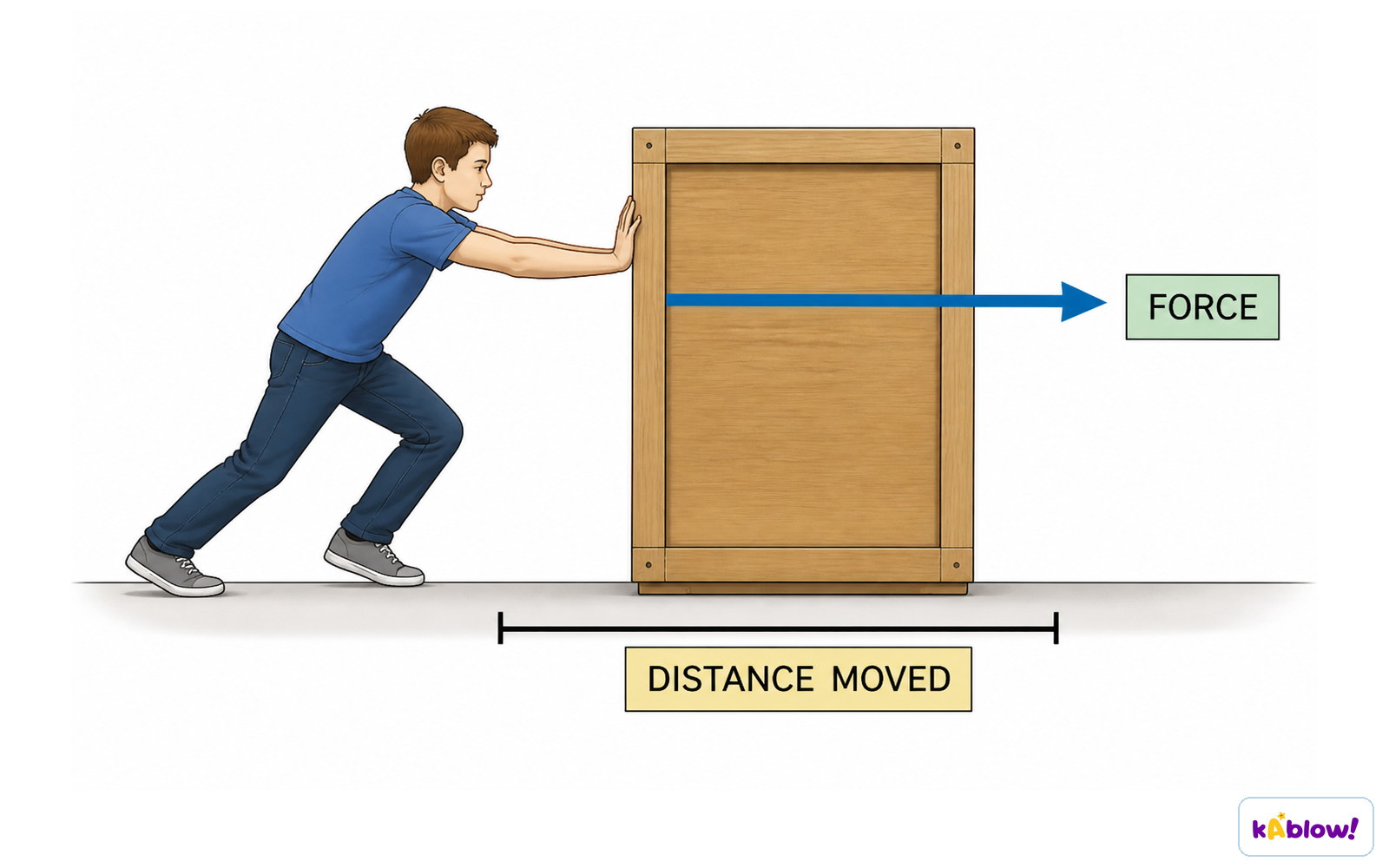
- In physics work is done when a force moves an object through a distance. Pushing a box across the floor does work. Holding a heavy box still does no work on the box, because it does not move.
- The energy transferred to the box is equal to the work done on it: if you do 100 J of work on the box, 100 J of energy is transferred.
A person pushing a box with the force and distance moved marked
Calculating work done
- The equation in words: work done = force x distance moved in the direction of the force.
- In symbols: W = F \times d . Work is in joules (J), force in newtons (N) and distance in metres (m). So 1 J = 1 N x 1 m.
- Worked example: a force of 20 N pushes a box 5 m. Work done = 20 N x 5 m = 100 J.
- Rearranging: force = work done / distance, and distance = work done / force.
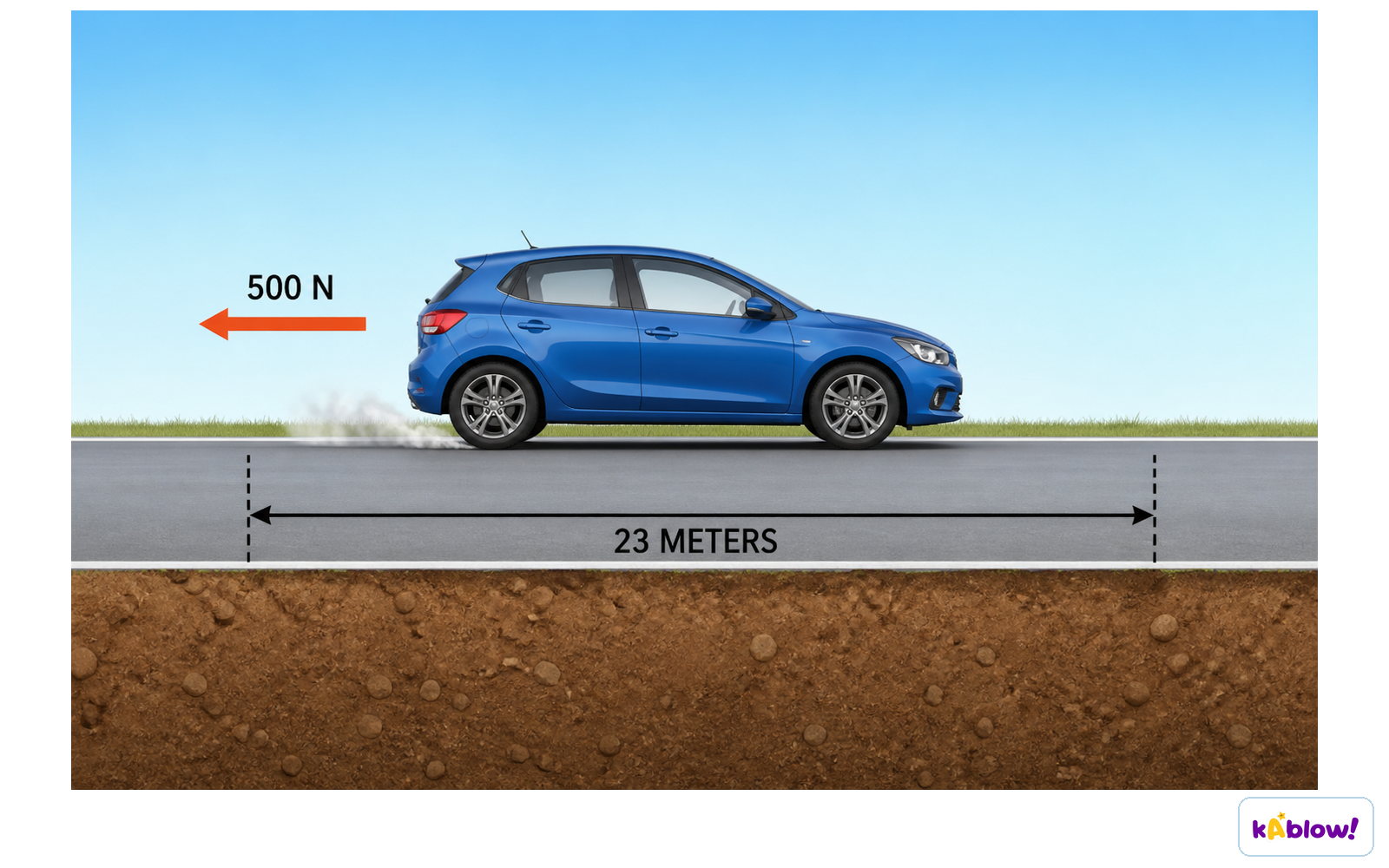
- Worked example (braking): the brakes of a car apply a force of 500 N while the car travels 23 m. Work done by the brakes = 500 N x 23 m = 11 500 J. This is the energy transferred away from the car's kinetic store.
- Always write the unit with your answer.
A braking force of 500 N acting over a distance of 23 m
Power: how fast energy is transferred
- Power is the rate at which energy is transferred, or the rate at which work is done.
- The equation in words: power = energy transferred / time taken. In symbols: P = E / t .
- Power is measured in watts (W). 1 W = 1 J/s. A larger unit is the kilowatt: 1 kW = 1000 W.
- Worked example: a motor transfers 3000 J in 60 s. Power = 3000 J / 60 s = 50 W.
- Rearranging: energy = power x time, and time = energy / power. A 60 W lamp left on for 120 s transfers 60 W x 120 s = 7200 J.
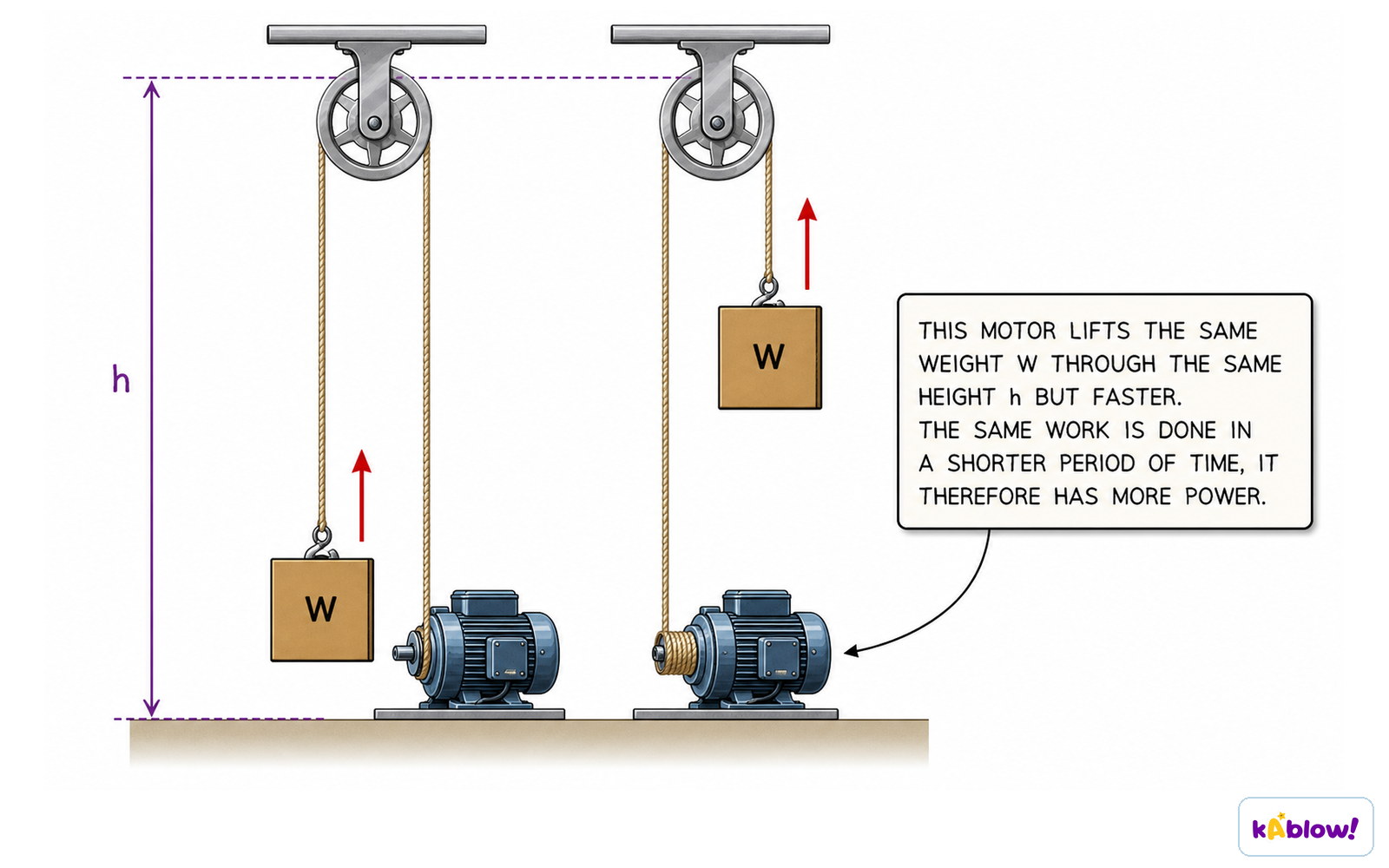
- Two motors can do the same work, but the one that does it in less time has more power. A more powerful machine transfers more energy each second.
Two motors lift the same weight through the same height
Kinetic and gravitational potential energy
- Moving objects have energy in their kinetic store: kinetic energy = 1/2 x mass x speed x speed, or Ek = \tfrac{1}{2} m v2 . Mass is in kg and speed in m/s.
- Worked example: a 2 kg trolley moving at 3 m/s has kinetic energy = 1/2 x 2 x 3 x 3 = 9 J.
- Because speed is squared, doubling the speed makes the kinetic energy 4 times bigger. Doubling the mass only doubles it.
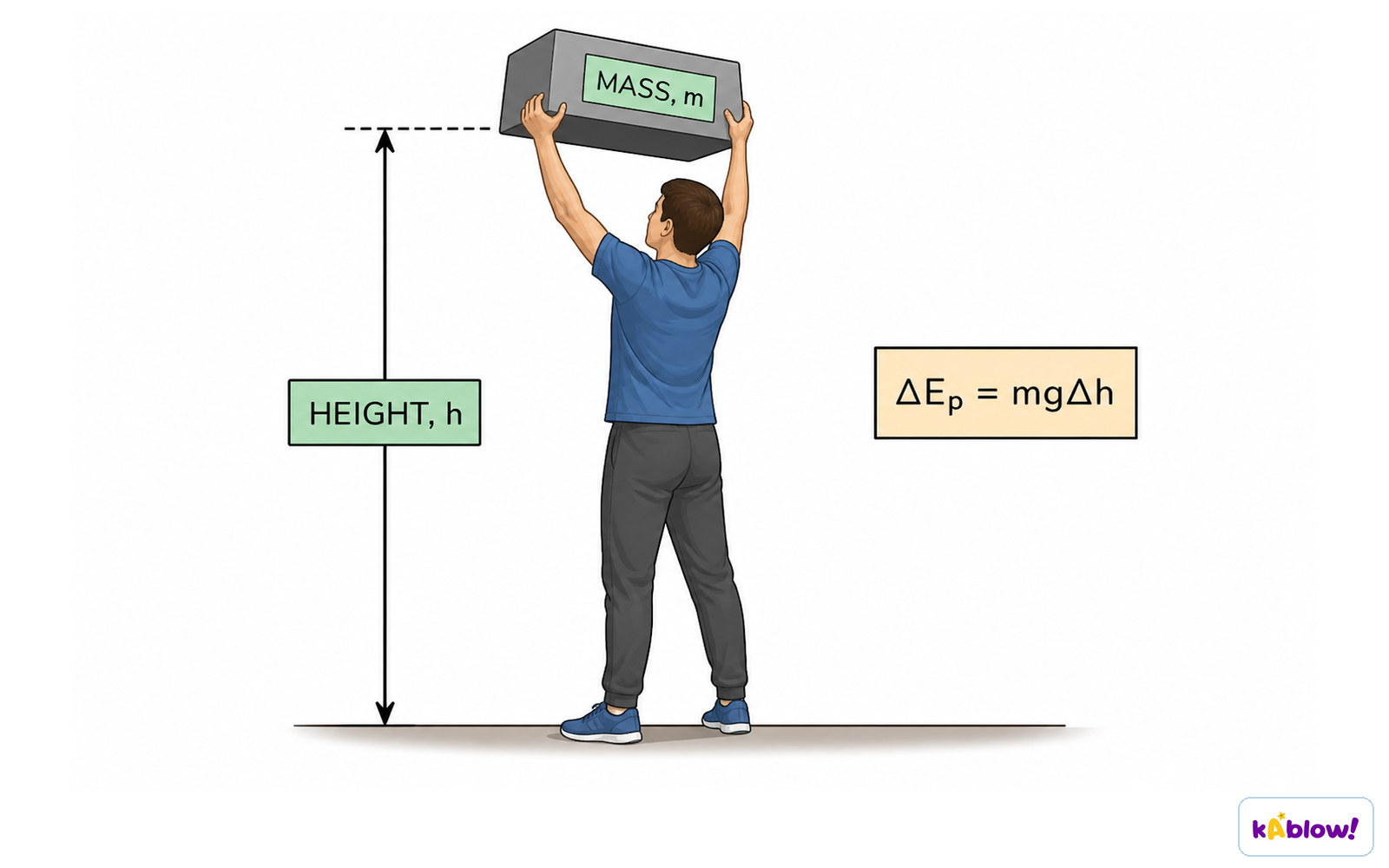
- Raised objects have energy in their gravitational potential store: change in energy = mass x g x change in height, or \Delta Ep = m g \Delta h . We use g = 10 N/kg on Earth.
- Worked example: a 5 kg box is lifted 4 m. Energy gained = 5 kg x 10 N/kg x 4 m = 200 J.
- Lifting the box needs a force equal to its weight (5 kg x 10 N/kg = 50 N), so the work done is 50 N x 4 m = 200 J: the same answer, because work done on the box is the energy transferred to it.
Lifting a mass through a height raises its gravitational store
Energy changes and efficiency
- Work done changes energy between stores. A falling object loses gravitational energy and gains kinetic energy. If we ignore air resistance, gravitational energy lost = kinetic energy gained.
- Worked example: a ball is dropped from 5 m. 1/2 x m x v x v = m x 10 x 5, so v x v = 100 and the speed at the bottom is 10 m/s. The mass cancels out.
- When brakes stop a car, the work done by the braking force transfers the car's kinetic energy to the thermal stores of the brakes, tyres and road.
- Real machines waste some energy. Efficiency = useful output energy / total input energy x 100%.
- Worked example: a motor takes in 500 J of electrical energy and does 350 J of useful work. Efficiency = 350 / 500 x 100% = 70%.
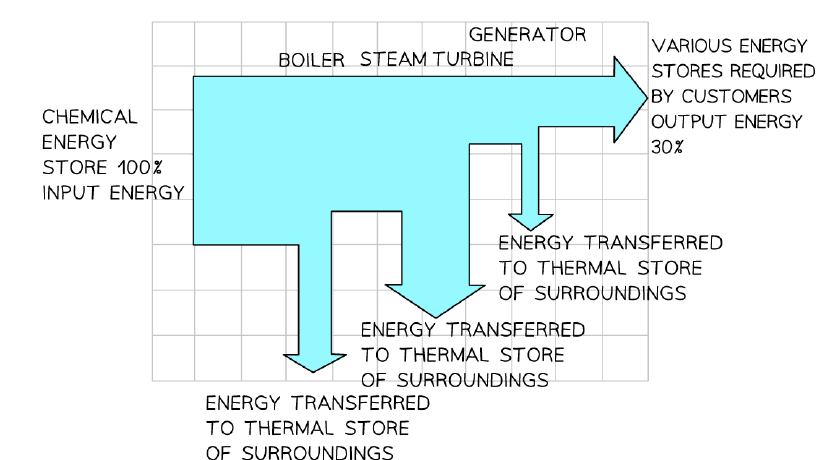
- A Sankey diagram shows the input energy splitting into useful and wasted outputs. In the coal power station shown, only about 30% of the input energy ends up as useful electrical energy.
Sankey diagram for a coal-fired power station
Think like a scientist: whose legs are the most powerful?
- A class compares the power of students by timing how long each takes to run up the same flight of stairs.
- Each student's power = (mass x 10 N/kg x height of the stairs) / time taken. The work done is the weight lifted through the height.
- The independent variable is the student. The dependent variable is the time taken. Control variables: the same staircase and the same starting and finishing lines.
- The students must be safe: wear sensible footwear, use a clear staircase and do not rush on wet surfaces. Nobody should be pressured to take part.
- Repeat each run at least 3 times and calculate the mean time, because one run may be affected by a slip or a late stopwatch click.
- Inquiry task: calculate each student's power in watts. Is the student who is fastest also the most powerful? Why might a heavier student with the same time have more power? How would you improve the method?
幻灯片
练习题
免费预览——53 题中的 8 题。注册即可查看全部。
1.In physics, when is work done?
Easy- AWhen a force moves an object through a distance
- BWhen a person feels tired
- CWhen an object has a large mass
- DWhen an object is held in one place
2.Which equation gives work done?
Easy- Awork done = force / distance
- Bwork done = force + distance
- Cwork done = force x distance moved
- Dwork done = force x time
3.Which unit is used to measure work done?
Easy- AWatt (W)
- BJoule (J)
- CNewton (N)
- DMetre (m)
4.What is power?
Easy- AThe total energy stored in an object
- BThe force needed to move an object
- CThe distance an object moves each second
- DThe rate at which energy is transferred
5.Which unit is used to measure power?
Easy- AWatt (W)
- BJoule (J)
- CNewton (N)
- DKilogram (kg)
6.A kettle is rated at 2 kW. How many watts is this?
Easy- A20 W
- B2000 W
- C200 W
- D20 000 W
7.Which two things does the kinetic energy of an object depend on?
Easy- AIts height and its mass
- BIts height and its speed
- CIts mass and its speed
- DIts volume and its temperature
8.Which two things does the gravitational potential energy of an object depend on (on Earth)?
Easy- AIts mass and its height
- BIts speed and its mass
- CIts speed and its height
- DIts shape and its colour
历年真题
该知识点的历年真题练习即将推出。
即将推出