Carbohydrates & Lipids
边玩边学
回答这些题目来赚取能量,然后钓鱼探索。无需账号。
课程笔记
Properties of Carbon
- Carbon is present in all four major categories of biological molecules: carbohydrates, lipids, proteins and nucleic acids — this is why life is described as carbon based.
- Carbon has four electrons in its outer shell, so each atom can form four covalent bonds, allowing it to be part of large, stable molecules.
- Carbon forms millions of different covalently-bonded compounds, mainly with hydrogen and oxygen.
- Carbon can bond to other carbon atoms or to atoms such as hydrogen, nitrogen, oxygen and sulfur.
- Carbon can form long branched chains (e.g. glycogen), long straight chains (e.g. cellulose), single rings (e.g. pyrimidines) and multiple rings (e.g. starches and purines).
- Carbon produces a tetrahedral structure, giving varied carbon compounds different 3-D shapes and therefore different biological properties.
- Carbon atoms can form up to four single covalent bonds or a combination of double and single bonds, e.g. carbon dioxide contains two double bonds and methane contains four single bonds.
- Double and triple bonds can form with an adjacent carbon atom, allowing unsaturated compounds to form.
Macromolecules and Condensation
- Monomers are the smaller units from which larger molecules are made; polymers are molecules made from a large number of monomers joined together in a chain.
- Polymerisation is the process by which monomers join to form polymers.
- Macromolecules are very large molecules containing 1000 or more atoms, so they have a high molecular mass.
- Polymers can be macromolecules, but not all macromolecules are polymers — polymers must consist of many repeating subunits; lipids are not polymers because they do not consist of repeating monomers.
- Key monomer–macromolecule pairs: polysaccharides from monosaccharides, lipids from fatty acids, glycerol and phosphate groups, polypeptides from amino acids, and nucleic acids from nucleotides.
- Macromolecules are formed during condensation reactions, in which molecules combine, forming covalent bonds, and water is removed.
- In polysaccharide formation, two hydroxyl (OH) groups on different monosaccharides interact to form a glycosidic bond.
- In nucleic acid formation, nucleotides join via condensation to form a phosphodiester bond between the phosphate group of one nucleotide and the pentose sugar of the next.
Hydrolysis of Polymers
- Macromolecules often need to be broken down into their monomers, e.g. during digestion.
- This is achieved by hydrolysis — 'lyse' (to break) and 'hydro' (with water).
- In hydrolysis, covalent bonds are broken when water is added; the -O and -OH from the water molecule form the functional groups of the products.
- Hydrolysis of glycosidic bonds in poly- or disaccharides produces monosaccharides.
- Hydrolysis of peptide bonds in polypeptides produces amino acids.
- Hydrolysis of ester bonds in triglycerides produces three fatty acids and glycerol.
Carbohydrates: Monosaccharides and Glucose
- The monomers of carbohydrates are monosaccharides; two can join to form a disaccharide, and many join to form a polysaccharide.
- Monosaccharides have the general formula CₙH₂ₙOₙ, where n is the number of carbon atoms (this formula applies only to monosaccharides).
- Monosaccharide properties: colourless crystalline molecules that are soluble in water.
- Monosaccharides vary in carbon number: triose (3C, e.g. glyceraldehyde), pentose (5C, e.g. ribose) and hexose (6C, e.g. glucose).
- Glucose has the molecular formula C₆H₁₂O₆; it is the most common monosaccharide and is of central importance to most forms of life.
- Glucose is the main substrate used in respiration, releasing energy for the production of ATP, and is produced during photosynthesis.
- Glucose exists as two structural isomers: α (α) glucose and β (β) glucose; this isomerism has far-reaching consequences on the functions of the polymers.
- Glucose properties: stable structure due to strong covalent bonds, soluble in water due to its polar nature, easily transportable, and a source of chemical energy when its covalent bonds are broken.
Polysaccharides: Starch, Glycogen and Cellulose
- Carbohydrates function as essential energy storage molecules and as structural molecules.
- Starch and glycogen are effective storage polysaccharides because they are compact (large quantities stored in a small space) and insoluble (so they do not lower the water potential of the cell).
- Starch is the storage polysaccharide of plants, stored as granules in chloroplasts, and is made of α glucose monomers.
- Starch is constructed from amylose (10–30%: unbranched helix-shaped chain with 1,4 glycosidic bonds) and amylopectin (70–90%: 1,4 and 1,6 glycosidic bonds, creating a branched molecule).
- Amylopectin's branches give many terminal glucose molecules that can be easily hydrolysed for respiration or added to for storage.
- Glycogen is the storage polysaccharide of animals and fungi, made of α glucose joined by 1,4 and 1,6 glycosidic bonds; it is more branched than amylopectin, providing more free ends for rapid hydrolysis.
- Glycogen is stored as visible granules in liver and muscle cells, enabling high rates of cellular respiration to supply the higher metabolic needs of animal cells.
- Cellulose is a structural carbohydrate found in plant cell walls; it is a straight, unbranched polymer of β glucose monomers.
- In cellulose, every alternate β-glucose molecule must invert (flip upside down) to form glycosidic bonds; this alternating pattern allows hydrogen bonding between strands, linking cellulose molecules into microfibrils that give structural strength.
Starch, glycogen and cellulose
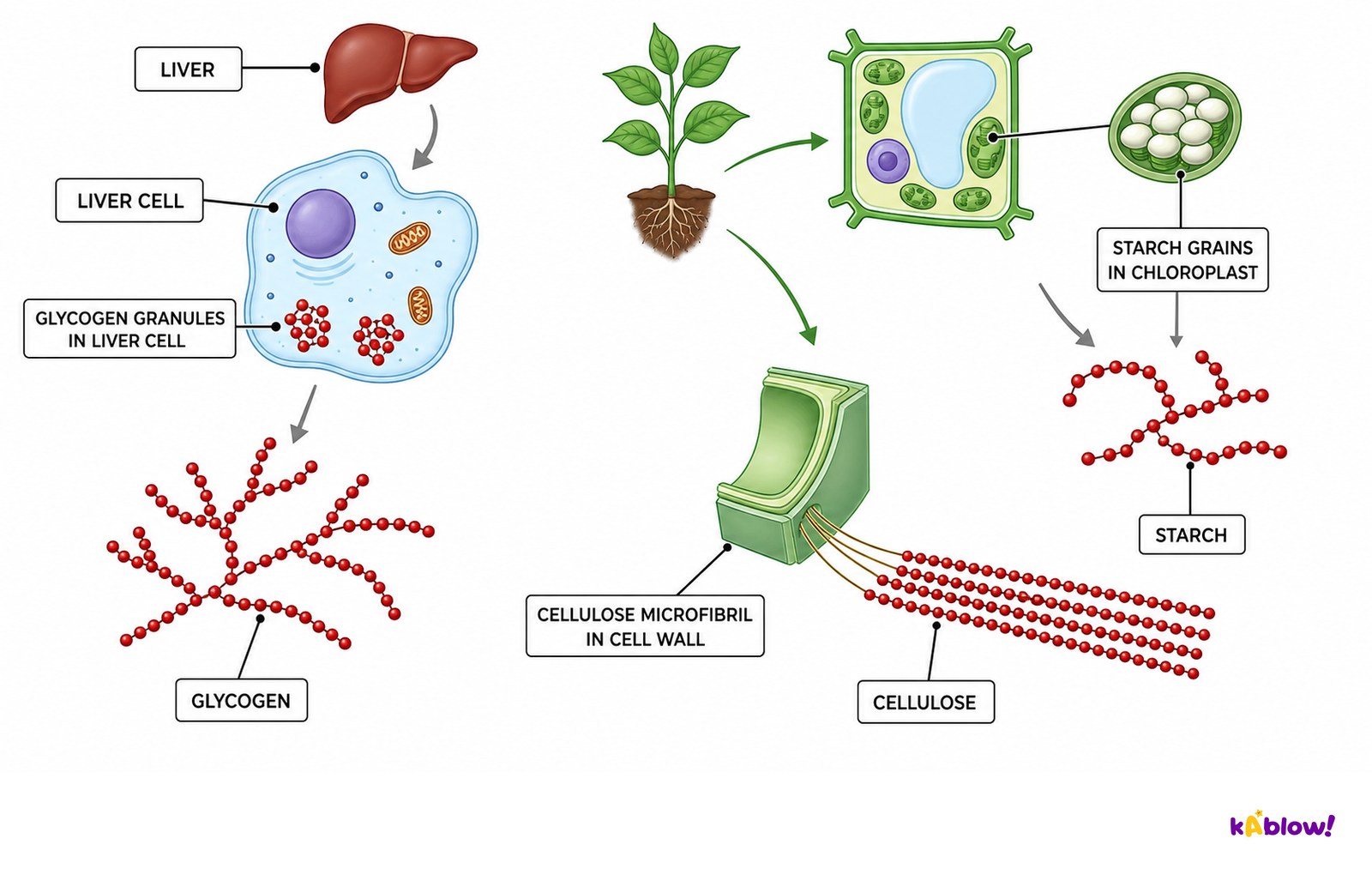
Role of Glycoproteins
- Carbohydrates and polypeptides can combine via covalent bonds to make glycoproteins, which are classed as proteins.
- Glycoproteins, along with glycolipids, form part of the structure of cell surface membranes.
- They act as receptor molecules in processes such as cell recognition and identification, receptors for cell signalling molecules (hormones and neurotransmitters), endocytosis, and cell adhesion and stabilisation.
- Glycoproteins can act as antigens identifying cells as 'self' or 'non-self'; cells recognised as non-self trigger an immune response.
- A person's ABO blood type is determined by glycoprotein antigens on the surface of their red blood cells: type A has type A antigens, type B has type B antigens, type AB has both, and type O has neither.
- Antibodies in the blood interact with glycoproteins if blood of the wrong type enters the body, e.g. a person with Type A antigens has anti-B antibodies.
- Incorrect blood transfusions can be fatal because antibodies cause the incorrect antigens from transfused blood to clump together, blocking blood vessels.
Lipids and Triglycerides
- Examples of lipids in living organisms are fats, oils, waxes and steroids; lipid macromolecules contain carbon, hydrogen and oxygen atoms.
- Lipids contain hydrocarbon molecules with many non-polar covalent bonds, making lipids insoluble in water or other polar solvents.
- In living organisms, lipid solubility can be improved by combining lipid molecules with other molecules, e.g. glycolipids and lipoproteins.
- Triglycerides form when three fatty acids join to one glycerol molecule.
- Triglycerides are formed by esterification: an ester bond forms when the hydroxyl (-OH) group of glycerol bonds with the carboxyl group (-COOH) of a fatty acid.
- The formation of an ester bond is a condensation reaction; for each ester bond formed a water molecule is released, so one triglyceride releases three water molecules.
- Lipids are energy-dense compared to carbohydrates due to their high number of C-H bonds, containing about 2× more energy per gram than most carbohydrates.
- Lipids are insoluble so are not easily transported around the body and remain in their storage cells; respiring lipids produces a lot of metabolic water (e.g. a camel's hump and a bird's egg yolk).
- In animals, lipids are stored in adipose tissue as subcutaneous fats (below the skin) and visceral fats (around major internal organs); adipose tissue can also act as a thermal insulator (e.g. blubber in seals and walruses).
Fatty Acids
- Both triglycerides and phospholipids contain glycerol with fatty acids attached; these have long hydrocarbon 'tails' containing hydrogen and carbon.
- Fatty acids occur in two forms: saturated and unsaturated; unsaturated fatty acids can be monounsaturated or polyunsaturated.
- In saturated fatty acids, all bonds between carbon atoms in the hydrocarbon tail are single bonds; the fatty acid is 'saturated' with hydrogen.
- Saturated fatty acids are straight molecules, so lipids containing them pack tightly together, increasing their melting point and making them solid at room temperature (e.g. fats in meat and butter).
- In unsaturated fatty acids, the hydrocarbon tail does not contain the maximum number of hydrogen atoms possible; each carbon in a C=C double bond bonds to only one hydrogen instead of two.
- Double bonds can cause the hydrocarbon tail to kink or bend, so unsaturated fatty acids cannot pack as tightly together and fats containing them are often liquids at room temperature.
- A fatty acid with one C=C double bond is a monounsaturated fatty acid; lipids containing them have a lower melting point and form liquid oils.
- Fatty acids with many C=C double bonds are polyunsaturated fatty acids; lipids containing them also have a low melting point and form oils used for energy storage in plants.
Phospholipids and Membranes
- Phospholipids are formed from glycerol and fatty acids, but contain only two fatty acids bonded to glycerol, as the third has been replaced by a phosphate ion (PO₄³⁻).
- The phosphate head is polar, so it is soluble in water (hydrophilic); the fatty acid tails are non-polar and insoluble in water (hydrophobic).
- Molecules with both hydrophobic and hydrophilic regions are said to be amphipathic.
- Phospholipids form the basic structure of the cell membrane as a phospholipid bilayer, with hydrophilic heads facing outwards and hydrophobic tails facing inwards.
- When placed in water, phospholipids can also form monolayers, with heads towards the water and tails away from it.
- The amphipathic nature of phospholipids means the bilayer acts as a barrier to most water-soluble substances; the non-polar tails prevent polar molecules or ions from passing between them.
- Small, non-polar molecules such as O₂ and CO₂ are soluble in the lipid bilayer and can diffuse across cell membranes quickly without transport proteins.
- Steroid hormones (e.g. oestradiol and testosterone, formed from cholesterol) can cross the lipid bilayer due to their lipid structure and travel into cells and nuclei, where they alter and direct transcription.
幻灯片
练习题
免费预览——60 题中的 8 题。注册即可查看全部。
1.Which of the following bonds link two monosaccharides together to form a disaccharide?
Easy- AHydrogen
- BEster
- CGlycosidic
- DPeptide
2.Which of the following statements does not refer to a property of carbon that allows it to play an integral biochemical role in the molecules of living things?
Easy- AIt has four electrons in its outer shell meaning it can form four covalent bonds with other atoms
- BWhen it bonds with hydrogen it creates a dipole that allows it to form hydrogen bonds with water and other polar molecules
- CIt can form double and triple bonds with adjacent carbon atoms to allow unsaturated compounds to form
- DIt produces a tetrahedral-shaped structure which allows the formation of varied carbon compounds which have different 3-D shapes
3.Which of the following features does not explain why lipids are excellent long-term storage compounds?
Easy- AThey can be saturated or unsaturated
- BLess body mass is required to store a given amount of energy
- CThey are insoluble and will not affect the osmolarity of the cell
- DLipids are energy dense molecules
4.Which of the following are involved in the formation of lipids? I. condensation II. amino acids III. hydrolysis IV. fatty acids
Easy- AI and II
- BI and IV
- CII and III
- DII, III and IV
5.Which property of carbon makes it a good basis for organic molecules?
Easy- AIt exists in hard and stable forms like graphite and diamond.
- BIt forms a varying number of covalent bonds to other atoms.
- CIt can form millions of different compounds in association with hydrogen and oxygen.
- DIt forms strong, ionic bonds with other atoms.
6.The molecular structure of starch makes it suited to its function. Which statement best explains why?
Medium- AMany condensation reactions, in the breakdown of amylose and amylopectin, release stored energy.
- BMany hydrolysis reactions, in the formation of amylose and amylopectin, allow the release of stored energy to fuel cellular processes.
- CAmylose has a branched structure and amylopectin is coiled to give a compact structure for transport around the plant through the phloem.
- DThe amylose-amylopectin complex is insoluble, so it does not affect the osmolarity of the cell.
7.Which of the following statements correctly describes a feature of carbohydrates OR lipids?
Medium- AGlycosidic bonds form during hydrolysis reactions, joining monosaccharides together to form disaccharides and polysaccharides.
- BA triglyceride is an example of a polymer as it is formed from many smaller, repeating subunits joined together by covalent bonds.
- CA triglyceride is not an example of a polymer although it is formed from smaller subunits joined together.
- DGlycosidic bonds join disaccharides together to form monosaccharides and polysaccharides.
8.Which of the following occurs when sucrose is formed from monosaccharides?
Medium- ACondensation of glucose and fructose, using water.
- BCondensation of glucose and galactose, using water.
- CCondensation of glucose and fructose, releasing water.
- DCondensation of glucose and galactose, releasing water.