Cell & Nuclear Division
边玩边学
回答这些题目来赚取能量,然后钓鱼探索。无需账号。
课程笔记
Cell Division and the Cell Theory
- According to the cell theory, new cells are produced from pre-existing ones.
- A cell that divides is called a parent (or 'mother') cell; it produces two daughter cells.
- There are two types of cell division: one produces genetically identical daughter cells, the other produces genetically different cells.
- The type that produces genetically different cells is an important source of genetic variation within populations.
Cytokinesis
- During cell division, the nucleus divides first (nuclear division), then the cytoplasm divides in two – this is cytokinesis.
- In animal cells, a cleavage furrow forms at the equator; actin and myosin proteins form a contractile ring that pulls the plasma membrane inwards, separating the cell.
- In plant cells, a cell plate forms at the equator from vesicles carrying carbohydrates, lipids and proteins; it grows to the cell walls and new cell walls form.
- Cytokinesis usually divides the cytoplasm equally, producing daughter cells of similar size.
- Each daughter cell must receive at least one mitochondrion (and plant cells at least one chloroplast).
- Unequal cytokinesis occurs in oogenesis (forming a secondary oocyte and a polar body) and in budding yeast.
Nuclear Division: Mitosis vs Meiosis
- The nucleus of a eukaryotic cell can divide by mitosis or meiosis.
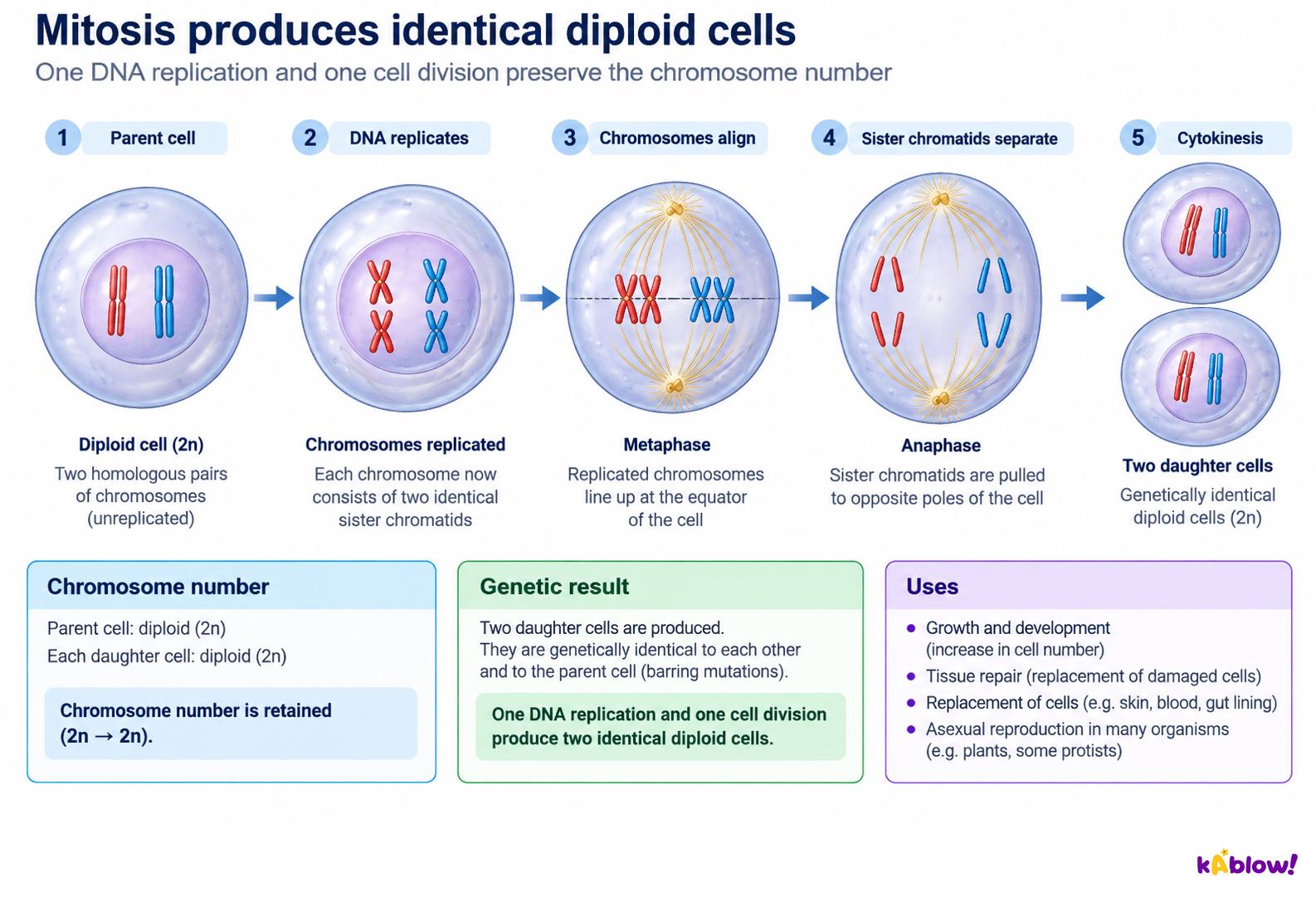
- Mitosis produces genetically identical cells and is used for growth, repair of damaged tissues, replacement of cells and asexual reproduction.
- Mitosis maintains the chromosome number and genome; daughter cells are usually diploid (2n).
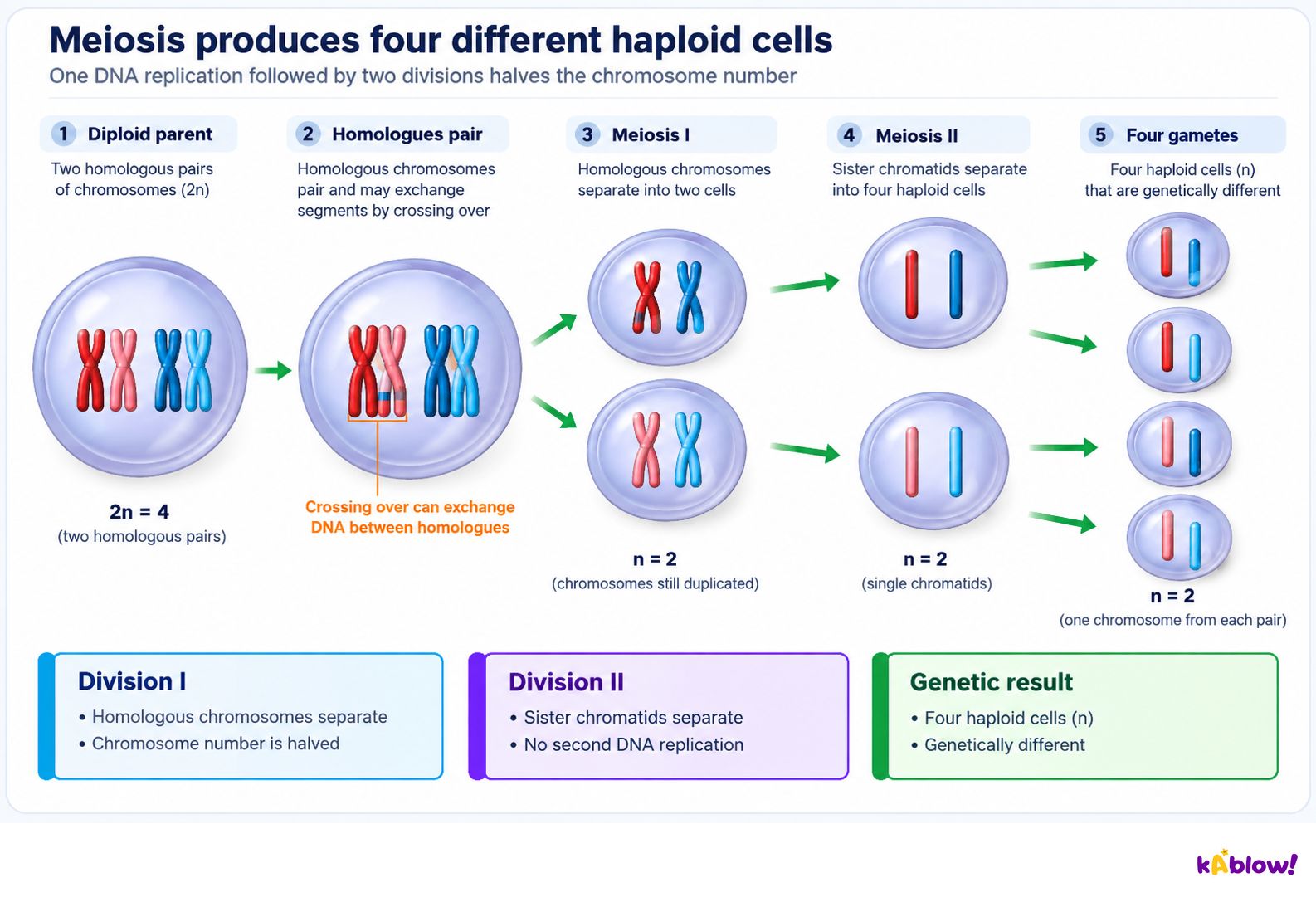
- Meiosis produces genetically different cells and is used to produce gametes (sex cells).
- Meiosis halves the chromosome number, producing haploid (n) cells.
- Meiosis is important for generating genetic diversity.
Meiosis
DNA Replication and Chromosome Structure
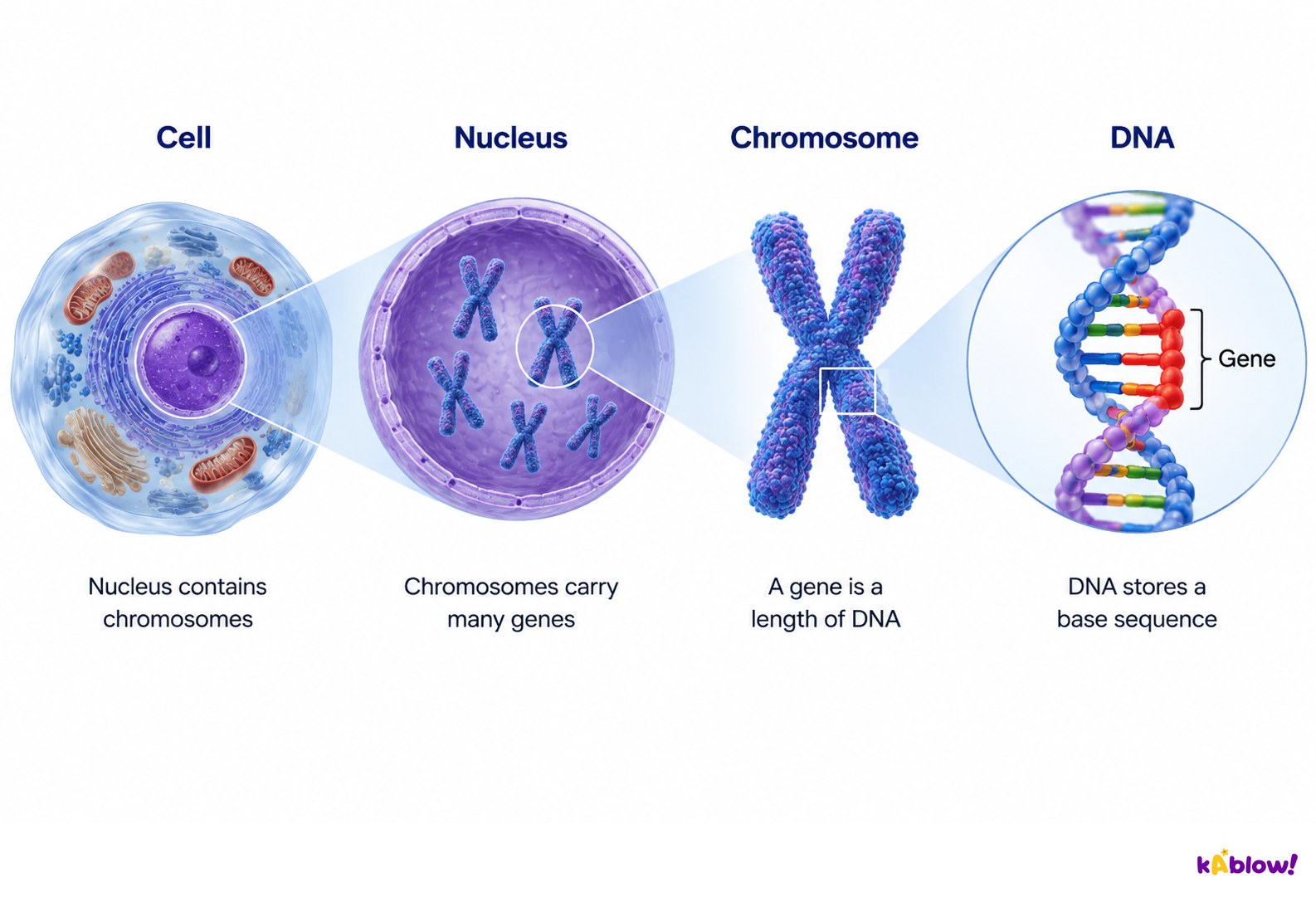
- During interphase, DNA replicates to form two identical strands called chromatids, joined at a narrow region called the centromere.
- The two chromatids of a chromosome are known as sister chromatids.
- During anaphase, sister chromatids separate; each chromatid becomes an individual chromosome again.
- DNA is very long and must fit into a much smaller nucleus; it is coiled around histone proteins to form chromatin.
- Histones package DNA into nucleosomes; each nucleosome consists of DNA coiled around eight histone proteins.
- During prophase, chromatin condenses by supercoiling to form visible chromosomes.
From cell to gene
Movement of Chromosomes
- Microtubules and microtubule motors are responsible for chromosome movement during cell division.
- Microtubules are tubulin fibres that can lengthen and shorten.
- Two types of tubulin, α-tubulin and β-tubulin, form dimers that can be added or removed at the ends of microtubules.
- Motor proteins carry chromosomes along microtubules to the equator of the cell.
Phases of Mitosis
- Mitosis produces two genetically identical daughter nuclei that are also identical to the parent nucleus.
- The four stages of mitosis are prophase, metaphase, anaphase, telophase (remember PMAT).
- Prophase: chromosomes condense and become visible; centrosomes move to opposite poles; spindle fibres emerge; nuclear envelope breaks down; nucleolus disappears.
- Metaphase: chromosomes line up at the equator (metaphase plate); spindle fibres attach to centromeres via kinetochores.
- Anaphase: sister chromatids separate at the centromere; spindle fibres shorten and pull chromatids to opposite poles.
- Telophase: chromosomes arrive at poles and decondense; nuclear envelopes reform; spindle fibres break down; new nucleoli form.
Mitosis
Identifying Phases of Mitosis (Skills)
- Cells in different stages of the cell cycle can be identified using photomicrographs.
- Interphase: most cells are in this stage; chromatin is visible but chromosomes are not, so nuclei appear dark.
- Prophase: chromosomes are visible; nuclear envelope is breaking down.
- Metaphase: chromosomes are lined up along the middle of the cell.
- Anaphase: chromosomes are moving away from the middle towards opposite poles, often with a characteristic 'V' shape.
- Telophase: chromosomes have arrived at opposite poles and begin to uncoil; nuclear envelope is reforming.
- Cytokinesis: animal cells form a cleavage furrow; plant cells form a cell plate at the metaphase plate.
Meiosis as Reduction Division
- Meiosis involves two rounds of division: Meiosis I and Meiosis II.
- Before meiosis I, chromosomes replicate; the parent cell is diploid (2n).
- During Meiosis I, homologous pairs of chromosomes are separated, producing two haploid (n) nuclei.
- The chromosome number halves from 2n to n in Meiosis I, so it is called reduction division.
- During prophase I, homologous chromosomes pair up to form a bivalent; crossing over can occur between non-sister chromatids at chiasmata.
- Between Meiosis I and II there is no replication of chromosomes.
- During Meiosis II, chromatids separate to produce four haploid (n) nuclei.
Meiosis and Genetic Variation
- Crossing over and random orientation result in different combinations of alleles in gametes.
- Crossing over: non-sister chromatids break and rejoin at the same position, exchanging alleles and producing recombinant chromosomes.
- Random orientation: at metaphase I, bivalents line up randomly at the equator; each homologous chromosome attaches to a different pole.
- Bivalents assort independently of one another.
- The number of possible chromosomal combinations is 2n, where n is the number of homologous chromosome pairs.
- For humans (n = 23), 223 = 8,388,608 possible chromosomal combinations.
Non-Disjunction and Down Syndrome
- Non-disjunction occurs when chromosomes fail to separate correctly during meiosis (anaphase I or II).
- Gametes may end up with an extra copy or no copy of a particular chromosome.
- If such a gamete is fertilised, the zygote will have an incorrect number of chromosomes.
- Down syndrome (Trisomy 21) is caused by non-disjunction of chromosome 21; individuals have 47 chromosomes (three copies of chromosome 21).
- Other examples include Patau syndrome (trisomy 13) and Edwards syndrome (trisomy 18).
- The risk of chromosomal abnormalities increases with maternal age.
- Karyotyping of foetal cells (obtained by amniocentesis or chorionic villus sampling) can identify chromosomal abnormalities.
幻灯片
练习题
免费预览——61 题中的 8 题。注册即可查看全部。
1.Which type of cell division produces two daughter cells that are genetically identical to each other and to the parent cell?
Easy- AMitosis
- BMeiosis
- CCytokinesis
- DFertilisation
2.Which type of cell division is used to produce gametes (sex cells)?
Easy- AMitosis
- BMeiosis
- CCytokinesis
- DBinary fission
3.What is the name of the narrow region that joins two sister chromatids together?
Easy- ACentromere
- BCentrosome
- CChiasma
- DKinetochore
4.What is the name of the process by which the cytoplasm divides to form two daughter cells after nuclear division?
Easy- ACytokinesis
- BMitosis
- CMeiosis
- DInterphase
5.In which stage of mitosis do the sister chromatids separate at the centromere and move to opposite poles?
Easy- AProphase
- BMetaphase
- CAnaphase
- DTelophase
6.A cell contains 74 chromosomes. It divides by mitosis. How many chromosomes will be present in each new daughter cell?
Easy- A37
- B74
- C148
- D18.5
7.Which of the following is a role of mitosis in living organisms?
Easy- AProduction of gametes
- BGrowth and repair of tissues
- CGeneration of genetic variation
- DHalving of chromosome number
8.During which phase of mitosis do the chromosomes line up along the equator of the cell?
Easy- AProphase
- BMetaphase
- CAnaphase
- DTelophase