Enzymes & Metabolism
边玩边学
回答这些题目来赚取能量,然后钓鱼探索。无需账号。
课程笔记
Metabolism: Enzymes & Reactions
- Metabolism is the sum of all chemical reactions that take place within cells and organisms; the molecules involved are called metabolites.
- Many metabolic reactions occur in multiple stages, each catalysed by a separate enzyme; a series of interlinked reactions is a metabolic pathway.
- Metabolic reactions are broadly classified as anabolic (building large molecules from smaller ones) or catabolic (breaking down large molecules into smaller ones).
- Anabolic reactions are endergonic, often involve condensation reactions, and store energy (e.g. photosynthesis, protein synthesis, glycogen formation).
- Catabolic reactions are exergonic, often involve hydrolysis reactions, and release energy (e.g. respiration, deamination, digestion).
- Both anabolism and catabolism are made up of enzyme-catalysed reactions and are coupled to ATP, the principal energy carrier in cells.
Enzymes as Biological Catalysts
- Enzymes are globular proteins that act as biological catalysts, speeding up reactions without being used up or permanently changed.
- They are reusable, so only a small number is needed to catalyse reactions.
- Without enzymes, the rate of chemical reactions in organisms would be too low to support life.
- Enzymes ensure substrate molecules are orientated correctly and close enough for a reaction to occur.
- The cell controls which enzymes are produced, giving it control over the chemical reactions in the cytoplasm.
The lock and key model
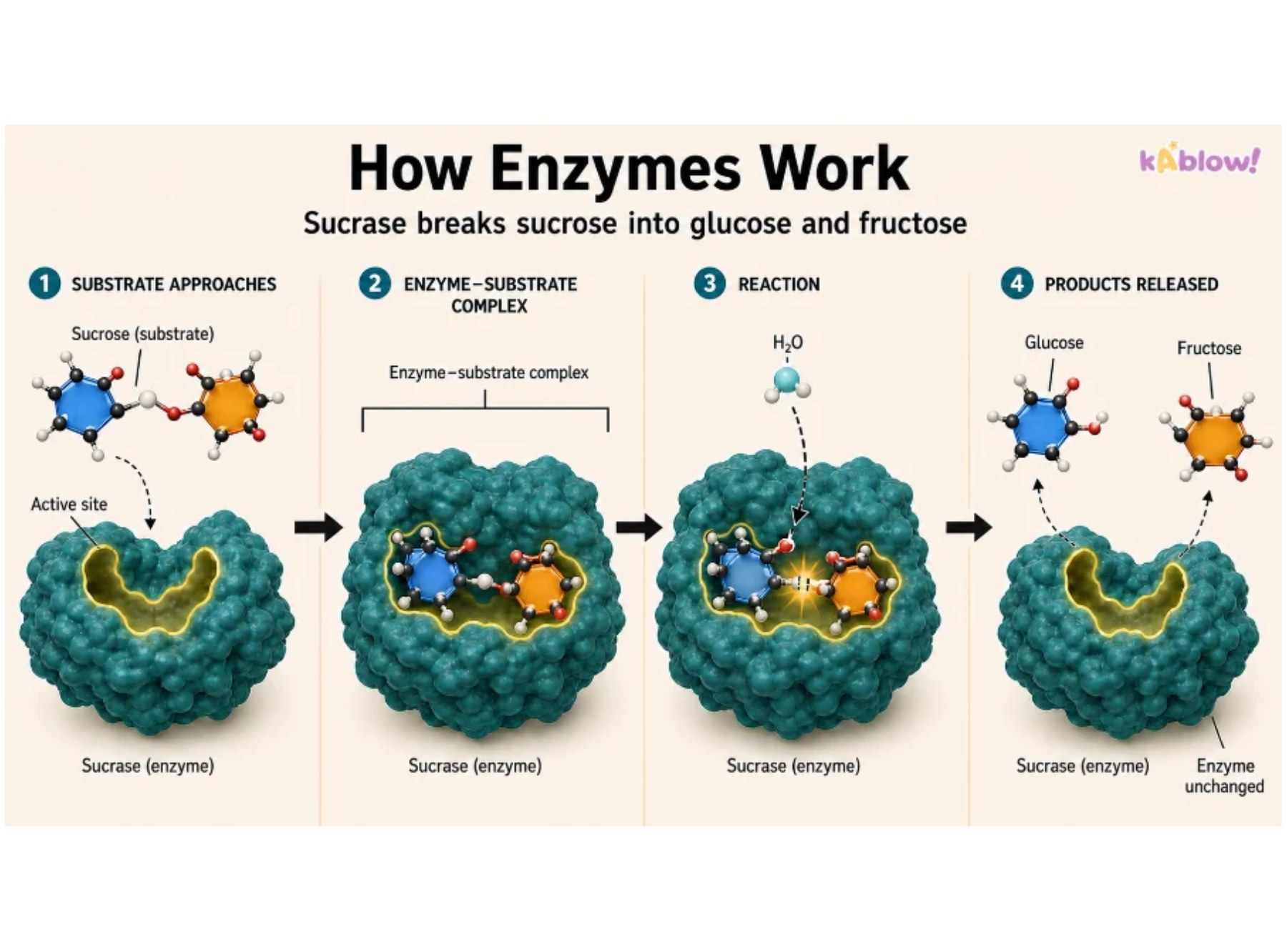
Enzyme Action & Specificity
- The active site is the specific region of an enzyme where the substrate binds; its shape and chemical properties are complementary to the substrate.
- This complementary fit is called enzyme-substrate specificity; the shapes are complementary, not identical.
- Substrates collide randomly with the active site; a reaction occurs only if the collision is at the correct orientation and speed.
- A temporary enzyme-substrate complex forms; the substrate is in a transitional state, products are formed, and the enzyme is released unchanged.
- The specificity of an enzyme is determined by the complex 3D shape of the protein, which is itself determined by the sequence of amino acids.
- The active site is made of only a few amino acids, but their interactions within the 3D shape allow catalysis by binding the substrate, holding it in position, and lowering the energy needed for the reaction.
Induced-Fit Hypothesis
- The original lock-and-key model proposed that the active site is precisely complementary to the substrate, like a key fitting a lock.
- The modified induced-fit hypothesis states that the enzyme and its active site (and sometimes the substrate) change shape slightly as the substrate enters.
- These shape changes are called conformational changes and ensure an ideal binding arrangement.
- This maximises the ability of the enzyme to catalyse the reaction.
- Our current understanding of enzyme-substrate interactions is based on the induced-fit hypothesis.
Denaturation
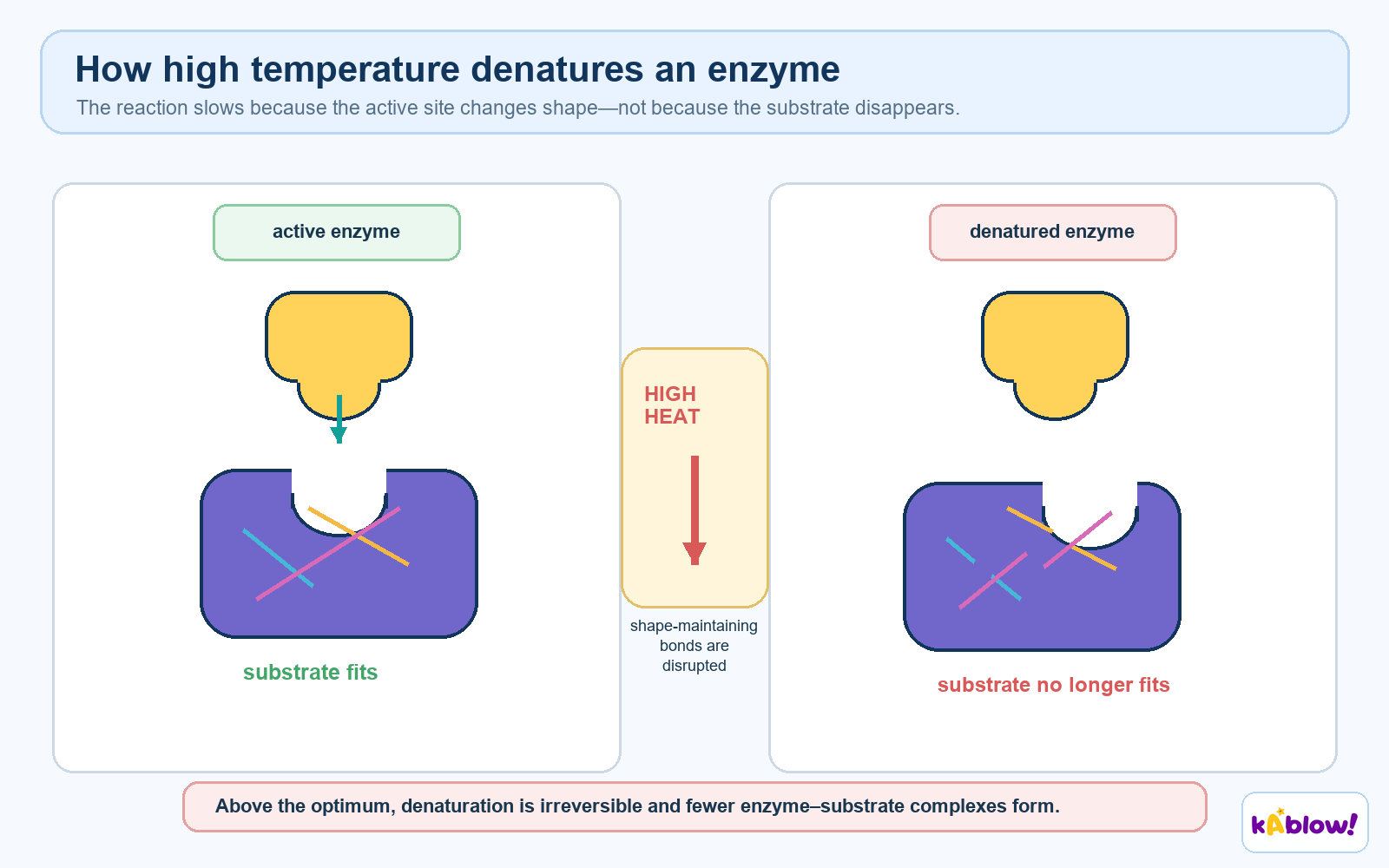
- Enzymes can be denatured by high temperatures or extremes of pH.
- Bonds (e.g. hydrogen bonds) holding the enzyme's precise 3D shape start to break; peptide bonds holding amino acids together are not broken.
- This permanently changes the shape of the active site, preventing the substrate from binding.
- Denaturation has occurred if the substrate can no longer bind, and the reaction no longer takes place.
- Denaturation often causes the enzyme to become insoluble and form a precipitate.
- Very few human enzymes function above 50°C; even temperatures exceeding 40°C can denature human enzymes because the body maintains about 37°C.
Denaturation of an enzyme
Factors Affecting Enzyme Activity
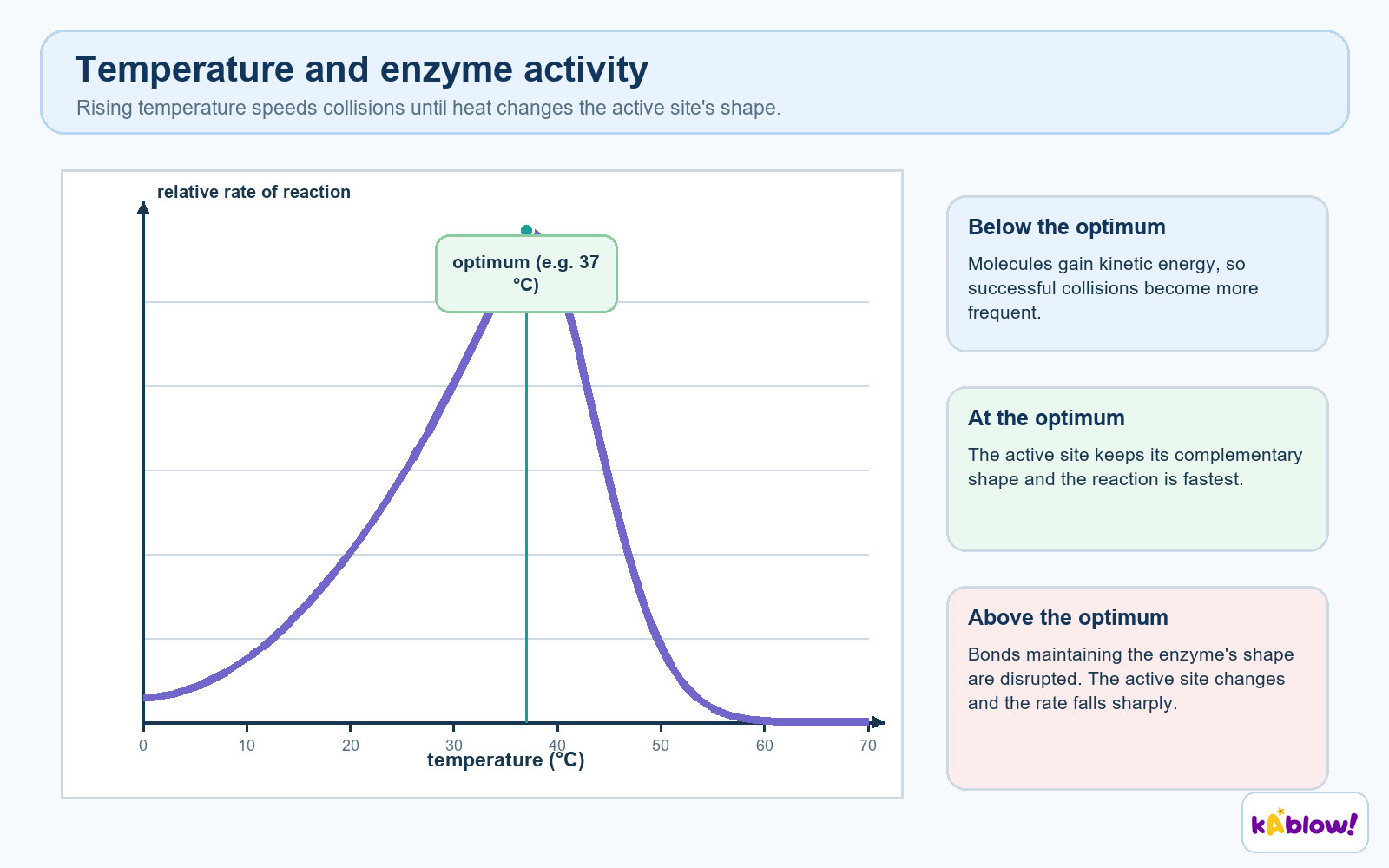
- Enzymes have a specific optimum temperature at which they catalyse a reaction at the maximum rate.
- Lower temperatures slow reactions because molecules have less kinetic energy, fewer successful collisions occur, and collisions have less energy.
- Higher temperatures speed up reactions because molecules have more kinetic energy, more successful collisions occur, and collisions have more energy.
- As temperatures continue to increase, the rate drops sharply as the enzyme begins to denature.
- Each enzyme has an optimum pH; extremes of pH alter hydrogen bonding and cause irreversible denaturation (e.g. pepsin works best at pH 2, some bacterial enzymes at pH 9–10).
- pH is measured on a logarithmic scale of hydrogen ion concentration; a 10× increase in hydrogen ion concentration lowers pH by 1 unit.
- As substrate concentration rises, the rate of reaction increases until active sites become saturated; beyond this, increasing substrate concentration causes no further increase in rate.
- At saturation, the rate can be increased by increasing enzyme concentration to make more active sites available.
Effect of temperature on enzyme activity
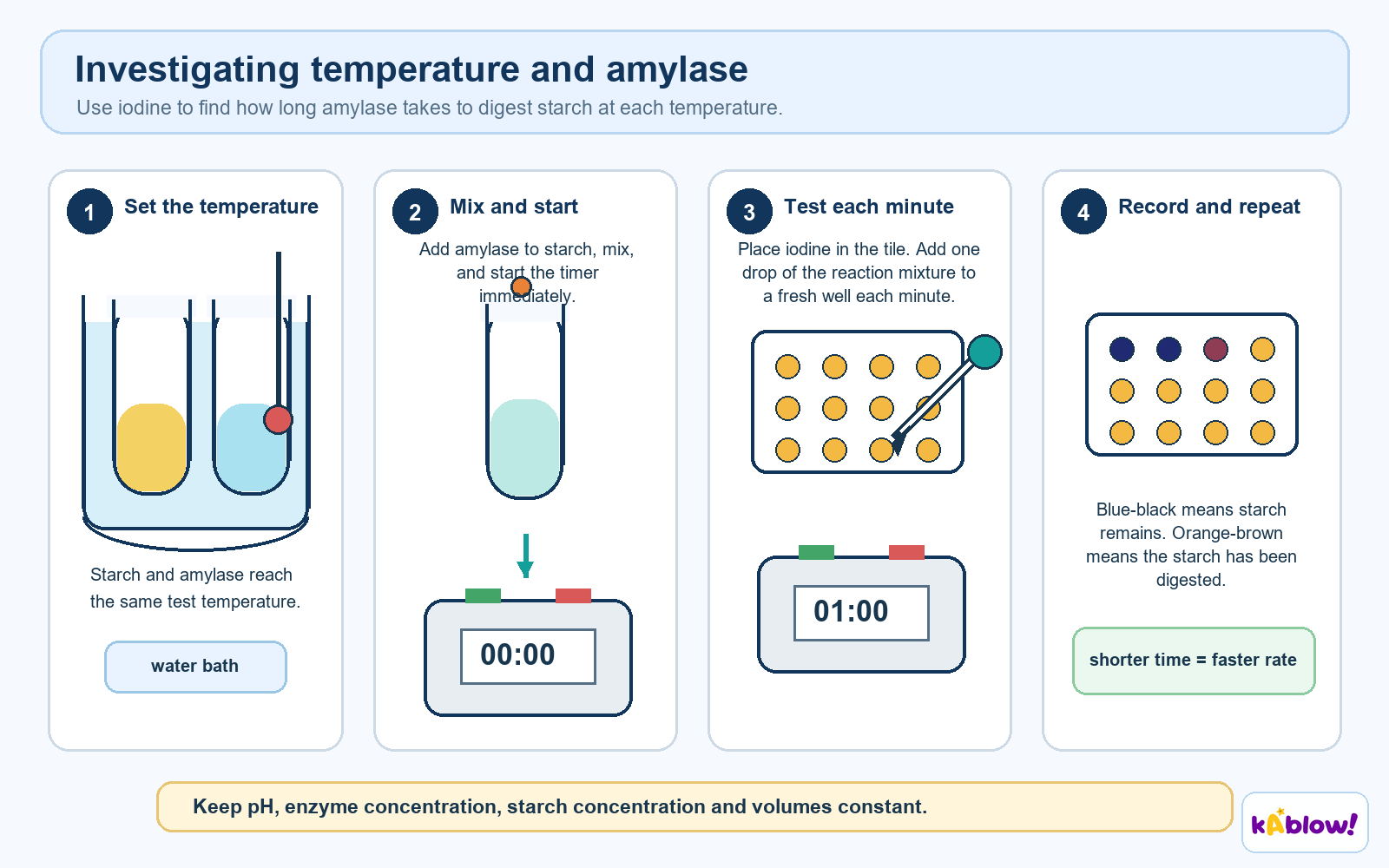
Investigating Enzyme Activity: Skills
- The rate of an enzyme-catalysed reaction can be measured by the rate of formation of a product or the rate of disappearance of a substrate.
- Catalase breaks down hydrogen peroxide into water and oxygen; the volume of oxygen produced in a set time measures the rate.
- Amylase hydrolyses starch into maltose and glucose; starch can be tested with iodine in potassium iodide solution, which turns blue-black if starch is present.
- Colorimetry can measure light absorbance or transmission in reactions involving a colour change; as starch is broken down, transmission increases or absorbance decreases.
- A colorimeter is calibrated (e.g. with weak iodine solution as 100% transmission) and a calibration graph of starch concentration vs absorbance/transmission is plotted.
- Serial dilutions are used to make a range of concentrations from a stock solution.
- The rate of reaction can be calculated as 1 ÷ time taken (s⁻¹), or from the gradient of a graph of product/substrate quantity against time.
Investigating enzyme activity
Activation Energy
- Activation energy is the amount of energy needed by the substrate to become unstable enough for a reaction to occur and for new products to be formed.
- Enzymes speed up reactions because they reduce the stability of bonds in the substrate.
- Enzymes lower the activation energy needed to catalyse a reaction; the energy released is unchanged but the activation energy required is lowered.
- The rate of reaction is therefore quicker.
- If energy is released to the surroundings, the reaction is exergonic; if energy is absorbed, it is endergonic.
- Endergonic and exergonic reactions are defined by the net intake or output of energy, unlike endothermic and exothermic reactions which are defined by thermal energy only.
Immobilised Enzymes
- Enzymes can be immobilised by attachment to an inert substance (e.g. glass), entrapment within a matrix (e.g. alginate gel), or entrapment within a partially permeable membrane.
- Immobilised enzymes are used in industries such as food processing, environmental management, pharmaceuticals and manufacturing.
- Advantages include: the product is uncontaminated with enzyme, so no further processing or filtering is needed.
- The immobilised enzyme can be reused multiple times, which is efficient and cost-effective.
- Reusing the enzyme avoids the need to separate it from the product in downstream processing.
- Immobilised enzymes have greater tolerance of temperature and pH changes and are often more stable.
- Substrates can be exposed to higher enzyme concentrations than with enzymes in solution, increasing the rate of throughput.
幻灯片
练习题
免费预览——61 题中的 8 题。注册即可查看全部。
1.Which of the options below refers to the features of catabolism?
Easy- AExergonic, condensation reaction, an example is polypeptide synthesis
- BEndergonic, hydrolysis reaction, an example is respiration
- CEndergonic, condensation reaction, an example is photosynthesis
- DExergonic, hydrolysis reaction, an example is deamination
2.Which of the following statements apply to enzymes? 1. They speed up the rate of chemical reactions in the body 2. They are fibrous proteins 3. The active site is where the substrate binds 4. The shape of the active site is complementary to the shape of the substrate molecule
Easy- AI, III and IV
- BI, II and III
- CI and IV
- DII and III
3.An enzyme catalysed reaction is heated to a temperature of 65 °C. Which of the following best explains the effect this temperature increase would have on the enzymes?
Medium- AThe enzyme and substrate molecules will gain kinetic energy and collide more frequently
- BThe bonds in the enzyme will vibrate more and break, which will cause a permanent change in the shape of the active site
- CThe bonds in the enzyme will vibrate more and break, causing a temporary change in the shape of the active site
- DThe active site of the enzyme will permanently change shape due to the increased speed of collisions between the substrate molecule and the active site
4.Which of the following statements is not true about enzymes in metabolic pathways?
Easy- AAll metabolic reactions are catalysed by an enzyme.
- BAll proteins are enzymes.
- CAll enzymes are proteins.
- DAll enzymes reduce activation energy of metabolic reactions in living organisms.
5.The following statements are about enzymes: 1. The speed that they function at can be reduced by competitive inhibitors. 2. Their primary structure is translated from mRNA. 3. They can be embedded in the plasma membrane of a cell. 4. They all have quaternary structures. Which of these statements are correct for all enzymes?
Medium- A1 and 3 only
- B1, 2 and 3 only
- C2, 3 and 4 only
- DAll of them are correct
6.Enzymes alter the activation energy required for a biochemical reaction to take place. Which of the following gives the best definition of activation energy?
Medium- AThe energy input required to break bonds in order for a reaction to take place.
- BThe energy is released as bonds breaks in a reaction.
- CThe energy required to allow substrates and enzymes to be closely aligned at the active site.
- DThe energy given off when an enzyme-substrate complex forms.
7.The four statements below are examples of the two types of metabolism, anabolism and catabolism. Which one of the statements represents a type of metabolism which is different to the other three options?
Medium- ADeamination of polypeptides to form urea.
- BFormation of glycosidic bonds between glucose and fructose.
- CDepletion of fat stores during a period of starvation.
- DAnaerobic respiration.
8.The following statements apply to enzyme-catalysed reactions. Which row of the table best describes the sequence of events in an anabolic reaction?
Medium- ASubstrate binds to active site, enzyme-substrate complex forms, product is released, enzyme is reused
- BSubstrate binds to active site, enzyme-substrate complex forms, enzyme is permanently changed, product is released
- CSubstrate binds to active site, enzyme-substrate complex forms, product is released, enzyme is denatured
- DSubstrate binds to active site, enzyme-substrate complex forms, product is released, enzyme is broken down