Nucleic Acids
边玩边学
回答这些题目来赚取能量,然后钓鱼探索。无需账号。
课程笔记
DNA as the Genetic Material
- DNA (deoxyribonucleic acid) carries the genetic code in all living organisms, which is why the genetic code is described as universal.
- DNA is mainly found in the nucleus where it forms chromosomes; it is also found in chloroplasts and mitochondria of eukaryotic cells.
- RNA (ribonucleic acid) is another nucleic acid and is the main component of ribosomes, playing an important role in protein synthesis.
- Some RNA is found in the nucleus and cytoplasm.
- Certain viruses (e.g. SARS-CoV-2) contain RNA as their genetic material instead of DNA, causing diseases such as COVID-19, Ebola, mumps and influenza.
- Viruses are not considered living organisms because they cannot replicate by themselves, depend on other cells, and lack a cellular structure.
From cell to gene
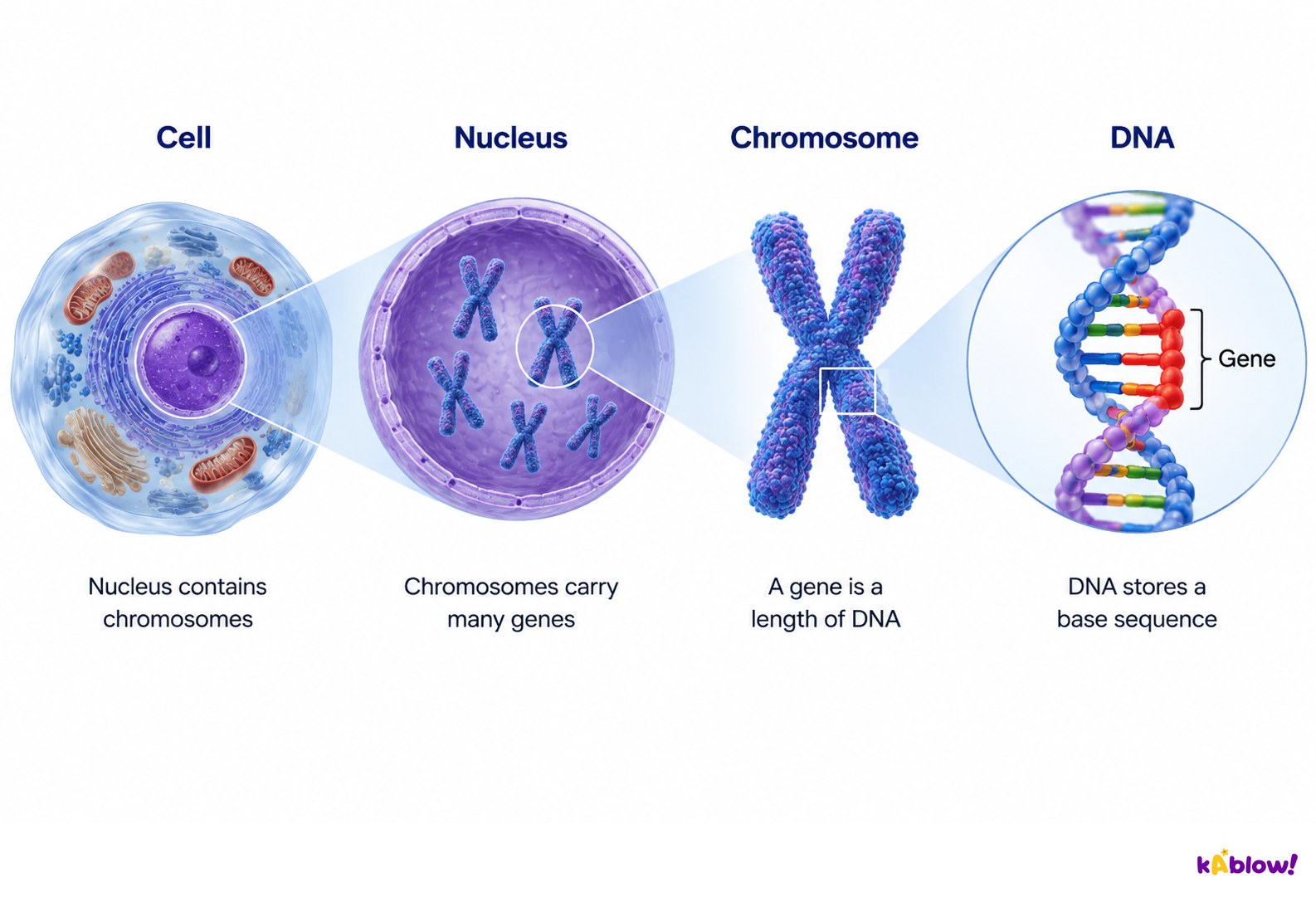
Nucleotide Structure
- Both DNA and RNA are polymers made of repeating units called nucleotides.
- Each nucleotide is formed from a pentose sugar (5 carbon atoms), a nitrogen-containing organic base (1 or 2 rings), and a phosphate group (acidic and negatively charged).
- The base and phosphate group are both covalently bonded to the sugar.
- The nitrogenous bases in DNA are adenine (A), guanine (G), cytosine (C) and thymine (T).
- RNA shares the same bases as DNA except thymine is replaced by uracil (U).
- Adenine and guanine are purine bases; cytosine, thymine and uracil are pyrimidine bases.
The sugar-phosphate backbone
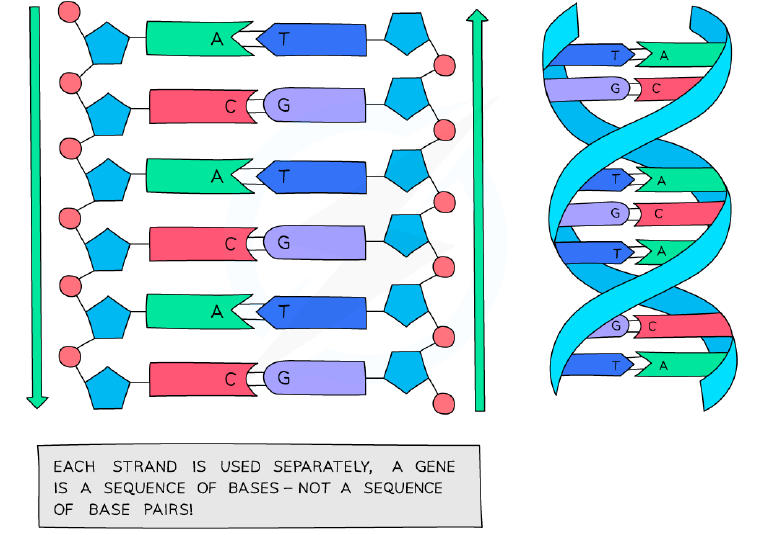
Drawing Nucleotides
- Simple shapes can be used to draw nucleotides: pentagons for pentose sugars, circles for phosphates (often with P inside), and rectangles for bases.
- Covalent bonds can be shown with solid lines; hydrogen bonds with dashed lines or complementary shapes.
- Advanced drawing skills are not required; clear, large diagrams are easier for examiners to award marks for.
Linking Nucleotides
- Nucleotides join in chains to form DNA or RNA strands; the phosphate group of one nucleotide forms a covalent bond to the pentose sugar of the next.
- This polymerisation occurs by condensation reactions, releasing a molecule of water for each bond formed.
- This creates a sugar-phosphate backbone with a base linked to each sugar.
- The polymer of nucleotides is known as a strand; DNA is double-stranded, RNA is usually single-stranded.
- There are just 4 separate bases that can be joined in any combination/sequence because the sugar and phosphate are the same in every nucleotide.
RNA Structure
- RNA molecules are relatively short (a hundred to a few thousand nucleotides) and usually form a single-stranded polynucleotide.
- RNA nucleotides contain ribose as the pentose sugar and the bases A, G, C and U (uracil instead of thymine).
- Carbon atoms in nucleotides are numbered from the right in a clockwise direction, which helps identify bonds and orientation.
- Adjacent RNA nucleotides are linked by condensation reactions, forming phosphodiester bonds between the pentose sugar of one nucleotide and the phosphate group of the next.
- Types of RNA include mRNA (formed in the nucleus, transported to ribosomes), tRNA (transports amino acids to ribosomes), and rRNA (forms part of ribosomes).
DNA Structure
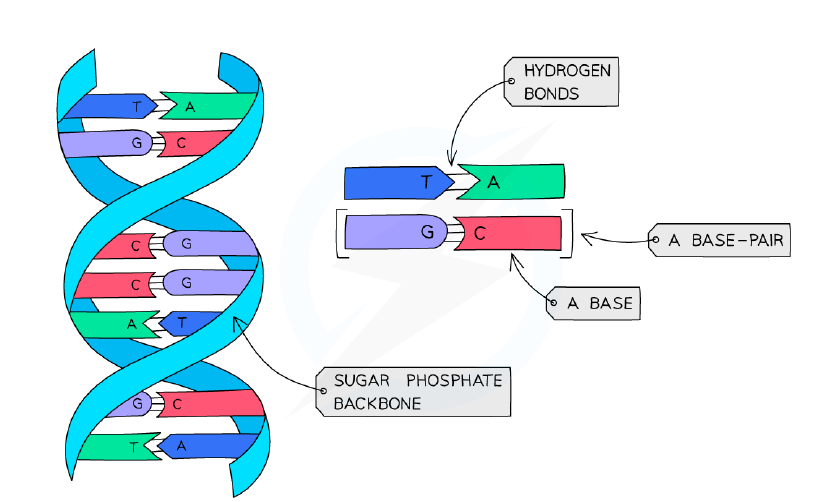
- DNA is a double helix made of two antiparallel strands of nucleotides linked by hydrogen bonding between complementary base pairs.
- Each DNA strand has alternating deoxyribose sugars and phosphate groups forming the sugar-phosphate backbone.
- Each strand has a 3' end and a 5' end, relating to which carbon atom on the pentose sugar could bond with another nucleotide.
- The strands run in opposite directions: one is 5' to 3' and the other is 3' to 5'.
- The nitrogenous bases project from the backbone towards the interior of the double-stranded molecule.
- Complementary base pairing: A pairs with T (two hydrogen bonds), G pairs with C (three hydrogen bonds).
The DNA double helix
The Genetic Code
- DNA carries the genetic code as a sequence of nitrogenous bases (A, G, C, T).
- One strand carries the base sequence read by enzymes: the coding strand.
- The sequence of bases in genes determines the order of amino acids in proteins.
- The code is read as a triplet of bases called a codon, each coding for one amino acid.
- There are 20 different amino acids that can be coded for; the sequence determines the shape and function of the protein.
- The genetic code is universal: almost every organism uses the same code, so genetic information is transferable between species.
- The universal code provides evidence for a universal common ancestor and is why genetic engineering is possible.
- Conserved sequences are coding and non-coding sequences that have remained unchanged in all organisms; highly conserved sequences are found in genes for transcription, translation and histone proteins.
DNA vs RNA
- Pentose sugar: DNA contains deoxyribose; RNA contains ribose.
- Bases: DNA contains A, C, G, T; RNA contains A, C, G, U (uracil replaces thymine).
- Strands: DNA is double-stranded (double helix); RNA is single-stranded.
- Length: RNA polynucleotide chains are relatively short compared to DNA.
DNA Function and Information Storage
- Complementary base pairing means the base sequence on one strand determines the sequence of the other; one strand acts as a template for the other.
- This allows DNA to be copied precisely during DNA replication, ensuring the genetic code is accurately copied and expressed.
- Despite only four bases, they can combine to form a very diverse range of sequences in DNA molecules of different lengths.
- DNA has an almost limitless capacity for storing genetic information.
- Storage capacity can be measured by the number of genes or the number of base pairs in the genome.
- The DNA in a human cell nucleus contains about 3.2 gigabases (about 109 base pairs) with a length of about 2 meters, fitting inside a microscopic nucleus.
- This indicates how incredibly well packaged DNA is, giving it enormous capacity for storing genetic data with great economy.
幻灯片
练习题
免费预览——59 题中的 8 题。注册即可查看全部。
1.Which of the following is the main role of DNA?
Easy- ACarrying the genetic code in all living organisms
- BTransporting amino acids to ribosomes
- CForming the structural component of ribosomes
- DCatalysing metabolic reactions
2.In the term 'polynucleotide', what does the prefix 'poly' mean?
Easy- AMany
- BFew
- COne
- DTwo
3.A section of DNA contains 17% of its nucleotides with the base cytosine. What percentage of the nucleotides in this section contain thymine?
Medium- A17%
- B33%
- C34%
- D66%
4.Why could the calculation of thymine percentage from a cytosine percentage not be performed for a piece of RNA?
Medium- ARNA is single-stranded, so there is no complementary base pairing to determine the proportion of other bases
- BRNA contains uracil instead of cytosine
- CRNA contains deoxyribose instead of ribose
- DRNA does not contain any phosphate groups
5.RNA is usually single-stranded, whereas DNA is double-stranded.
EasyTrue or false?
6.Which of the following statements apply only to RNA? (select all that apply)
Medium- AThe molecule is in the shape of a double helix, with antiparallel strands
- BThe four bases are adenine, cytosine, guanine, thymine
- CRibose is present as the pentose sugar in its nucleotides
- DIt is a polymer formed by the linkage of many nucleotides
- EUracil is present instead of thymine
7.Which of the following correctly identifies the components of a nucleotide?
Medium- AA pentose sugar, a nitrogen-containing organic base and a phosphate group
- BA hexose sugar, an amino acid and a phosphate group
- CA pentose sugar, a nitrogen-containing organic base and a carboxyl group
- DA glycerol molecule, a fatty acid and a phosphate group
8.The diagram represents the structure of a nucleotide. Which row correctly identifies the components labelled 1, 2 and 3?
Easy- A1 = phosphate group, 2 = pentose sugar, 3 = adenine
- B1 = adenine, 2 = pentose sugar, 3 = phosphate group
- C1 = pentose sugar, 2 = phosphate group, 3 = adenine
- D1 = phosphate group, 2 = adenine, 3 = pentose sugar