Electron Transfer Reactions
边玩边学
回答这些题目来赚取能量,然后钓鱼探索。无需账号。
给教育者: 面向 Electron Transfer Reactions(Chemistry,HL)的即用型课程幻灯片, 复习笔记——用在你的课堂上,或将该知识点作为学习者可实时游玩的互动课堂活动来运行。
课程笔记
Oxidation & Reduction
- Oxidation is the loss of electrons, while reduction is the gain of electrons.
- An oxidising agent oxidises another species by causing it to lose electrons; the oxidising agent itself is reduced and its oxidation number decreases.
- A reducing agent reduces another species by causing it to gain electrons; the reducing agent itself is oxidised and its oxidation number increases.
- In a redox reaction, both oxidation and reduction occur simultaneously, so both an oxidising agent and a reducing agent are present.
- Some substances can act as either oxidising or reducing agents depending on what they react with and the reaction conditions.
- Oxidation numbers are used to identify what is oxidised or reduced; they are also used in naming compounds, e.g. iron(II) sulfate contains Fe²⁺ and iron(III) sulfate contains Fe³⁺.
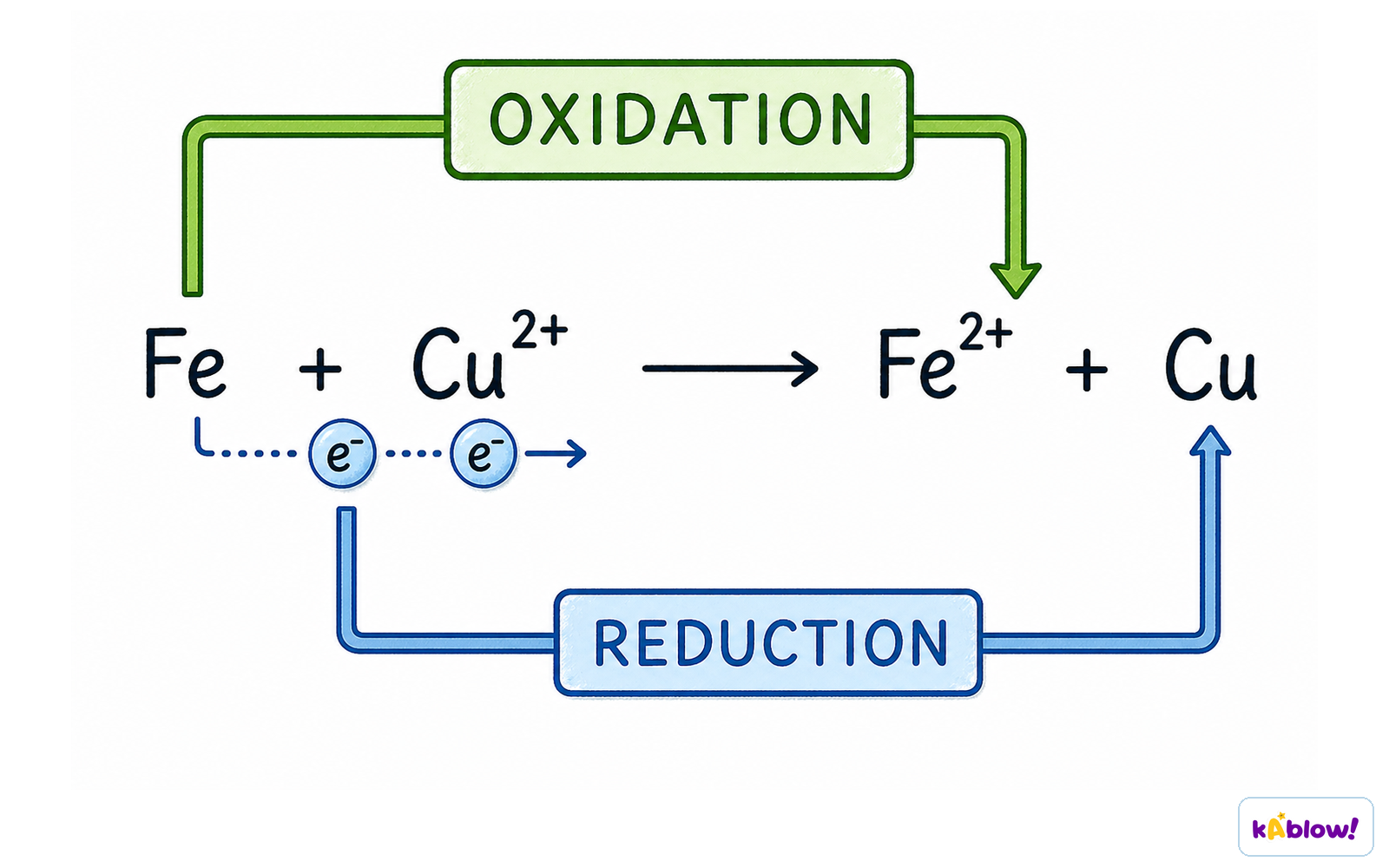
Oxidation and reduction by electron transfer
Half Equations
- Half equations show the separate oxidation and reduction processes, including electrons.
- To balance a redox equation: write the unbalanced equation, deduce oxidation number changes, balance the changes, balance charges, then balance atoms.
- In acidic conditions, balance oxygen by adding H₂O and hydrogen by adding H⁺.
- Example half equations: Fe²⁺(aq) → Fe³⁺(aq) + e⁻ (oxidation) and MnO₄⁻(aq) + 8H⁺(aq) + 5e⁻ → Mn²⁺(aq) + 4H₂O(l) (reduction).
- The overall equation is obtained by combining half equations so that electrons cancel: MnO₄⁻(aq) + 8H⁺(aq) + 5Fe²⁺(aq) → Mn²⁺(aq) + 5Fe³⁺(aq) + 4H₂O(l).
- Redox titrations involve an oxidising agent titrated against a reducing agent; the endpoint can be shown by a colour change or by an indicator.
- In manganate(VII) titrations, the purple MnO₄⁻ ion acts as its own indicator, turning colourless at the endpoint.
- In iodine–thiosulfate titrations, iodine (brown/yellow) is reduced to colourless iodide; starch is added near the endpoint to sharpen the colour change.
Relative Ease of Oxidation & Reduction
- Down Group 1 and Group 2, the relative ease of oxidation of the metal increases; reactivity with water becomes more vigorous.
- For example, lithium reacts vigorously with water, and down Group 1 the reaction becomes even more violent.
- Magnesium reacts very slowly with water, while calcium reacts much more quickly.
- Halogens are oxidising agents: they gain an electron from a metal, oxidising the metal and becoming reduced themselves.
- The oxidising power of halogens decreases down Group 17: F₂ > Cl₂ > Br₂ > I₂.
- A more reactive halogen displaces a less reactive halogen from its halide solution, e.g. Cl₂ + 2KBr → 2KCl + Br₂.
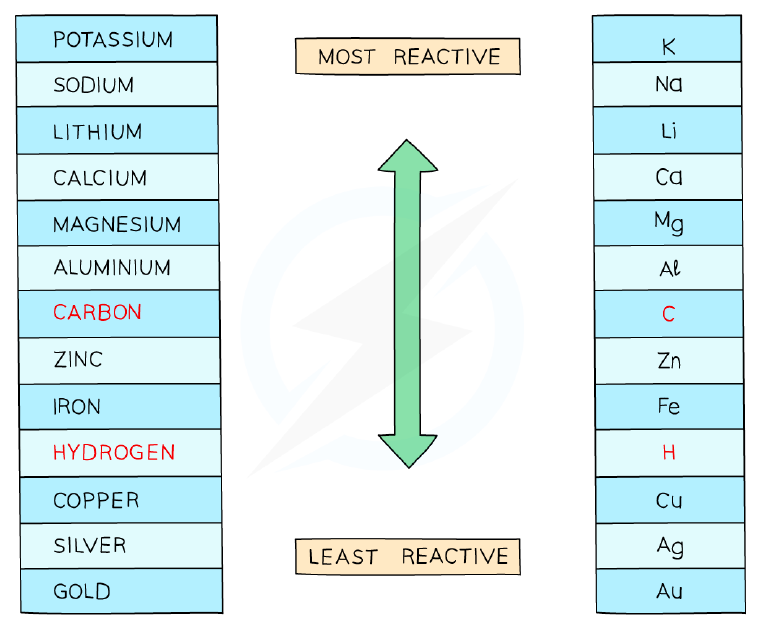
- Metals can be ranked in a reactivity series; more reactive metals displace less reactive metals from their compounds.
- In metal displacement, the more reactive metal acts as the reducing agent, e.g. Mg(s) + CuSO₄(aq) → MgSO₄(aq) + Cu(s).
The reactivity series of metals
Acids with Reactive Metals
- The general reaction is: acid + metal → salt + hydrogen.
- Example: 2HCl(aq) + Zn(s) → ZnCl₂(aq) + H₂(g).
- The ionic equation is 2H⁺(aq) + Zn(s) → Zn²⁺(aq) + H₂(g); chloride ions are spectator ions.
- The half equations are 2H⁺(aq) + 2e⁻ → H₂(g) (reduction) and Zn(s) → Zn²⁺(aq) + 2e⁻ (oxidation).
- The metal is the reducing agent (it is oxidised), and H⁺ from the acid is the oxidising agent (it is reduced).
- The extent of reaction depends on the reactivity of the metal and the strength of the acid; stronger acids react more vigorously.
- Very reactive metals react dangerously with acids, while metals low in reactivity (e.g. copper) do not react with dilute acids.
- Relative reducing power of metals (strongest to weakest): Mg > Al > Zn > Fe > Pb > H > Cu > Ag.
Primary Cells
- A voltaic (galvanic) cell generates electricity from a spontaneous redox reaction.
- The potential difference is called the electromotive force (EMF) or cell potential, symbol E.
- A half-cell consists of a metal electrode dipped in a solution of its own ions, setting up an equilibrium such as Zn(s) ⇌ Zn²⁺(aq) + 2e⁻.
- Electrons flow through the external circuit from the anode (oxidation) to the cathode (reduction).
- A salt bridge completes the circuit, allowing ions to migrate and balance charge; it often contains KNO₃(aq) or KCl(aq).
- Cell notation uses a single vertical line for a phase boundary and a double vertical line for the salt bridge, e.g. Zn(s) | Zn²⁺(aq) || Cu²⁺(aq) | Cu(s) E = +1.10 V.
- In a hydrogen–oxygen fuel cell, the overall reaction is 2H₂(g) + O₂(g) → 2H₂O(l) with E = +1.23 V.
- Fuel cells produce only water, are more efficient than combustion engines, and avoid nitrogen oxides, but hydrogen storage and production pose safety and economic challenges.
Secondary Cells
- Secondary (rechargeable) cells can be reversed by applying a voltage greater than the cell voltage, pushing electrons in the opposite direction.
- A lead-acid battery uses lead as the negative electrode, lead(IV) oxide as the positive electrode, and sulfuric acid as the electrolyte.
- Lead-acid half equations: Pb(s) + SO₄²⁻(aq) → PbSO₄(s) + 2e⁻ and PbO₂(s) + 4H⁺(aq) + SO₄²⁻(aq) + 2e⁻ → PbSO₄(s) + 2H₂O(l); overall E = +2.06 V.
- Lead-acid batteries deliver high current for short periods (ideal for car engines) but are heavy, bulky, and contain toxic lead and corrosive acid.
- Nickel-cadmium (NiCad) cells use cadmium as the negative electrode and a nickel(II) hydroxide-oxide system as the positive electrode; overall E = +1.2 V.
- NiCad cells can be recharged hundreds of times but cadmium is toxic and they can suffer from the memory effect.
- Lithium-ion cells use a lithium cobalt oxide positive electrode, a carbon negative electrode, and a solid polymer electrolyte.
- Lithium-ion cells are lightweight, deliver high voltage (3.5–4.0 V), and contain no toxic heavy metals, but degrade over time, are expensive, and pose a fire risk.
Electrolytic Cells
- Electrolysis is the splitting of an ionic compound by electricity when molten or in aqueous solution.
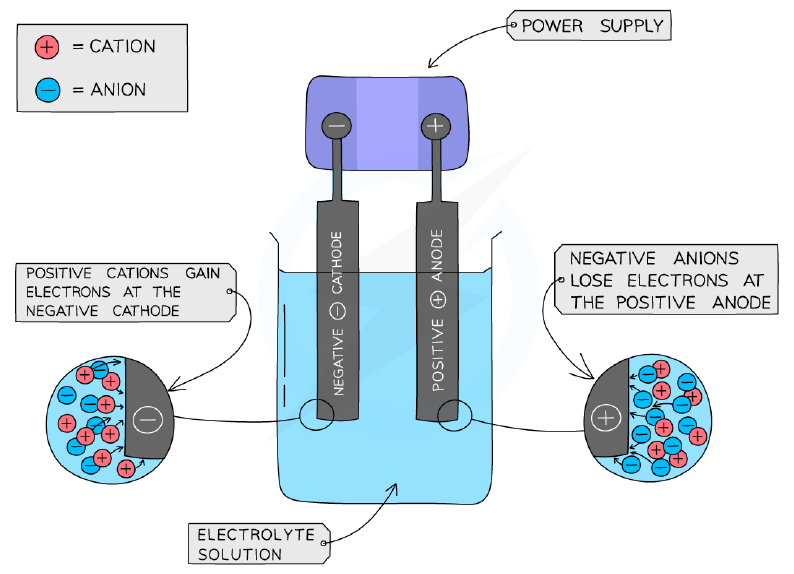
- In an electrolytic cell, the electrolyte contains positive and negative ions; cations move to the cathode and anions move to the anode.
- At the cathode, positive ions gain electrons (reduction); at the anode, negative ions lose electrons (oxidation).
- For molten lead bromide: Pb²⁺(l) + 2e⁻ → Pb(l) at the cathode and 2Br⁻(l) → Br₂(l) + 2e⁻ at the anode.
- In electrolysis of molten salts, metals are always formed at the cathode and non-metals at the anode.
- In voltaic cells, the anode is negative and the cathode is positive; in electrolytic cells, the anode is positive and the cathode is negative.
- RED CAT reminds you that reduction takes place at the cathode in both cell types.
The basic set-up of an electrolytic cell
Oxidation of Alcohols
- Alcohols contain the –OH group and have the general formula CₙH₂ₙ₊₁OH; they are classified as primary, secondary, or tertiary.
- A primary alcohol has the –OH carbon bonded to one other carbon; a secondary alcohol to two; a tertiary alcohol to three.
- The oxidising agent for alcohols is acidified potassium dichromate(VI), K₂Cr₂O₇; the colour change is orange to green.
- Primary alcohols can be oxidised to aldehydes and then further to carboxylic acids.
- Secondary alcohols are oxidised to ketones only; tertiary alcohols do not undergo oxidation.
- To form an aldehyde, use distillation apparatus so the lower-boiling aldehyde distils off as it forms.
- To form a carboxylic acid, use reflux apparatus with excess oxidising agent.
- Tertiary alcohols do not oxidise because there is no hydrogen on the functional group carbon to break off and form water.
Reduction of Carboxylic Acids, Aldehydes & Ketones
- Carboxylic acids can be reduced to primary alcohols.
- Aldehydes can be reduced to primary alcohols.
- Ketones can be reduced to secondary alcohols.
- These reductions typically use reducing agents such as lithium aluminium hydride (LiAlH₄) in dry ether, or sodium borohydride (NaBH₄).
- The reduction of an aldehyde or ketone involves the addition of hydrogen across the C=O bond.
Reduction of Unsaturated Compounds
- Unsaturated compounds contain carbon–carbon double or triple bonds and can undergo addition reactions.
- Alkenes can be reduced to alkanes by addition of hydrogen across the C=C bond.
- This hydrogenation reaction requires a metal catalyst, such as nickel, platinum, or palladium.
- For example, ethene reacts with hydrogen to form ethane: CH₂=CH₂ + H₂ → CH₃CH₃.
- The process is used industrially to harden vegetable oils into margarine.
幻灯片
练习题
免费预览——63 题中的 8 题。注册即可查看全部。
1.Which statement correctly defines an oxidising agent?
Easy- AA substance that oxidises another species by causing it to lose electrons
- BA substance that oxidises another species by causing it to gain electrons
- CA substance that reduces another species by causing it to lose electrons
- DA substance that reduces another species by causing it to gain electrons
2.A reducing agent is itself oxidised and its oxidation number increases.
EasyTrue or false?
3.Which of the following statements about oxidising and reducing agents are correct? (select all that apply)
Medium- AOxidising agents accept electrons.
- BReducing agents donate electrons.
- COxidising agents are themselves oxidised.
- DReducing agents are themselves reduced.
- EOxidising agents cause other species to lose electrons.
4.Match each term with its correct description.
Medium- Oxidising agent
- Reducing agent
- Redox reaction
- Spectator ion
- A species that gains electrons and is itself reduced
- A species that loses electrons and is itself oxidised
- A reaction in which both oxidation and reduction occur
- An ion that does not change in the reaction
5.Place the steps for balancing a redox equation into the correct order.
Medium- Write the unbalanced equation and identify the atoms which change in oxidation number.
- Deduce the oxidation number changes.
- Balance the oxidation number changes.
- Balance the charges.
- Balance the atoms.
6.In the reaction 2Fe²⁺ + H₂O₂ + 2H⁺ → 2Fe³⁺ + 2H₂O, which species is acting as the oxidising agent?
Medium- AFe²⁺
- BH₂O₂
- CH⁺
- DH₂O
7.Which of the following is a redox reaction?
Medium- AHCl + NaOH → NaCl + H₂O
- B2HCl + Zn → ZnCl₂ + H₂
- CCaCO₃ → CaO + CO₂
- DAgNO₃ + NaCl → AgCl + NaNO₃
8.In a voltaic cell, oxidation takes place at the negative electrode.
EasyTrue or false?
历年真题
该知识点的历年真题练习即将推出。
即将推出