Structure Of The Atom
边玩边学
回答这些题目来赚取能量,然后钓鱼探索。无需账号。
给教育者: 面向 Structure Of The Atom(Physics,HL)的即用型课程幻灯片, 复习笔记——用在你的课堂上,或将该知识点作为学习者可实时游玩的互动课堂活动来运行。
课程笔记
Rutherford's Gold Foil Experiment
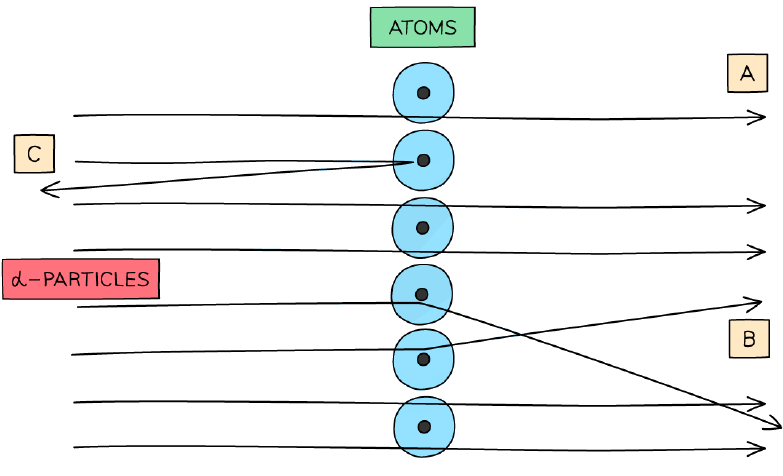
- Rutherford's gold foil experiment provided evidence for the structure of the atom by firing high-energy α particles at a thin gold foil and detecting the angles of deflection.
- The apparatus consisted of: a source of α particles in a lead container, a thin gold foil, a movable detector, and an evacuated chamber.
- The lead container produced a collimated beam of α particles because α particles are absorbed by lead, so a narrow hole allowed a concentrated beam to escape.
- The gold foil had to be extremely thin (about 10⁻⁶ m) because a thicker foil would stop the α particles completely; gold was chosen for its malleability.
- The evacuated chamber prevented α particles from colliding with air molecules, as α particles are highly ionising and travel only about 5 cm in air.
- Observations: most α particles passed straight through (atom is mostly empty space); some deflected through small angles <10° (positive nucleus at centre); a small number deflected back >90° (nucleus is extremely small and contains most mass and charge).
- Conclusion: atoms consist of a small, dense, positively charged nucleus surrounded by negatively charged electrons; the atom is about 100,000 times larger than the nucleus.
Nuclear Notation
- Atoms are made of three subatomic particles: protons, neutrons, and electrons.
- Protons and neutrons are found in the nucleus, while electrons orbit the nucleus.
- Charge can be expressed in coulombs (C) or units of elementary charge (e); mass can be expressed in kilograms (kg) or atomic mass units (u).
- Proton: charge +1.60 × 10⁻¹⁹ C (+1e), mass 1.673 × 10⁻²⁷ kg (1.007276 u).
- Neutron: charge 0, mass 1.675 × 10⁻²⁷ kg (1.008665 u).
- Electron: charge −1.60 × 10⁻¹⁹ C (−1e), mass 9.109 × 10⁻³¹ kg (0.000549 u).
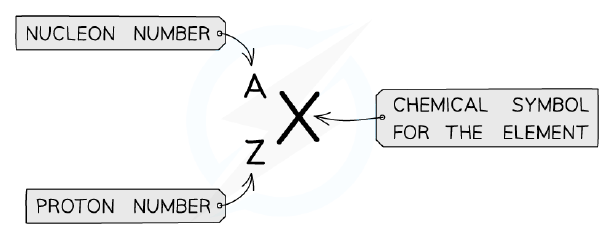
- A nucleus is described using ZA X notation: A is the nucleon (mass) number (total protons + neutrons) and Z is the proton (atomic) number (total protons).
Nuclide notation
Emission & Absorption Spectra
- Atomic spectra are observed when atoms emit or absorb light of certain wavelengths, providing evidence that electrons can only transition between discrete energy levels.
- Emission spectra are produced by heating a low-pressure gas: electrons are excited to higher levels, then emit photons when they transition back down, producing coloured lines on a black background.
- Absorption spectra are produced by passing white light through a cool, low-pressure gas: photons with the exact energy required to excite electrons are absorbed, producing dark lines on a coloured background.
- The dark lines in an absorption spectrum correspond to the same wavelengths as the bright lines in the emission spectrum of the same element.
- Each element produces a unique pattern of spectral lines, so elements can be identified by their atomic spectrum (like a fingerprint).
- Examples: hydrogen has strong red lines at 656 nm; sodium produces yellow lines at 589 nm; mercury has most lines below 450 nm, giving blue light.
- In a fluorescent tube, an electrical discharge excites electrons in vapourised atoms; when electrons return to the ground state, they emit specific wavelengths of light.
Photon Energy
- A photon is defined as a massless "packet" or "quantum" of electromagnetic energy; energy is transferred in discrete packets, not continuously.
- Electrons in an atom occupy certain energy levels; they occupy the lowest possible energy level (ground state) for stability.
- Excitation: an electron moves to a higher energy level by absorbing a photon; the atom is in an excited state.
- De-excitation: an electron moves to a lower energy level by emitting a photon.
- Ionisation: an electron is removed from an atom; the ionisation energy is the minimum energy required to remove an electron from the ground state.
- Energy levels are represented as horizontal lines: the bottom line (most negative energy) is the ground state, lines above are excited states, and the top line (0 V or infinity) represents the ionisation energy.
- Photon energy is calculated using E = hf or E = hc/λ, where h = Planck's constant (J s), c = speed of light (m s⁻¹), f = frequency (Hz), λ = wavelength (m).
- The energy difference between two levels is ΔE = hf = E₂ − E₁; the larger the energy difference, the shorter the wavelength.
Rutherford Scattering & Nuclear Radius
- The nuclear radius R depends on the nucleon number A: R = R₀ A^(1/3), where R₀ = 1.20 × 10⁻¹⁵ m is the Fermi radius (radius of a hydrogen nucleus, A = 1).
- Nuclear volume V = (4/3)πR³ = (4/3)πR₀³ A, so V is proportional to the mass of the nucleus m = Au, where u is the atomic mass unit.
- Nuclear density is given by ρ = 3u / (4πR₀³); since A cancels, density is the same for all nuclei and independent of radius.
- Nuclear density is of the order 10¹⁷ kg m⁻³, significantly larger than atomic density, showing the nucleus contains most of the atom's mass and the atom is predominantly empty space.
- In the Rutherford scattering experiment, α particles are fired at a thin gold foil; some come straight back due to electrostatic repulsion between the α particle and the gold nucleus.
- At the point of closest approach d, the α particle's initial kinetic energy equals the electric potential energy: Ek = Ep = kQq/d = k(2e)(Ze)/d.
- Rearranging gives d = k(2Ze²)/Ek, which gives a value for the radius of the nucleus (assuming high-energy α particles).
- The charge of an α particle is 2e (2 protons); the charge of a target nucleus is Ze, where Z is the proton number.
Deviations from Rutherford Scattering
- Rutherford's model predicted that as the scattering angle increases, the number of α particles scattered at that angle decreases; this holds at low to moderately high energies.
- At very high energies (>27.5 MeV), significant deviations occur: the number of back-scattered α particles sharply decreases to zero instead of following the predicted relationship.
- Rutherford's original model assumed α particles interact only through electrostatic repulsion.
- If α particle energy exceeds 27.5 MeV, they get close enough to interact with the nucleus via the strong nuclear force.
- Factoring in the strong nuclear force explains the observed scattering pattern, so deviations provide evidence for the strong nuclear force.
- Deviations are greatest when α particles have high energies and target nuclei have low nucleon number (e.g., aluminium vs gold).
- At very small separations (<1.5 fm), the strong nuclear force becomes significant.
Rutherford's Alpha Scattering Experiment
The Bohr Model of Hydrogen
- Hydrogen is the simplest atom, ideal for investigating electron energy levels; its line spectra show electrons transition between specific energy levels, producing photons of specific energies.
- Transitions are grouped into series: Lyman series converges on n = 1 (ultraviolet, highest energy photons); Balmer series converges on n = 2; Ritz-Paschen on n = 3; Pfund series converges on n = 5 (infrared, lowest energy photons).
- The Bohr model states that electrons can only move in fixed orbits and the orbital radius is restricted to certain values.
- The discrete energy levels of hydrogen are given by E = −13.6/n² eV, where n is an integer (1, 2, 3, ...).
- Angular momentum is quantised: L = n(h/2π), where n is an integer, h is Planck's constant; angular momentum for an electron in a circular orbit is constant.
- de Broglie proposed that an electron with momentum p = mv has a wavelength λ = h/p; for a circular orbit, the matter wave must form a standing wave with constructive interference.
- The condition for a standing wave is nλ = 2πr, leading to the Bohr condition: nh/2π = mvr.
- A limitation of the Bohr model is that it cannot explain the spectra of atoms with more than one electron.
幻灯片
练习题
免费预览——63 题中的 8 题。注册即可查看全部。
1.Which of the following is the correct definition of an isotope?
Easy- AAtoms of the same element with the same number of protons but different numbers of neutrons
- BAtoms of different elements with the same nucleon number
- CAtoms of the same element with the same number of neutrons but different numbers of protons
- DAtoms that have lost or gained electrons to become charged
2.In the notation for a nuclide, what does the top number A represent?
Easy- AThe total number of protons and neutrons in the nucleus
- BThe total number of protons in the nucleus
- CThe total number of neutrons in the nucleus
- DThe total number of electrons in the atom
3.Which subatomic particle has a relative charge of +1 and a mass of approximately 1 u?
Easy- AProton
- BNeutron
- CElectron
- Dα particle
4.In Rutherford's gold foil experiment, what observation led him to conclude that the atom is mostly empty space?
Medium- AMost α particles passed straight through the foil undeflected.
- BA small number of α particles were deflected through angles greater than 90°.
- CSome α particles were deflected through small angles of less than 10°.
- Dα particles were absorbed by the gold foil.
5.Which statement about nuclear density is correct?
Medium- AIt is the same for all nuclei and independent of the nuclear radius.
- BIt increases as the nucleon number increases.
- CIt decreases as the nucleon number increases.
- DIt is proportional to the volume of the nucleus.
6.An emission spectrum consists of:
Medium- ABright coloured lines on a dark background
- BDark lines on a continuous coloured background
- CA continuous spectrum of all wavelengths
- DA single bright line
7.Which of the following gives the energy of a photon in terms of its wavelength λ?
Medium- AE = hc/λ
- BE = hλ/c
- CE = hf
- DE = λ/hc
8.In the Bohr model of the hydrogen atom, the energy of an electron in level n is given by E = −13.6/n² eV. What is the energy of the electron in the ground state?
Medium- A−13.6 eV
- B−3.4 eV
- C−1.51 eV
- D0 eV
历年真题
该知识点的历年真题练习即将推出。
即将推出