Thermodynamics
边玩边学
回答这些题目来赚取能量,然后钓鱼探索。无需账号。
课程笔记
Thermodynamic Systems and Internal Energy
- The internal energy of an ideal gas is the total kinetic energy of its particles, as ideal gas molecules have no intermolecular forces and therefore no potential energy.
- For an ideal gas, the change in internal energy is directly proportional to the change in temperature: ΔU ∝ ΔT.
- The change in internal energy can be calculated using ΔU = (3/2)NkBΔT, where N is the number of particles and kB is the Boltzmann constant.
- Alternatively, ΔU = (3/2)nRΔT, where n is the number of moles and R is the molar gas constant.
- When a gas is heated, its molecules move faster, increasing their kinetic energy and thus the internal energy.
- In solids and liquids, molecules have both kinetic and potential energy due to intermolecular forces, but in an ideal gas, only kinetic energy contributes to internal energy.
Work Done by a Gas
- When a gas expands, it does work on its surroundings; when it is compressed, work is done on the gas.
- For a gas expanding at constant pressure, the work done is given by W = pΔV, where p is the pressure and ΔV is the change in volume.
- The work done by a gas can be determined from the area under a pressure-volume (p-V) diagram.
- On a p-V diagram, an expansion (volume increase) corresponds to positive work done by the gas, while a compression (volume decrease) corresponds to negative work done by the gas.
- When the volume is constant, no work is done (W = 0).
- The pressure p in the work done equation is the pressure of the surroundings, not the pressure of the gas itself.
Energy transfer and conservation
First Law of Thermodynamics
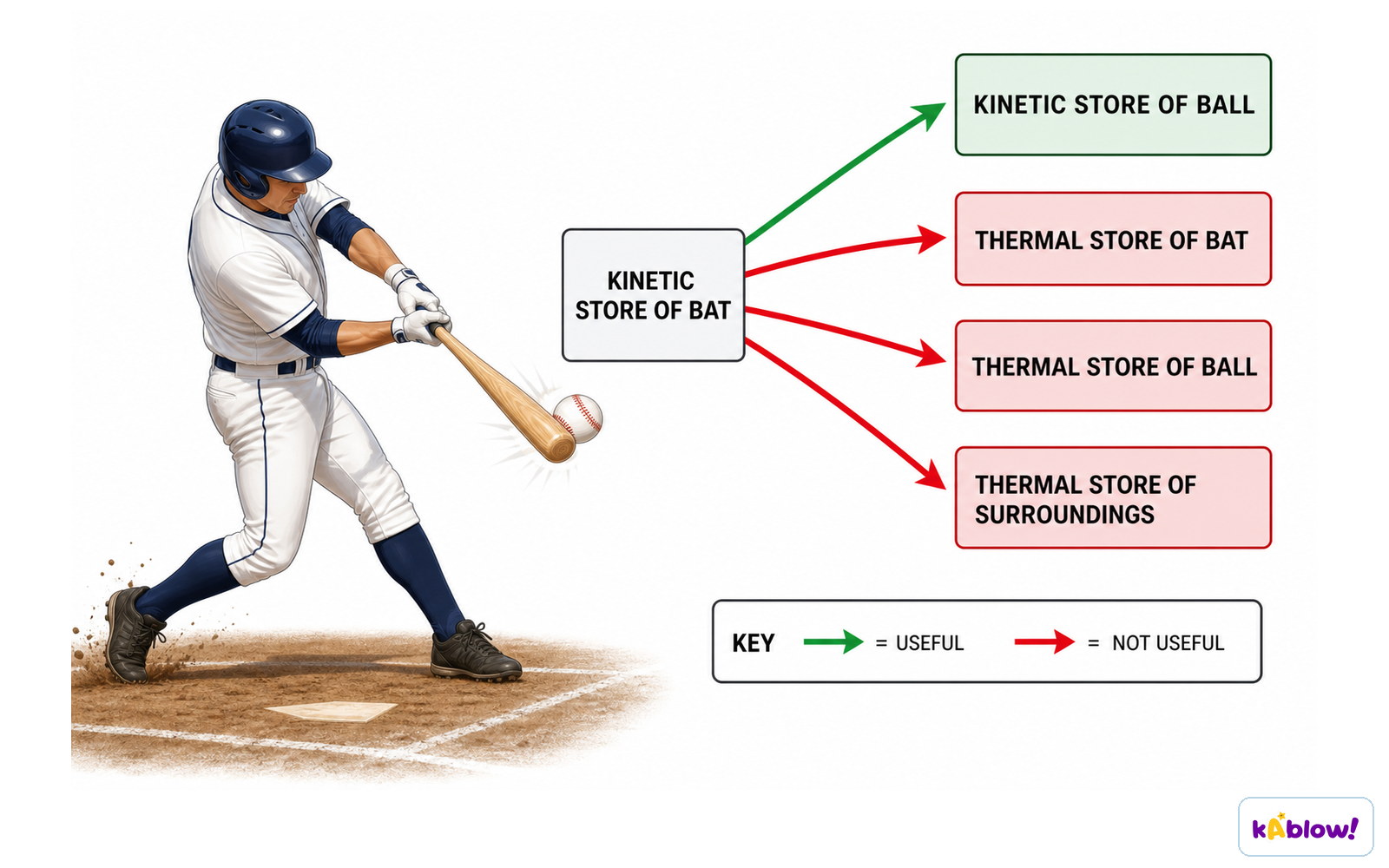
- The First Law of Thermodynamics is a statement of conservation of energy: Q = ΔU + W, where Q is energy supplied by heating, ΔU is change in internal energy, and W is work done by the system.
- Sign convention: Q is positive when heat is added to the system, W is positive when work is done by the system, and ΔU is positive when internal energy increases.
- For a constant pressure (isobaric) process, work done is W = pΔV, so Q = ΔU + pΔV.
- For a constant volume (isovolumetric) process, no work is done (W = 0), so Q = ΔU.
- For an isothermal process, ΔU = 0, so Q = W.
- For an adiabatic process, Q = 0, so W = −ΔU, meaning work done is at the expense of internal energy.
Entropy
- Entropy is a measure of the number of possible arrangements of particles and their energies, i.e., a measure of disorder.
- The order of entropy from most disordered to least is: gas > liquid > solid.
- Entropy increases when a substance melts or boils, and decreases when it condenses or freezes.
- Entropy increases when a solid dissolves in a solvent or when a gas diffuses, because particles become more spread out and there are more ways to arrange energy.
- On a microscopic level, entropy is given by S = kB ln Ω, where Ω is the number of microstates.
- The change in entropy when the number of microstates changes from Ω1 to Ω2 is ΔS = kB ln(Ω2/Ω1).
Calculating Changes in Entropy
- At constant temperature, the change in entropy is ΔS = ΔQ/T, where ΔQ is heat added or removed and T is the temperature in Kelvin.
- When heat is added (ΔQ > 0), entropy increases (ΔS > 0); when heat is removed (ΔQ < 0), entropy decreases (ΔS < 0).
- For a reversible process that returns to the original state, ΔQ = 0 and ΔS = 0.
- For a system of N distinguishable particles confined to one of two compartments, the initial number of microstates is Ω1 = 1, and after removing the partition, Ω2 = 2N.
- The change in entropy when a gas expands from volume V to 2V is ΔS = NkB ln 2.
Second Law of Thermodynamics
- The Second Law of Thermodynamics states that the total entropy of an isolated system always increases; for a non-isolated system, the entropy of the Universe must increase.
- Clausius form: Thermal energy cannot spontaneously transfer from a region of lower temperature to a region of higher temperature.
- Kelvin form: When extracting energy from a heat reservoir, it is impossible to convert it all into work.
- A reversible process is one where there is no overall change in entropy as the system and surroundings return to their original states.
- An irreversible process results in an increase in entropy, and real isolated systems always undergo irreversible processes.
- The entropy of a non-isolated system can decrease locally, but this is compensated by an equal or greater increase in the entropy of the surroundings.
Thermodynamic Processes
- Isovolumetric (constant volume): W = 0, so Q = ΔU.
- Isobaric (constant pressure): W = pΔV, so Q = ΔU + pΔV.
- Isothermal (constant temperature): ΔU = 0, so Q = W.
- Adiabatic (no heat transfer): Q = 0, so W = −ΔU.
- For a monatomic ideal gas undergoing an adiabatic process, pV^(5/3) = constant, which can be used to find changes in pressure, volume, and temperature.
- In an adiabatic expansion, the gas does work and cools down; in an adiabatic compression, work is done on the gas and it heats up.
Heat Engines
- A heat engine converts thermal energy into mechanical work through a cyclic process.
- The cycle involves: extracting heat QH from a hot reservoir, doing work W, and releasing heat QC to a cold reservoir.
- The net work done by the engine is W = QH − QC.
- The efficiency of a heat engine is η = W/QH = 1 − QC/QH.
- On a p-V diagram, a cyclic process forms a closed loop, and the area inside the loop equals the net work done per cycle.
The Carnot Cycle
- The Carnot cycle is an idealised reversible cycle with the maximum possible efficiency.
- It consists of four stages: isothermal expansion, adiabatic expansion, isothermal compression, and adiabatic compression.
- During isothermal expansion, the gas absorbs heat QH at temperature TH; during isothermal compression, it releases heat QC at temperature TC.
- During adiabatic stages, no heat is transferred, but temperature changes between TH and TC.
- The maximum theoretical efficiency of a Carnot engine is ηC = 1 − TC/TH, where temperatures are in Kelvin.
- For a Carnot cycle, QH/TH = QC/TC, which leads to the efficiency formula.
- Any heat engine operating between two temperatures cannot exceed the Carnot efficiency; otherwise, it violates the second law of thermodynamics.
幻灯片
练习题
免费预览——64 题中的 8 题。注册即可查看全部。
1.What is internal energy?
Easy- AThe total kinetic and potential energy of the particles in a system
- BThe total energy transferred to a system by heating
- CThe energy transferred when work is done on a system
- DThe average kinetic energy of the particles in a system
2.Which of the following is the correct definition of entropy?
Easy- AA measure of the disorder of a system
- BA measure of the average kinetic energy of particles
- CA measure of the total energy of a system
- DA measure of the work done by a system
3.In an adiabatic process, no heat is transferred into or out of the system.
EasyTrue or false?
4.The second law of thermodynamics states that the total entropy of an isolated system always decreases.
EasyTrue or false?
5.In which process is a gas doing the least amount of work?
Medium- AIsothermal expansion
- BIsobaric expansion
- CIsovolumetric heating
- DAdiabatic expansion
6.A gas is kept in a closed container at room temperature. A lit Bunsen burner is then placed under this container. Which row correctly describes the changes the gas undergoes?
Medium- AWork done on gas: positive; Change in internal energy: positive
- BWork done on gas: zero; Change in internal energy: zero
- CWork done on gas: positive; Change in internal energy: zero
- DWork done on gas: zero; Change in internal energy: positive
7.A hypothetical car is running on a Carnot engine. Once the car has been driving for a while, the gas in the engine has a minimum temperature of 275 K. The engine has an efficiency of 0.75. What is the temperature range of the gas in the engine?
Medium- A92 K
- B367 K
- C825 K
- D1100 K
8.An ideal gas has an initial pressure of 150 kPa, an initial temperature of 27°C, and an initial volume of 0.2 m³. During an isobaric compression, the volume of the gas decreases by 0.005 m³. What is the final pressure of the gas?
Medium- A50 kPa
- B150 kPa
- C240 kPa
- D480 kPa