Forces & Momentum
边玩边学
回答这些题目来赚取能量,然后钓鱼探索。无需账号。
课程笔记
Free-Body Diagrams
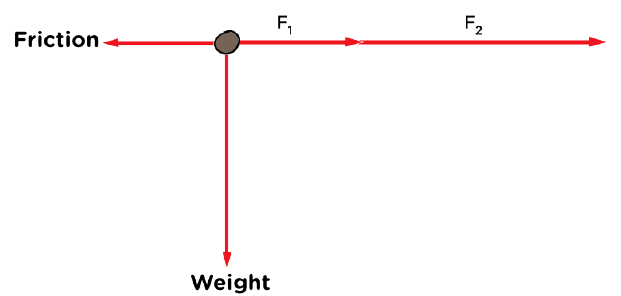
- A free-body diagram shows all the forces acting on a single object, represented as a point particle at its centre of mass.
- Each force is drawn as a vector arrow: the length represents magnitude and the direction shows the force's direction.
- Forces are labelled with conventional symbols such as Fg (weight), FN (normal contact force), FT (tension) and Ff (friction).
- Common forces to include: weight always acts towards the planet's surface; tension pulls away from the mass; normal contact force acts perpendicular to a surface; friction opposes motion.
- The resultant force is the vector sum of all forces acting on the body and determines the change in its motion.
- Forces can be balanced (resultant force zero) or unbalanced (non-zero resultant force).
- In one dimension, combine forces by adding them with sign according to direction; in two dimensions, use Pythagoras or trigonometry to find the resultant.
Forces on an object
Newton's First Law
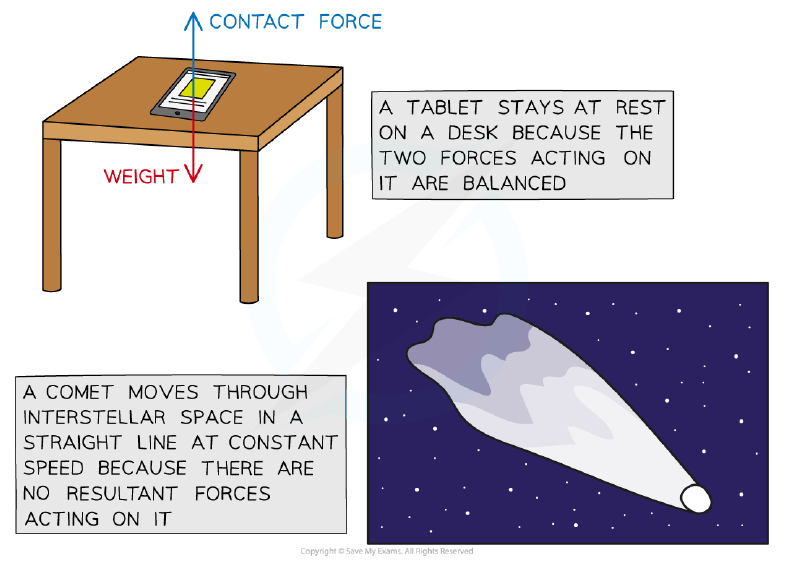
- Newton's first law: a body remains at rest or moves with constant velocity unless acted on by a resultant force.
- If the resultant force on an object is zero, it is in translational equilibrium and must be either at rest or moving at a constant velocity.
- A resultant force changes an object's motion by speeding it up, slowing it down, or changing its direction.
- For balanced forces, the forces to the left equal the forces to the right, and upward forces equal downward forces.
- Constant velocity means zero acceleration, so the forces must be balanced even if the object is moving.
Examples of Newton's First Law
Newton's Second Law
- Newton's second law: the resultant force on an object is directly proportional to its acceleration, written as F = ma.
- The acceleration always acts in the same direction as the resultant force.
- If the resultant force acts along the direction of motion, the object speeds up; if it opposes motion, the object slows down.
- If the resultant force acts at an angle to the direction of motion, the object changes direction.
- Newton's second law can also be expressed as: the resultant force equals the rate of change of momentum, F = Δp/Δt.
- For a falling object with no drag, acceleration is independent of mass.
Newton's second law in action

Newton's Third Law
- Newton's third law: if Object A exerts a force on Object B, then Object B exerts a force on Object A that is equal in magnitude and opposite in direction.
- Forces in a third-law pair must be the same type, have the same magnitude, act in opposite directions, and act on different objects.
- Example: a foot pushes the ground backwards, and the ground pushes the foot forwards; both are normal contact forces.
- A free-body diagram showing weight and normal contact force on the same object is an example of Newton's first law, not third law.
- To apply Newton's third law, consider the interaction between two objects: e.g., the book pushes on the table and the table pushes back on the book.
Contact and Non-Contact Forces
- A contact force acts between objects that are physically touching; examples include friction, fluid resistance (viscous drag), tension, and normal reaction force.
- Surface friction opposes motion when surfaces rub against each other, e.g., car wheels on the ground.
- Viscous drag (fluid resistance) occurs when an object moves through a liquid or gas; air resistance is a type of viscous drag.
- Tension occurs within an object when pulling forces are applied to both ends.
- The normal force is the component of the contact force perpendicular to the surface that counteracts the body.
- A non-contact force acts at a distance due to a field; examples include gravitational, electrostatic, and magnetic forces.
- Gravitational force is the attractive force between objects with mass; weight is Fg = mg.
- Electrostatic and magnetic forces can be attractive or repulsive.
Frictional Forces
- Frictional forces oppose motion: they can prevent a stationary object from moving or reduce the speed of a moving object.
- Friction transfers energy by heating, raising the thermal energy of the objects and surroundings.
- Static friction occurs when a body is stationary on a surface; it matches any push or pull until it can no longer hold the object stationary.
- Dynamic friction occurs when a body is in motion on a surface and has a constant value for a given situation.
- For any given situation, the maximum static friction is larger than dynamic friction.
- The equation for static friction is Ff ≤ μs FN; for dynamic friction it is Ff = μd FN.
- The coefficient of friction is a number between 0 and 1 (not including 0 or 1) and depends on the two surfaces.
Hooke's Law
- Hooke's law: the extension of a material is directly proportional to the applied force up to the limit of proportionality.
- Hooke's law is expressed as FH = −kx, where k is the spring constant (N m⁻¹) and x is the extension (m).
- The spring constant measures the stiffness of a material; a larger k means a stiffer material.
- Extension is the difference between the stretched length and the unstretched length: extension = stretched length − unstretched length.
- A force–extension graph for a material obeying Hooke's law is a straight line through the origin; the gradient of this linear region equals the spring constant k.
- If the axes are swapped (force on x-axis, extension on y-axis), the gradient is 1/k instead.
Stoke's Law
- Viscous drag is the frictional force between an object and a fluid that opposes their relative motion.
- Stoke's law gives the viscous drag force on a sphere: Fd = 6πηrv.
- In the equation, η is the fluid viscosity (N s m⁻² or Pa s), r is the sphere's radius (m), and v is its velocity (m s⁻¹).
- The drag force depends on the speed, size, and shape of the object, and on the viscosity of the fluid.
- Viscosity is a measure of a fluid's resistance to flow; fluids with high viscosity are difficult to pour.
- The rate of flow of a fluid is inversely proportional to its coefficient of viscosity.
Conservation of Linear Momentum
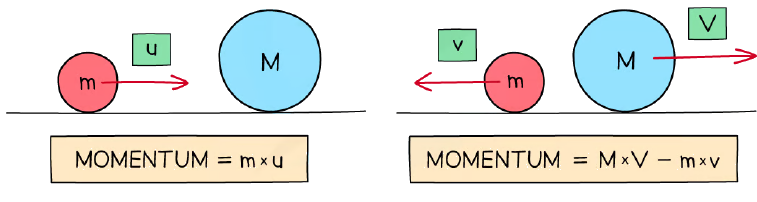
- Momentum is the product of mass and velocity: p = mv; it is a vector quantity.
- The fundamental SI units of momentum are kg m s⁻¹ (or N s).
- The conservation of linear momentum states that total momentum remains constant in a closed system with no external forces.
- For collisions or explosions in one dimension, total momentum before = total momentum after.
- In an elastic collision, both momentum and kinetic energy are conserved.
- In an inelastic collision, momentum is conserved but kinetic energy is not conserved (some is transferred to other forms).
Conservation of momentum
Impulse and Force
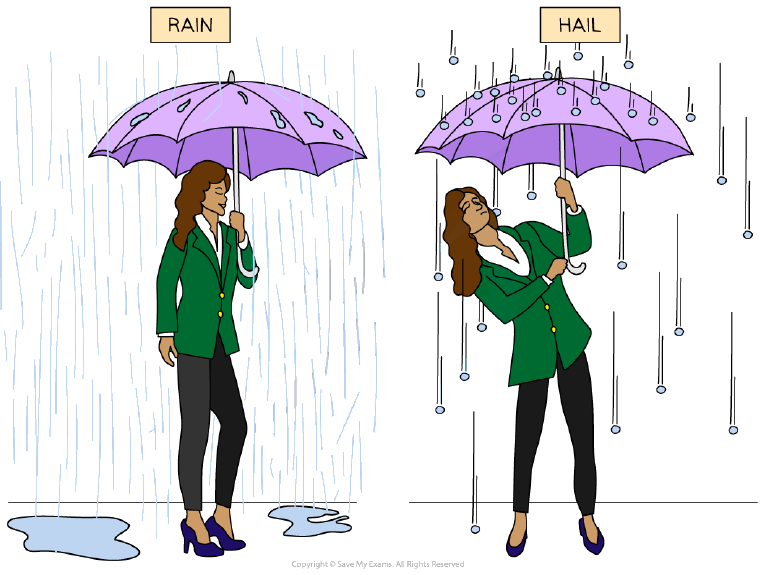
- Impulse is the product of force and the time for which it acts: Impulse = FΔt.
- Impulse is also equal to the change in momentum: FΔt = Δp.
- The area under a force–time graph gives the impulse.
- Newton's second law in terms of momentum: the resultant force equals the rate of change of momentum, F = Δp/Δt.
- A crumple zone increases the impact time during a collision, which reduces the force exerted on the car and its passengers.
Comparison of holding an umbrella in rain versus hail, illustrating impulse.
Circular Motion
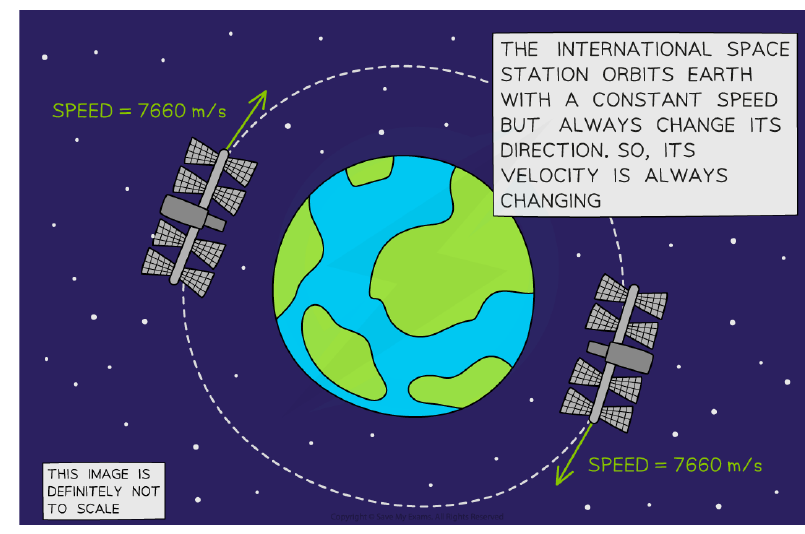
- Objects moving in a circle have a constantly changing direction, so their velocity is constantly changing and they are accelerating.
- Angular velocity ω is the rate of change of angle, measured in rad s⁻¹.
- Centripetal acceleration is directed towards the centre of the circle and has magnitude a = v²/r or a = ω²r.
- Centripetal force is the resultant force directed towards the centre that keeps an object moving in a circle, given by F = mv²/r or F = mω²r.
- In non-uniform circular motion, the speed changes as well as the direction, so there is both a centripetal and a tangential component of acceleration.
Circular motion of the International Space Station
幻灯片
练习题
免费预览——65 题中的 8 题。注册即可查看全部。
1.Which of the following is the correct definition of a contact force?
Easy- AA force which acts between objects that are physically touching
- BA force which acts at a distance without physical contact
- CA force that only acts on stationary objects
- DA force that always opposes motion
2.Which of the following is a non-contact force?
Easy- AFriction
- BTension
- CGravitational force
- DNormal contact force
3.Which of the following is the correct equation for static friction?
Easy- AFf = μs FN
- BFf ≤ μs FN
- CFf ≥ μs FN
- DFf = μs / FN
4.A box is sliding down a slope at constant speed. Which of the following is true about the frictional force acting on it?
Medium- AIt acts up the slope and is equal in magnitude to the component of weight down the slope
- BIt acts down the slope and is equal in magnitude to the component of weight down the slope
- CIt acts up the slope and is greater than the component of weight down the slope
- DIt acts perpendicular to the slope
5.A spherical stone falls through the air and experiences a drag force of 3 mN at a particular instant. Air has a viscosity of 1.81 × 10⁻⁵ Pa s and the stone has a radius of 0.04 m. Calculate the speed of the stone at that instant.
Medium- A0.66 m/s
- B0.33 m/s
- C1.32 m/s
- D0.22 m/s
6.Which of the following are examples of contact forces? (Select all that apply)
Medium- AFriction
- BTension
- CGravitational force
- DNormal contact force
- EMagnetic force
7.Which of the following statements about Newton's third law are correct? (Select all that apply)
Medium- AThe forces are the same type
- BThe forces act on the same object
- CThe forces are equal in magnitude
- DThe forces act in opposite directions
- EThe forces act on different objects
8.Newton's first law states that a body will remain at rest or move with constant velocity unless acted on by a resultant force.
EasyTrue or false?