Radioactive Decay
边玩边学
回答这些题目来赚取能量,然后钓鱼探索。无需账号。
给教育者: 面向 Radioactive Decay(Physics,SL)的即用型课程幻灯片, 复习笔记——用在你的课堂上,或将该知识点作为学习者可实时游玩的互动课堂活动来运行。
课程笔记
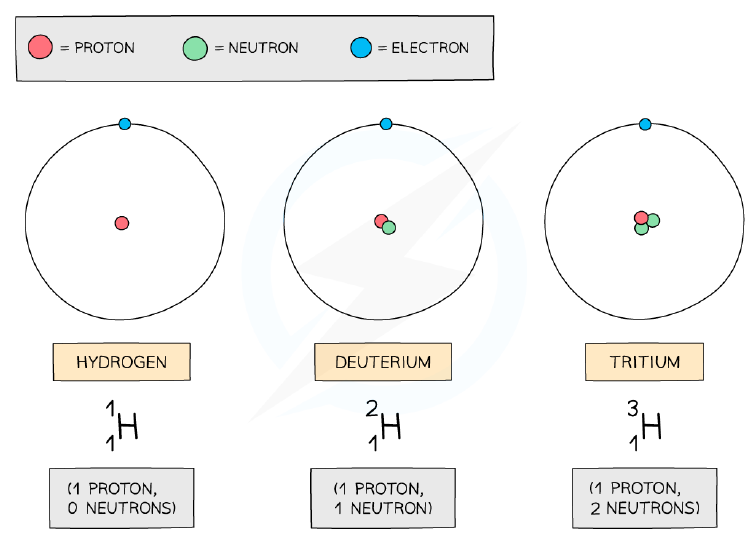
Isotopes
- Isotopes are nuclei with the same number of protons but different numbers of neutrons.
- An isotope of an element has a fixed proton number (Z) but a different nucleon number (A).
- Some isotopes are unstable due to an imbalance of neutrons and protons, causing them to decay and emit radiation.
- Unstable isotopes can decay over timescales ranging from a few nanoseconds to 100,000 years.
- Isotopic data refers to the relative amounts of different isotopes of an element in a substance.
- The relative atomic mass of an element is calculated using the masses and abundances of its naturally occurring isotopes.
- The percentage abundance of isotopes in a sample can be measured using a mass spectrometer.
Isotopes of hydrogen
Radioactive Decay
- Radioactive decay is the spontaneous disintegration of a nucleus to form a more stable nucleus, emitting an α, β or gamma particle.
- Radioactive decay is a random process: the exact time of decay of a nucleus cannot be predicted.
- Each nucleus has a constant probability of decaying in a given time.
- Radioactive decay is spontaneous: it cannot be influenced by environmental factors such as temperature, pressure or chemical conditions.
- The random nature of decay is demonstrated by fluctuations in the count rate of a Geiger-Muller (GM) tube.
- With large numbers of nuclei, the behaviour of the group can be statistically predicted.
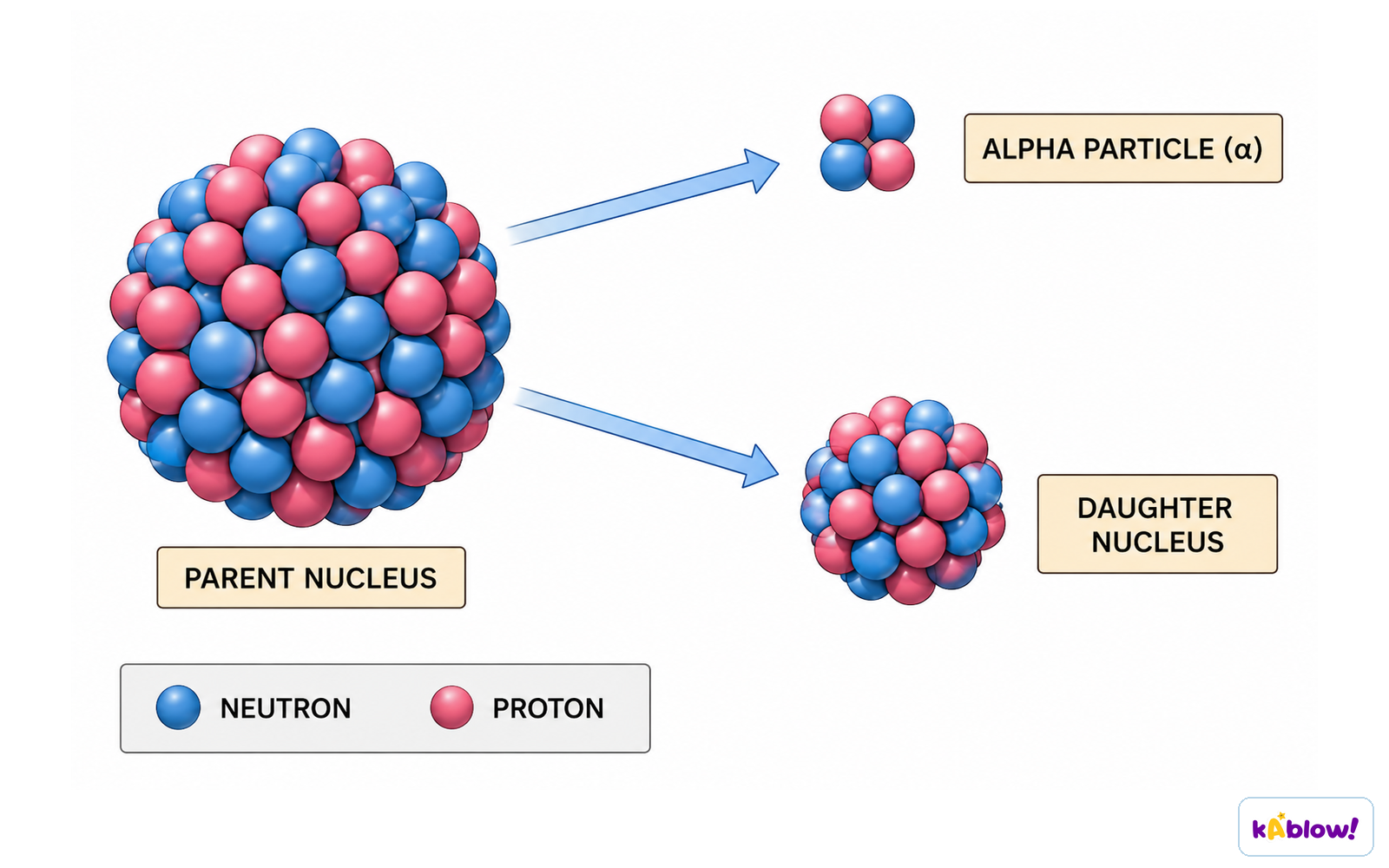
Alpha decay
Background Radiation
- Background radiation is the ionising radiation present in the environment.
- Natural sources include radon gas from rocks and buildings, cosmic rays from space, carbon-14 in biological material, and radioactive material in food and drink.
- In the UK, radon gas is the largest proportion of background radiation.
- Artificial sources include nuclear medicine, nuclear waste, nuclear fallout and nuclear accidents.
- Background radiation must be accounted for by measuring the count rate with no source present and subtracting it from readings with the source present.
- The corrected count rate is the count rate of a source minus the background count rate.
- Accuracy of count rate measurements can be improved by repeating readings and taking averages, and by taking readings over a long period of time.
Alpha, Beta & Gamma Particles
- An α (α) particle is a high-energy helium nucleus containing 2 protons and 2 neutrons; it has mass 4u and charge +2e.
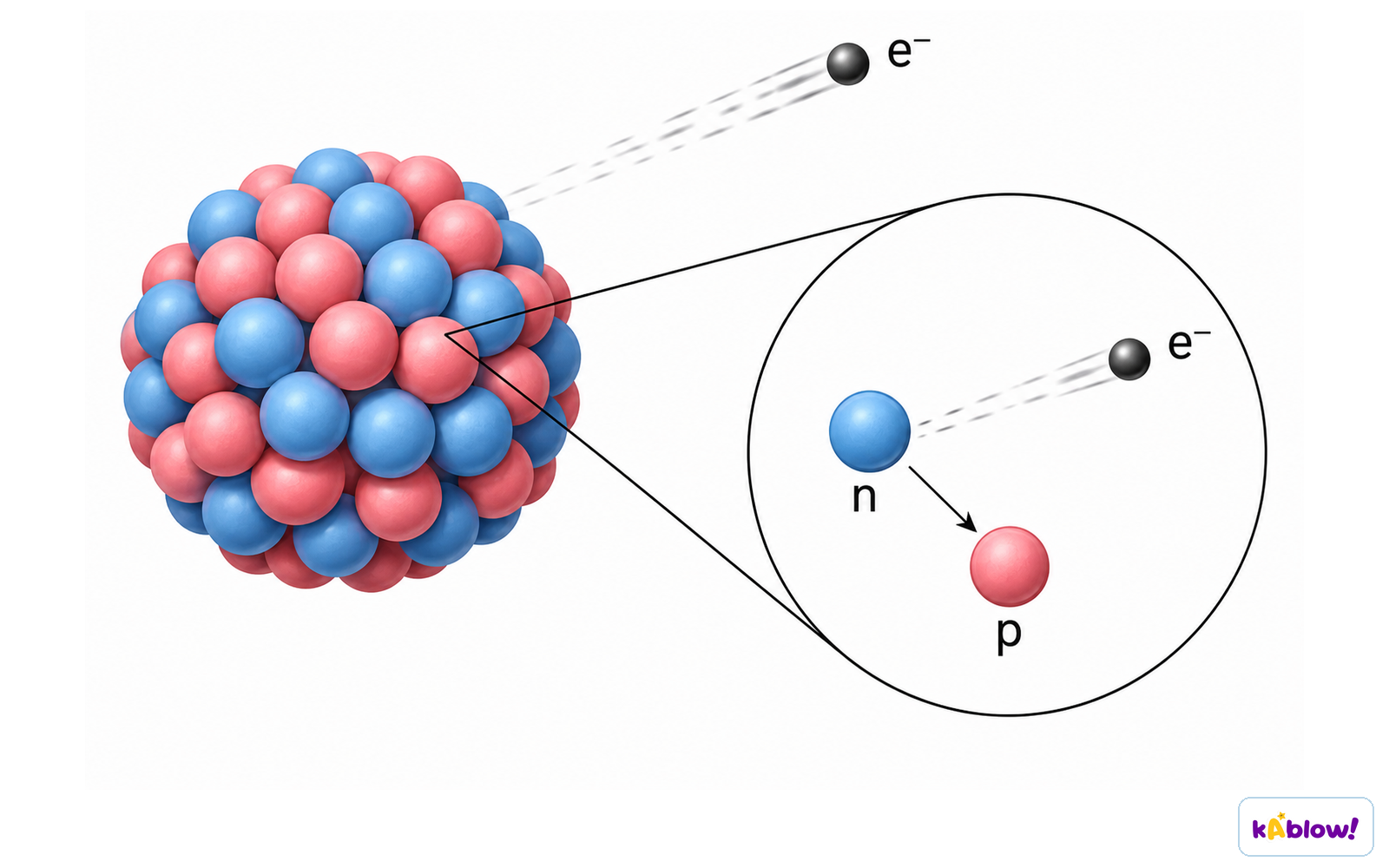
- A β-minus (β⁻) particle is a high-energy electron with mass 0.0005u and charge −1e; it is emitted when a neutron turns into a proton.
- A β-plus (β⁺) particle is a high-energy positron with mass 0.0005u and charge +1e; it is emitted when a proton turns into a neutron.
- Gamma (γ) radiation is high-energy electromagnetic radiation emitted by nuclei losing excess energy; it has no charge and no mass.
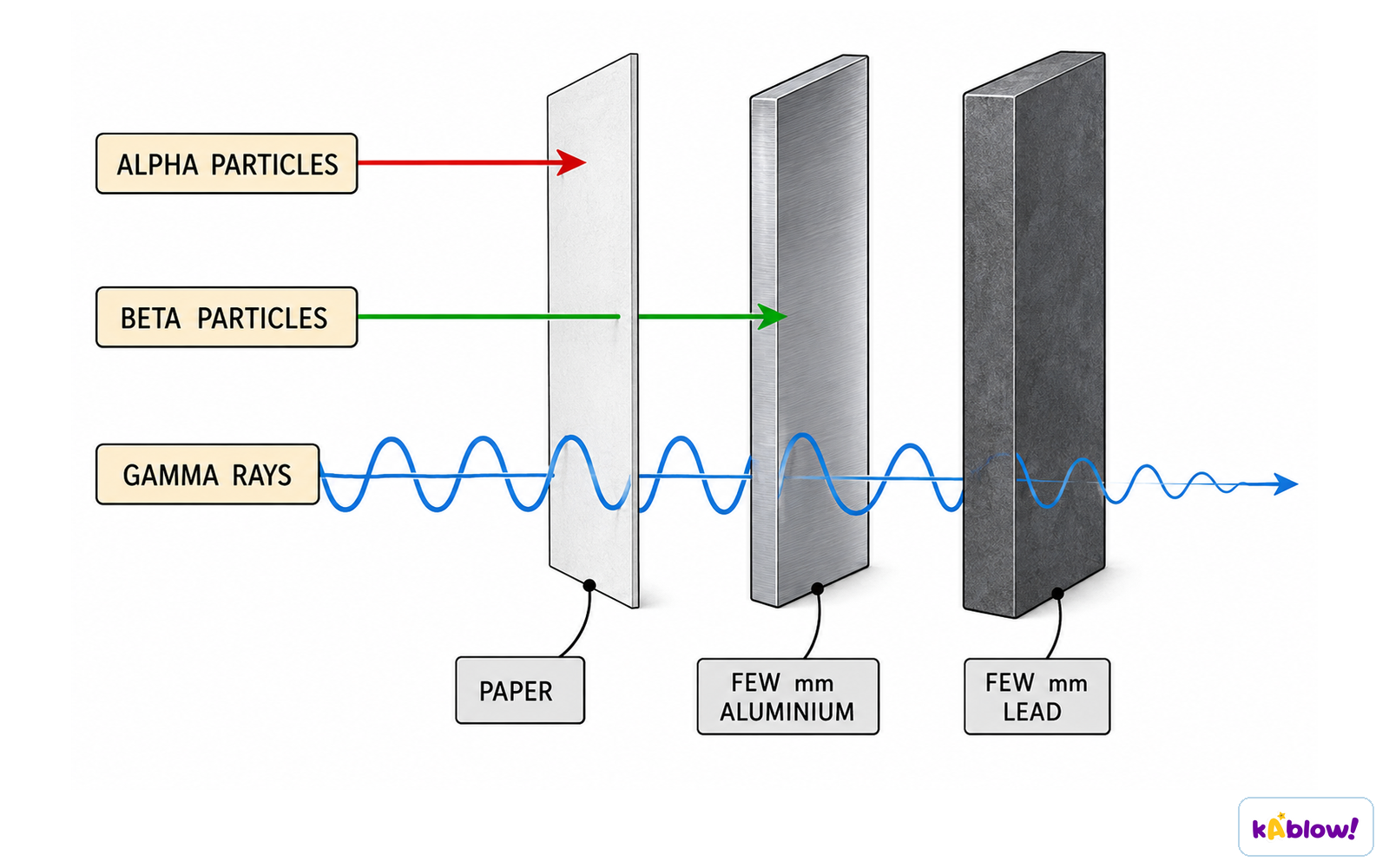
- α particles are highly ionising and have low penetrating power; they can be stopped by a sheet of paper.
- β particles are moderately ionising and penetrating; they can be stopped by a few millimetres of aluminium foil.
- Gamma radiation is weakly ionising and highly penetrating; its intensity can be reduced by several centimetres of lead or metres of concrete.
- In electric and magnetic fields, α and β particles are deflected, while gamma radiation is not.
Penetrating power of alpha, beta and gamma radiation
Radioactive Decay Equations
- α decay: nucleon number decreases by 4, proton number decreases by 2. General equation: ᴬZ X → ᴬ⁻⁴Z−2 Y + ⁴₂α.
- β-minus decay: nucleon number stays the same, proton number increases by 1. General equation: ᴬZ X → ᴬZ+1 Y + ⁰−1β + ν̄e.
- β-plus decay: nucleon number stays the same, proton number decreases by 1. General equation: ᴬZ X → ᴬZ−1 Y + ⁰+1β + νe.
- Electron capture: a proton combines with an orbiting electron to form a neutron and a neutrino; proton number decreases by 1, nucleon number stays the same.
- Gamma emission: proton number and nucleon number remain unchanged; it usually follows α or β decay.
- An electron neutrino (νe) is produced during β⁺ decay; an electron antineutrino (ν̄e) is produced during β⁻ decay.
- Decay modes are determined by the type of instability: too many neutrons → β⁻; too many protons → β⁺ or electron capture; too many nucleons → α; too much energy → γ.
Beta decay
Activity & Half-Life
- Activity is the number of nuclei that decay per unit time, measured in becquerels (Bq); 1 Bq = 1 decay per second.
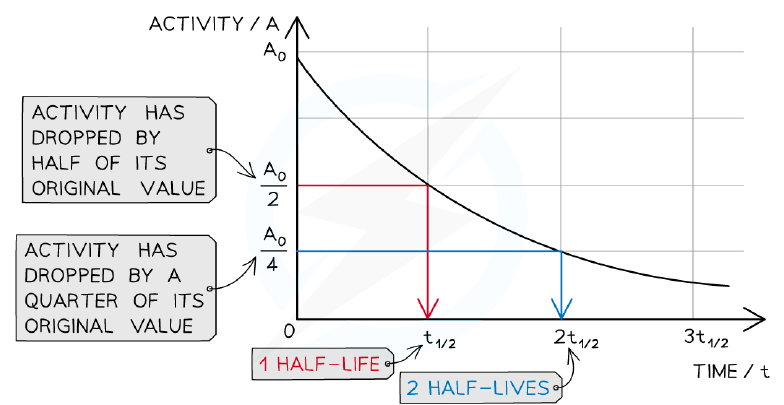
- Half-life is the time taken for half the undecayed nuclei to decay, or for the activity to fall to half its original value.
- Different isotopes have different half-lives, ranging from fractions of a second to billions of years.
- The proportion of an isotope remaining after n half-lives is (1/2)ⁿ.
- After 1 half-life, 50% remains; after 2, 25%; after 3, 12.5%; after 4, 6.25%.
- To find half-life from a graph, determine the time for the activity to halve from its initial value.
- The half-life is constant for a particular isotope.
A half-life graph showing activity falling from A0 to A0/2 to A0/4
Applications of Radioactivity
- When selecting a radioactive isotope for use, consider its penetrating power and half-life.
- Carbon dating: carbon-14 has a half-life of about 5730 years; it is used to date samples between 500 and 60,000 years old.
- Uranium-lead dating: uranium-238 decays to lead-206 with a half-life of 4.5 billion years; used to determine the age of rocks and the Earth.
- Detecting leaks in underground pipes uses a gamma emitter (e.g. sodium-24) because gamma radiation can penetrate several metres of ground.
- Controlling thickness of materials uses β radiation (e.g. for aluminium foil) because α would be absorbed and gamma would pass through undetected.
- Smoke detectors contain americium-241, an α emitter; α particles ionise air, allowing a small current that is disrupted by smoke.
- Sterilising equipment uses gamma radiation (e.g. cobalt-60) because it can penetrate sealed plastic bags.
Mass Defect & Nuclear Binding Energy
- Mass defect is the difference between the mass of a nucleus and the sum of the masses of its individual nucleons.
- Binding energy is the energy required to separate a nucleus into its constituent protons and neutrons.
- Mass and energy are related by Einstein's equation: ΔE = Δmc².
- The binding energy of a nucleus can be calculated using the mass defect: E = Δm c².
- Binding energy per nucleon is the binding energy of a nucleus divided by the number of nucleons in the nucleus.
- A higher binding energy per nucleon indicates a more stable nucleus.
- The mass defect for helium-4 is about 5.04 × 10⁻²⁹ kg, giving a binding energy of about 28 MeV.
Binding Energy per Nucleon Curve
- The binding energy per nucleon curve plots binding energy per nucleon against nucleon number.
- The curve rises steeply for light nuclei, peaks around iron-56 (nucleon number ~56), and gradually decreases for heavier nuclei.
- The peak represents the most stable nuclei, with a binding energy per nucleon of about 8.8 MeV.
- Nuclei with lower binding energy per nucleon are less stable and can undergo fusion (light nuclei) or fission (heavy nuclei) to become more stable.
- The graph helps explain why energy is released in nuclear fusion and fission.
幻灯片
练习题
免费预览——61 题中的 8 题。注册即可查看全部。
1.Which of the following is the correct definition of isotopes?
Easy- ANuclei that have the same number of protons but different numbers of neutrons
- BNuclei that have the same number of neutrons but different numbers of protons
- CNuclei that have the same number of protons and the same number of neutrons
- DNuclei that have the same mass number but different proton numbers
2.Which of the following statements about radioactive decay is correct?
Medium- AIt is spontaneous and random.
- BIt is spontaneous but not random.
- CIt is random but can be influenced by temperature.
- DIt can be affected by chemical conditions.
3.Which of the following are natural sources of background radiation? (select all that apply)
Medium- ARadon gas from rocks and buildings
- BCosmic rays from space
- CNuclear fallout from nuclear weapons
- DCarbon-14 in biological material
- ENuclear medicine
4.An α particle is a high-energy helium nucleus containing 2 protons and 2 neutrons.
EasyTrue or false?
5.Match each type of radiation with its correct description.
Medium- α particle
- β-minus particle
- Gamma radiation
- High-energy electron
- High-energy electromagnetic radiation
- High-energy helium nucleus
6.Which of the following correctly describes the charge and mass of an electron neutrino?
Easy- ACharge zero, mass negligible
- BCharge +1e, mass 0.0005 u
- CCharge -1e, mass 0.0005 u
- DCharge zero, mass 1 u
7.A radioactive sample has a half-life of 10 days. What is the approximate percentage of the sample remaining after 25 days?
Medium- A20%
- B19%
- C16%
- D15%
8.Which of the following is the correct definition of half-life?
Easy- AThe time taken for half the undecayed nuclei to decay
- BThe time taken for all the nuclei to decay
- CThe time taken for the activity to double
- DThe time taken for the number of nuclei to halve in size
历年真题
该知识点的历年真题练习即将推出。
即将推出