Work, Energy & Power
边玩边学
回答这些题目来赚取能量,然后钓鱼探索。无需账号。
课程笔记
Principle of Conservation of Energy
- Energy cannot be created or destroyed; it can only be transferred from one form to another.
- The total amount of energy in a closed system remains constant, although the distribution among different forms may change.
- A system is defined as an object or a group of objects; defining the system helps focus on what is relevant.
- When a system is in equilibrium, nothing changes; when there is a change, energy is transferred.
- Kinetic energy, gravitational potential energy, and elastic potential energy are collectively known as mechanical energy.
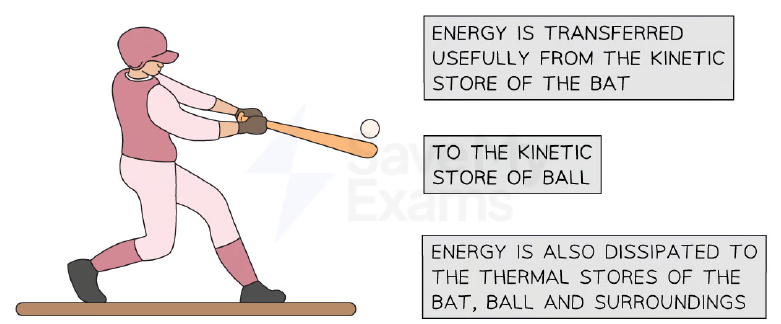
- No energy transfer is 100% efficient; some energy is always dissipated to the surroundings, usually as thermal energy.
Energy transfer and conservation
Sankey Diagrams
- Sankey diagrams represent energy transfers using arrows whose widths are proportional to the amount of energy.
- The arrow pointing to the right represents useful energy output; downward arrows represent wasted energy.
- The total energy in equals the useful energy out plus the wasted energy: Total energy in = Useful energy out + Wasted energy.
- More efficient devices have smaller wasted energy arrows; for example, a modern light bulb compared to an old filament bulb.
- Sankey diagrams can also represent power transfers, with the same conservation principle applied to power.
Work Done
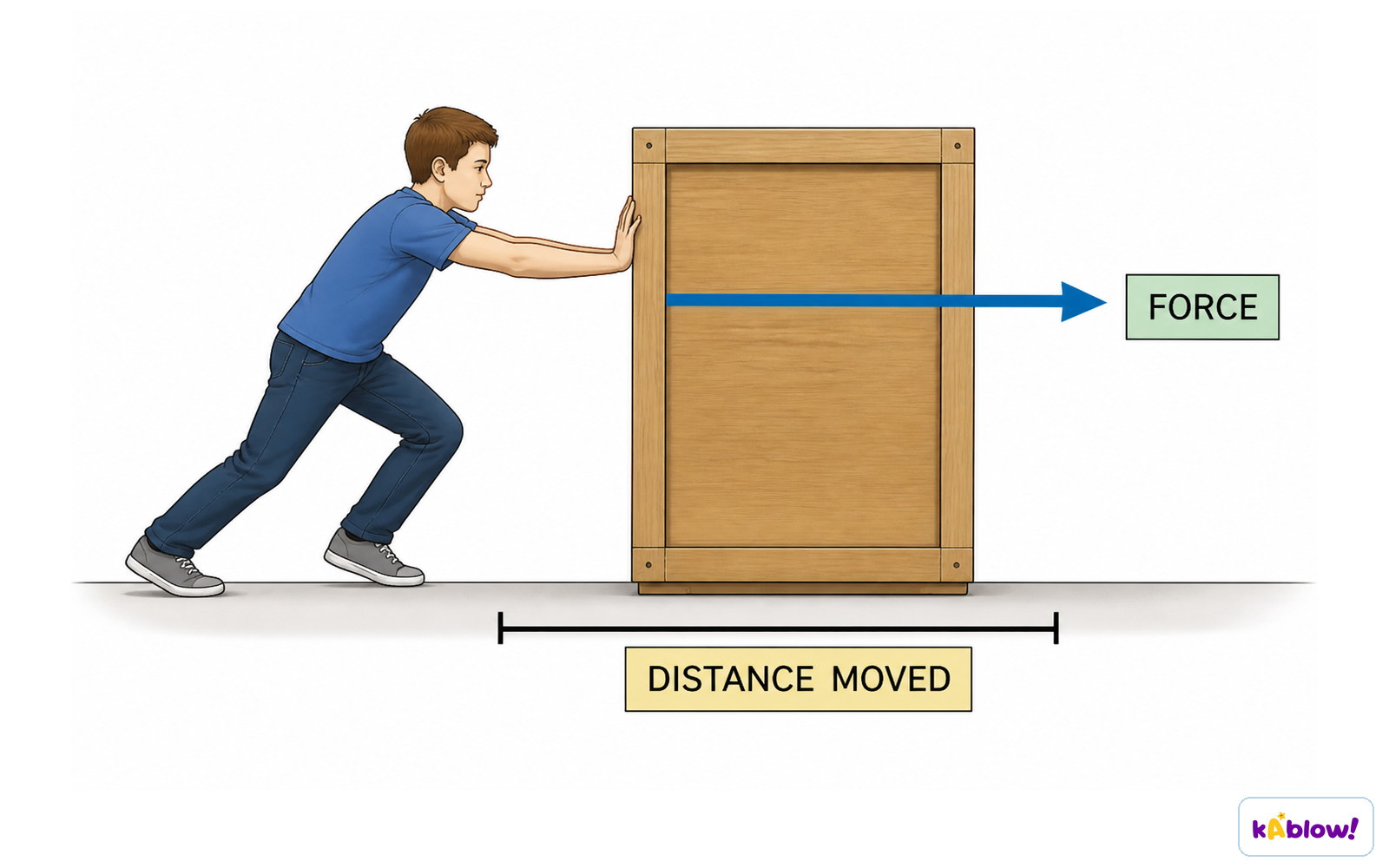
- Work done by a force is equivalent to a transfer of energy; its units are newton metres (N m) or joules (J).
- Mechanical work is the transfer of energy when an external force causes an object to move over a certain distance.
- For a constant force parallel to displacement: W = Fs, where W is work done (J), F is force (N), and s is displacement (m).
- If the force is at an angle θ to the displacement: W = Fs cos θ; only the component of force parallel to motion does work.
- The area under a force–displacement graph equals the work done.
- When work is done against friction, energy is transferred to heat and sound.
Work is done when a force is used to move an object over a distance
Kinetic Energy
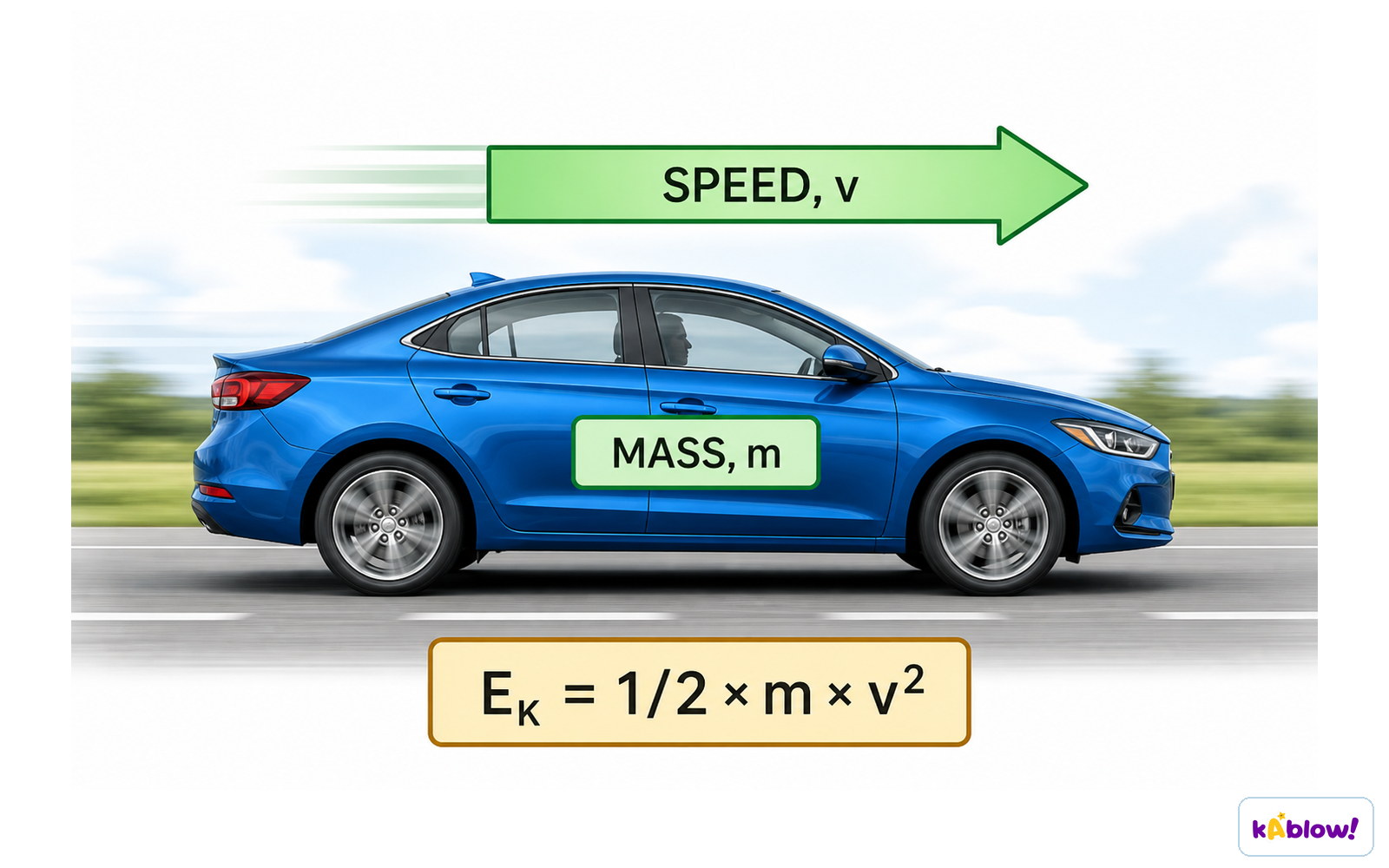
- Kinetic energy (Ek) is the energy an object has due to its motion; it depends on mass and speed.
- The kinetic energy equation is: Ek = ½ m v², where m is mass (kg) and v is velocity (m s⁻¹).
- Kinetic energy can also be written in terms of momentum: Ek = p² / (2m), where p is momentum (kg m s⁻¹).
- When an object falls, gravitational potential energy is transferred to kinetic energy.
- Kinetic energy is a scalar quantity; a loss of kinetic energy is expressed as a positive value.
Kinetic energy of a moving car
Gravitational Potential Energy
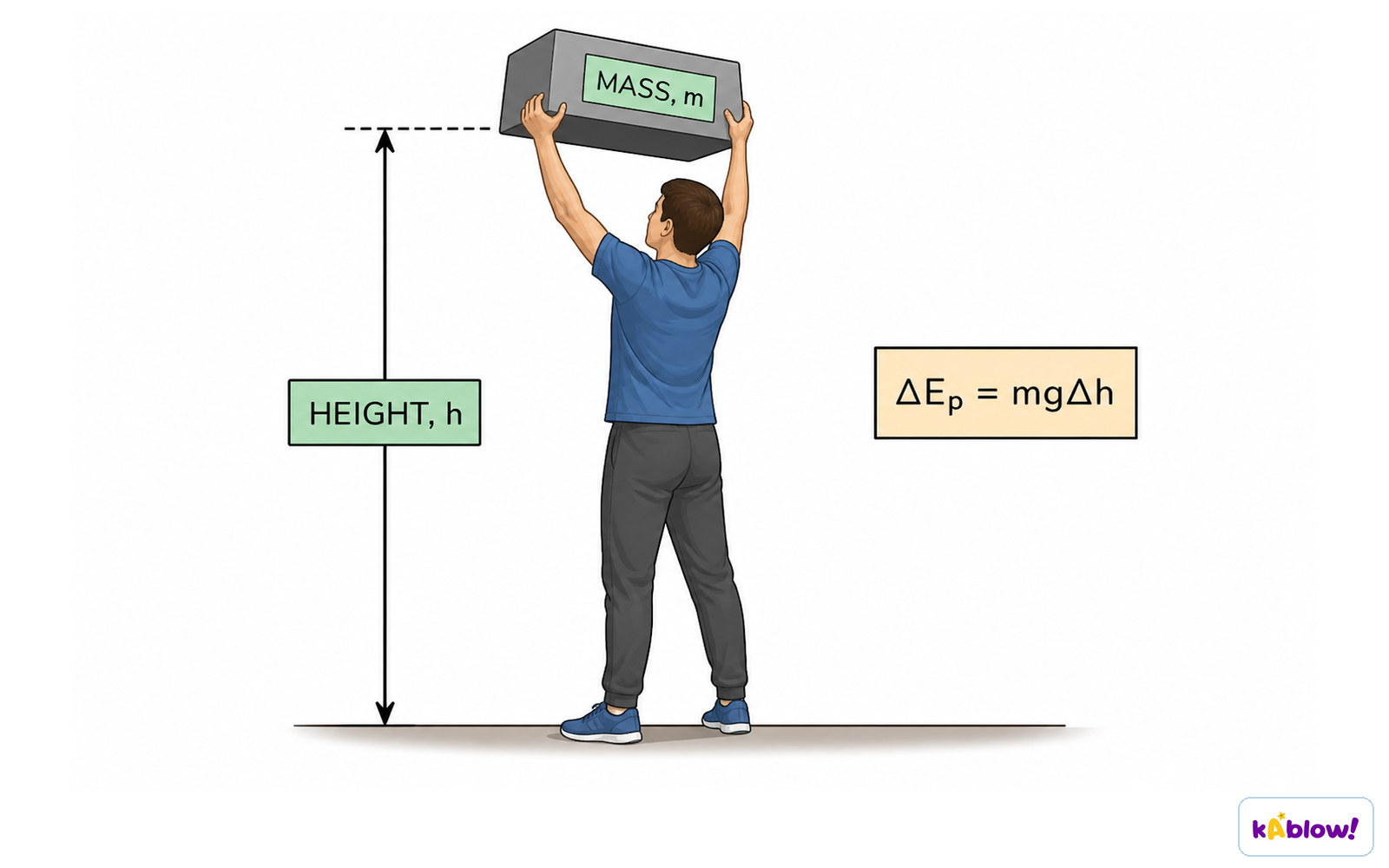
- Gravitational potential energy (GPE) is the energy stored in a mass due to its position in a gravitational field.
- The equation for GPE near the Earth's surface is: ΔEp = mgΔh, where m is mass (kg), g is gravitational field strength (9.8 N kg⁻¹), and Δh is change in height (m).
- If a mass is lifted, it gains GPE; if it falls, it loses GPE.
- The zero of GPE can be chosen at any convenient position; only changes in GPE are physically meaningful.
- GPE and height have a linear relationship; a graph of GPE against height is a straight line.
Gravitational potential energy of a lifted mass
Elastic Potential Energy
- Elastic potential energy is the energy stored within a material when it is stretched or compressed.
- For a material obeying Hooke's Law: EH = ½ k Δx², where k is the spring constant (N m⁻¹) and Δx is the extension (m).
- It can also be written as EH = ½ F Δx, where F is the restoring force (N).
- When a stretched wire breaks, its elastic potential energy is converted into kinetic energy: ½ k Δx² = ½ m v².
- The greater the extension Δx, the greater the speed v of the fragments when the wire breaks (v ∝ Δx).
Conservation of Mechanical Energy
- Mechanical energy is the sum of kinetic energy, gravitational potential energy, and elastic potential energy: Mechanical energy = Ek + ΔEp + EH.
- In the absence of frictional or resistive forces, the total mechanical energy of a system is conserved.
- For a falling object (no air resistance): Loss in gravitational potential energy = Gain in kinetic energy.
- For a horizontal mass on a spring: Loss in elastic potential energy = Gain in kinetic energy.
- A non-conservative force (such as friction) dissipates energy away from the system, reducing mechanical energy.
- For an object moving up a rough incline: Loss in kinetic energy = Gain in GPE + Work done against friction.
- In a vertical spring system, energy converts between elastic potential, kinetic, and gravitational potential energy, but the total remains constant.
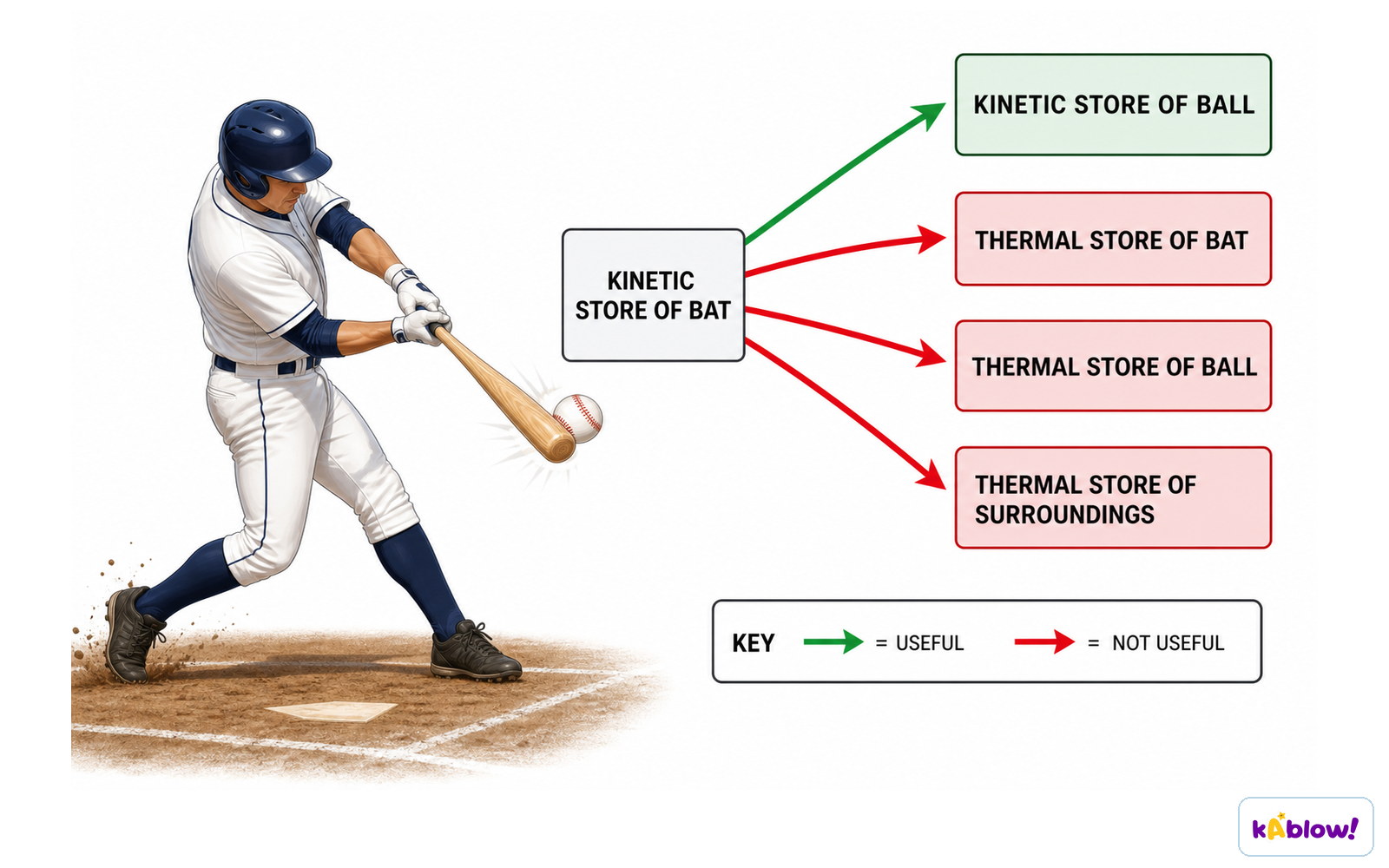
The principle of conservation of energy applied to a bat hitting a ball
Energy & Power
- Power is the rate at which energy is transferred or work is done: P = ΔW / Δt.
- Power can also be calculated as P = Fv, where F is a constant force and v is constant velocity.
- The watt (W) is the unit of power: 1 W = 1 J s⁻¹.
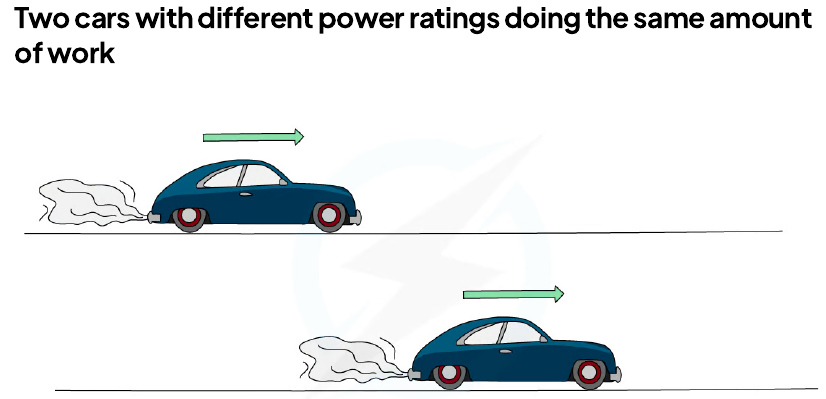
- Two motors lifting the same weight through the same height: the one that does it faster has more power.
- Power is required to produce acceleration; the force must be applied in the direction of velocity.
- Appliances have power ratings indicating the energy transferred per second.
Power and rate of energy transfer
Efficiency Formula
- Efficiency is a measure of how successfully energy is transferred in a system.
- Efficiency = (useful energy output / total energy input) × 100% or (useful power output / total power input) × 100%.
- The symbol for efficiency is η (eta); it has no units and can be expressed as a ratio (0 to 1) or a percentage (0% to 100%).
- A high-efficiency system transfers most of its energy usefully; a low-efficiency system wastes most of it.
- Determining which energy transfers are useful or wasted depends on the purpose of the system.
- To convert efficiency from a ratio to a percentage, multiply by 100%.
Energy Density
- Energy density is a measure of the amount of energy per unit volume of a fuel.
- Energy density is measured in J m⁻³ (or MJ L⁻¹).
- Different fuels have different energy densities, making them suitable for different uses.
- Examples of energy densities: coal 38 MJ L⁻¹, diesel 39 MJ L⁻¹, wood 3 MJ L⁻¹.
- Fuels are chosen based on energy density, safety, and pollutants released.
幻灯片
练习题
免费预览——66 题中的 8 题。注册即可查看全部。
1.Which of the following best describes the principle of conservation of energy?
Easy- AEnergy cannot be created or destroyed, only transferred from one form to another
- BEnergy can be created and destroyed in a closed system
- CThe total energy in a closed system always decreases
- DEnergy can only be transferred from kinetic to potential stores
2.Mechanical energy is the sum of kinetic energy, gravitational potential energy and elastic potential energy.
EasyTrue or false?
3.Which of the following are considered mechanical energy types? (Select all that apply.)
Medium- AKinetic energy
- BGravitational potential energy
- CElastic potential energy
- DThermal energy
- EChemical energy
4.Match each energy type with its correct description.
Easy- Kinetic energy
- Gravitational potential energy
- Elastic potential energy
- Energy stored due to position in a gravitational field
- Energy an object has due to its motion
- Energy stored when a material is stretched or compressed
5.Which equation correctly defines work done when a constant force acts at an angle θ to the displacement?
Easy- AW = F s cos θ
- BW = F s sin θ
- CW = F s tan θ
- DW = F s
6.A runner of mass 52 kg maintains a constant velocity of 7 m s⁻¹ by exerting a forward force of 15.2 N against air resistance. What is her power output?
Medium- A106.4 W
- B53.2 W
- C212.8 W
- D7.6 W
7.Which of the following statements about energy dissipation are correct? (Select all that apply.)
Medium- ANo energy transfer is 100% efficient.
- BDissipated energy usually ends up as thermal energy transferred to the surroundings.
- CDissipated energy is usually regarded as wasted energy.
- DDissipated energy can always be easily used for another purpose.
- EEnergy is destroyed when it is dissipated.
8.A car transfers chemical energy from its fuel into kinetic energy. Which of the following are wasted energy transfers in this system? (Select all that apply.)
Medium- AThermal energy transferred to the surroundings
- BSound from the engine
- CKinetic energy of the car
- DChemical energy stored in the fuel
- EThermal energy transferred to the engine casing