Excretion In Humans
边玩边学
回答这些题目来赚取能量,然后钓鱼探索。无需账号。
给教育者: 面向 Excretion In Humans(Biology,CIE)的即用型课程幻灯片, 复习笔记, 图示——用在你的课堂上,或将该知识点作为学习者可实时游玩的互动课堂活动来运行。
课程笔记
Excretion: Definition & Organs
- Excretion is the removal of waste products of metabolic reactions, toxic materials, and substances in excess of requirements.
- The main excretory organs are the lungs (excrete CO₂), kidneys (excrete excess water, salts, and urea), and the liver (produces urea via deamination).
- Egestion (removal of undigested food via the anus) is not excretion.
- CO₂ must be excreted because it dissolves in water to form an acidic solution, lowering pH and reducing enzyme activity.
- Urea is toxic at high concentrations and must be removed.
The Urinary System
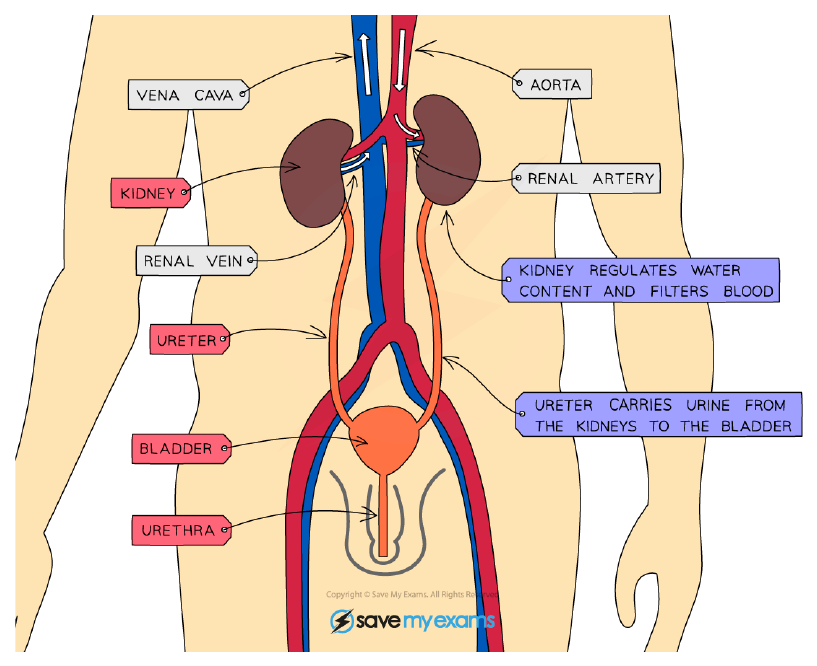
- Kidneys: two bean-shaped organs that filter blood to form urine.
- Ureter: tube connecting each kidney to the bladder.
- Bladder: stores urine until it is released.
- Urethra: tube that carries urine from the bladder to the exterior.
- Note: ureter and urethra are different tubes — do not confuse them.
The excretory system in humans
Kidney Function & the Nephron
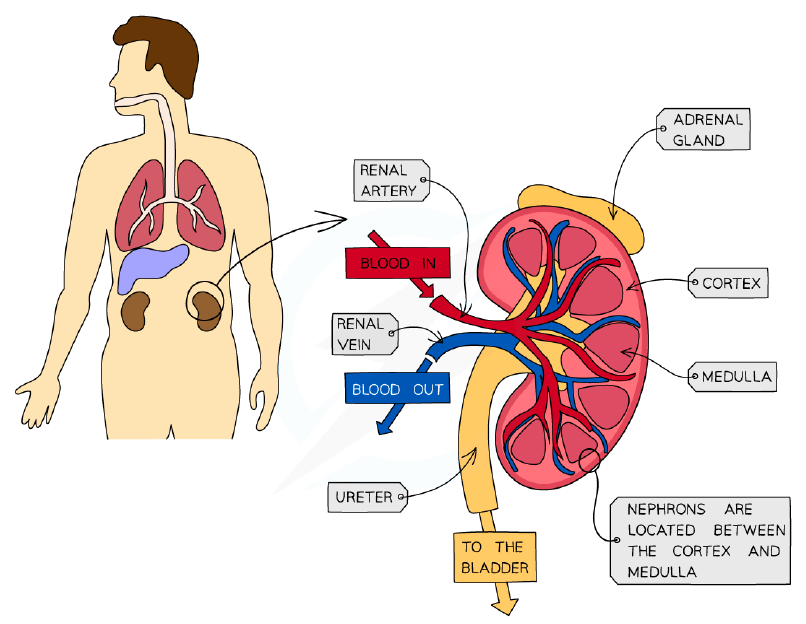
- Kidneys regulate water content of blood (maintains blood pressure) and excrete urea and excess salts.
- Each kidney contains about 1 million nephrons (kidney tubules).
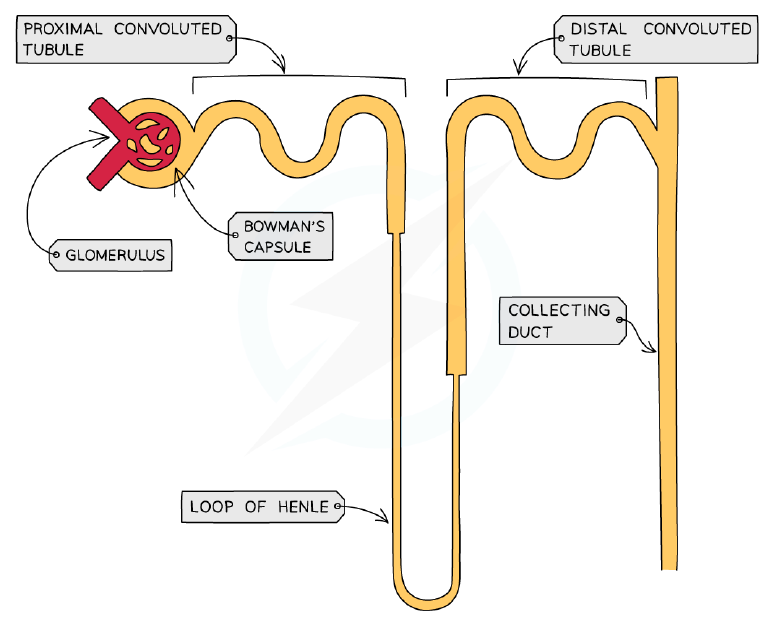
- Nephrons start in the cortex, loop into the medulla, and return to the cortex; urine drains into the renal pelvis then ureter.
The structure of a human kidney
Ultrafiltration
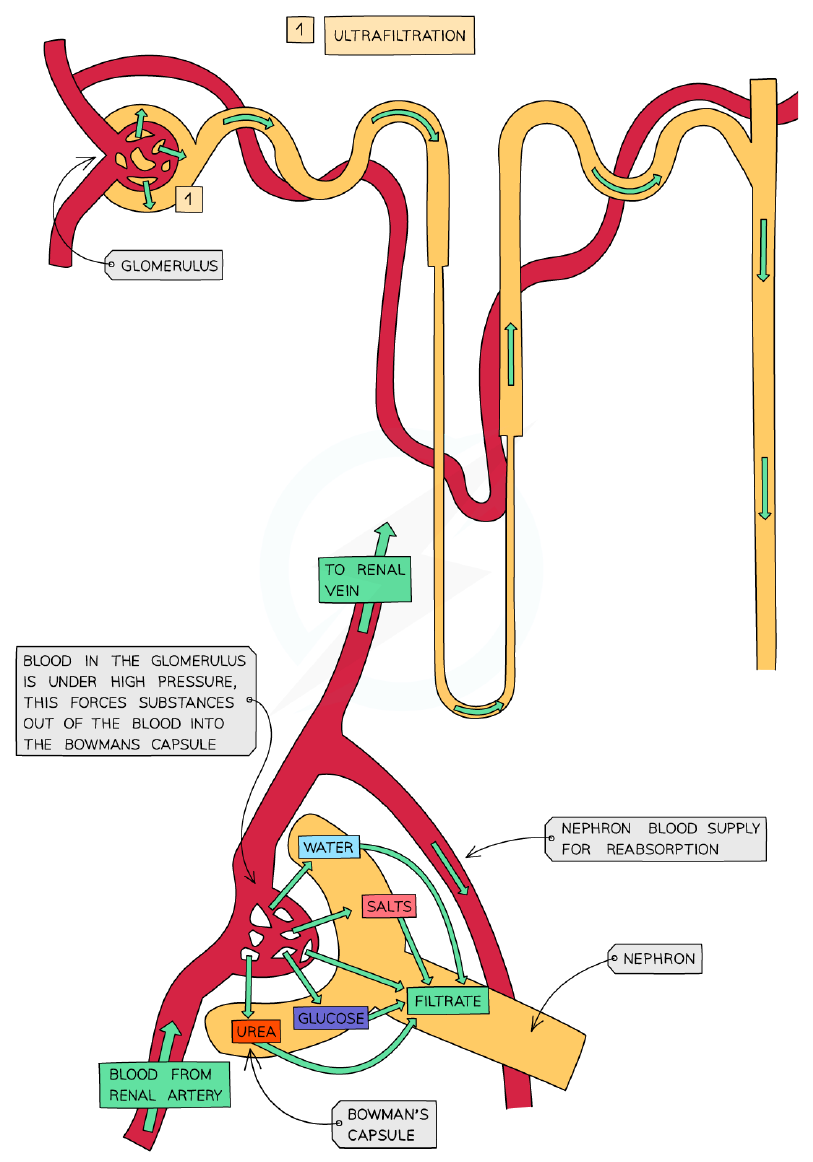
- Blood enters the glomerulus via an afferent arteriole at high pressure.
- Capillaries narrow, increasing pressure, forcing small molecules out into Bowman's capsule — this is ultrafiltration.
- Filtrate contains: glucose, water, urea, salts. Large molecules like proteins remain in blood.
- The filtrate then flows through the nephron for selective reabsorption.
Diagram showing the process of ultrafiltration
Selective Reabsorption
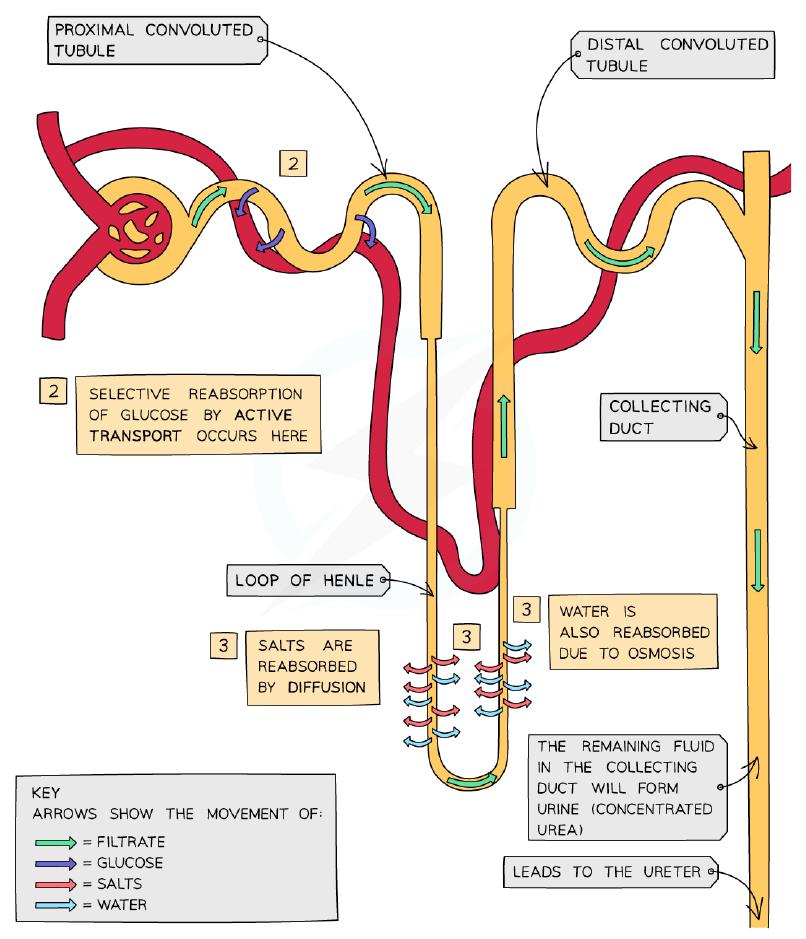
- Glucose is reabsorbed by active transport in the proximal convoluted tubule (PCT).
- PCT cells have many mitochondria to supply energy for active transport.
- In a healthy person, all glucose is reabsorbed; in diabetes, excess glucose remains in urine.
- Salts are reabsorbed in the Loop of Henle by diffusion and active transport; water follows by osmosis.
- Water reabsorption in the collecting duct varies according to the body's needs.
Diagram showing the reabsorption of glucose
Role of the Liver: Deamination
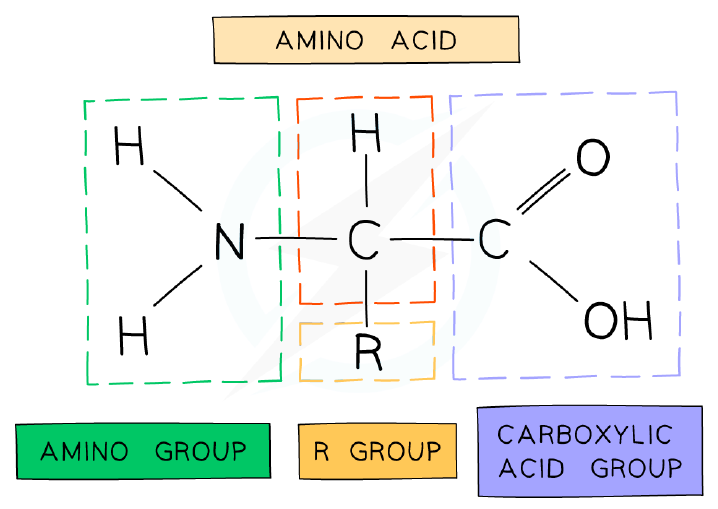
- Excess amino acids cannot be stored and are broken down in the liver by deamination.
- The amino group (-NH₂) is removed; the carbon part is converted to glycogen and stored.
- The nitrogen part is converted to ammonia (highly toxic), then immediately to urea (less toxic).
- Urea dissolves in blood, is carried to the kidneys, and excreted in urine (a small amount in sweat).
- High urea levels can cause cell death, reduced insulin response, and deposits in blood vessels.
Amino acid groups
Excretory Products Summary
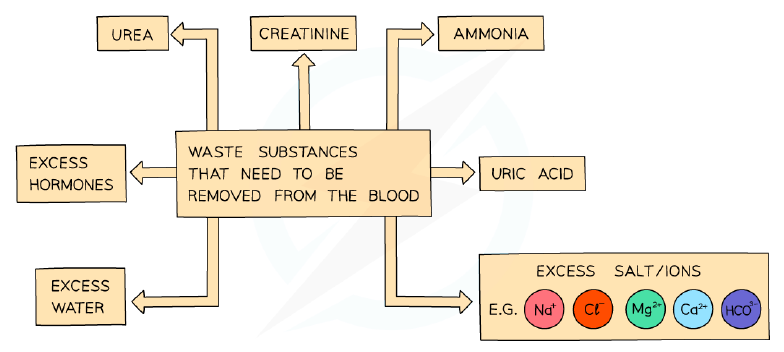
- Lungs: excrete CO₂ (from aerobic respiration).
- Kidneys: excrete excess water, salts, and urea.
- Liver: produces urea from deamination of excess amino acids; also breaks down alcohol and toxins.
- Skin: excretes small amounts of urea and salts in sweat.
Waste substances
幻灯片
练习题
免费预览——57 题中的 8 题。注册即可查看全部。
1.What is urea produced from?
Easy- AAmino acids
- BFatty acids
- CGlucose
- DGlycerol
2.Which of the following is a correct example of excretion in mammals?
Easy- AThe removal of excess salts from the blood.
- BThe production of carbon dioxide from aerobic respiration.
- CThe removal of undigested food via the anus.
- DThe release of hormones from glands.
3.Which of the following is not a main function of the kidneys in a healthy person?
Medium- ATo breakdown toxins.
- BTo reabsorb all glucose.
- CTo regulate blood pressure.
- DTo eliminate excess sodium and potassium ions.
4.Which of the following substances would be reabsorbed by the kidneys?
Medium- ASalts and glucose
- BSalts, urea and glycogen
- CSalts and glycogen
- DUrea and glucose
5.Which statement about urea is correct?
Easy- AUrea is formed from excess amino acids in the liver and excreted by the kidneys.
- BUrea is formed from excess amino acids in the kidneys and excreted by the liver.
- CUrea is formed from excess glucose in the liver and egested by the kidneys.
- DUrea is formed from excess glucose in the kidneys and egested by the liver.
- 6.Medium
The table shows the composition of blood entering the kidneys.
Substance Blood (%) Glucose 0.20 Urea 0.01 Protein 7.00 Which row shows the composition of urine in a healthy person?
- Aglucose 0.00%, urea 2.50%, protein 0.00%
- Bglucose 0.00%, urea 2.50%, protein 3.50%
- Cglucose 2.00%, urea 0.00%, protein 7.00%
- Dglucose 0.20%, urea 0.01%, protein 0.00%
7.A person produced 1.75 dm³ of urine on a cool day. How will the volume and concentration of urine change on a hot day, if fluid intake is the same?
Medium- Avolume decreases, concentration increases
- Bvolume increases, concentration decreases
- Cvolume decreases, concentration decreases
- Dvolume increases, concentration increases
8.Which of the following organs are responsible for removing excretory products from the blood?
Easy- AKidneys and lungs
- BBladder and kidneys
- CLungs and liver
- DBladder and liver
历年真题
该知识点的历年真题练习即将推出。
即将推出