Electrochemistry
边玩边学
回答这些题目来赚取能量,然后钓鱼探索。无需账号。
课程笔记
Electrolysis Principles
- Electrolysis is the breakdown of a molten or aqueous ionic compound by an electric current.
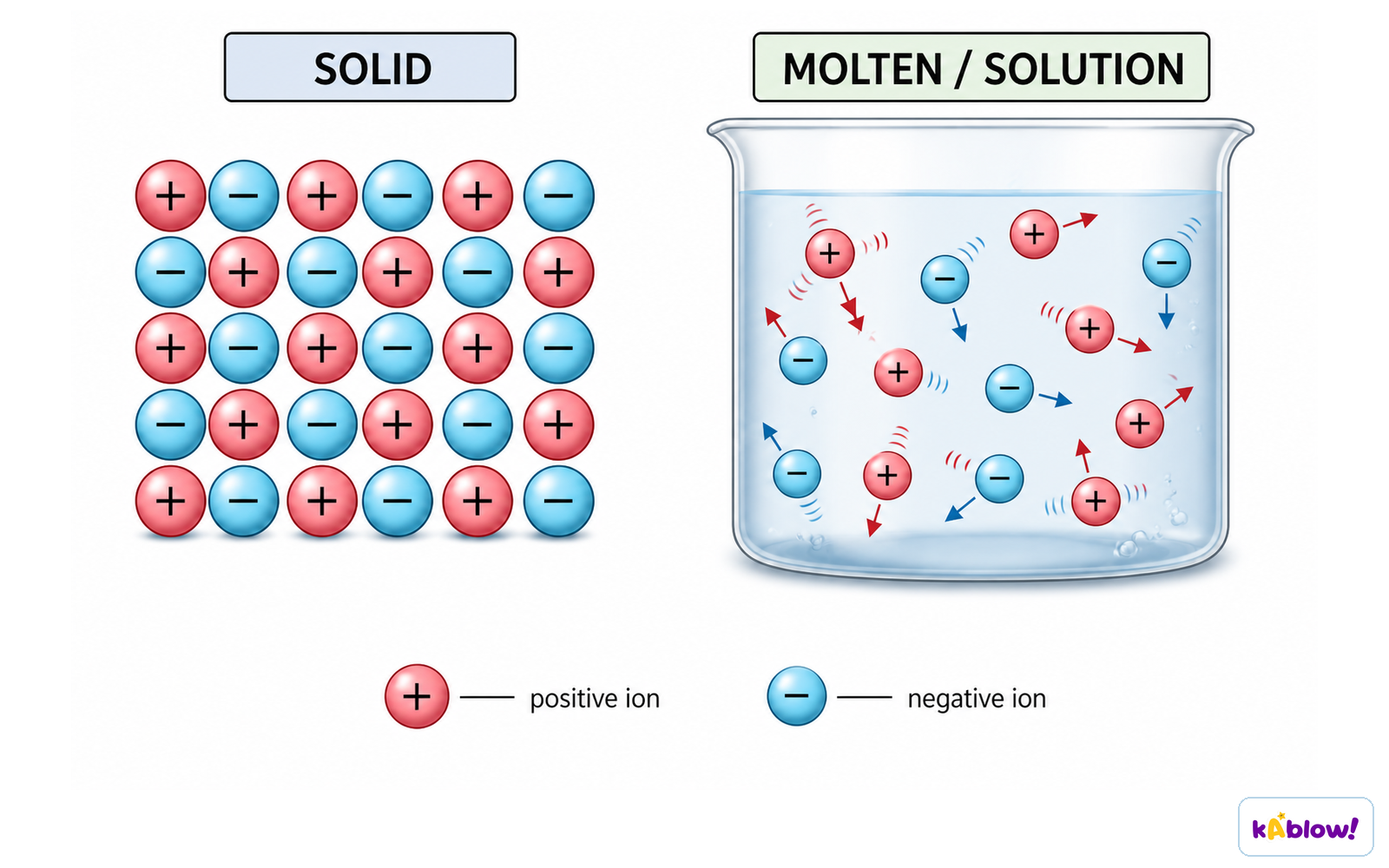
- Ionic compounds conduct electricity only when molten or in solution because ions are free to move.
- Electrolyte: the ionic compound (molten or dissolved) that conducts electricity.
- Electrodes: rods (usually graphite or platinum) that conduct current into/out of the electrolyte.
- Anode: positive electrode; attracts anions (negative ions).
- Cathode: negative electrode; attracts cations (positive ions).
- PANIC mnemonic: Positive = Anode, Negative Is Cathode.
- Electrons flow from the power supply's negative terminal to the cathode; ions carry charge through the electrolyte.
Ionic conductivity: solid vs molten/dissolved
Electrolysis of Molten Compounds
- Molten binary ionic compounds (e.g., PbBr₂) decompose into their elements.
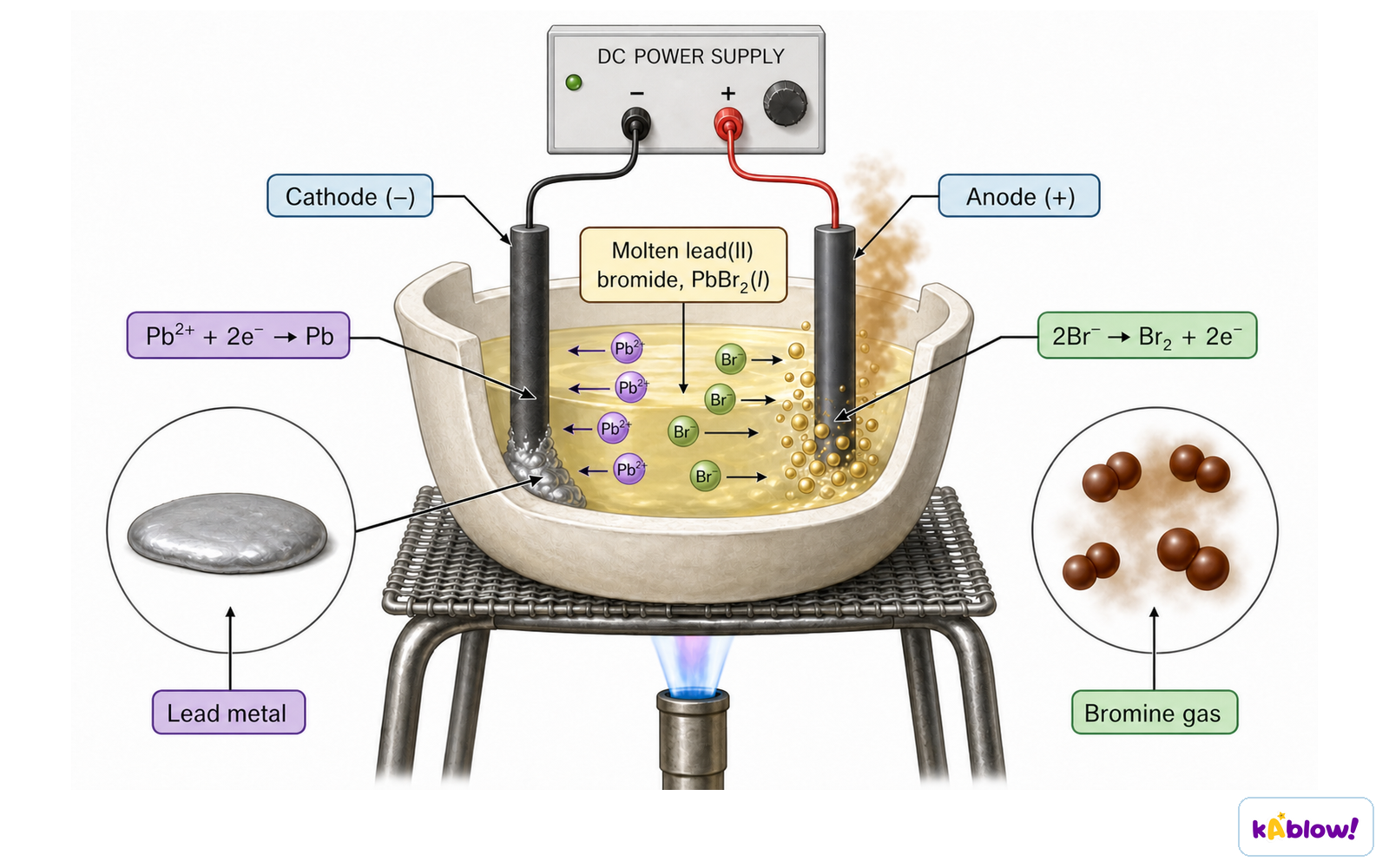
- Example: molten lead(II) bromide → at cathode: grey lead metal forms; at anode: brown bromine gas bubbles.
- Cathode product = metal (reduction: Mⁿ⁺ + n e⁻ → M).
- Anode product = non‑metal (oxidation: 2X⁻ → X₂ + 2 e⁻).
- Electrodes must be inert (graphite or platinum) to avoid side reactions.
Electrolysis of molten lead(II) bromide
Electrolysis of Aqueous Sodium Chloride & Dilute Sulfuric Acid
- Aqueous solutions contain ions from the compound and from water (H⁺ and OH⁻).
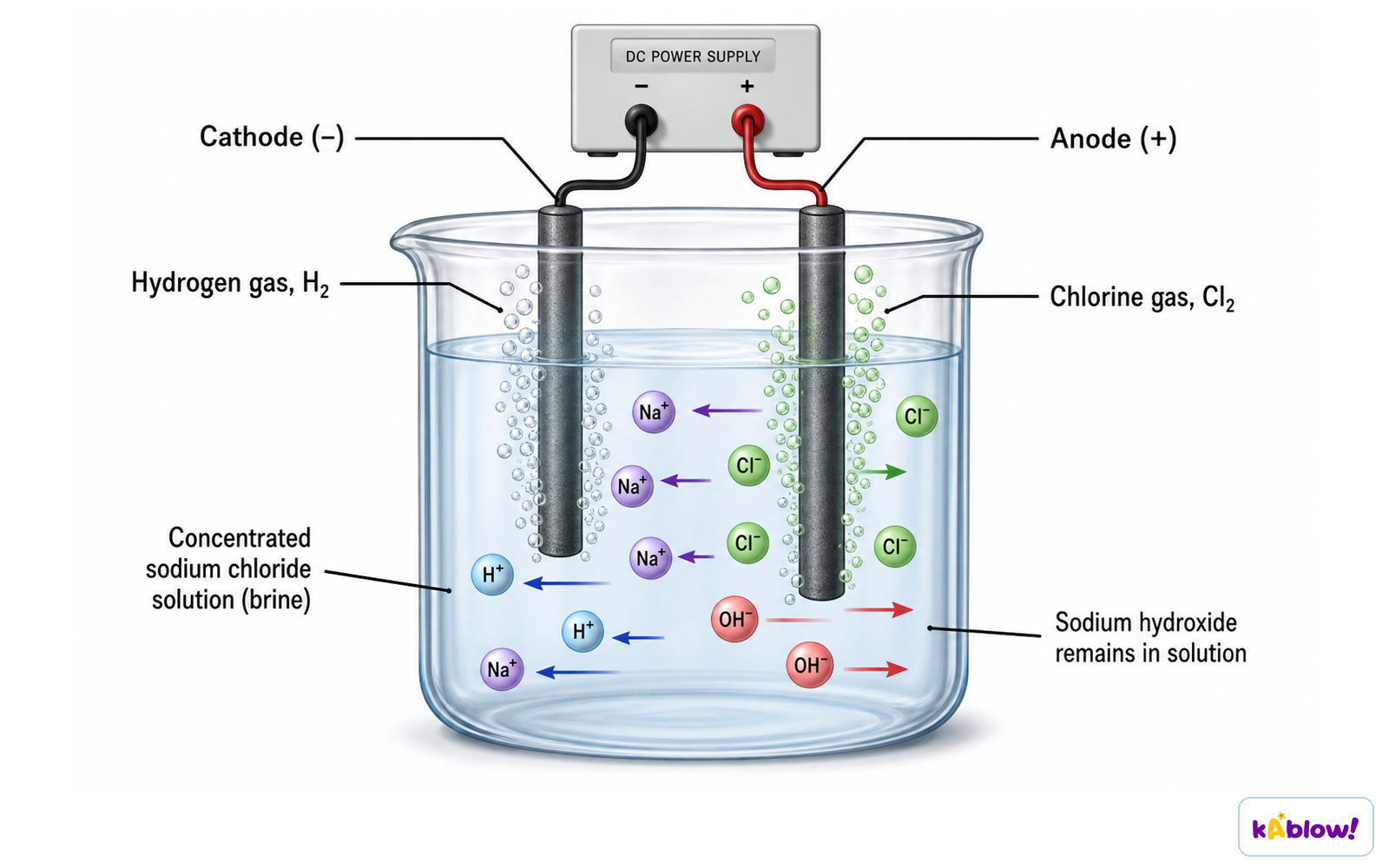
- Brine (conc. NaCl): at cathode, H⁺ is discharged → hydrogen gas; at anode, Cl⁻ is discharged → chlorine gas; NaOH remains in solution.
- Industrial uses: chlorine → bleach; hydrogen → margarine; NaOH → soap/detergents.
- Dilute H₂SO₄: at cathode, H⁺ → hydrogen; at anode, OH⁻ → oxygen (2× volume of H₂ compared to O₂).
- Gas tests: H₂ – ‘squeaky pop’ with lit splint; O₂ – relights glowing splint; Cl₂ – bleaches damp litmus.
Electrolysis of aqueous sodium chloride (brine)
Electrolysis of Aqueous Solutions (Extended Tier)
- Water dissociates: H₂O ⇌ H⁺ + OH⁻; these ions compete with ions from the solute.
- At cathode: if metal is less reactive than H, metal is deposited; if more reactive, H₂ gas forms.
- At anode: if halide ions are present (conc. solution), halogen forms; otherwise, OH⁻ is discharged → oxygen.
- Concentration matters: conc. halide → halogen; dilute halide → oxygen.
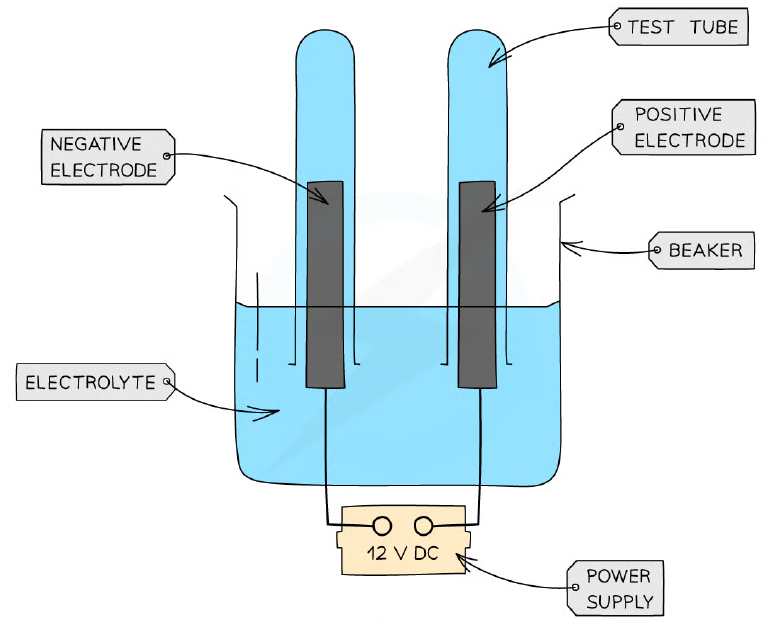
- Example: CuSO₄(aq) with graphite electrodes → cathode: pink‑brown copper; anode: oxygen; blue colour fades.
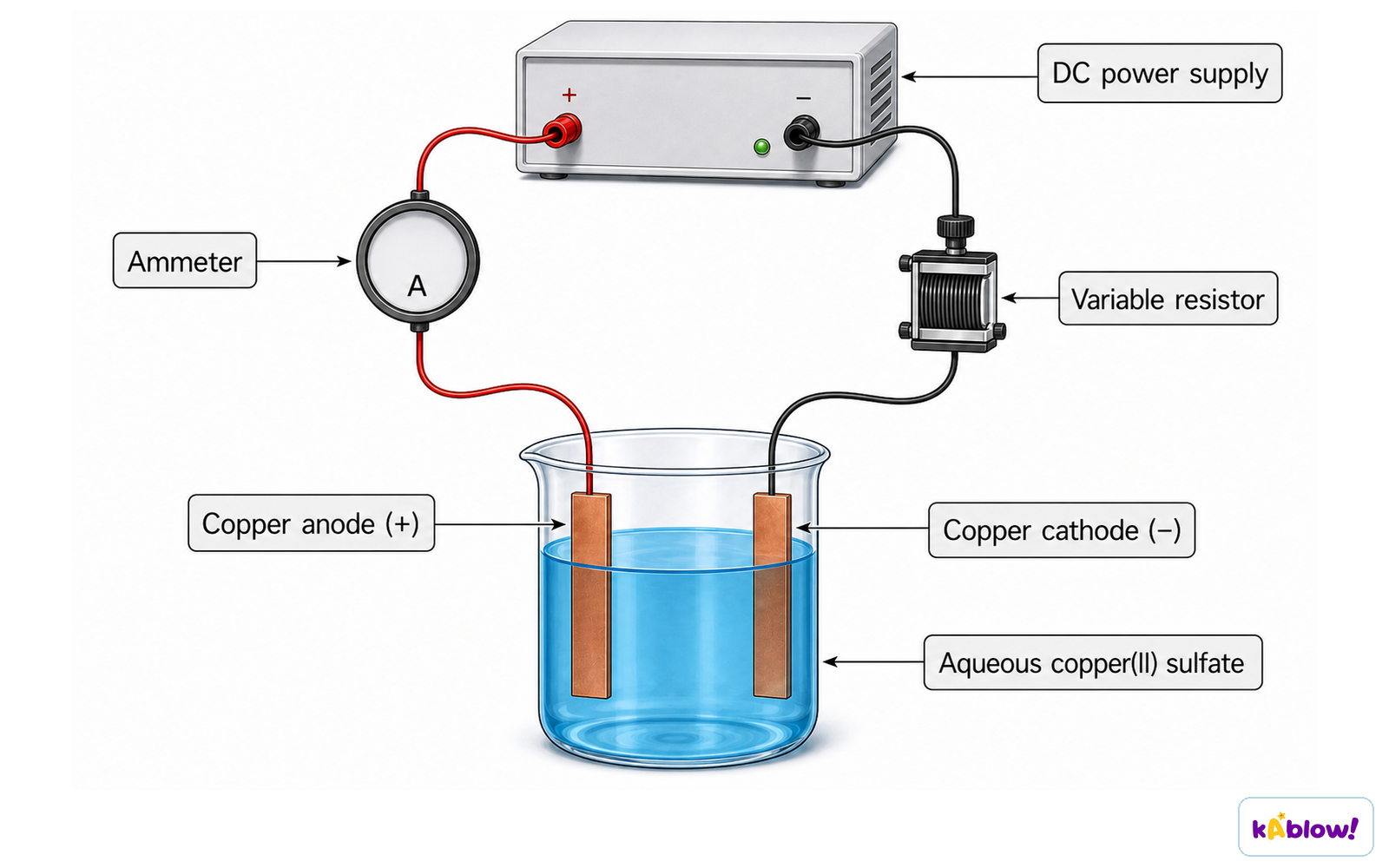
- With copper electrodes: cathode gains mass (Cu²⁺ + 2e⁻ → Cu); anode loses mass (Cu → Cu²⁺ + 2e⁻); Cu²⁺ concentration stays constant.
Apparatus for the electrolysis of copper(II) sulfate (graphite electrodes)
Ionic Half Equations (Extended Tier)
- Oxidation = loss of electrons; Reduction = gain of electrons (OIL RIG).
- RED CAT: Reduction at the Cathode; AN OX: Oxidation at the Anode.
- Half‑equations must balance atoms and charge.
- Metal formation: Mⁿ⁺ + n e⁻ → M (e.g., Cu²⁺ + 2e⁻ → Cu).
- Hydrogen formation: 2H⁺ + 2e⁻ → H₂.
- Halogen formation: 2X⁻ → X₂ + 2e⁻ (e.g., 2Cl⁻ → Cl₂ + 2e⁻).
- Oxygen formation: 4OH⁻ → O₂ + 2H₂O + 4e⁻.
Reduction and Oxidation Reactions at the Electrodes
Hydrogen‑Oxygen Fuel Cells
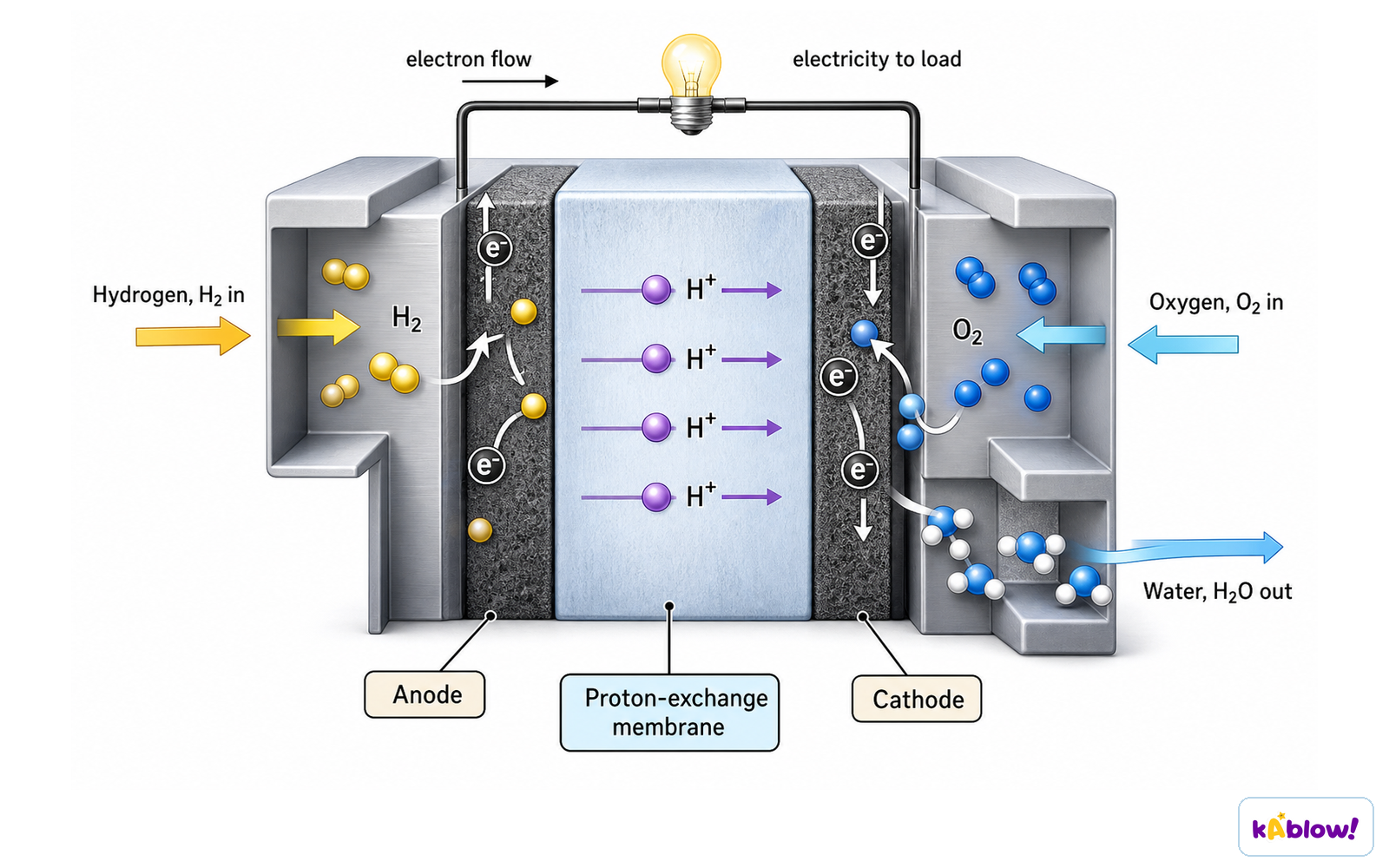
- A fuel cell converts chemical energy of a fuel (H₂) and oxidant (O₂) directly into electricity.
- At anode: H₂ → 2H⁺ + 2e⁻ (oxidation).
- At cathode: O₂ + 4H⁺ + 4e⁻ → 2H₂O (reduction).
- Overall reaction: 2H₂ + O₂ → 2H₂O; only product is water.
- Advantages: no pollutants, high efficiency, renewable (H₂ from electrolysis).
- Disadvantages: H₂ production often uses fossil fuels; storage is difficult (flammable, high‑pressure); expensive materials; limited refuelling stations.
Diagram showing the movement of hydrogen, oxygen and electrons in a hydrogen-oxygen fuel cell
幻灯片
练习题
免费预览——56 题中的 8 题。注册即可查看全部。
1.Which statement about electrolysis is correct?
Easy- ACovalent compounds can undergo electrolysis when molten.
- BSolid ionic compounds conduct electricity because ions are free to move.
- CIonic compounds conduct electricity when molten or in aqueous solution.
- DElectrolysis breaks down covalent compounds by an electric current.
2.In electrolysis, the anode is the negative electrode.
EasyTrue or false?
3.Complete the sentence about the PANIC mnemonic.
EasyIn the PANIC mnemonic, Positive is ____ and Negative is ____.
4.State the product formed at the cathode during the electrolysis of molten lead(II) bromide.
Easy5.During the electrolysis of concentrated aqueous sodium chloride (brine) using inert electrodes, which gas is produced at the anode?
Medium- AHydrogen
- BOxygen
- CChlorine
- DSodium
6.Give the test for hydrogen gas.
Easy7.Match each electrode with the process that occurs there.
Easy- Anode
- Cathode
- Oxidation
- Reduction
8.During electrolysis of dilute sulfuric acid, the volume of hydrogen produced is twice the volume of oxygen. If 40 cm³ of oxygen is collected, what volume of hydrogen (in cm³) is produced?
Medium- A72
- B88
- C80
- D96