Organic Families
边玩边学
回答这些题目来赚取能量,然后钓鱼探索。无需账号。
给教育者: 面向 Organic Families(Co-ordinated Sciences (Double Award) [CIE],Chemistry)的即用型课程幻灯片, 复习笔记, 图示——用在你的课堂上,或将该知识点作为学习者可实时游玩的互动课堂活动来运行。
课程笔记
Fossil Fuels & Fractional Distillation
- Fossil fuels (coal, natural gas, petroleum) release heat energy when burned.
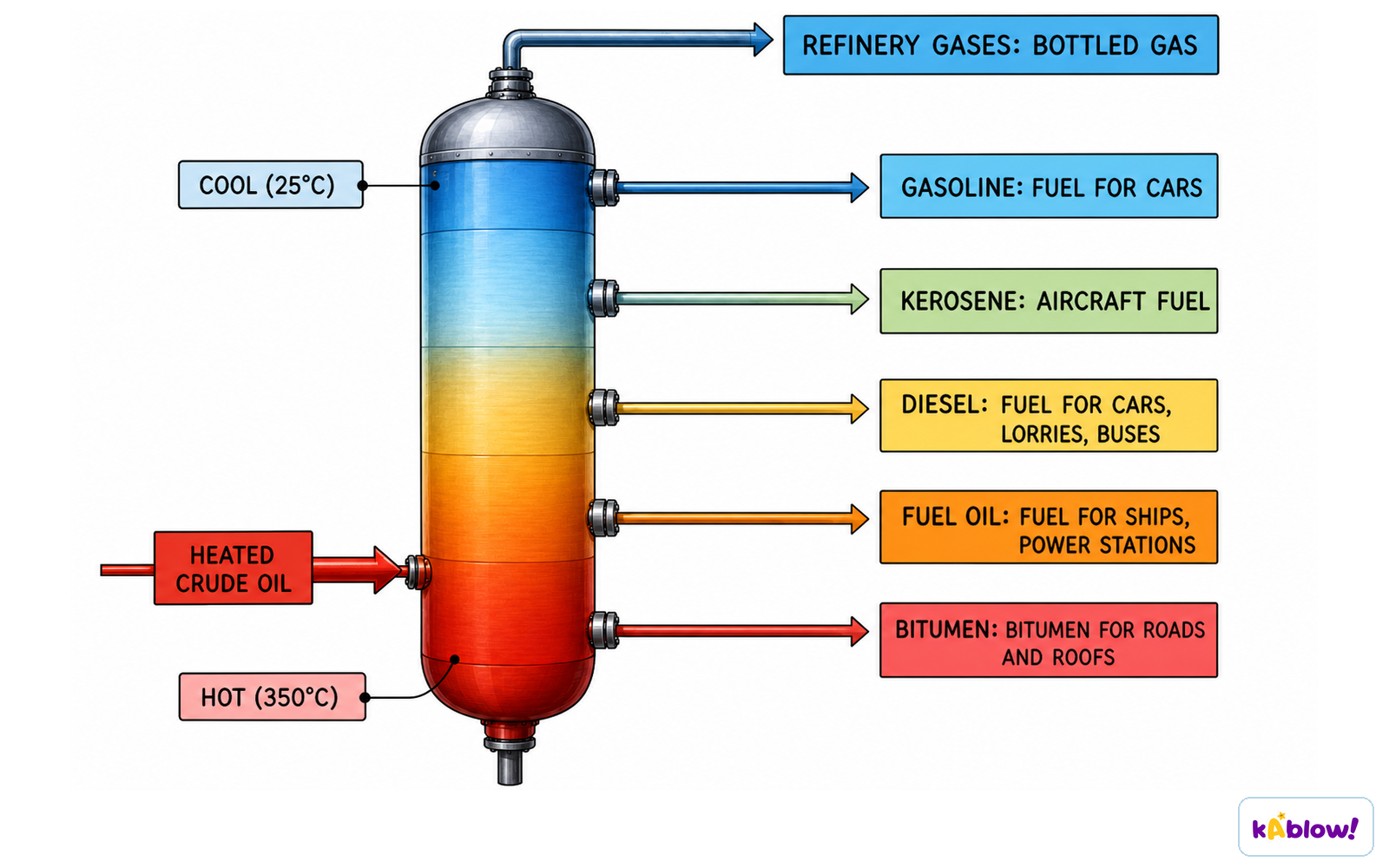
- Petroleum (crude oil) is a mixture of hydrocarbons separated by fractional distillation.
- Fractional distillation separates fractions by boiling point in a column with a temperature gradient (hot at bottom, cool at top).
- Fractions include: refinery gas (heating/cooking), gasoline (car fuel), naphtha (chemicals), diesel (diesel engines), bitumen (road surfacing).
- As chain length increases down the column, boiling point increases due to stronger intermolecular forces.
Fractional distillation of petroleum
Alkanes
- Alkanes are saturated hydrocarbons with only single C–C bonds and general formula CₙH₂ₙ₊₂.
- They are colourless, generally unreactive due to strong single covalent bonds.
- Complete combustion of alkanes produces CO₂ and H₂O (e.g., CH₄ + 2O₂ → CO₂ + 2H₂O).
- First five members: methane (CH₄), ethane (C₂H₆), propane (C₃H₈), butane (C₄H₁₀), pentane (C₅H₁₂).
Butane, an alkane
Alkenes & Cracking
- Alkenes are unsaturated hydrocarbons with at least one C=C double bond and general formula CₙH₂ₙ.
- The C=C bond makes alkenes more reactive than alkanes; it can open to form new bonds.
- Cracking breaks long-chain alkanes into shorter alkanes, alkenes, and H₂ using high temperature (600–700 °C) and a catalyst (Al₂O₃ or SiO₂).
- Example: decane → octane + ethene (C₁₀H₂₂ → C₈H₁₈ + C₂H₄).
- Cracking increases supply of useful fuels (e.g., petrol) and produces alkenes for polymers.
But-1-ene, an alkene
Test for Alkenes
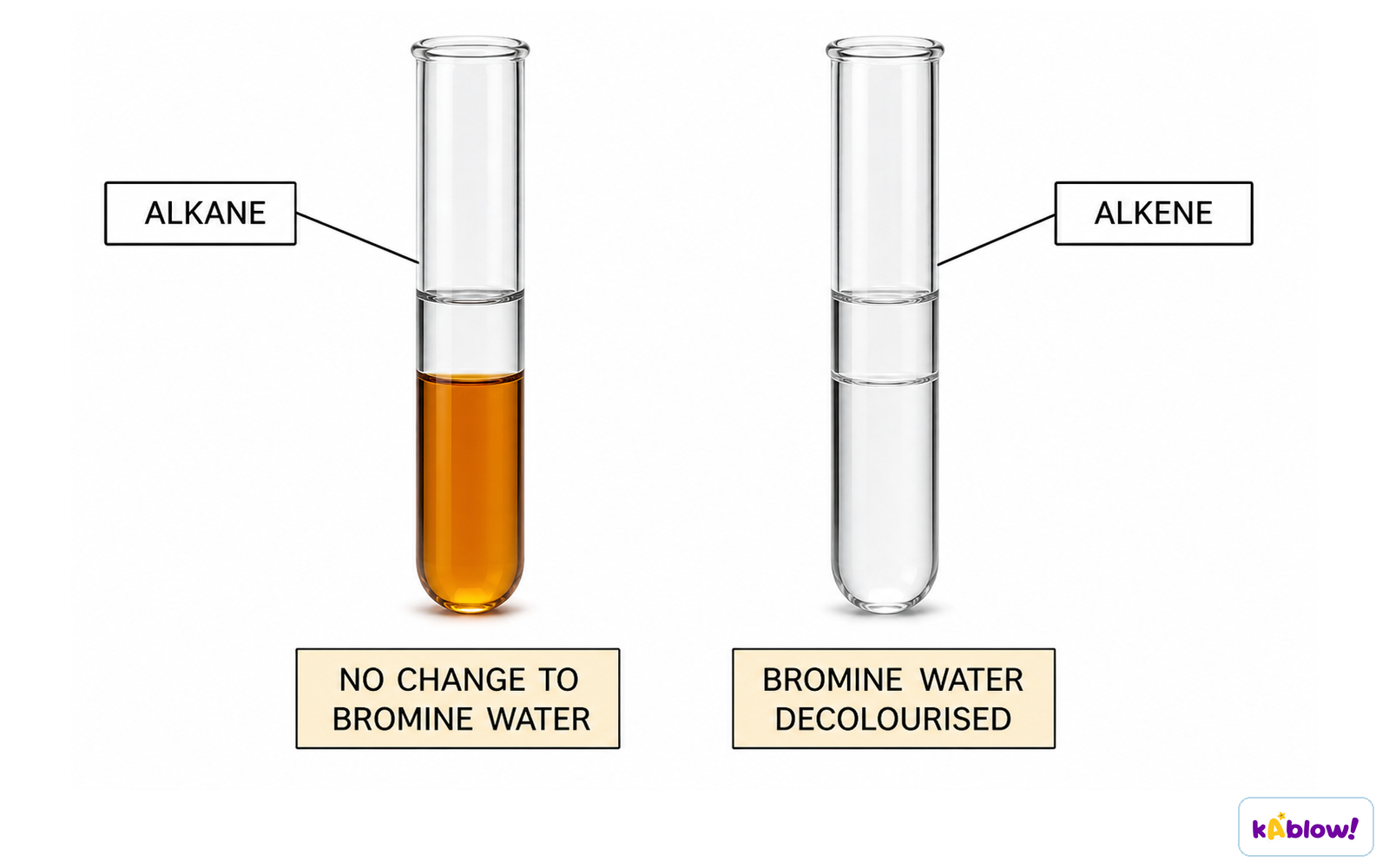
- Alkenes are identified by adding aqueous bromine (bromine water), which is orange.
- Alkane: no colour change (remains orange).
- Alkene: decolourises (orange → colourless) because bromine adds across the C=C bond.
Bromine water test for alkanes and alkenes
Addition Reactions (Extended)
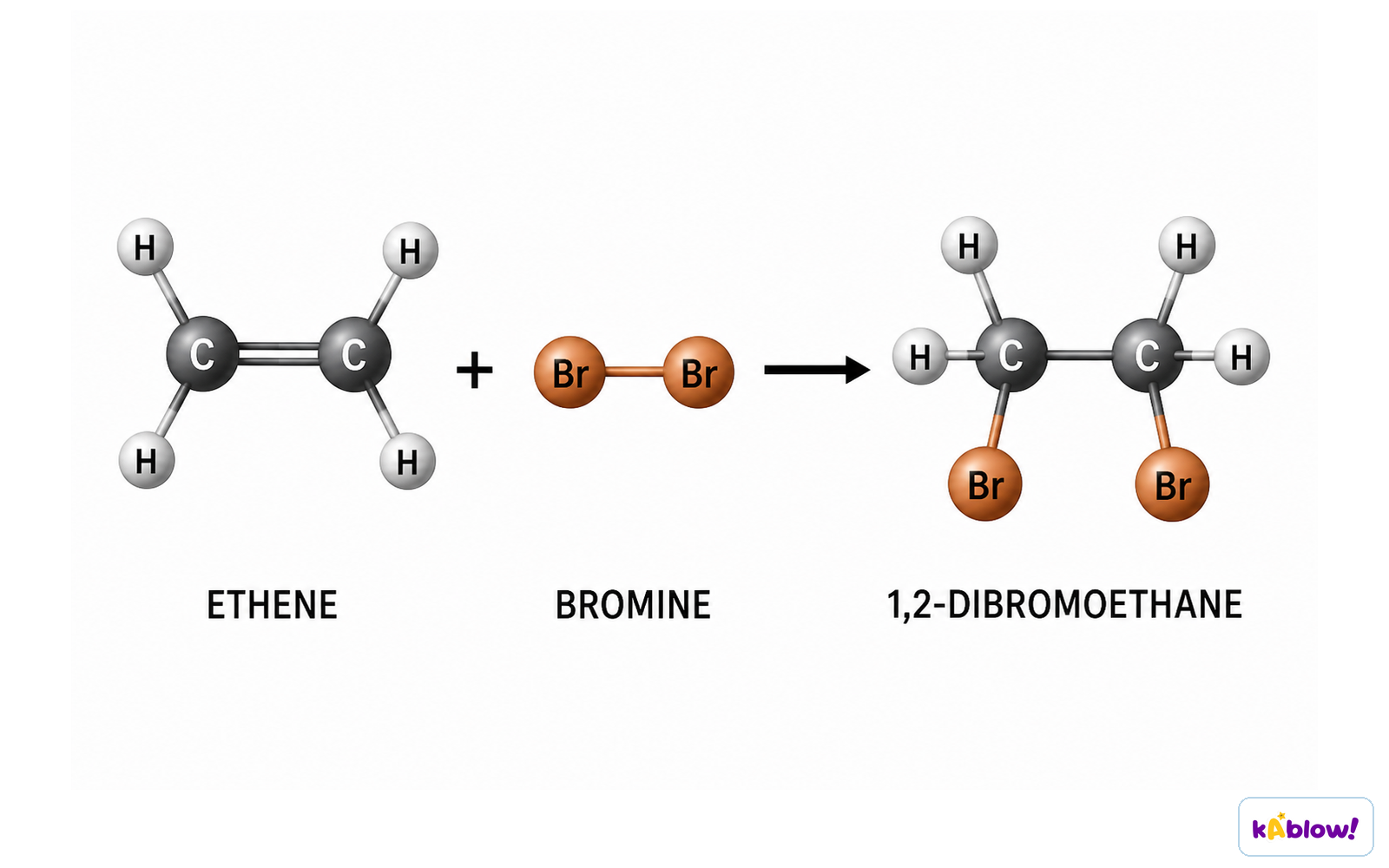
- Addition reactions involve atoms adding across the C=C double bond, forming a single saturated product.
- Alkene + bromine → dibromoalkane (e.g., ethene + Br₂ → 1,2-dibromoethane).
- Alkene + hydrogen (with Ni catalyst) → alkane (e.g., ethene + H₂ → ethane).
- Alkene + steam (with acid catalyst) → alcohol (hydration; e.g., ethene + H₂O → ethanol).
Addition reaction of ethene and bromine
Alcohols
- Alcohols contain the hydroxyl (–OH) functional group and have general formula CₙH₂ₙ₊₁OH.
- First three: methanol (CH₃OH), ethanol (C₂H₅OH), propanol (C₃H₇OH).
- Ethanol is used in alcoholic drinks, as a fuel, and as a solvent.
- Ethanol undergoes complete combustion: C₂H₅OH + 3O₂ → 2CO₂ + 3H₂O.
Ethanol, an alcohol
幻灯片
练习题
免费预览——42 题中的 8 题。注册即可查看全部。
1.What is the main constituent of natural gas?
Easy- Aethane
- Bpropane
- Cmethane
- Dbutane
2.State the general formula of the alkanes.
Easy3.Alkenes are saturated hydrocarbons.
EasyTrue or false?
4.Complete the sentence.
EasyThe process of breaking down long-chain hydrocarbons into shorter, more useful molecules is called ____.
5.How many carbon atoms are in a molecule of butane?
Easy- A3
- B5
- C4
- D6
6.Which of the following is the product of the complete combustion of methane?
Easy- Acarbon monoxide and water
- Bcarbon dioxide and water
- Ccarbon and hydrogen
- Dcarbon dioxide and hydrogen
7.What colour change is observed when bromine water is added to an alkene?
Easy8.Cracking requires a high temperature of around 600–700 °C and a catalyst such as aluminium oxide.
MediumTrue or false?
历年真题
该知识点的历年真题练习即将推出。
即将推出