The Characteristic Properties Of Acids And Bases
边玩边学
回答这些题目来赚取能量,然后钓鱼探索。无需账号。
给教育者: 面向 The Characteristic Properties Of Acids And Bases(Co-ordinated Sciences (Double Award) [CIE],Chemistry)的即用型课程幻灯片, 复习笔记——用在你的课堂上,或将该知识点作为学习者可实时游玩的互动课堂活动来运行。
课程笔记
Properties of Acids
- Acids have pH < 7, sour taste (if edible), and are corrosive.
- Acids neutralise bases to form a salt and water.
- In water, acids release hydrogen ions (H⁺); e.g., HCl → H⁺ + Cl⁻.
- Acids react with metals (above H in reactivity series) to give salt + H₂.
- Acids react with metal oxides/hydroxides (bases) to give salt + water (neutralisation).
- Acids react with metal carbonates to give salt + CO₂ + H₂O.
Properties of Bases & Alkalis
- Bases have pH > 7; a water‑soluble base is an alkali.
- Bases neutralise acids to form a salt and water.
- In water, alkalis release hydroxide ions (OH⁻); e.g., NaOH → Na⁺ + OH⁻.
- Bases are usually metal oxides or hydroxides.
- Alkalis react with ammonium salts (e.g., NH₄Cl) to give salt + water + NH₃ (test: damp red litmus turns blue).
Indicators
- Litmus: red in acid, blue in alkali (not sharp for titrations).
- Methyl orange: red in acid, yellow in alkali.
- Thymolphthalein: colourless in acid, blue in alkali.
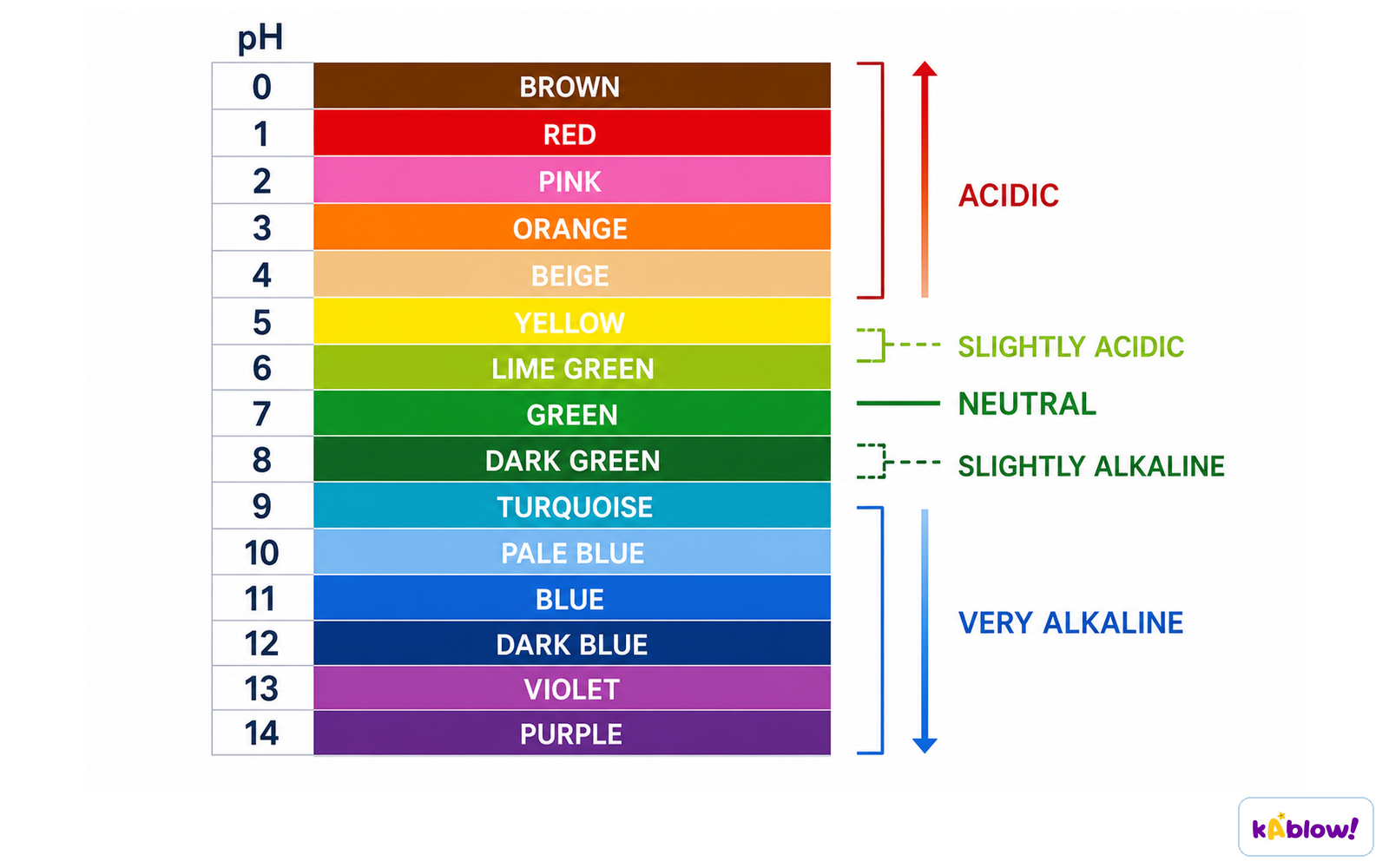
- Universal indicator: mixture of dyes giving a colour range for pH 1–14.
Universal indicator colours across the pH scale
Neutralisation & Ions
- Neutralisation: H⁺ + OH⁻ → H₂O (net ionic equation).
- Acids are sources of H⁺; alkalis are sources of OH⁻.
- Not all acid reactions are neutralisations (e.g., acid + metal produces no water).
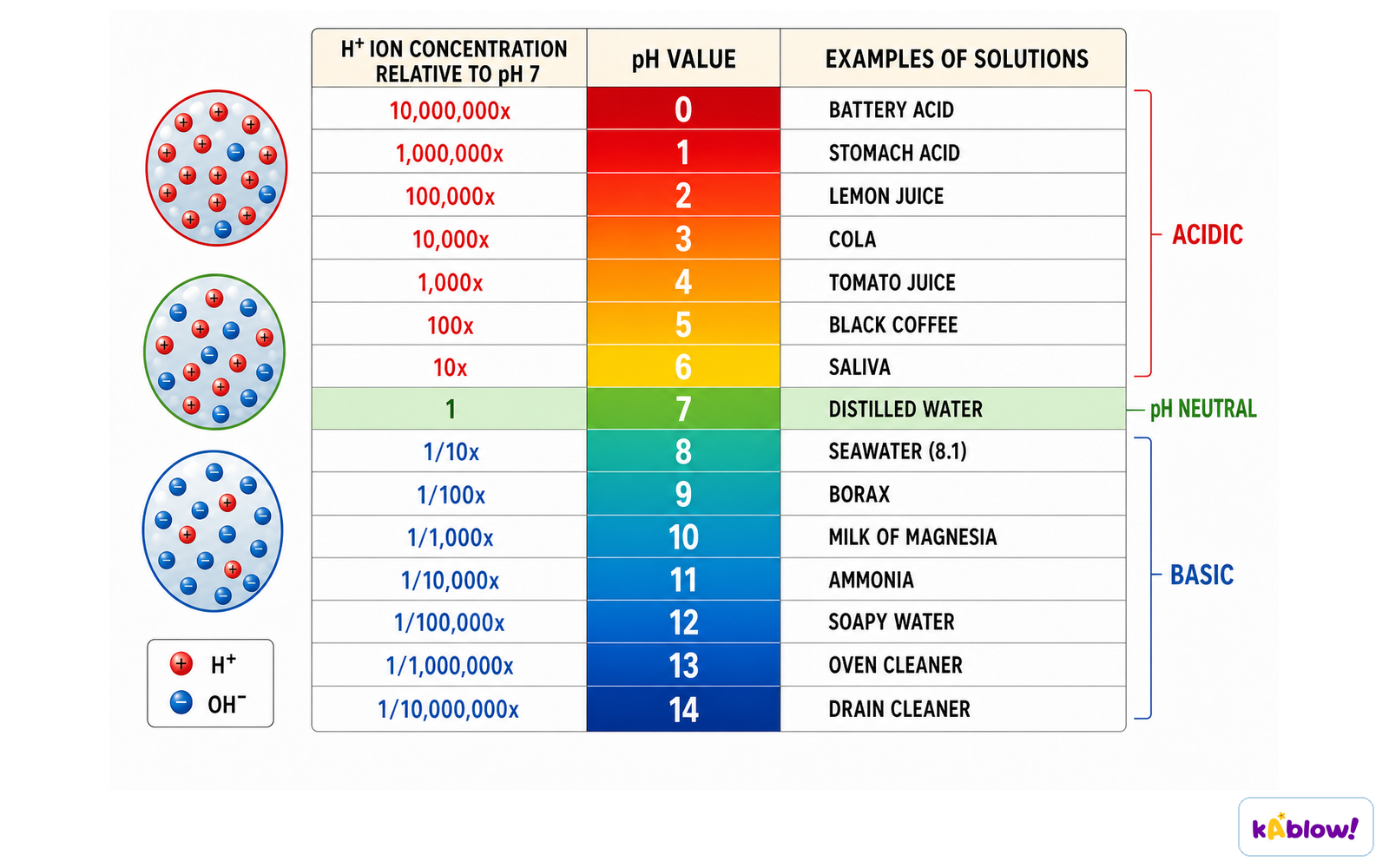
- The pH scale is logarithmic: a change of 1 pH unit = ×10 change in [H⁺].
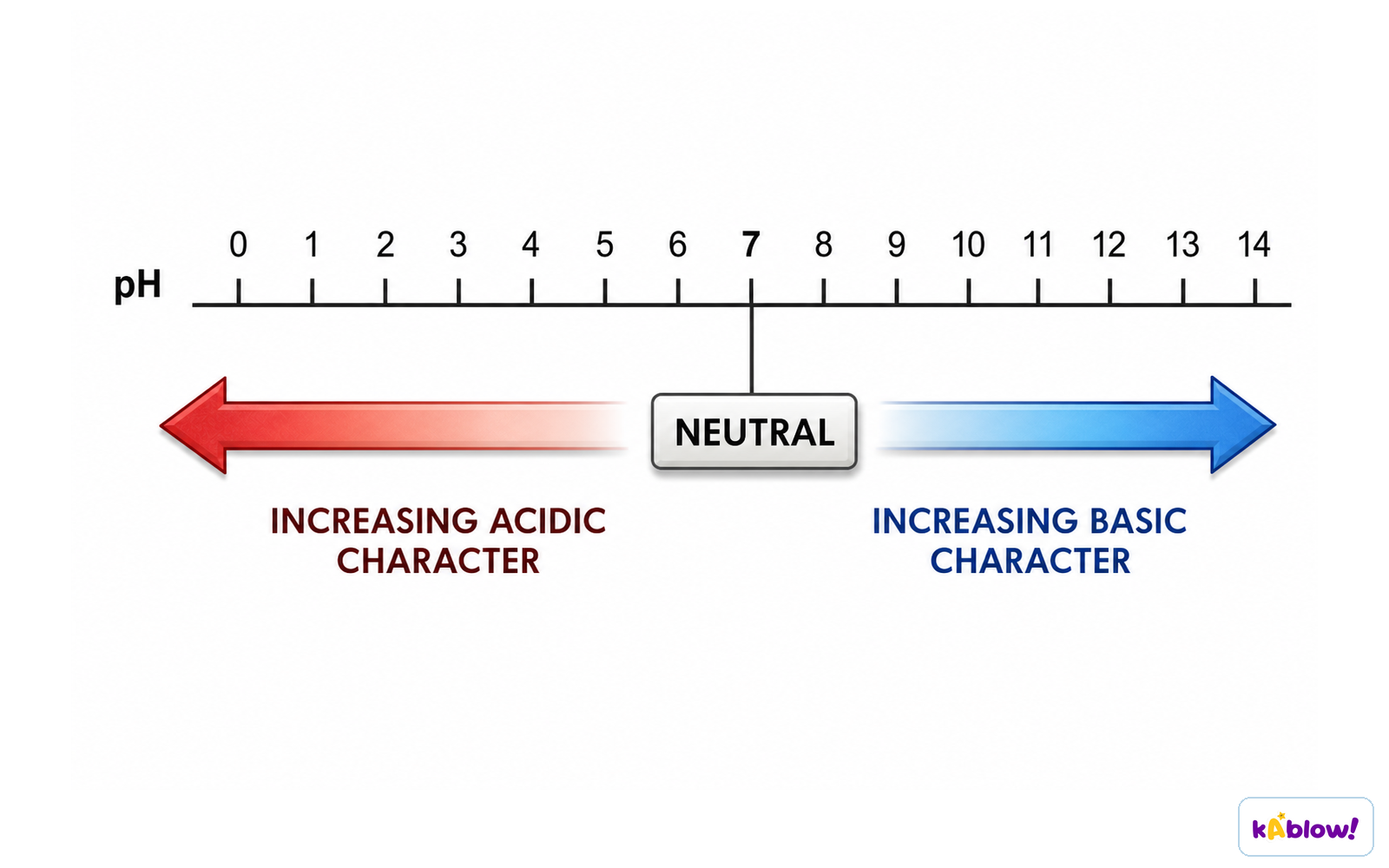
The pH scale
pH Scale & Hydrogen Ion Concentration
- pH 0–2: strong acid; pH 3–6: weak acid; pH 7: neutral.
- pH 8–11: weak alkali; pH 12–14: strong alkali.
- Lower pH = higher [H⁺]; higher pH = higher [OH⁻].
- Universal indicator gives approximate pH by matching colour to a chart.
H+ ion concentration relative to pH
Classifying Oxides
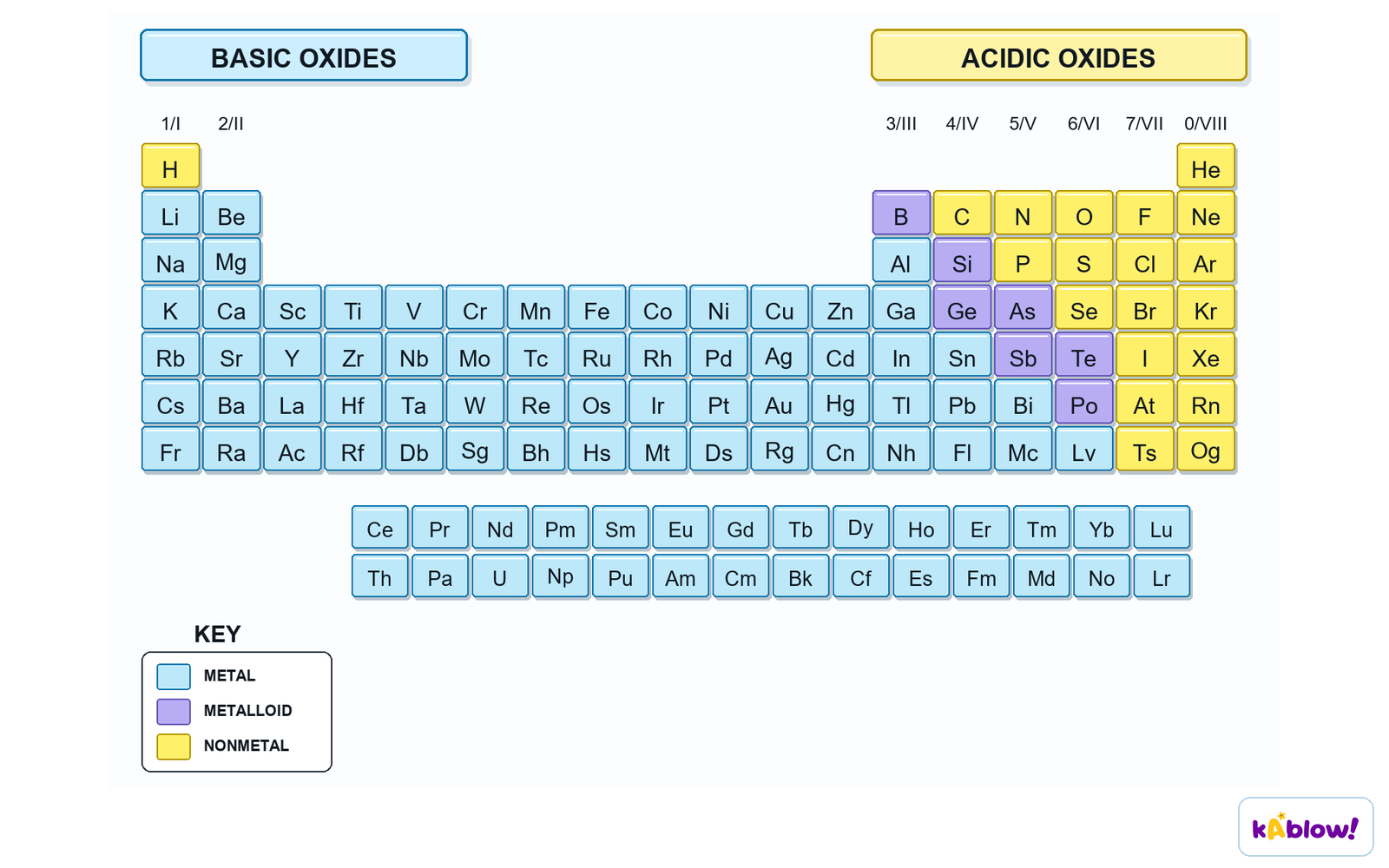
- Acidic oxides (non‑metal + O): react with bases to form salt + water; produce acidic solutions (e.g., CO₂, SO₂).
- Basic oxides (metal + O): react with acids to form salt + water; produce alkaline solutions (e.g., CuO, CaO).
- Amphoteric oxides (e.g., ZnO, Al₂O₃): react with both acids and bases to give salt + water.
- Neutral oxides (e.g., N₂O, NO, CO): do not react with acids or bases.
Metals form basic oxides, non-metals form acidic oxides
幻灯片
练习题
免费预览——52 题中的 8 题。注册即可查看全部。
1.All bases are soluble in water and are called alkalis.
EasyTrue or false?
2.Which of the following is the correct net ionic equation for the neutralisation of an acid by a base?
Easy- AH⁺(aq) + OH⁻(aq) → H₂O(l)
- BH⁺(aq) + OH⁻(aq) → H₂O₂(l)
- CH⁺(aq) + O²⁻(aq) → H₂O(l)
- DH₂O(l) → H⁺(aq) + OH⁻(aq)
3.State the colour of litmus in an alkali.
Easy4.Complete the sentence about the reaction of acids with metals.
EasyWhen an acid reacts with a metal, the products are a ____ and hydrogen gas.
5.A solution has a pH of 3. How many times greater is the hydrogen ion concentration compared to a solution of pH 5?
Medium- A100
- B120
- C90
- D110
6.Match each oxide to its classification.
Medium- CO₂
- MgO
- Al₂O₃
- Acidic oxide
- Basic oxide
- Amphoteric oxide
7.Name the gas produced when an acid reacts with a metal carbonate.
Easy8.Which indicator is NOT suitable for determining the endpoint in an acid-alkali titration?
Medium- ALitmus
- BMethyl orange
- CThymolphthalein
- DUniversal indicator
历年真题
该知识点的历年真题练习即将推出。
即将推出