The Periodic Table And Trends
边玩边学
回答这些题目来赚取能量,然后钓鱼探索。无需账号。
给教育者: 面向 The Periodic Table And Trends(Co-ordinated Sciences (Double Award) [CIE],Chemistry)的即用型课程幻灯片, 复习笔记——用在你的课堂上,或将该知识点作为学习者可实时游玩的互动课堂活动来运行。
课程笔记
The Periodic Table
- Elements are arranged in order of increasing atomic number.
- Vertical columns are called groups; horizontal rows are called periods.
- The period number indicates the number of electron shells an atom has.
- The group number (1–7, plus Group 0) indicates the number of outer-shell electrons.
- Group number helps determine the charge of ions: metals lose electrons (positive ions), non-metals gain electrons (negative ions).
- For example, Group 1 metals form 1+ ions; Group 7 non-metals form 1− ions.
The Periodic Table: metals, non-metals, metalloids and liquids at room temperature
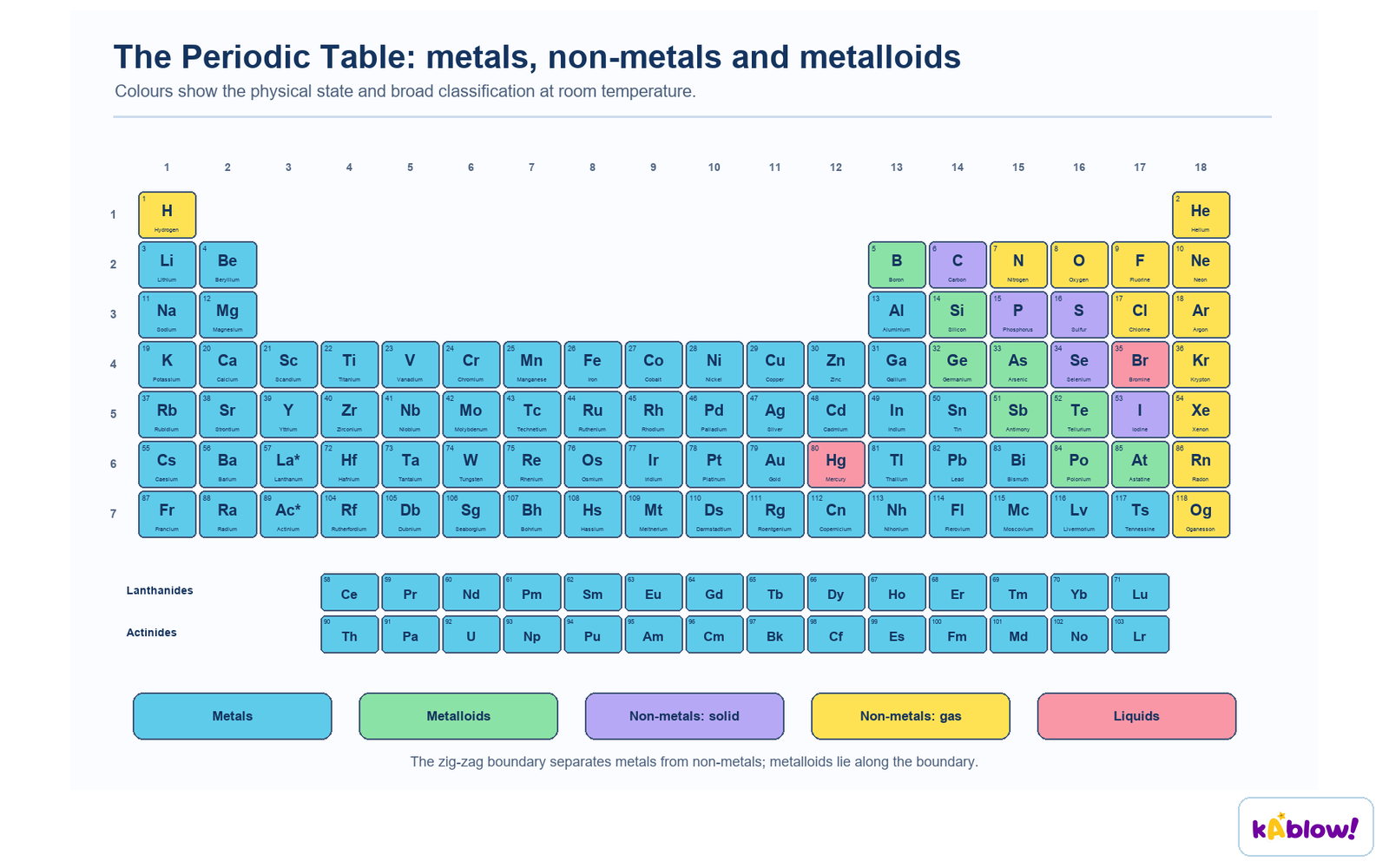
Periodic Trends in Metallic Character
- Metallic character decreases from left to right across a period.
- Metallic character increases down a group.
- Metals are on the left of the Periodic Table; non-metals on the right.
- Elements between metals and non-metals are called metalloids or semi-metals.
- Metals have 1–3 outer electrons, form metallic bonds, conduct electricity, and produce basic oxides.
- Non-metals have 4–7 outer electrons, form covalent bonds, are poor conductors, and produce acidic oxides.
The metal/non-metal divide, with basic and acidic oxide regions
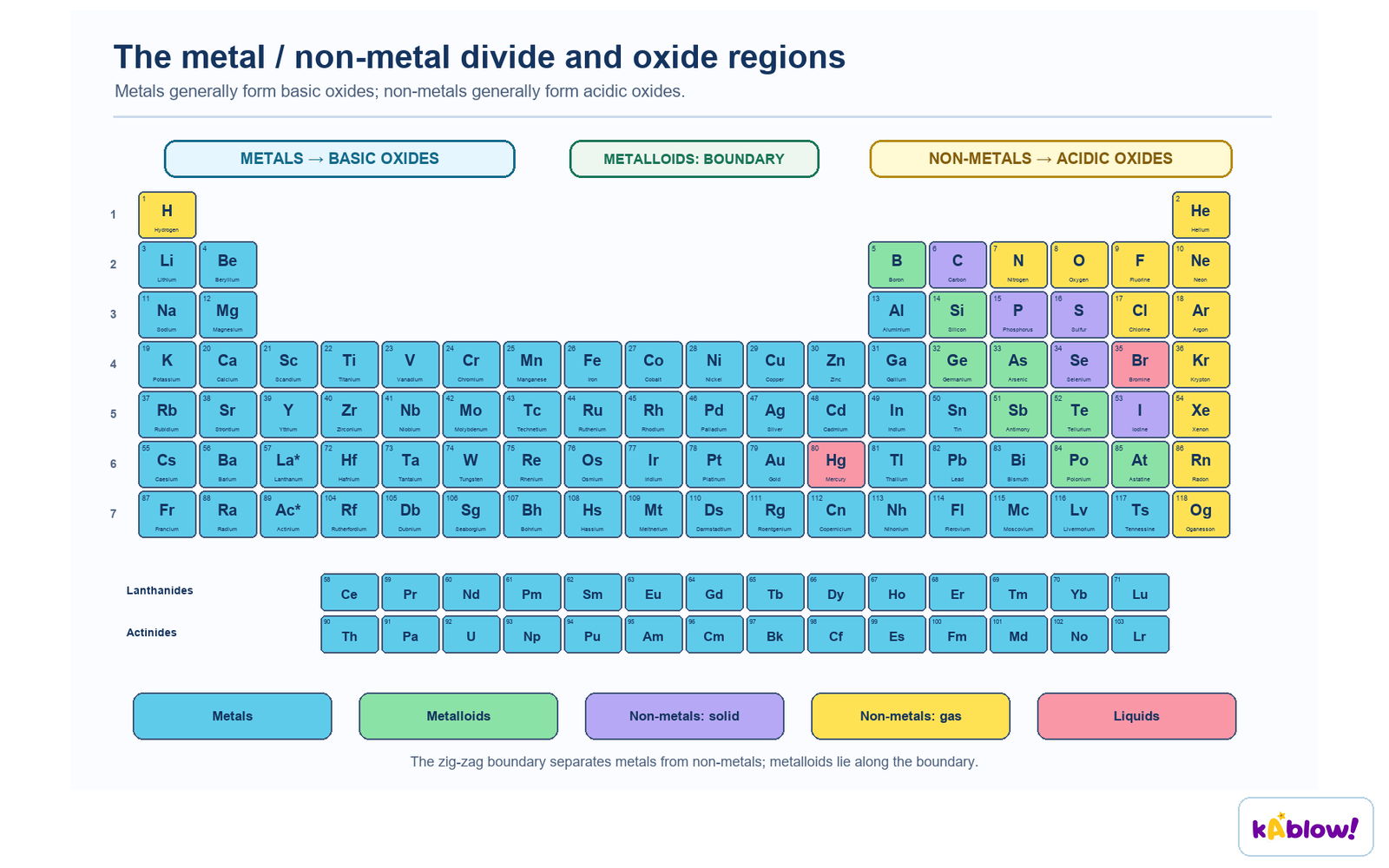
Electronic Configuration and Position
- Electronic configuration (e.g., 2,4 for carbon) shows the number of electrons in each shell.
- The number of notations (shells) equals the period number.
- The last notation (outer electrons) equals the group number.
- Elements in the same group have the same number of outer electrons and similar chemical properties.
- For example, lithium (2,1) and sodium (2,8,1) are both in Group 1 and react similarly.
Trends in Reactivity: Group 1 Metals (Extended)
- Reactivity of Group 1 metals increases down the group.
- Lithium reacts slowly with water, fizzing and moving on the surface.
- Sodium reacts more vigorously, moving rapidly and dissolving quickly.
- Potassium reacts even more vigorously, burning with a lilac flame.
- Rubidium and caesium react explosively; francium is too reactive to predict.
- The trend can be used to predict properties of other elements in the group.
幻灯片
练习题
免费预览——56 题中的 8 题。注册即可查看全部。
1.Elements are arranged on the Periodic Table in order of increasing
Easy- Aatomic mass
- Batomic number
- Cnumber of neutrons
- Dmass number
2.What is the name given to the vertical columns in the Periodic Table?
Easy3.What is the name given to the horizontal rows in the Periodic Table?
Easy4.How many electrons are in the outer shell of an element in Group 6?
Easy- A7
- B6
- C5
- D8
5.Elements in the same group have similar chemical properties because they have the same number of outer shell electrons.
EasyTrue or false?
6.Complete the sentence.
EasyThe metallic character of elements ____ as you move across a period from left to right.
7.Match each element to its electronic configuration.
Easy- Sodium
- Chlorine
- Carbon
- 2,4
- 2,8,1
- 2,8,7
8.Arrange these Group 1 metals in order of increasing reactivity with water (least reactive first).
Easy- sodium
- lithium
- potassium
历年真题
该知识点的历年真题练习即将推出。
即将推出