Methods Of Error Detection
边玩边学
回答这些题目来赚取能量,然后钓鱼探索。无需账号。
给教育者: 面向 Methods Of Error Detection(Computer Science,CIE)的即用型课程幻灯片, 复习笔记——用在你的课堂上,或将该知识点作为学习者可实时游玩的互动课堂活动来运行。
课程笔记
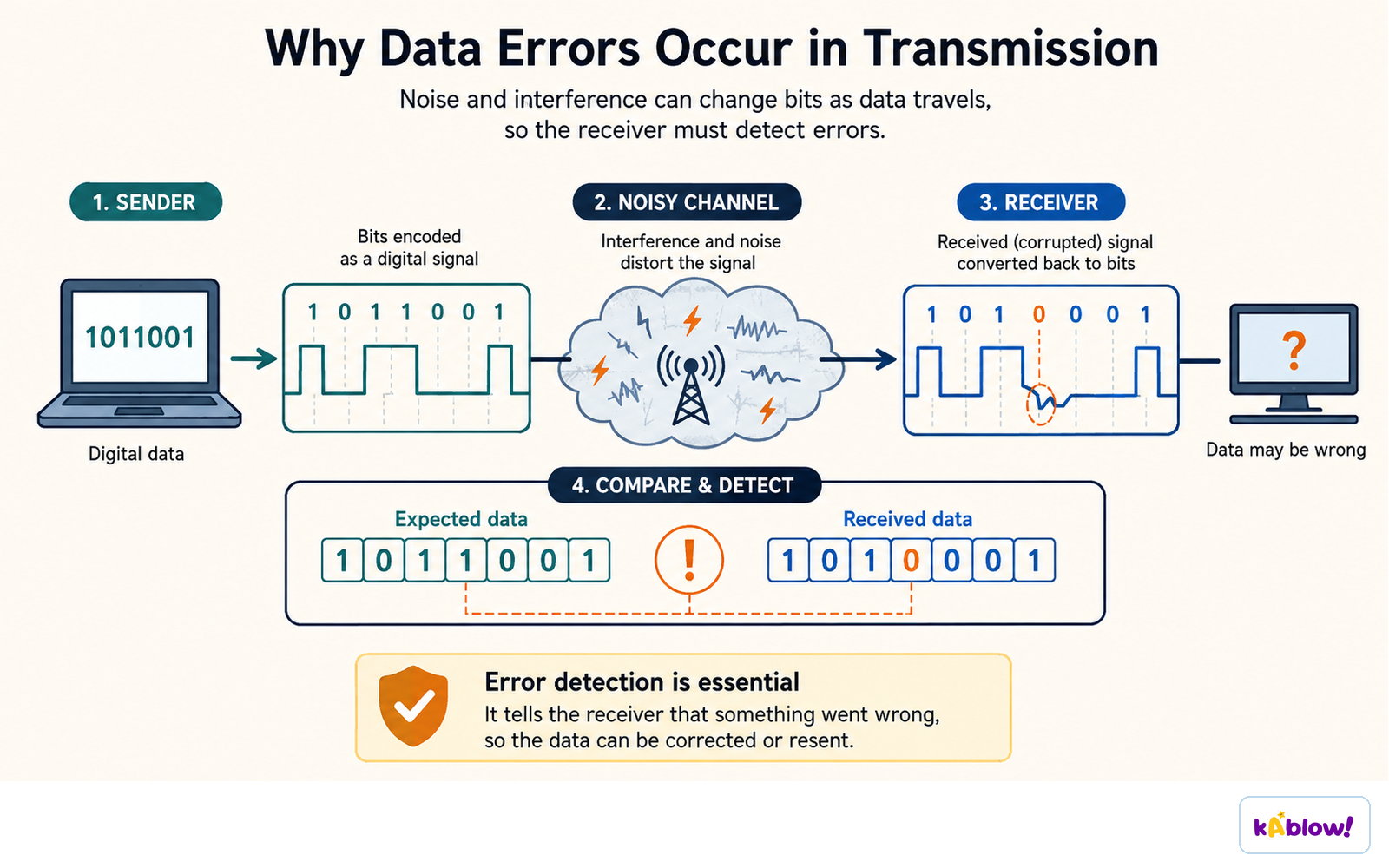
Why Errors Occur
- Errors occur due to interference in wired or wireless transmission (e.g., wire degradation, electrical fields, weather, physical barriers).
- Results of interference: data loss, data gain, or data change (bits flipped).
- Computers expect data in specific formats; unexpected data causes errors or corruption.
Noise and interference distort the signal in transit, so received bits can differ from the ones sent.
Parity Check
- A parity bit is added to each byte; sender and receiver agree on odd or even parity.
- For even parity, total number of 1s (including parity bit) must be even; for odd parity, total must be odd.
- If parity doesn't match, an error is detected, but the location is unknown.
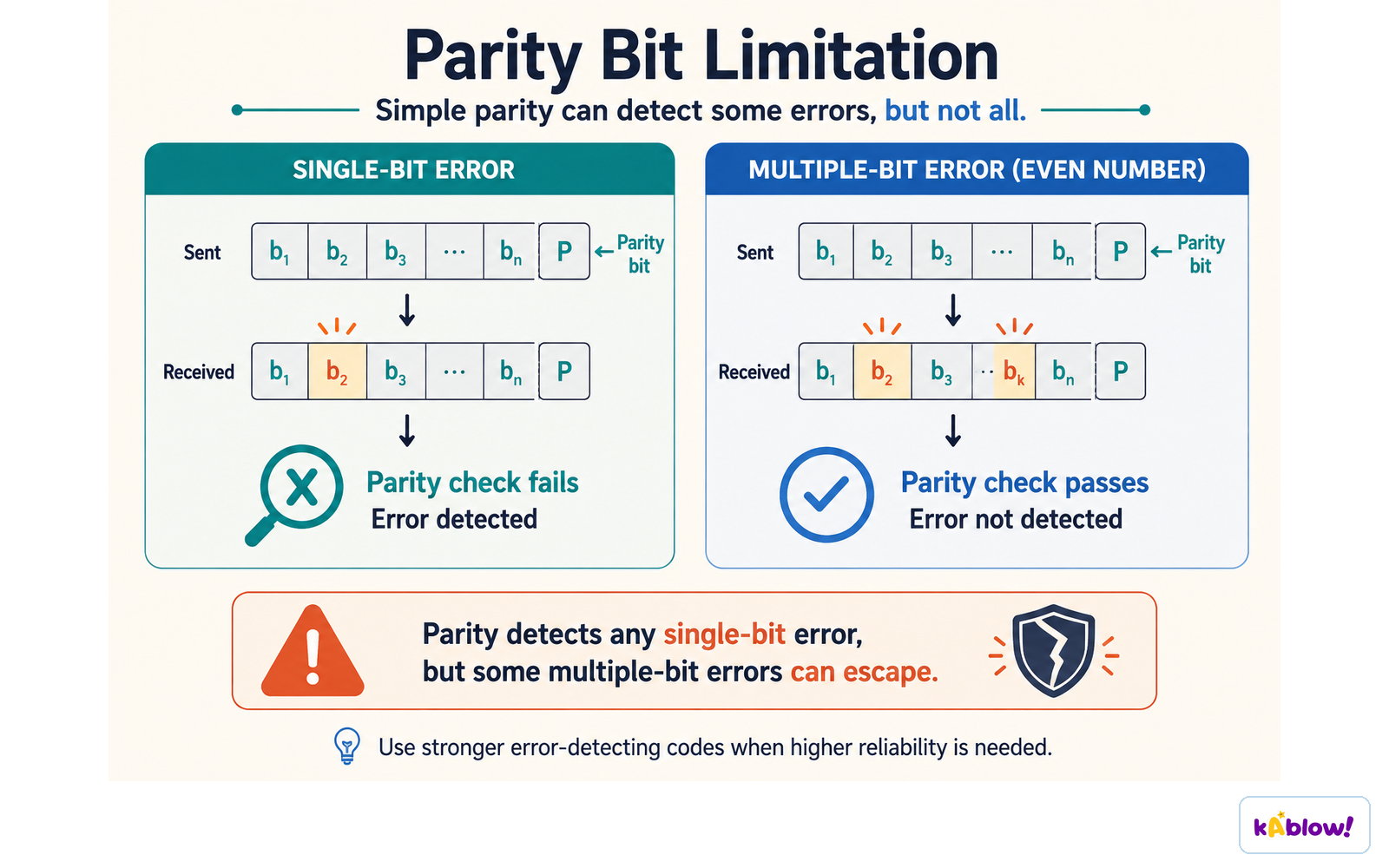
- Limitation: parity check fails if an even number of bits are flipped or bits are transposed.
Parity detects any single-bit error, but an even number of flipped bits passes the check undetected.
Parity Block & Parity Byte
- A parity block uses horizontal (per byte) and vertical (per column) parity calculations.
- The parity byte contains vertical parity bits for each column.
- Cross-referencing horizontal and vertical parity pinpoints the exact error location.
- The error can be corrected automatically or a retransmission requested.
Checksum
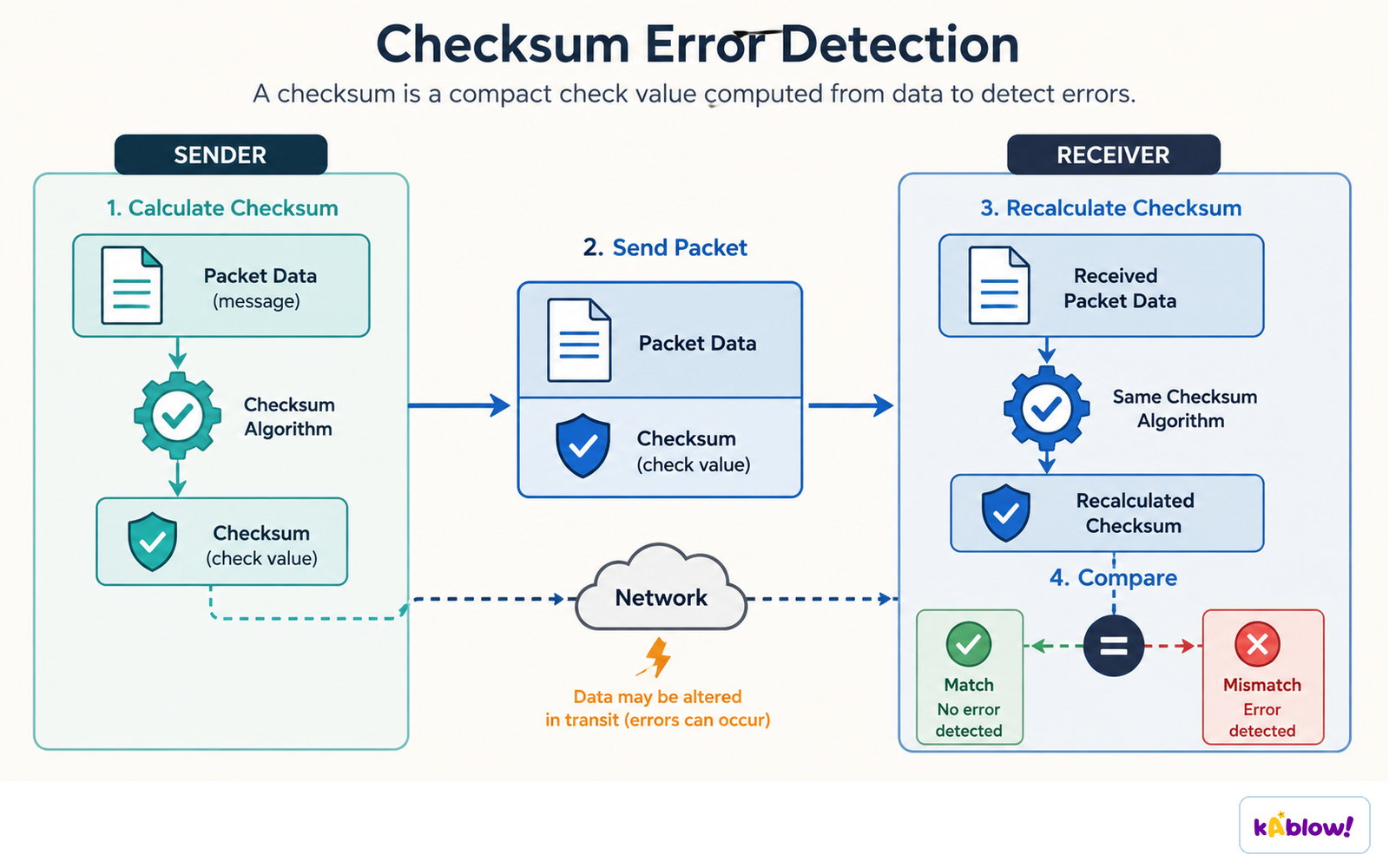
- A checksum is a value calculated from data using an algorithm and sent with the data.
- Receiver recalculates the checksum and compares it to the transmitted value.
- If they do not match, an error is assumed; checksum does not indicate error location.
The sender computes a checksum from the data; the receiver recalculates it and compares.
Echo Check
- The receiver echoes (sends back) the received data to the sender.
- Sender compares echoed data to original; if different, an error occurred and data is retransmitted.
- Limitation: an error could occur during the echo transmission itself.
Check Digits
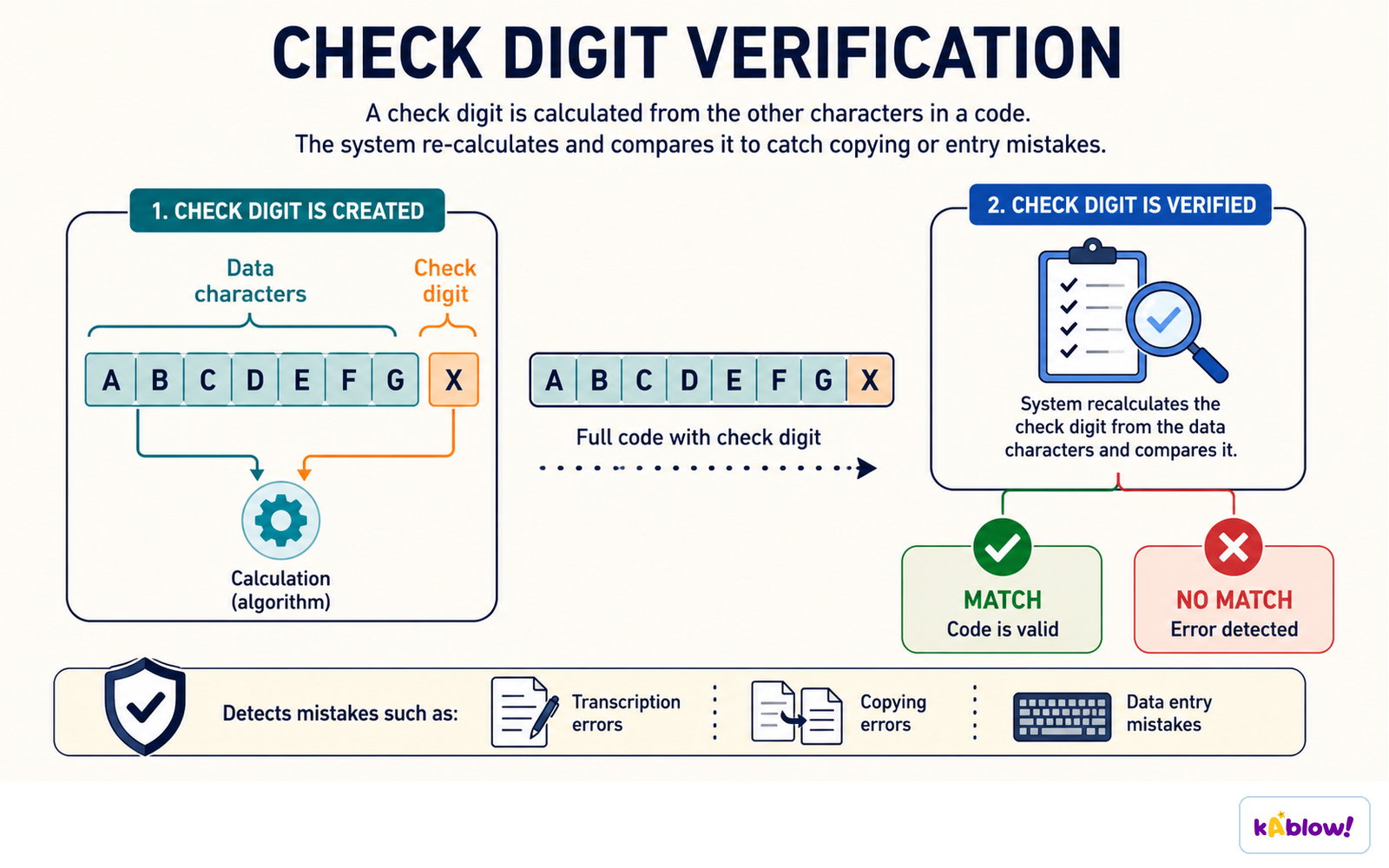
- A check digit is the last digit in a numeric code (e.g., ISBN, barcode) used to detect entry errors.
- Detects: incorrect digits, omitted/extra digits, phonetic errors.
- Calculated using a standard algorithm; if the result is a whole number, the code is valid.
A check digit is recalculated from the other characters and compared, catching copying and entry mistakes.
Automatic Repeat Query (ARQ)
- ARQ is a protocol using acknowledgements and timeout to ensure error-free transmission.
- Receiver sends positive acknowledgement (ACK) if data is correct, or negative acknowledgement (NAK) if corrupted.
- If no acknowledgement is received within a timeout period, the sender automatically retransmits the data.
- Process repeats until data is received correctly or a limit is reached.
If a packet arrives damaged the receiver sends a negative acknowledgement and the sender retransmits.
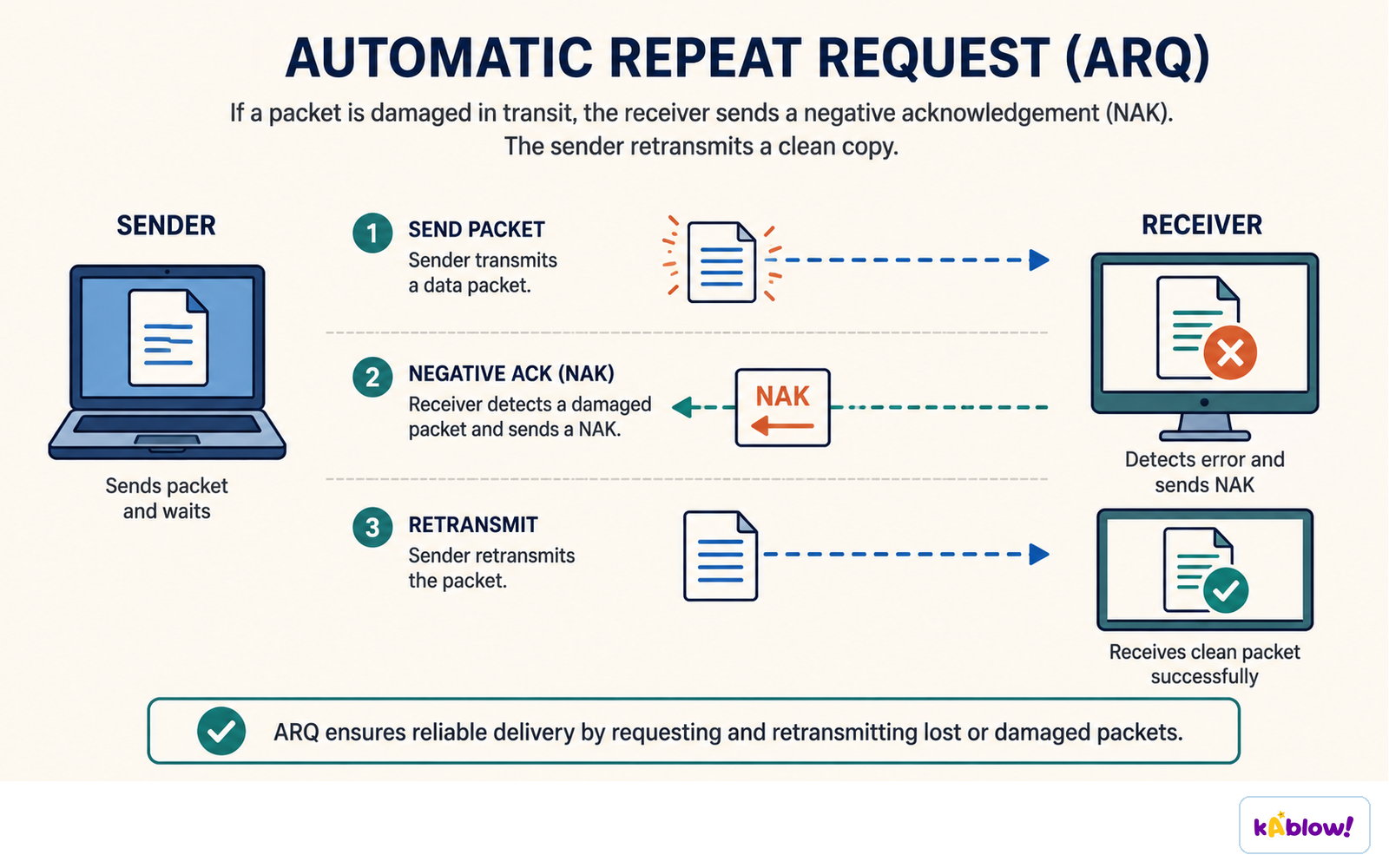
幻灯片
练习题
免费预览——58 题中的 8 题。注册即可查看全部。
1.Which of the following is a result of interference during data transmission?
Easy- AData loss
- BData encryption
- CData compression
- DData indexing
2.What is the purpose of a parity bit in data transmission?
Easy- ATo detect errors in the transmitted data
- BTo correct errors in the transmitted data
- CTo encrypt the transmitted data
- DTo compress the transmitted data
3.A byte is transmitted with even parity. The byte received is 10110010. Does this byte contain an error?
Medium- AYes, because there are four 1s
- BNo, because there are four 1s
- CYes, because there are five 1s
- DNo, because there are five 1s
4.Why might a parity check fail to detect an error?
Medium- AIf an even number of bits are flipped
- BIf an odd number of bits are flipped
- CIf the parity bit itself is corrupted
- DIf the data is encrypted
5.In a parity block check using odd parity, the parity byte is calculated as 01111111. If the received parity byte is 01111110, what does this indicate?
Medium- AAn error has occurred in bit column 8
- BAn error has occurred in bit column 7
- CAn error has occurred in byte row 8
- DNo error has occurred
6.What is a checksum used for?
Easy- ATo determine if data has been corrupted
- BTo encrypt data
- CTo compress data
- DTo convert data to a different format
7.In an echo check, the receiver sends the received data back to the sender. Why is this method not fully reliable?
Medium- AAn error could occur when the receiver transmits the data back
- BThe sender cannot detect errors
- CThe receiver cannot detect errors
- DIt requires too much bandwidth
8.What is a check digit?
Easy- AThe last digit in a code used to detect errors in numeric data entry
- BThe first digit in a code used to identify the data type
- CA digit used to encrypt the data
- DA digit used to compress the data
历年真题
该知识点的历年真题练习即将推出。
即将推出