Sequences
边玩边学
回答这些题目来赚取能量,然后钓鱼探索。无需账号。
给教育者: 面向 Sequences(Maths [CIE],Core)的即用型课程幻灯片, 复习笔记——用在你的课堂上,或将该知识点作为学习者可实时游玩的互动课堂活动来运行。
课程笔记
Introduction to Sequences
- A sequence is an ordered set of numbers that follow a rule (e.g., 3, 6, 9, 12... rule: add 3).
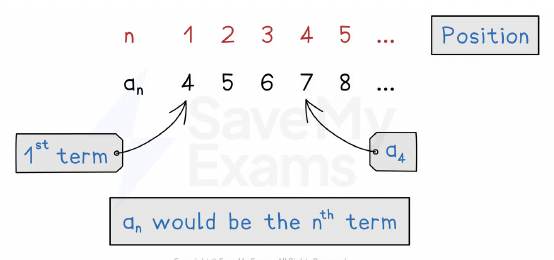
- Each number is a term; its position is given by n (n=1 is 1st term).
- A term-to-term rule tells how to get the next term (e.g., add 4 each time).
- A position-to-term rule (nth term formula) lets you find any term directly (e.g., 8n+2).
- To check if a value belongs to a sequence, set the nth term formula equal to the value and solve for n; if n is a whole number, it is a term.
Sequence position notation
Continuing Sequences
- Use first differences to spot patterns: e.g., 4,7,10,13 → differences +3, next term 16.
- If first differences change by a constant amount (second differences constant), the sequence is quadratic.
- If first differences double each time, the next difference is double the last.
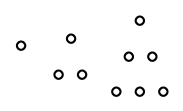
- Be familiar with special sequences: square numbers (1,4,9,16...), cube numbers (1,8,27,64...), triangular numbers (1,3,6,10...).
Triangular numbers as dots
nth Terms of Linear Sequences
- A linear sequence (arithmetic) has a constant common difference d.
- The nth term formula is dn + b, where d is the common difference and b is the term before the 1st term (zero term).
- To find b, continue the sequence backwards by one term (subtract d from the 1st term).
- Example: 5,7,9,11 → d=2, b=3 → nth term = 2n+3.
Quadratic Sequences
- A quadratic sequence has an nth term involving n²; its second differences are constant.
- Compare to square numbers (n²): e.g., 6,9,14,21,30 → each term is 5 more than n² → nth term = n²+5.
- For simple quadratics an²+b, a = ½ × (second difference).
- Example: sequence 3,9,19,33,51 → second difference = 4 → a=2, then find b by comparing to 2n².
Cubic Sequences
- A cubic sequence has an nth term involving n³; its third differences are constant.
- Compare to cube numbers (n³): e.g., 2,9,28,65,126 → each term is 1 more than n³ → nth term = n³+1.
- For simple cubics an³+b, a = ⅙ × (third difference).
- Know cube numbers up to 5³=125 and 10³=1000.
Finding the nth Term: Worked Examples
- Linear: Find nth term of -7,-3,1,5,9 → d=4, b=-11 → nth term = 4n-11.
- Quadratic: Find nth term of 6,9,14,21,30 → second diff=2 → a=1 → compare to n² → nth term = n²+5.
- Cubic: Sequence 4,25,82,193,376 → third diff=18 → a=3 → compare to 3n³ → nth term = 3n³+1.
- Always check your formula by substituting n=1,2,3 to see if it matches the given terms.
Using nth Term to Find Terms and Check Membership
- To find a specific term, substitute n into the formula (e.g., 20th term of n²+5 = 400+5=405).
- To check if a number is in the sequence, set formula = number and solve for n; if n is a positive integer, it is a term.
- Example: Is 98 in sequence 8n+2? 8n+2=98 → n=12 → yes, 12th term.
- If n is not an integer (e.g., n=15.25), the number is not in the sequence.
Pattern Sequences (Exam Style)
- Many exam questions involve patterns of counters, lines, or squares; find the nth term for each quantity.
- Example: Pattern n has black counters = 2n+2, white counters = n².
- Use the nth term to check if a pattern can be made with given resources (e.g., 30 black, 140 white for Pattern 12).
- For linear patterns, the number of rows or houses can be found using the nth term formula.
幻灯片
练习题
免费预览——55 题中的 8 题。注册即可查看全部。
1.What is the next term in the sequence 18, 21, 26, 33, 42, ...?
Easy- A53
- B51
- C55
- D49
2.Find the next term in the sequence 18, 20, 24, 32, 48, ...
Medium- A80
- B64
- C56
- D72
3.The first four terms of a sequence are 17, 10, 3, -4. What is the next term?
Easy- A-11
- B-10
- C-12
- D-9
4.The nth term of a sequence is n3 - 5. What is the first term?
Easy- A-4
- B-3
- C0
- D1
5.The first four terms of a sequence are 29, 32, 35, 38. What is the next term?
Easy- A41
- B40
- C42
- D39
6.The first four terms of a sequence are 32, 27, 22, 17. What is the next term?
Easy- A12
- B13
- C11
- D10
7.The nth term of a sequence is n2 + 5. What is the second term?
Easy- A9
- B6
- C7
- D10
8.Find the next term in the sequence 12, 7, 2, -3, -8, ...
Easy- A-13
- B-12
- C-14
- D-11
历年真题
该知识点的历年真题练习即将推出。
即将推出