Bearings Constructions And Scale Drawings
边玩边学
回答这些题目来赚取能量,然后钓鱼探索。无需账号。
课程笔记
Bearings
- Bearings describe an angle used in navigation, measured from North (usually straight up on a diagram) clockwise, and written with three digits (e.g., 059°).
- To find the bearing of A from B: start at B, draw a North line, then measure the clockwise angle to the line joining B to A.
- To find the bearing of B from A: start at A, draw a North line, then measure the clockwise angle to the line joining A to B.
- If the bearing of A from B is less than 180°, add 180° to get the bearing of B from A; if it is more than 180°, subtract 180°.
- Always draw a clear, large diagram and label angles carefully; use a protractor for accurate angle measurement.
Bearings of compass points
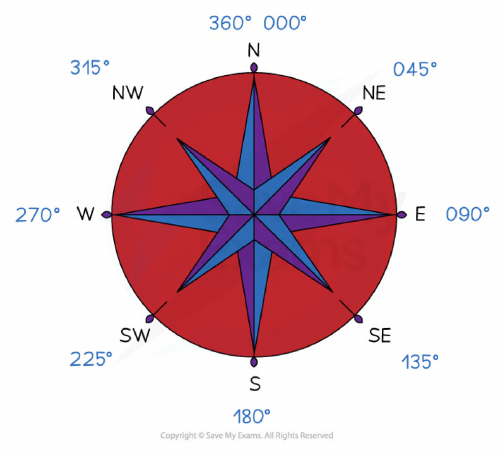
Scale
- A scale is a ratio comparing drawn size to real-life size; e.g., 1:50 000 means 1 cm on the drawing represents 50 000 cm in reality.
- To find actual distance from a map: measure the drawn length, multiply by the scale factor, then convert units (e.g., cm → m → km).
- To find drawn length from actual distance: convert actual distance to the same units as the scale, then divide by the scale factor.
- Common sense checks: when converting to smaller units (e.g., km → m), the number gets larger; when converting to larger units, it gets smaller.
Constructing SSS Triangles
- SSS triangle construction uses the lengths of all three sides; you need a pencil, ruler, and compasses.
- Step 1: Draw the longest side as a horizontal base near the bottom of your space, label its length.
- Step 2: Set compasses to the length of one remaining side, place the point at one end of the base, and draw an arc above the base.
- Step 3: Without changing compass width, set to the third side, place the point at the other end of the base, and draw another arc crossing the first.
- Step 4: Use a ruler to draw straight lines from each end of the base to the intersection point of the arcs.
- Step 5: Check the two new sides match the given lengths; do not erase construction arcs – they are required for marks.
Constructing triangle ABC
Drawing a Point on a Bearing
- To plot a point B from A on a given bearing and distance: draw a North line at A, measure the bearing clockwise from North, draw a line in that direction.
- Use the scale to convert the real distance to the drawing length, then measure along the bearing line to mark point B.
- Always label North lines and points clearly; use a sharp pencil for accuracy.
Plotting point B from A
Back Bearings
- A back bearing is the bearing in the opposite direction; it differs by 180°.
- If the original bearing is less than 180°, add 180° to get the back bearing; if it is more than 180°, subtract 180°.
- Example: bearing of B from A is 105°, so bearing of A from B is 105° + 180° = 285°.
The bearing of B from A
Using Bearings with Trigonometry
- Trickier bearing problems may require Pythagoras or trigonometry to find missing distances or angles.
- Always draw a diagram if not given; annotate all known angles and lengths.
- Remember that bearings are measured from North, so angles in triangles may need to be calculated using alternate angles or co-interior angles.
幻灯片
练习题
免费预览——40 题中的 8 题。注册即可查看全部。
1.The bearing of a ship from a lighthouse is 050°. Work out the bearing of the lighthouse from the ship.
Easy- A050°
- B130°
- C230°
- D310°
2.The scale of a map is 1 cm to 3 km. On the map, the distance between two towns is 4.5 cm. Find the actual distance.
Easy- A1.5 km
- B7.5 km
- C13.5 km
- D15 km
3.Which of the following is a correct rule for bearings?
Easy- ABearings are measured anticlockwise from North.
- BBearings are measured clockwise from South.
- CBearings are measured clockwise from North and written as three-digit numbers.
- DBearings are measured anticlockwise from South and written as three-digit numbers.
4.Martin runs from checkpoint A to checkpoint B on a bearing of 065°. What is the bearing of A from B?
Easy- A065°
- B115°
- C245°
- D295°
5.The bearing of B from A is 105°. Find the bearing of A from B.
Medium- A075°
- B105°
- C195°
- D285°
6.A map has scale 1 : 25000. A lake has area 33.6 cm² on the map. Calculate the actual area of the lake in km².
Medium- A0.021 km²
- B0.21 km²
- C2.1 km²
- D21 km²
7.In triangle PQR, QR = 10 cm and PR = 11 cm. Using a ruler and compasses only, which of the following is the correct first step to construct triangle PQR if PQ is already drawn?
Medium- ADraw a circle of radius 10 cm around P.
- BDraw a circle of radius 11 cm around Q.
- CDraw a circle of radius 10 cm around Q and a circle of radius 11 cm around P.
- DDraw a circle of radius 11 cm around P and a circle of radius 10 cm around Q.
8.The bearing of D from A is 070°. Angle CAD = 35.8°. Find the bearing of A from C.
Medium- A034.2°
- B124.2°
- C214.2°
- D304.2°