Cell organisation
边玩边学
回答这些题目来赚取能量,然后钓鱼探索。无需账号。
给教育者: 面向 Cell organisation(KS3 Science,Biology)的即用型课程幻灯片, 复习笔记——用在你的课堂上,或将该知识点作为学习者可实时游玩的互动课堂活动来运行。
课程笔记
The Levels of Organisation
- Multicellular organisms organise their cells into a hierarchy, from simple to complex: cells → tissues → organs → organ systems → organism.
- A cell is the basic unit of life. Similar cells group together to form a tissue.
- A tissue is a group of similar cells working together to do one job.
- An organ is made of several different tissues working together.
- An organ system is a group of organs working together to carry out a major body function.
- The whole organism is made up of all its organ systems working together.
The levels of cell organisation, from a single cell to the whole organism
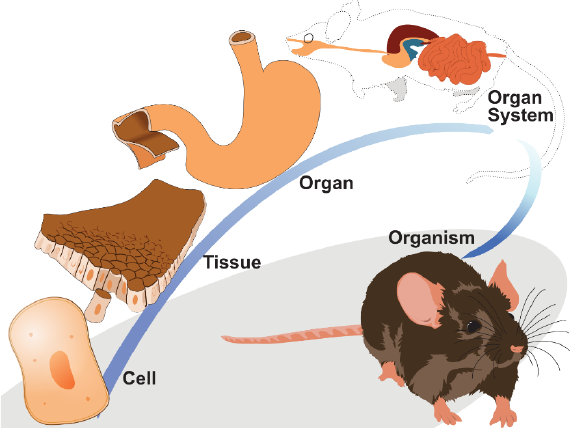
Animal Example: The Mouse Digestive System
- Epithelial cells line the stomach. They provide a protective barrier and help absorb nutrients.
- Epithelial cells group together to form epithelial tissue.
- Epithelial tissue joins with other tissues (such as muscle tissue) to form the stomach, an organ.
- The stomach combines with other organs, such as the intestines, to form the digestive system, an organ system.
- The digestive system is one of several organ systems that together make up the whole organism (the mouse).
Summary of cell organisation: the mouse digestive system

Plant Example: The Leaf
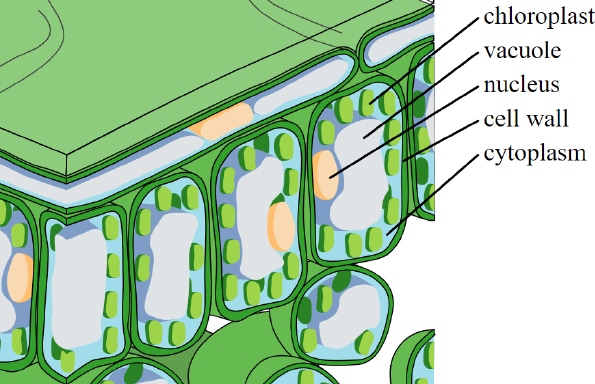
- Palisade cells are found near the surface of a leaf. They contain many chloroplasts for photosynthesis.
- Palisade cells group together to form palisade tissue.
- Palisade tissue joins with other tissues to form a leaf, an organ.
- Leaves combine with other organs, such as stems and roots, to form the shoot system, an organ system.
- The shoot system is part of the whole plant organism.
Summary of cell organisation: the leaf

Tissues vs Organs
- A tissue is a group of similar cells working together to do one job, for example epithelial tissue or palisade tissue.
- An organ is made of several different tissues working together, for example the stomach contains epithelial tissue, muscle tissue and connective tissue.
- An organ has a more complex structure than a tissue, and usually does more than one job.
Organelles in the Palisade Cell
- Chloroplast: the site of photosynthesis; contains chlorophyll to absorb light energy.
- Nucleus: contains DNA and controls the activities of the cell.
- Vacuole: stores cell sap and helps keep the cell firm (turgid).
- Cell wall: made of cellulose; supports and protects the cell.
- Cytoplasm: the jelly-like substance where most chemical reactions in the cell happen.
Palisade cells in leaf tissue, with organelles labelled
幻灯片
练习题
免费预览——26 题中的 8 题。注册即可查看全部。
1.What is the correct order of cell organisation from simplest to most complex?
Easy- Acells → tissues → organs → organ systems → organisms
- Btissues → cells → organs → organ systems → organisms
- Ccells → organs → tissues → organ systems → organisms
- Dcells → tissues → organ systems → organs → organisms
2.A group of similar cells working together is called a:
Easy- Atissue
- Borgan
- Corgan system
- Dorganism
3.Which of the following correctly describes an organ?
Medium- AA structure made of different tissues working together
- BA group of similar cells performing a specific function
- CA group of organs working together
- DA single cell performing a specific function
4.Which of the following is an organ system?
Easy- AStomach
- BEpithelial tissue
- CDigestive system
- DPalisade cell
5.What type of cell lines the stomach and provides a protective barrier?
Easy- Aepithelial cell
- Bpalisade cell
- Cnerve cell
- Dred blood cell
6.In the digestive system, epithelial cells form epithelial tissue. Epithelial tissue, along with other tissues, forms the stomach. This is an example of:
Medium- Acell organisation in an animal
- Bcell organisation in a plant
- Ca unicellular organism
- Da prokaryotic cell
7.Epithelial cells line the stomach. What is the main function of these cells?
Medium- ATo produce enzymes
- BTo provide a protective barrier and aid in nutrient absorption
- CTo contract and move food
- DTo carry oxygen
8.In a leaf, which cells contain many chloroplasts for photosynthesis?
Easy- Apalisade cells
- Bepithelial cells
- Cguard cells
- Dspongy mesophyll cells
历年真题
该知识点的历年真题练习即将推出。
即将推出