Mass and weight
边玩边学
回答这些题目来赚取能量,然后钓鱼探索。无需账号。
给教育者: 面向 Mass and weight(KS3 Science,Physics)的即用型课程幻灯片, 复习笔记, 图示——用在你的课堂上,或将该知识点作为学习者可实时游玩的互动课堂活动来运行。
课程笔记
Mass and Weight – Key Definitions
- Mass is the amount of matter in an object, measured in kilograms (kg).
- Weight is a downwards force due to gravity, measured in newtons (N).
- Mass stays the same everywhere; weight changes with gravitational field strength.
- Gravitational field strength (g) is the force per unit mass, measured in N/kg.
- On Earth, g = 9.8 N/kg; on the Moon, g = 1.6 N/kg.
A person's mass stays the same on Earth and the Moon, but their weight is much lower on the Moon because gravitational field strength is lower.
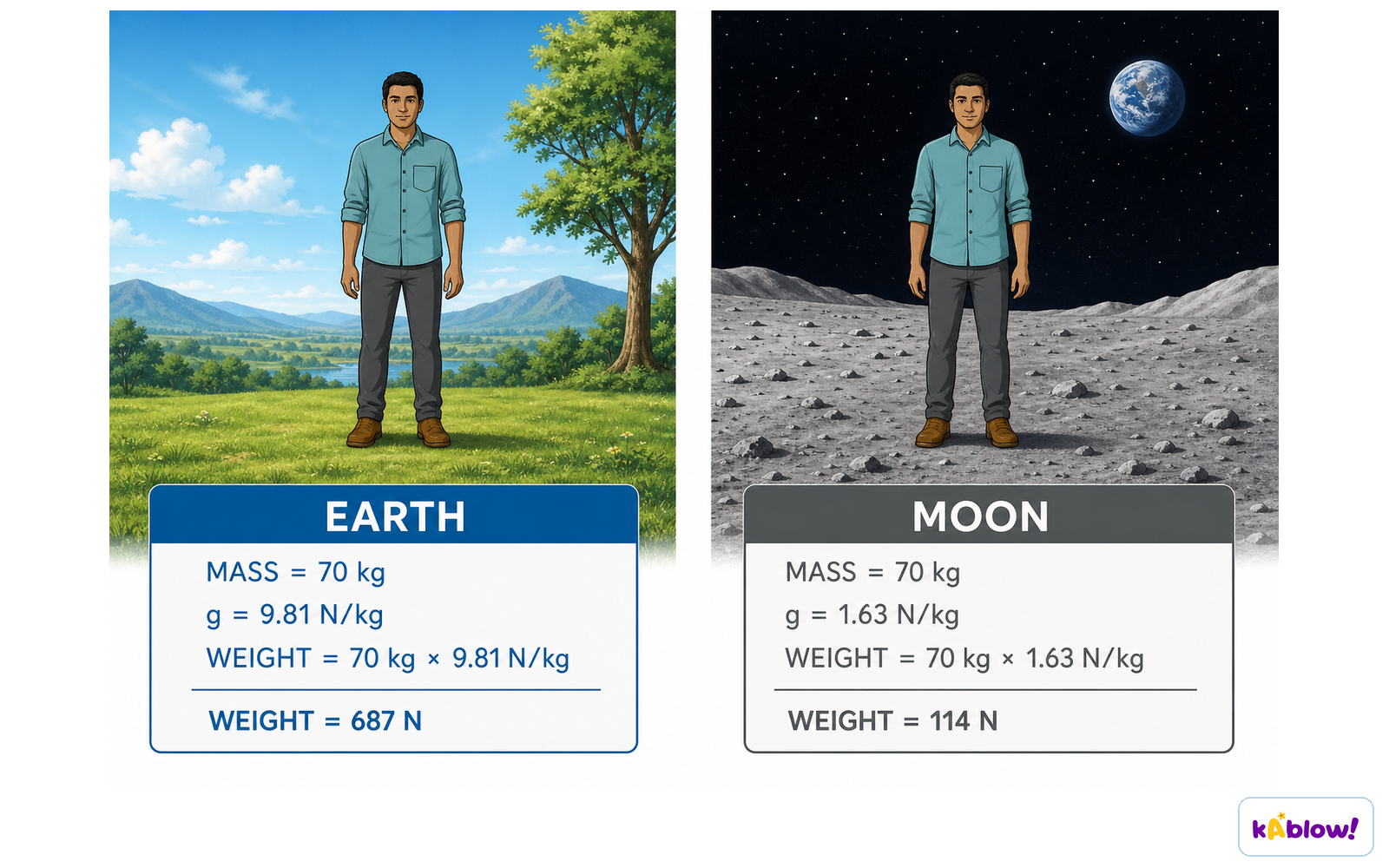
The Weight Equation
- Weight = Mass × Gravitational field strength (W = m × g).
- To calculate weight: multiply mass (kg) by g (N/kg).
- To calculate mass: rearrange to m = W ÷ g.
- To calculate g: rearrange to g = W ÷ m.
- Always include units in your answer (N for weight, kg for mass).
Worked Example – Calculating Weight
- Example: A 20 kg object on the Moon (g = 1.6 N/kg).
- Write equation: Weight = Mass × g.
- Substitute: 20 kg × 1.6 N/kg = 32 N.
- The weight is 32 N.
Worked Example – Calculating Mass
- Example: An object weighs 0.74 N on Mars (g = 3.7 N/kg).
- Rearrange: Mass = Weight ÷ g.
- Substitute: 0.74 N ÷ 3.7 N/kg = 0.2 kg.
- The mass is 0.2 kg.
Key Points to Remember
- Weight is a force; it always acts downwards.
- Gravitational field strength depends on the mass of the planet.
- Even you attract other objects, but your mass is too small for a noticeable force.
- On Earth, a 1 kg mass has a weight of 9.8 N.
Particle arrangement in solids, liquids and gases – mass is the amount of matter, weight depends on gravity.
幻灯片
练习题
免费预览——56 题中的 8 题。注册即可查看全部。
1.What is the equation linking weight (W), mass (m), and gravitational field strength (g)?
Easy- AW = m × g
- BW = m ÷ g
- CW = g ÷ m
- DW = m + g
2.Which of the following statements is true?
Easy- AThe mass of an object is the same everywhere.
- BThe weight of an object is the same everywhere.
- CMass changes with location, but weight does not.
- DWeight is measured in kilograms.
3.What is the weight of a 0.5 kg book on Earth where g = 9.8 N/kg?
Easy- A4.9 N
- B0.5 N
- C9.8 N
- D5.0 N
4.A Lunar Rover has a mass of 210 kg. What is its weight on the Moon where g = 1.6 N/kg?
Easy- A336 N
- B131 N
- C210 N
- D1.6 N
5.A 2 kg rock on Venus has a weight of 17.6 N. What is the gravitational field strength on Venus?
Medium- A8.8 N/kg
- B35.2 N/kg
- C0.11 N/kg
- D2.0 N/kg
6.On Pluto, g = 0.5 N/kg. What is the weight of a 4 kg object?
Easy- A2.0 N
- B0.5 N
- C8.0 N
- D4.5 N
7.An object on Ceres has weight 0.81 N and mass 3 kg. What is g on Ceres?
Medium- A0.27 N/kg
- B2.43 N/kg
- C3.7 N/kg
- D0.81 N/kg
8.Dr Edmunds has mass 70 kg and weight 259 N on Mercury. What is g on Mercury?
Medium- A3.7 N/kg
- B0.27 N/kg
- C9.8 N/kg
- D259 N/kg
历年真题
该知识点的历年真题练习即将推出。
即将推出