Thermal energy transfer
边玩边学
回答这些题目来赚取能量,然后钓鱼探索。无需账号。
给教育者: 面向 Thermal energy transfer(KS3 Science,Physics)的即用型课程幻灯片, 复习笔记——用在你的课堂上,或将该知识点作为学习者可实时游玩的互动课堂活动来运行。
课程笔记
Goals and a useful starting question
- Explain three mechanisms, interpret evidence and justify an insulation choice.
- Why does a metal spoon handle warm faster than a comparable wooden one in hot water? Predict, then check your explanation after reading.
Temperature and thermal energy transfer
- Temperature describes how hot or cold something is. Thermal energy is energy associated with the particles of a system; temperature alone does not tell you its total thermal energy.
- Net thermal energy transfer is from a hotter region to a cooler region. “Cold” is not a substance that flows into the hot object.
- Conduction, convection and radiation can occur together. Identify the particular route you are explaining.
Conduction: a particle model
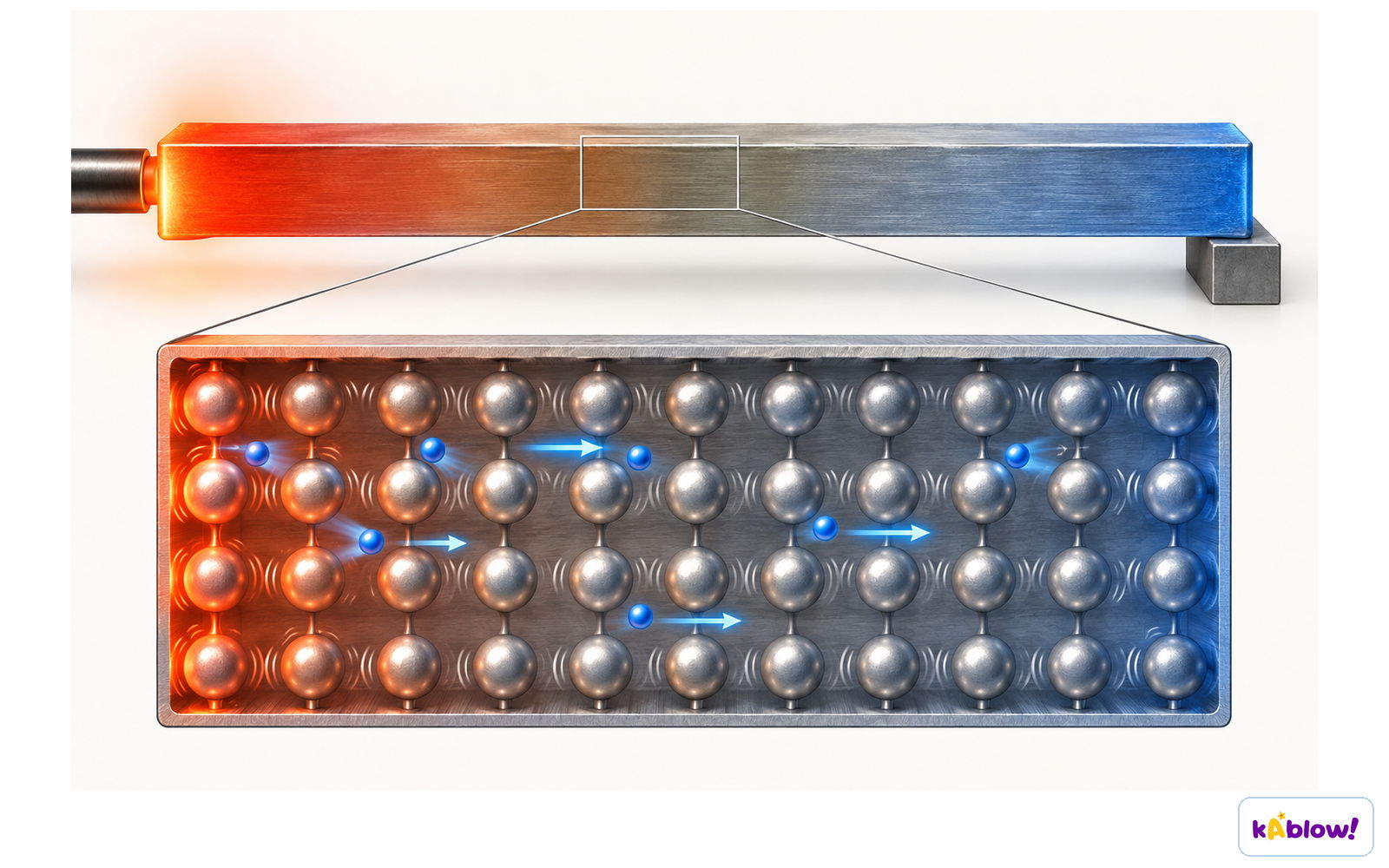
- In a solid, heated particles vibrate more energetically and transfer energy through interactions with neighbours. The particles stay near their positions; they do not flow from one end to the other.
- In metals, mobile electrons also transfer energy. Metals are usually good thermal conductors; plastic, wood and trapped air are poor conductors.
- Worked explanation: a metal spoon in hot water warms at its immersed end. Energy travels through the spoon by conduction towards the cooler handle.
- Check: a plastic handle slows conduction; it does not guarantee that the handle will always remain cool.
Conduction in a metal
Convection: explain each link
- In liquids and gases, heating usually makes a region expand. Its mass is spread over a larger volume, so that fluid region becomes less dense.
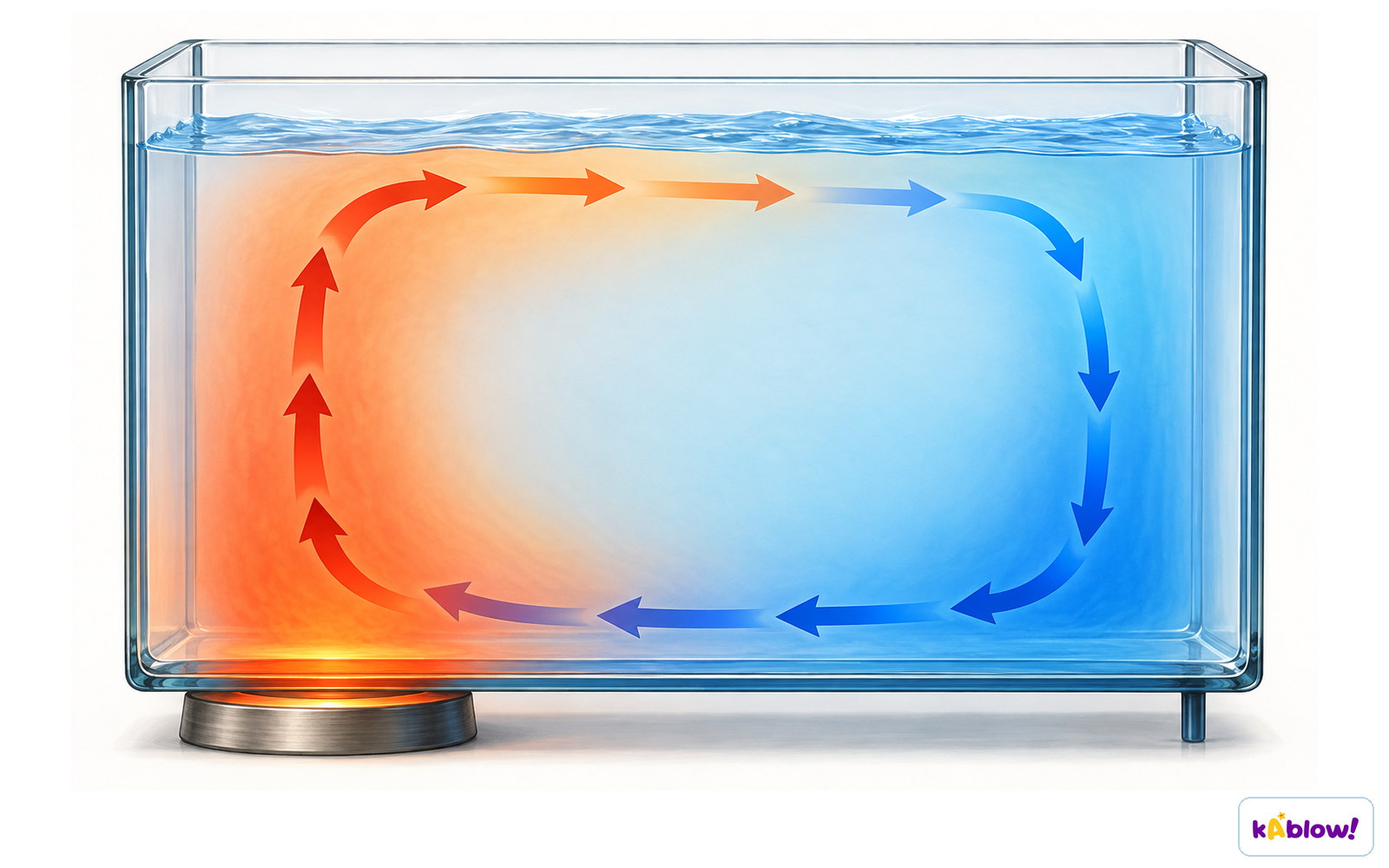
- Less dense warm fluid rises through cooler, denser fluid. Cooler fluid moves down to replace it, forming circulation that carries energy.
- It is the fluid that becomes less dense, not each particle. Ordinary solids do not circulate like a liquid or gas.
- Worked example: water heated at the bottom of a pan rises, while cooler water moves down. This is a convection current.
- Explain from memory: why can thermal energy travel sideways by conduction even though warm fluid rises in convection?
A convection current
Radiation and surfaces
- Radiation transfers energy by electromagnetic waves and can cross a vacuum. Energy from the Sun includes visible light and infrared radiation.
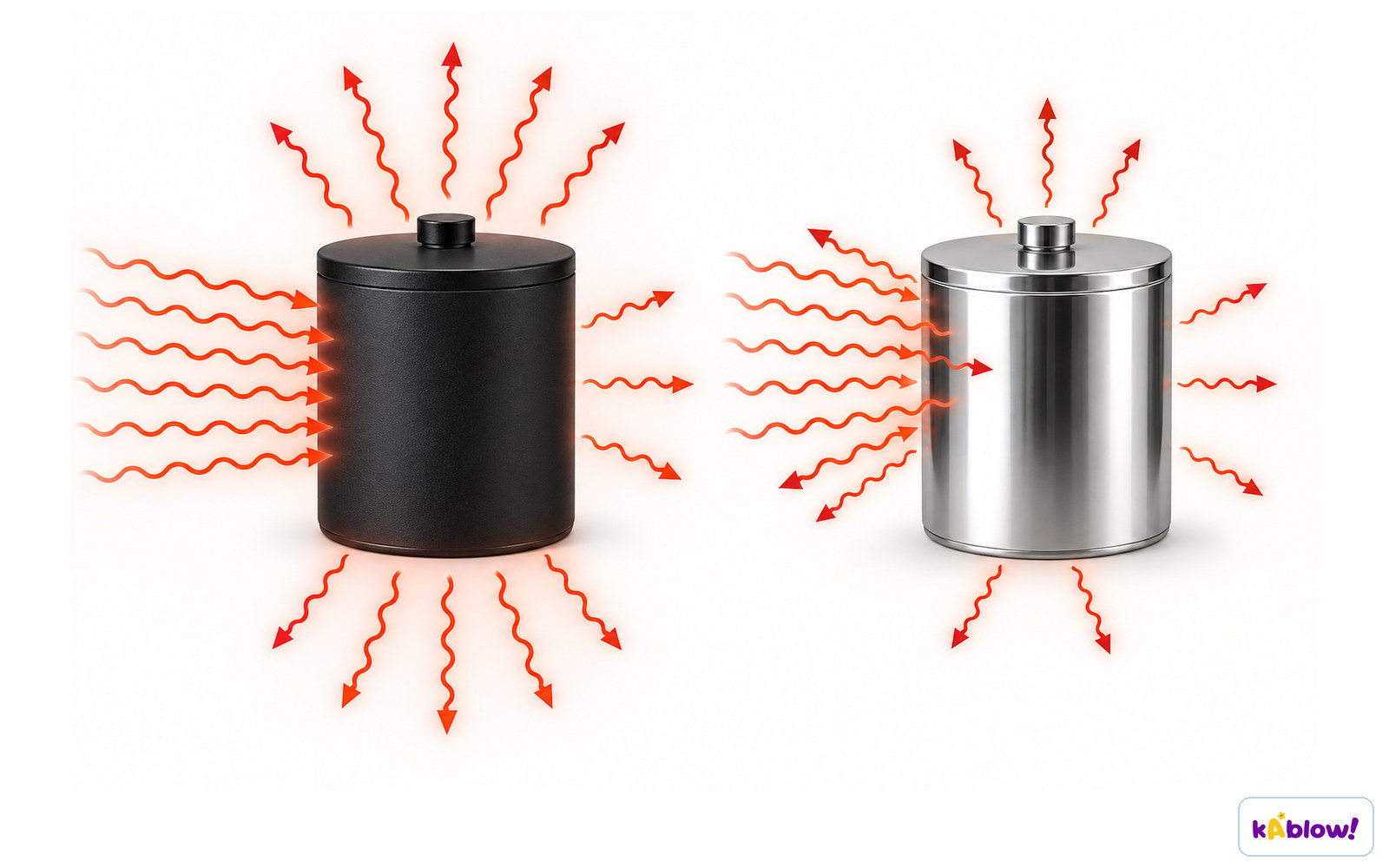
- Objects at ordinary temperatures emit infrared and absorb radiation from their surroundings. A warmer object in cooler surroundings loses energy overall.
- For comparable surfaces, matt black is generally a better infrared absorber and emitter than shiny silver. Keep temperature, area and other conditions the same in a test.
- Do not confuse: radiation needs no matter; convection needs moving fluid; conduction needs matter but no bulk movement.
Infrared radiation and surface finish
Using more than one form of insulation
- A vacuum gap prevents conduction and convection through the gap. Radiation can still cross it.
- Shiny flask walls reduce radiation; a stopper reduces transfer through the opening. Solid supports can still conduct energy.
- Trapped air reduces conduction and restricts convection. A sleeve slows cooling rather than preventing all thermal energy transfer.
- Apply: justify two design features for a container that keeps a drink warm. For each, name the mechanism and explain how the feature reduces it.
Evidence and fair tests
- In identical covered cups, equal masses of water start at 80°C. After 10 minutes, a sleeved cup is 65°C and an unsleeved cup is 52°C. The drops are 15°C and 28°C.
- The smaller temperature drop supports the sleeve reducing cooling under these conditions. Repeat the test before drawing a strong conclusion.
- Change one variable. Keep the water mass, starting temperature, cup, lid, room conditions, time and measurement method the same. When comparing sleeve materials, also match thickness and coverage.
- Avoid touching heated rods to compare conduction. Use suitable temperature measurements and follow the teacher’s practical safety instructions.
- Independent practice: propose an insulation comparison, predict its result, specify controls, and explain what evidence would support or challenge your prediction.
幻灯片
练习题
免费预览——52 题中的 8 题。注册即可查看全部。
1.Which of the following is NOT a method of thermal energy transfer?
Easy- AConduction
- BConvection
- CRadiation
- DRefraction
2.Net thermal energy transfer happens from hotter regions to cooler regions.
Easy- ATrue
- BFalse
- COnly in solids
- DOnly in liquids
3.Which of the following is the best conductor of thermal energy?
Easy- APlastic
- BAir
- CMetal
- DWood
4.In which state of matter does conduction primarily occur?
Easy- ASolids
- BLiquids
- CGases
- DAll states equally
5.Which type of thermal energy transfer can occur through a vacuum?
Easy- AConduction
- BConvection
- CRadiation
- DBoth conduction and convection
6.Why are gases good insulators?
Easy- ABecause their particles are far apart
- BBecause they are light
- CBecause they are transparent
- DBecause they have no particles
7.In a convection current, what happens to the heated liquid or gas?
Easy- AIt becomes denser and sinks
- BIt becomes less dense and rises
- CIt remains at the same density
- DIt turns into a solid
8.Which statement correctly compares identical matt black and shiny silver surfaces under the same classroom conditions?
Easy- AShiny silver always absorbs more infrared.
- BNeither absorbs infrared at room temperature.
- CMatt black generally absorbs infrared more effectively.
- DBoth must absorb exactly the same amount.
历年真题
该知识点的历年真题练习即将推出。
即将推出