Water waves and superposition
边玩边学
回答这些题目来赚取能量,然后钓鱼探索。无需账号。
给教育者: 面向 Water waves and superposition(KS3 Science,Physics)的即用型课程幻灯片, 复习笔记, 图示——用在你的课堂上,或将该知识点作为学习者可实时游玩的互动课堂活动来运行。
课程笔记
Water Waves
- Water waves are formed in a ripple tank using a motor-driven dipper that vibrates up and down.
- Each vibration of the dipper creates a water wave that travels outward.
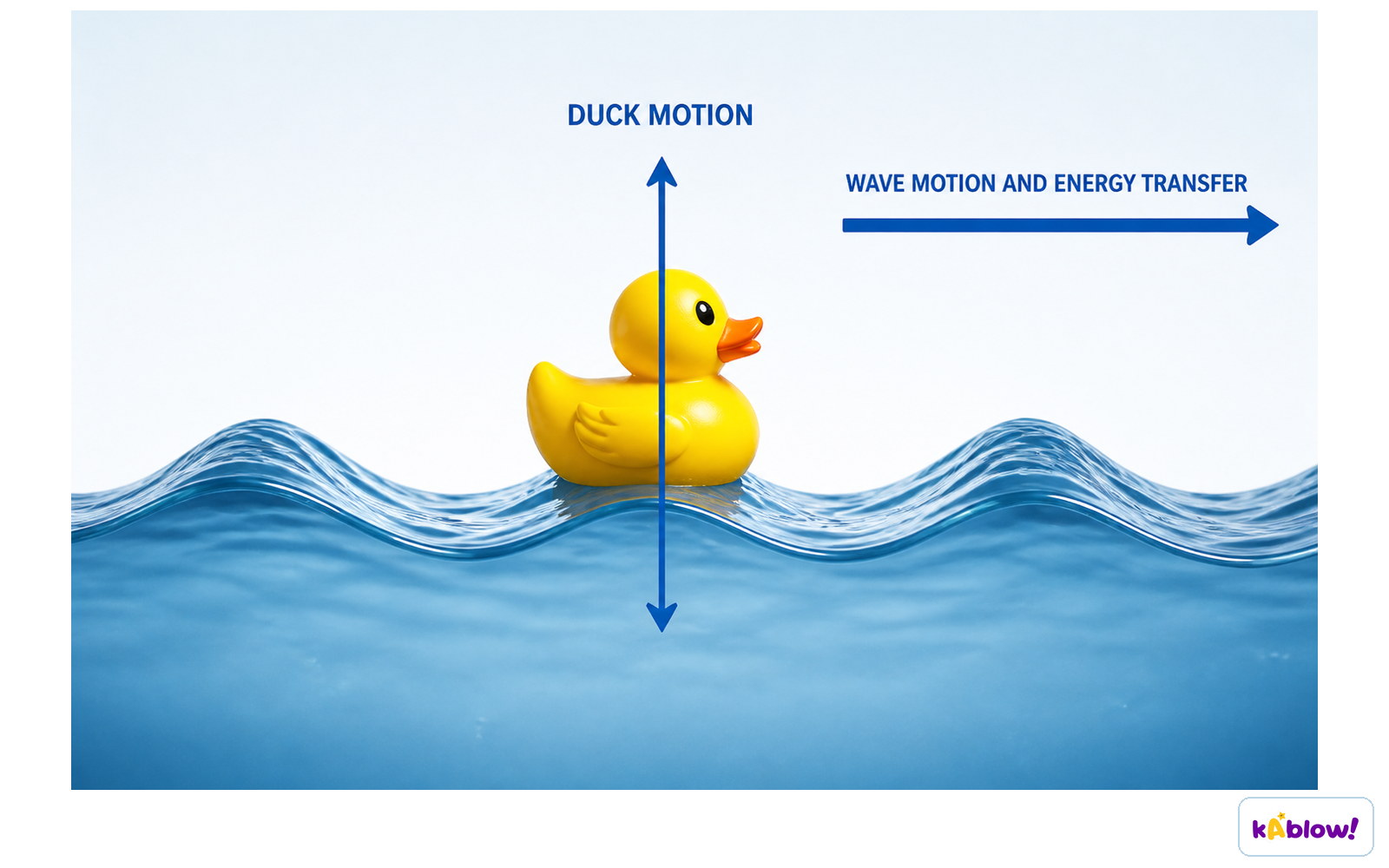
- Waves transfer energy without transferring matter.
- Water waves are a type of transverse wave.
A toy duck bobbing up and down on water waves, illustrating that waves transfer energy but not matter.
Transverse Waves
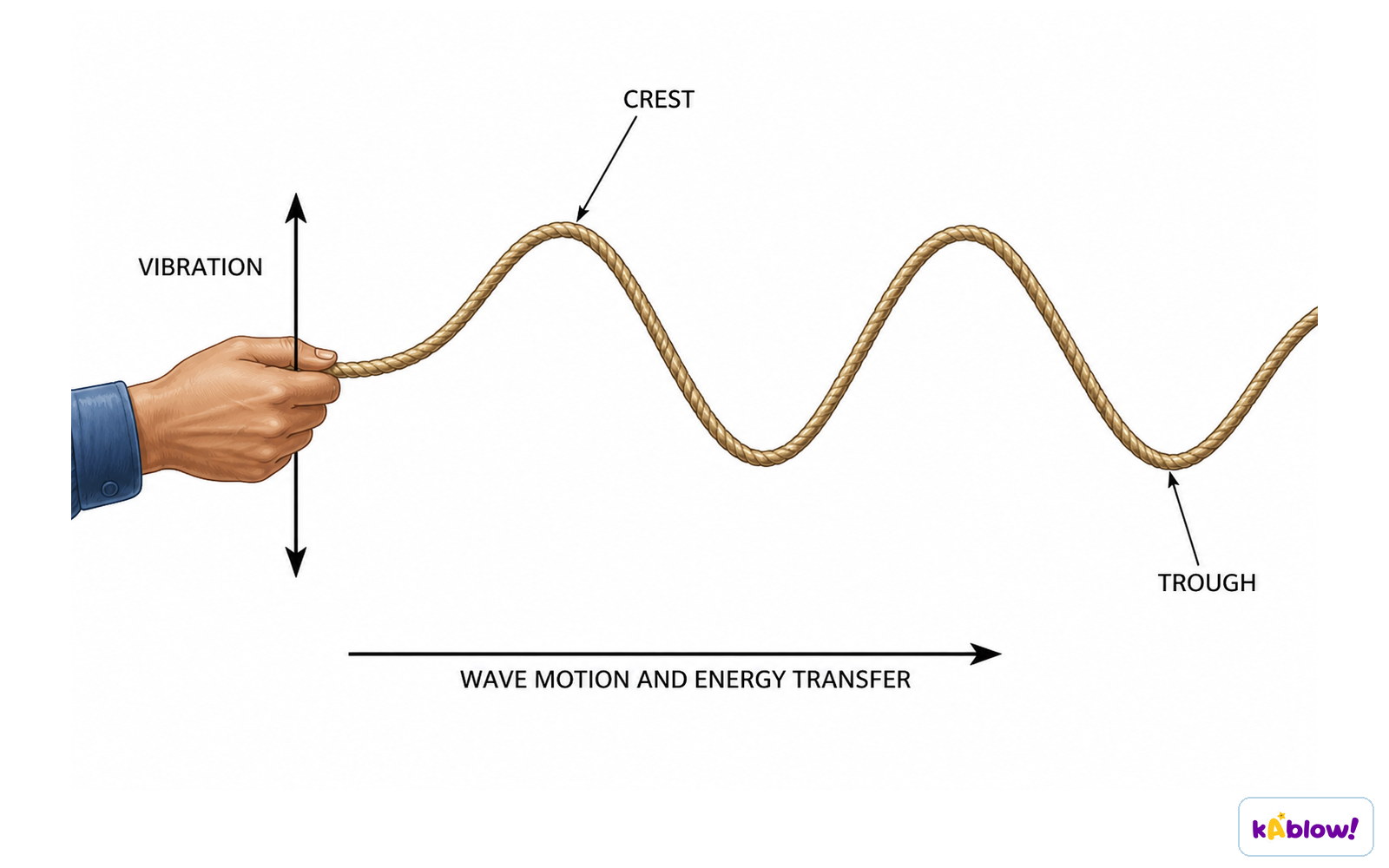
- In a transverse wave, the vibration is perpendicular to the direction of wave travel.
- For water waves, the dipper moves up and down while the wave moves outward horizontally.
- Examples of transverse waves include water waves, light waves, and waves on a string.
Transverse wave motion in a rope: the vibration is at 90 degrees to the direction of wave motion and energy transfer, with the crest and trough labelled.
Superposition
- Superposition occurs when two waves pass through each other and overlap.
- The displacement of a particle in a wave is its distance from the rest position.
- During superposition, the displacements of the individual waves add together.
Constructive Interference
- When two peaks (crests) arrive at the same place at the same time, they add together.
- The amplitude of the combined wave is greater than each individual wave.
- This is called constructive interference.
Destructive Interference
- When a peak and a trough arrive at the same place at the same time, they cancel out.
- The amplitude of the combined wave is less than each individual wave.
- This is called destructive interference.
General Rule for Superposition
- If displacements have the same sign (both positive or both negative), they add.
- If displacements have opposite signs, they subtract.
- The result is the net displacement at each point.
幻灯片
练习题
免费预览——56 题中的 8 题。注册即可查看全部。
1.Which of the following is a transverse wave?
Easy- AWater wave
- BSound wave
- CLongitudinal wave
- DP-wave
2.Water waves transfer energy without transferring what?
Easy- AMatter
- BAmplitude
- CFrequency
- DWavelength
3.In a transverse wave, the vibration is ________ to the direction of wave travel.
Easy- Aperpendicular
- Bparallel
- Copposite
- Dat 45°
4.What is superposition?
Easy- AWhen two waves pass through each other and their displacements add
- BWhen a wave reflects off a barrier
- CWhen a wave changes speed
- DWhen a wave diffracts
5.When a peak of one wave meets a peak of another wave at the same place and time, what happens to the amplitude?
Easy- AIt increases
- BIt decreases
- CIt stays the same
- DIt becomes zero
6.When a peak of one wave meets a trough of another wave at the same place and time, what happens to the amplitude?
Easy- AIt decreases
- BIt increases
- CIt stays the same
- DIt doubles
7.In the ripple tank, what causes the water waves to form?
Easy- AA motor connected to a dipper vibrating up and down
- BA fan blowing across the water surface
- CHeating the water
- DPouring water slowly
8.If two waves have displacements of +3 cm and -3 cm at the same point, what is the resultant displacement?
Medium- A0 cm
- B6 cm
- C-6 cm
- D3 cm
历年真题
该知识点的历年真题练习即将推出。
即将推出