Cells and cell theory
边玩边学
回答这些题目来赚取能量,然后钓鱼探索。无需账号。
给教育者: 面向 Cells and cell theory(NGSS Middle School Science,Biology)的即用型课程幻灯片, 复习笔记, 图示——用在你的课堂上,或将该知识点作为学习者可实时游玩的互动课堂活动来运行。
课程笔记
What are cells?
- Cells are the smallest structural and functional units of all living organisms.
- All living things, including plants, animals, bacteria, and fungi, are made up of cells.
- Cells are microscopic – they can only be seen with a microscope.
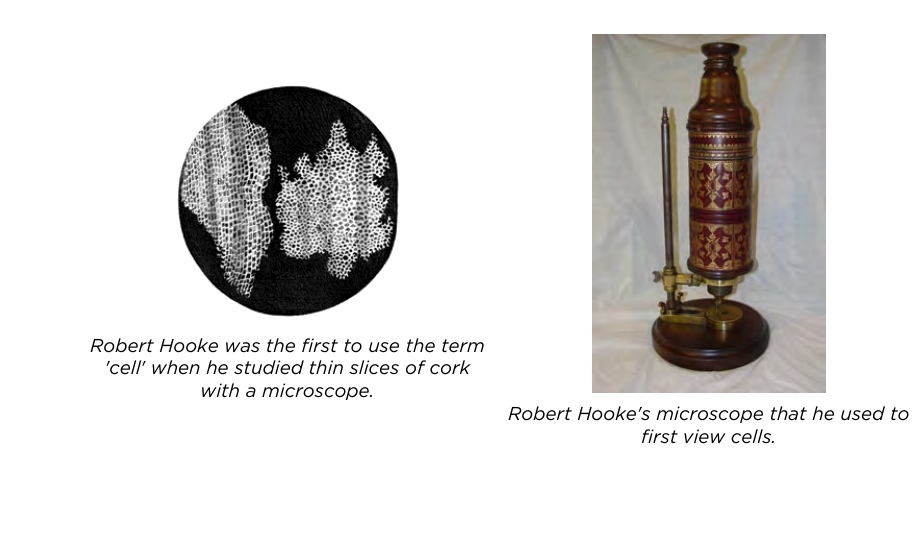
- Robert Hooke first observed and named cells in 1665 using a microscope on cork.
- Cells can differ in shape and size; different shapes usually mean they do different jobs.
Robert Hooke's microscope and his observation of cork cells.
Cell Theory
- Cell theory states that all organisms are composed of cells.
- Cells are alive and are the basic living units of organization in all organisms.
- All cells come from other cells (Rudolf Virchow, 1858).
- Many experiments support cell theory, and no evidence contradicts it.
Eukaryotic vs Prokaryotic Cells
- The main difference is the presence of a nucleus: eukaryotic cells have a nucleus, prokaryotic cells do not.
- Eukaryotic cells include plant and animal cells; prokaryotic cells include bacteria.
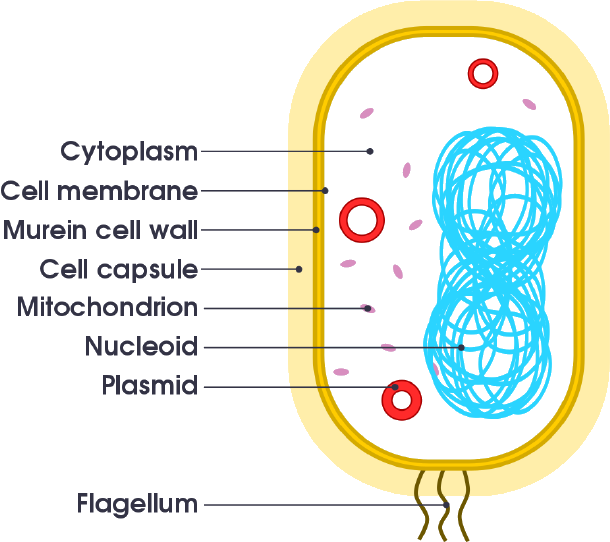
- In prokaryotes, DNA floats in the cytoplasm without a membrane.
- Eukaryotic cells have membrane-bound organelles, while prokaryotes generally do not.
Diagram of a prokaryotic cell with labeled parts.
Common Cell Structures
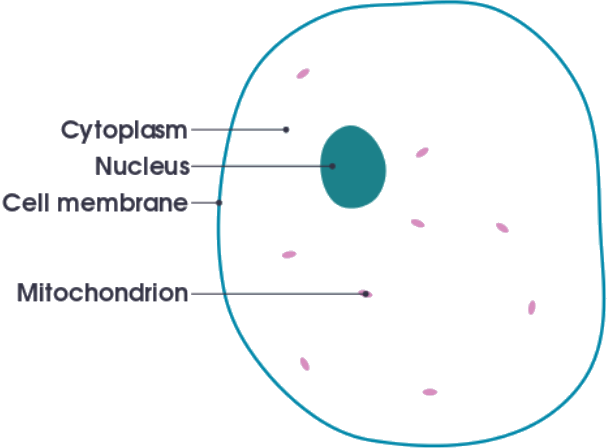
- All cells have a cell membrane, cytoplasm, and (in most eukaryotes) a nucleus.
- The cell membrane is a thin layer that encloses the cell and separates it from its environment.
- The cell membrane is selectively permeable – it controls what enters and leaves the cell.
- Cytoplasm includes all living parts of the cell within the membrane, excluding the nucleus.
- Cytoplasm consists of cytosol (watery, jelly-like medium) and organelles.
Diagram of a cell with common structures labeled
Nucleus and DNA
- The nucleus controls all processes and chemical reactions in the cell.
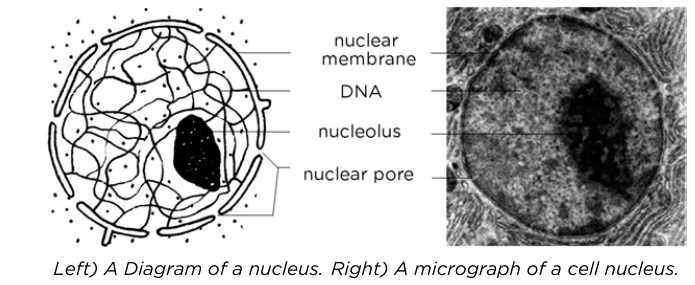
- It contains the cell's genetic material organized into DNA molecules.
- The nucleus is enclosed by a nuclear membrane with pores.
- DNA contains information about inherited characteristics (hereditary traits).
- Differences in DNA between individuals are called variation.
Diagram and micrograph of a cell nucleus.
Mitochondria
- Mitochondria are organelles enclosed by a double membrane.
- They are the site of cellular respiration, where food molecules are combined with oxygen to release energy.
- Carbon dioxide, water, and waste are by-products of respiration.
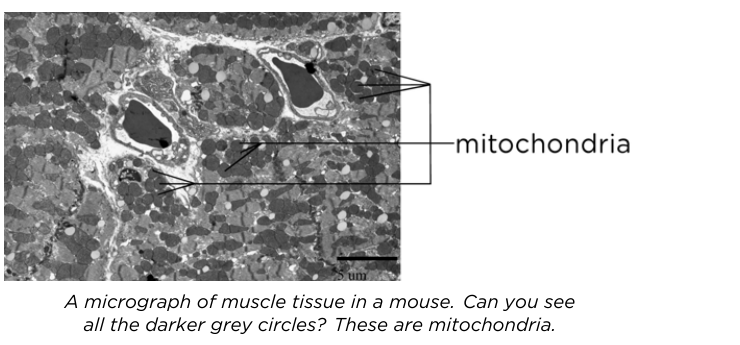
- Active cells (e.g., muscle cells) have more mitochondria than less active cells.
- Mitochondria have their own DNA, different from nuclear DNA.
A micrograph of muscle tissue in a mouse showing mitochondria.
Specialized Cells
- In multicellular organisms, cells are specialized to perform specific functions.
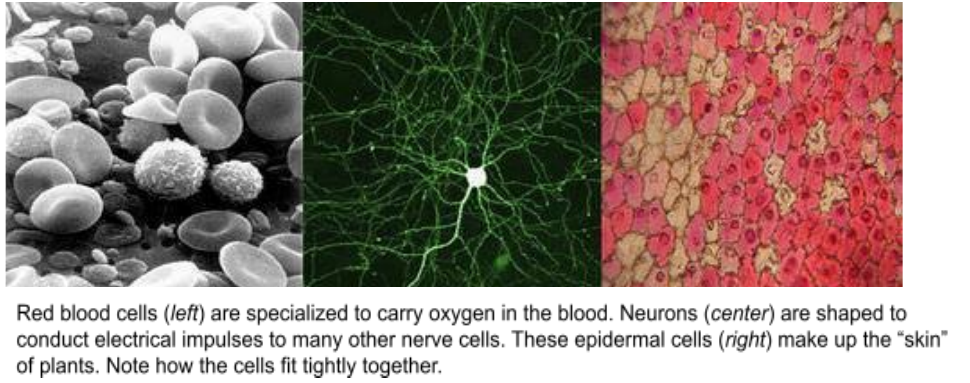
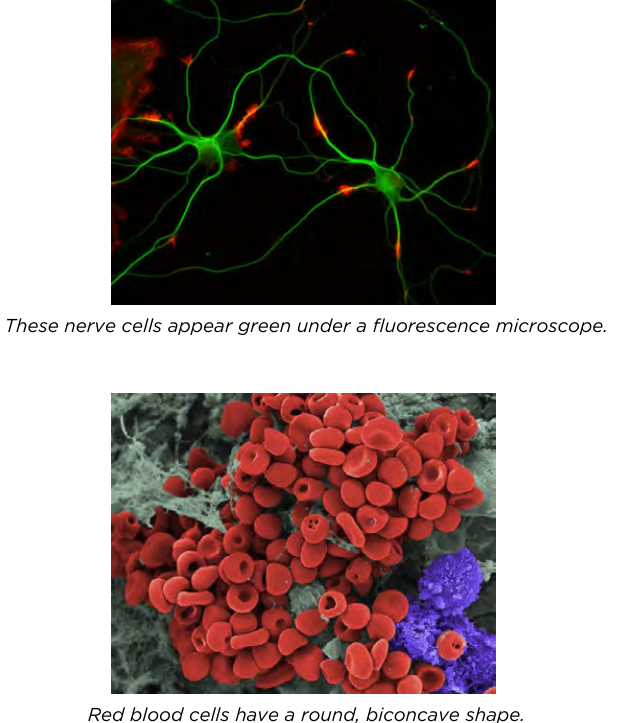
- Red blood cells have a biconcave shape to trap oxygen and have a large surface area for oxygen transfer.
- Nerve cells are long and stringy to form communication lines and send signals quickly.
- Skin cells are flat and fit tightly together to protect the body.
- A cell's function is partly based on its structure.
Red blood cells, neurons, and epidermal (skin) cells.
Unicellular vs Multicellular Organisms
- Unicellular organisms (e.g., bacteria) consist of one cell that performs all life functions.
- Multicellular organisms are made of many cells, often trillions, that work together.
- Unicellular cells must perform metabolism, homeostasis, and reproduction on their own.
- Multicellular cells may collaborate with other cells to perform functions.
- Examples of multicellular organisms include protists (some), fungi, plants, and animals.
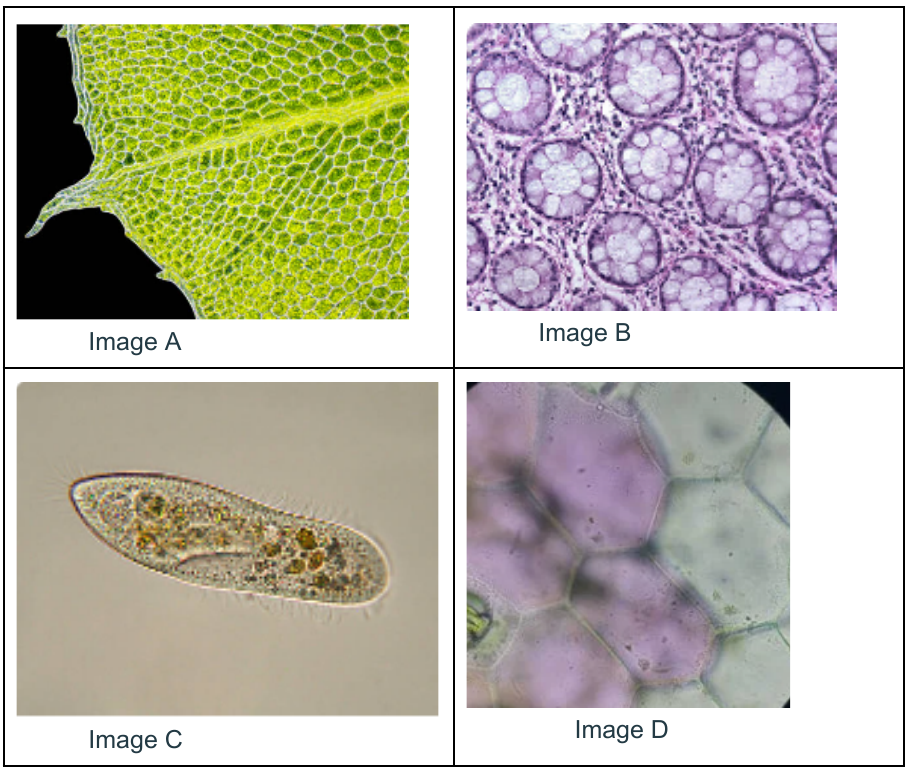
Unicellular and multicellular organisms under the microscope.
Plant vs Animal Cells
- Plant and animal cells are similar but have key differences.
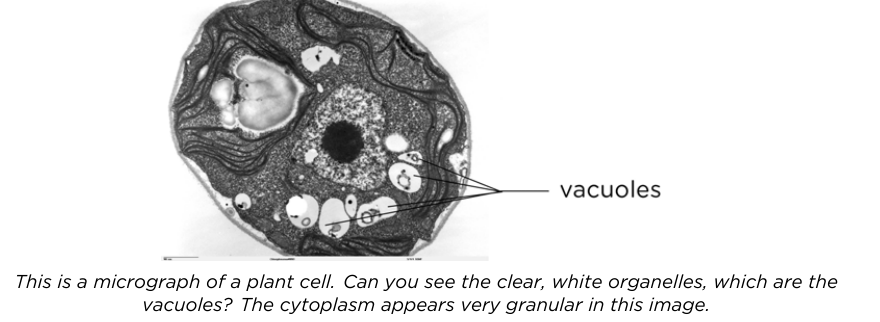
- Plant cells have vacuoles that are often large and central; animal cells have smaller vacuoles.
- Plant cells have chloroplasts for photosynthesis; animal cells do not.
- Plant cells have a cell wall outside the cell membrane; animal cells do not.
- Both have a nucleus, cytoplasm, cell membrane, and mitochondria.
A micrograph of a plant cell.
Levels of Organization
- In multicellular organisms, specialized cells group together to form tissues.
- Tissues work together to form organs.
- Organs work together in organ systems.
- Example: smooth muscle tissue contracts and enables movement; nerve cells send messages; red blood cells carry oxygen.
幻灯片
练习题
免费预览——42 题中的 8 题。注册即可查看全部。
1.What is the smallest structural and functional unit of an organism?
Easy- ACell
- BTissue
- COrgan
- DOrganism
2.Which scientist first observed cells in 1665 using a basic light microscope?
Easy- ARobert Hooke
- BRudolf Virchow
- CAntonie van Leeuwenhoek
- DCharles Darwin
3.Which of the following is a key component of the cell theory?
Easy- AAll cells come from non-living matter.
- BAll organisms are composed of cells.
- CCells can arise spontaneously.
- DOnly multicellular organisms are made of cells.
4.The cell membrane is selectively permeable, meaning it controls which substances enter and leave the cell.
EasyTrue or false?
5.Which structure in a cell contains the genetic material (DNA) and controls the cell's processes?
Easy- AMitochondrion
- BNucleus
- CVacuole
- DCytoplasm
6.Which of the following are components common to all cells? (Select all that apply)
Easy- ACell membrane
- BNucleus
- CCytoplasm
- DMitochondria
- EChloroplasts
7.Arrange the following in order from smallest to largest level of organization in a multicellular organism.
Easy- Cell
- Tissue
- Organ
- Organ system
8.Which type of cell would likely have more mitochondria?
Medium- AMuscle cell
- BSkin cell
- CBone cell
- DRed blood cell
历年真题
该知识点的历年真题练习即将推出。
即将推出