States of matter and particle motion
边玩边学
回答这些题目来赚取能量,然后钓鱼探索。无需账号。
给教育者: 面向 States of matter and particle motion(NGSS Middle School Science,Chemistry)的即用型课程幻灯片, 复习笔记, 图示——用在你的课堂上,或将该知识点作为学习者可实时游玩的互动课堂活动来运行。
课程笔记
States of Matter
- There are three major states of matter: solid, liquid, and gas.
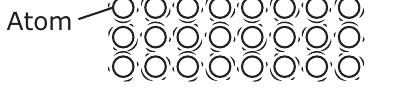
- Solids have a definite shape and definite volume; their particles vibrate in place.
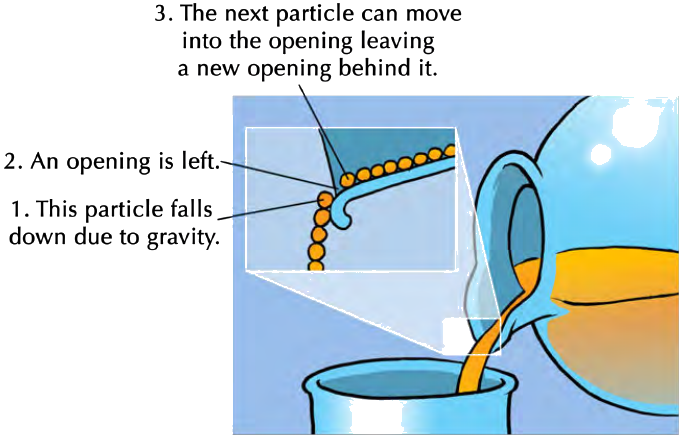
- Liquids have no definite shape (take the shape of their container) but have a definite volume; particles move slowly past each other but are still attracted.
- Gases have no definite shape and no definite volume (fill their container); particles move freely with little or no attraction.
- Particles in all states are the same; only their behavior changes.
A liquid being poured, with a magnified view showing particles falling due to gravity and creating openings for other particles to move into.
Particle Motion and Density
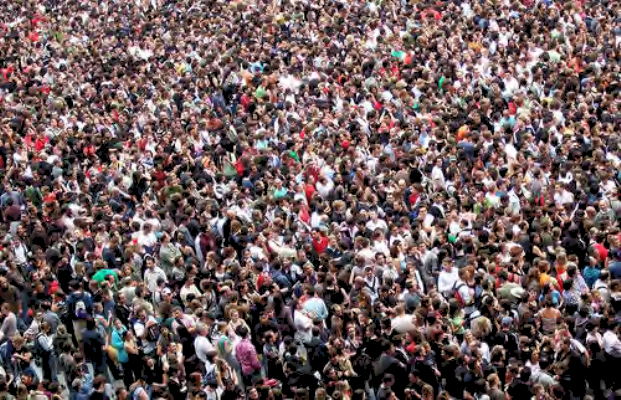
- Density is how tightly particles are packed; solids are denser than liquids, and liquids are denser than gases.
- Adding heat energy increases particle motion and the space between particles, decreasing density.
- Removing heat energy decreases particle motion and the space between particles, increasing density.
- Density is calculated as mass divided by volume (D = m/V).
A dense crowd of people
Heat and Thermal Energy Transfer
- Heat is the transfer of thermal energy between substances.
- Thermal energy is the energy of moving particles; temperature is the average measure of that energy.
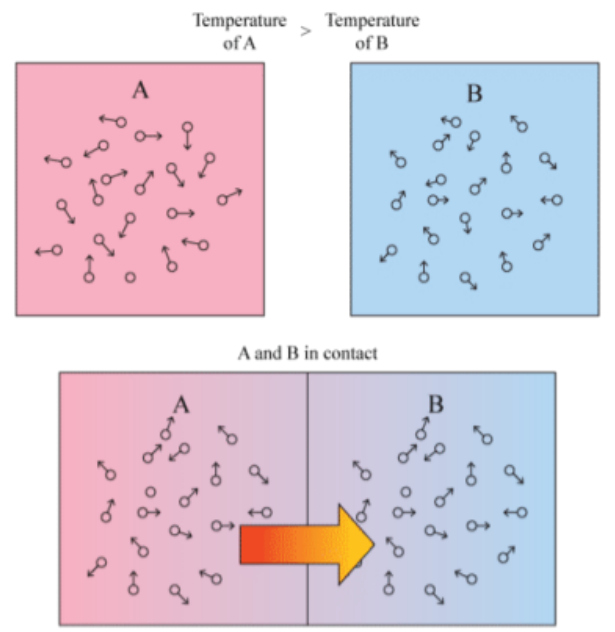
- Thermal energy always moves from warmer to cooler substances until they reach the same temperature.
- Faster-moving particles of the warmer substance transfer energy to slower-moving particles of the cooler substance.
Thermal energy moves from the warmer substance (A) to the cooler substance (B) until they reach the same temperature.
Phase Changes
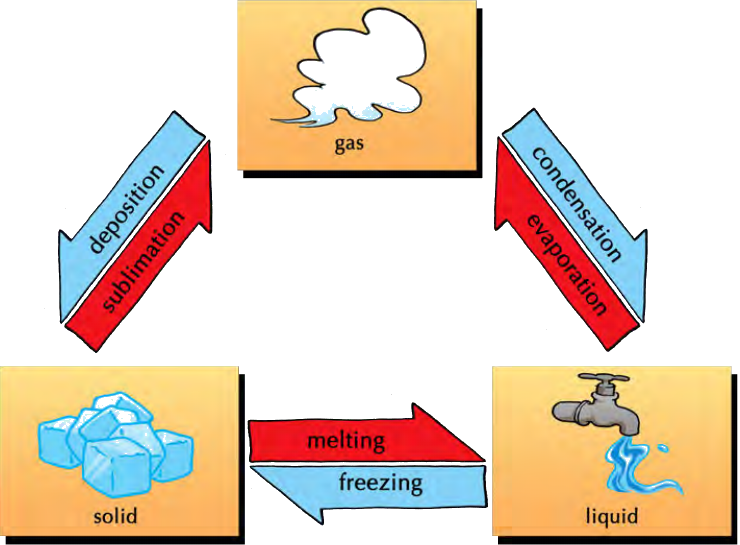
- A phase change is a physical change from one state to another (e.g., solid to liquid).
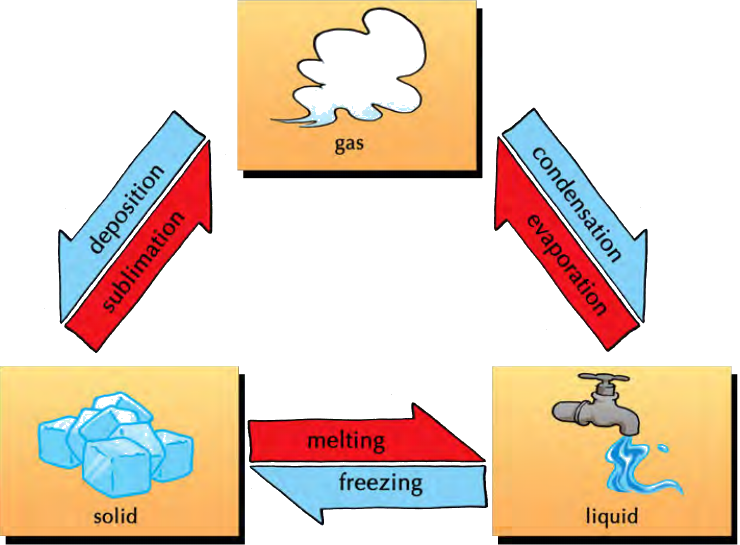
- Melting occurs when a solid absorbs enough energy to overcome particle attractions and become a liquid.
- Freezing occurs when a liquid cools and particles lock into fixed positions, becoming a solid.
- Evaporation is when liquid particles at the surface gain enough energy to become a gas.
- Condensation is when a gas loses energy and particles come together to form a liquid.
- Adding heat causes melting, evaporation, and boiling; removing heat causes freezing and condensation.
Diagram illustrating phase changes between solid, liquid, and gas states, including melting, freezing, evaporation, condensation, sublimation, and deposition.
Diffusion
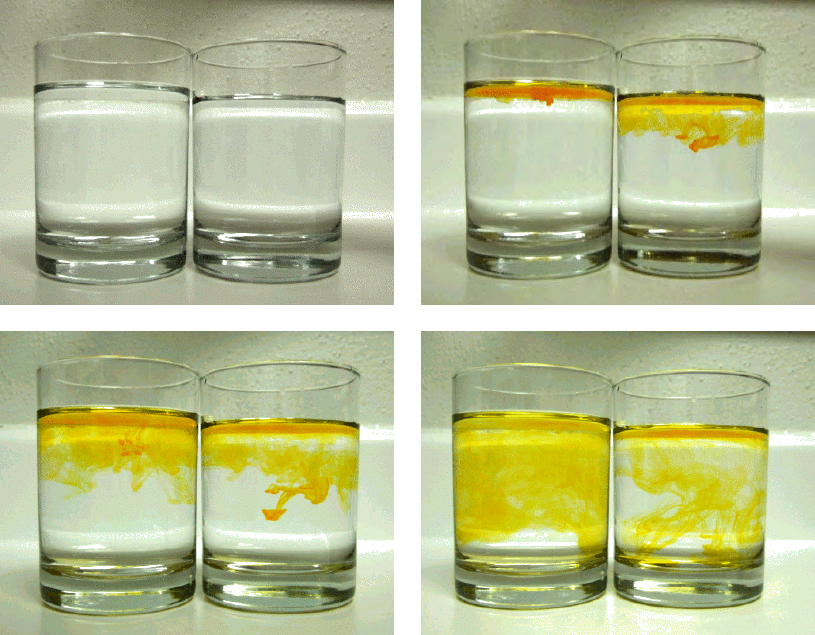
- Diffusion is the random movement of particles from high concentration to low concentration until evenly spread.
- Particles in liquids and gases are in constant random motion, causing diffusion.
- Gases diffuse faster than liquids because their particles are farther apart and collide less.
- Diffusion rate increases with higher temperature and lighter particle mass.
Diffusion of colored liquid in water over time
Applying the Model: Chocolate Chip Phenomenon
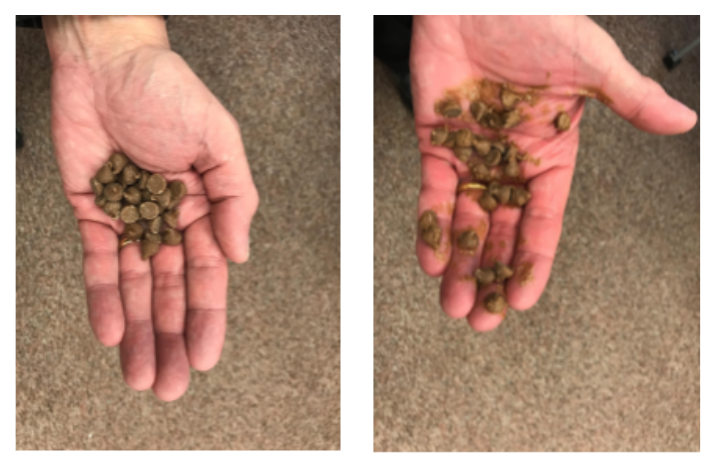
- When chocolate chips are held in a hand, thermal energy transfers from the warmer hand (90°F) to the cooler chips (70°F).
- The chips warm to 85°F, causing their particles to gain energy and move more freely, leading to melting (solid to liquid).
- Evidence: the hand stays at 90°F, the room at 70°F, but the chips rise to 85°F, showing energy transfer.
- The model should show particles vibrating in place before (solid) and moving past each other after (liquid).
Chocolate chips held in a hand before and after warming, going soft and squishy.
幻灯片
练习题
免费预览——52 题中的 8 题。注册即可查看全部。
1.Which of the following is NOT one of the three major states of matter?
Easy- ASolid
- BLiquid
- CGas
- DPlasma
2.In which state of matter do particles vibrate in fixed positions?
Easy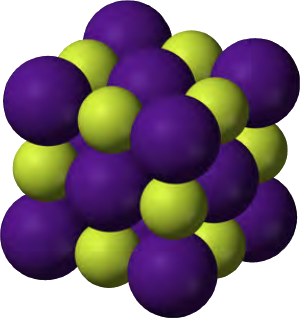
- ASolid
- BLiquid
- CGas
- DPlasma
3.Which state of matter has no definite shape and no definite volume?
Easy- ASolid
- BLiquid
- CGas
- DPlasma
4.What is the process called when a liquid changes into a gas?
Easy
- ACondensation
- BEvaporation
- CMelting
- DFreezing
5.What is the process called when a gas changes into a liquid?
Easy- ACondensation
- BEvaporation
- CMelting
- DFreezing
6.Which of the following correctly describes the particles in a liquid?
Easy- AParticles are packed tightly and vibrate in place.
- BParticles are close together but can slide past each other.
- CParticles are spread far apart and move freely.
- DParticles have no attraction to each other.
7.Solids have a definite shape and volume.
EasyTrue or false?
8.Thermal energy always moves from cooler substances to warmer substances.
EasyTrue or false?
历年真题
该知识点的历年真题练习即将推出。
即将推出