The water cycle
边玩边学
回答这些题目来赚取能量,然后钓鱼探索。无需账号。
给老师: 面向 The water cycle(NGSS Middle School Science,Earth and Space Science)的即用型课程幻灯片, 复习笔记——用在你的课堂上,或将该知识点作为学生可实时游玩的互动课堂活动来运行。
课程笔记
Overview of the Water Cycle
- The water cycle is a nonstop recycling process with no starting or ending point.
- Water constantly moves between living organisms (e.g., plants) and non-living things (e.g., clouds, rivers, oceans).
- It involves oceans, lakes, land surfaces, and the atmosphere.
- Water molecules can cycle through almost anywhere on Earth due to water's properties.
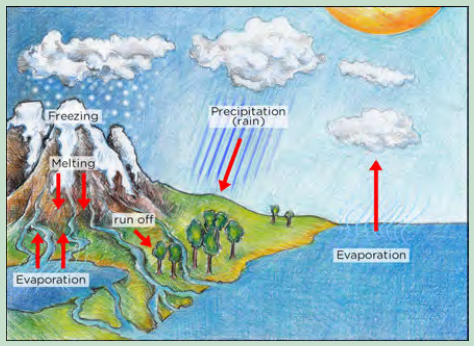
A hand-drawn water cycle diagram showing evaporation from the ocean and from mountain streams, precipitation falling as rain over the hills, and freezing, melting and runoff on the mountainside.
Key Processes in the Water Cycle
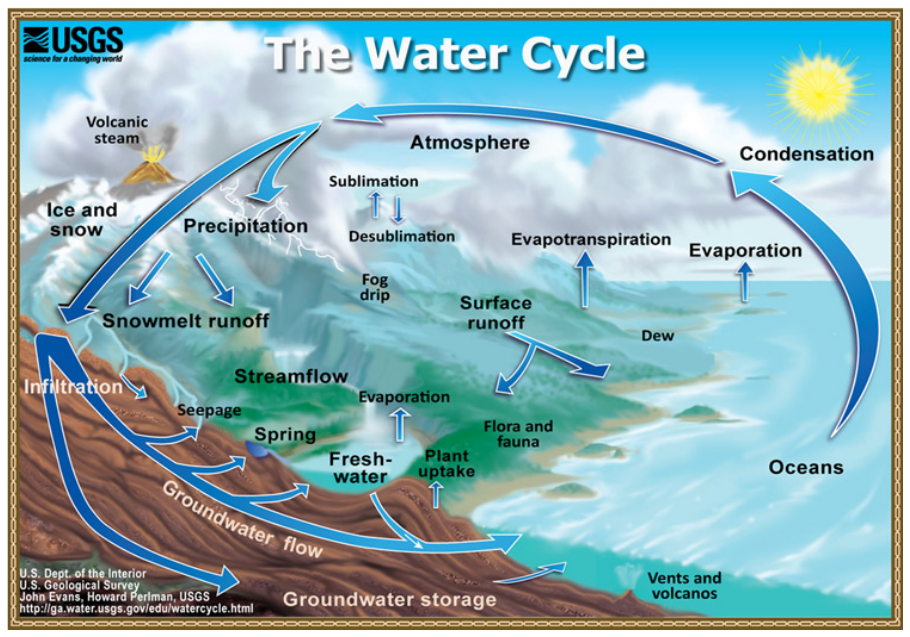
- Evaporation: Liquid water changes to gas (water vapor) when it gains energy from the Sun.
- Condensation: Water vapor loses energy, becomes denser, and changes to tiny liquid droplets, forming clouds.
- Precipitation: Cloud droplets collide and grow; when heavy enough, they fall as rain, snow, sleet, or hail.
- Runoff: Precipitation that flows over land into streams and rivers, eventually returning to oceans.
- Infiltration: Water seeping into the ground.
- Transpiration (or evapotranspiration): Water evaporates from plant leaves, returning water to the atmosphere.
The USGS water cycle diagram, showing evaporation and evapotranspiration rising from the ocean and land, condensation and precipitation over the mountains, and runoff, infiltration and groundwater flow returning water underground and across the surface to the ocean.
Forces Driving the Water Cycle
- Solar Energy: The Sun provides the energy that drives evaporation and the water cycle.
- Density: Heated air expands, becomes less dense, and rises; cooler, denser air sinks.
- Gravity: Pulls denser air downward, causing rising air; also causes water to flow downhill as runoff.
- Energy transfer: Condensation releases energy to surrounding air, heating it and causing updrafts that keep cloud droplets aloft.
Earth's Water Reservoirs
- Oceans: Store about 97% of Earth's water.
- Atmosphere: Holds water vapor, clouds, and precipitation.
- Streams and Lakes: Freshwater bodies fed by runoff and melting snow/ice.
- Soil: Holds soil moisture important for plant growth.
- Groundwater: Water stored in aquifers (porous rock layers) for centuries.
- Biosphere: Water stored in plants and animals; plants release water vapor via transpiration.
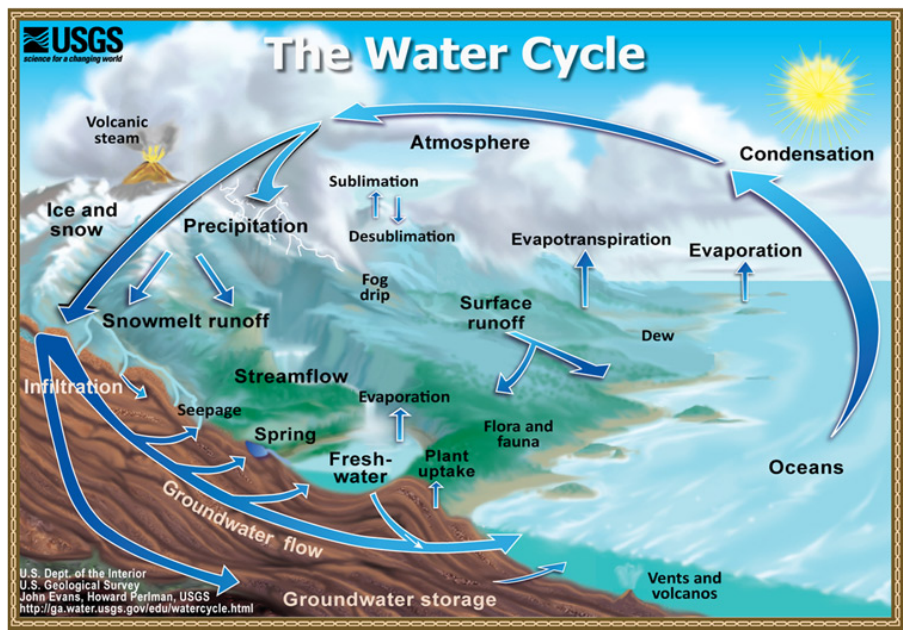
The USGS water cycle diagram, showing the ocean, groundwater storage, freshwater and plant-uptake reservoirs where water is held as it moves through the cycle.
Water Cycle and States of Matter
- Water exists in solid (ice, snow), liquid (rain, lakes), and gas (water vapor) states in the cycle.
- The hydrosphere includes all water in all states of matter.
- Condensation can form liquid droplets; if cold enough, water vapor can freeze into ice crystals.
Water Cycle and Living Things
- Plants absorb water through roots and release it via transpiration.
- Animals depend on water for survival and are part of the biosphere reservoir.
- Aquatic habitats include freshwater (streams, lakes) and saltwater (oceans, seas).
- A small percentage of Earth's water is freshwater; most is saltwater.
幻灯片
练习题
免费预览——35 题中的 8 题。注册即可查看全部。
1.What is the process by which water changes from a liquid to a gas?
Easy- ACondensation
- BEvaporation
- CPrecipitation
- DTranspiration
2.Which of the following is the process by which water vapor changes into tiny droplets of liquid water?
Easy- AEvaporation
- BCondensation
- CPrecipitation
- DRunoff
3.The water cycle has a starting point and an ending point.
EasyTrue or false?
4.Transpiration is the process by which plants release water vapor into the atmosphere.
EasyTrue or false?
5.Match each water cycle process with its correct description.
Easy- Transpiration
- Condensation
- Precipitation
- Water vapor changes to liquid droplets
- Water falls from clouds to the ground
- Water vapor released from plant leaves
6.Put the following steps of the water cycle in the correct order, starting with evaporation from the ocean.
Medium- Condensation forms clouds
- Precipitation falls to the ground
- Evaporation of ocean water
- Runoff flows back to the ocean
7.Which of the following are processes that return water to the atmosphere? (Select all that apply)
Easy- AEvaporation
- BCondensation
- CTranspiration
- DPrecipitation
- ERunoff
8.The Sun is the primary source of energy that drives the water cycle.
EasyTrue or false?
历年真题
该知识点的历年真题练习即将推出。
即将推出