Responding to stimuli and homeostasis
邊玩邊學
回答這些題目賺取能量,接著就能釣魚、探索。不需要帳號。
課程筆記
Homeostasis – Keeping the Internal Environment Stable
- Homeostasis is the maintenance of a stable internal environment despite external changes.
- It ensures optimal conditions for enzyme activity and cell function.
- Key variables regulated include body temperature, blood glucose, pH, and fluid balance.
- Homeostatic mechanisms involve receptors, control centres, and effectors.
- Most homeostatic control uses negative feedback to reverse a change.
Components of a Homeostatic Control System
- Receptor – detects a change (stimulus) in the environment (e.g., thermoreceptors detect temperature change).
- Control centre – processes the information and determines the response (e.g., hypothalamus in the brain).
- Effector – carries out the response to restore balance (e.g., muscles, glands, or organs).
- The response feeds back to the receptor to reduce or stop the stimulus (negative feedback).
Negative Feedback – The Core Mechanism
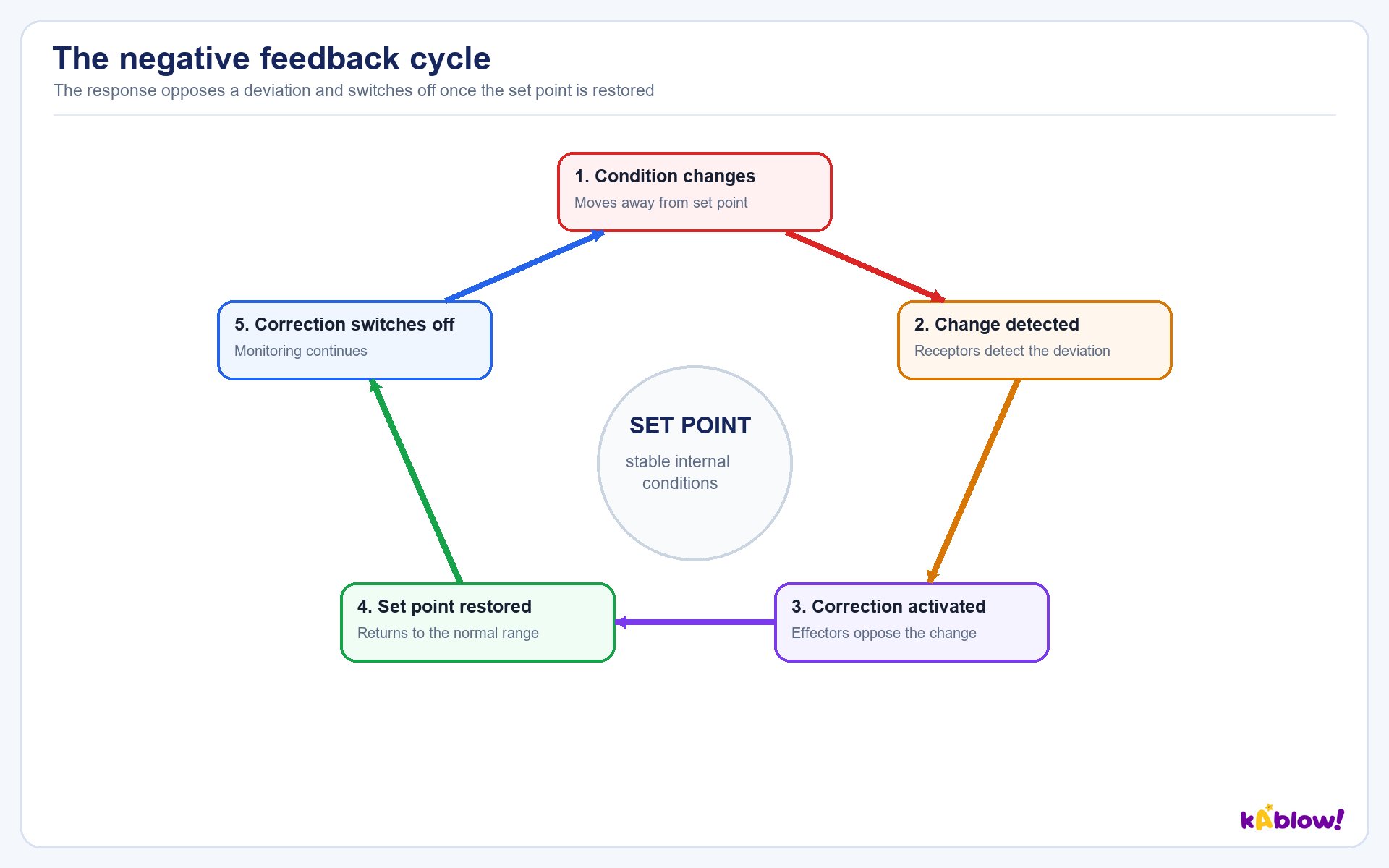
- Negative feedback counteracts deviations from the set point, bringing the variable back to normal.
- Example: Body temperature rises → receptors send signal to brain → effectors (sweat glands) cool the body → temperature drops.
- Example: Blood glucose rises after eating → pancreas releases insulin → cells take up glucose → glucose level falls.
- Most homeostatic systems rely on negative feedback to maintain stability.
A corrective response opposes the original deviation
The Nervous System – Rapid Responses
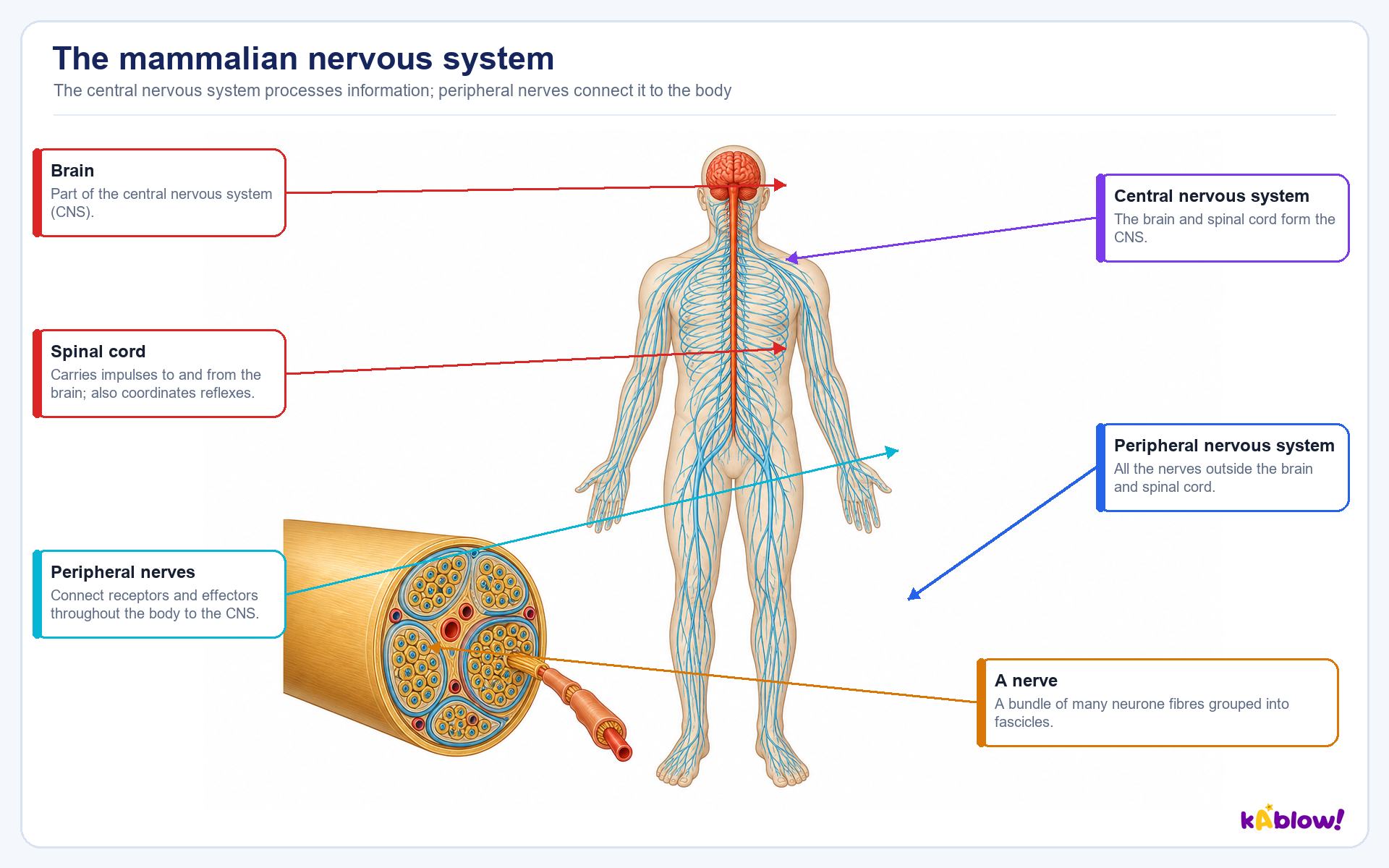
- The nervous system detects stimuli and sends electrical signals (nerve impulses) for rapid, short-lived responses.
- Sensory neurones carry impulses from receptors to the central nervous system (CNS – brain and spinal cord).
- Motor neurones carry impulses from the CNS to effectors (muscles or glands).
- Reflex arcs are automatic, rapid responses that bypass the brain for speed (e.g., pulling hand from a hot object).
CNS, PNS and the structure of a peripheral nerve
The Endocrine System – Slower, Longer-Lasting Responses
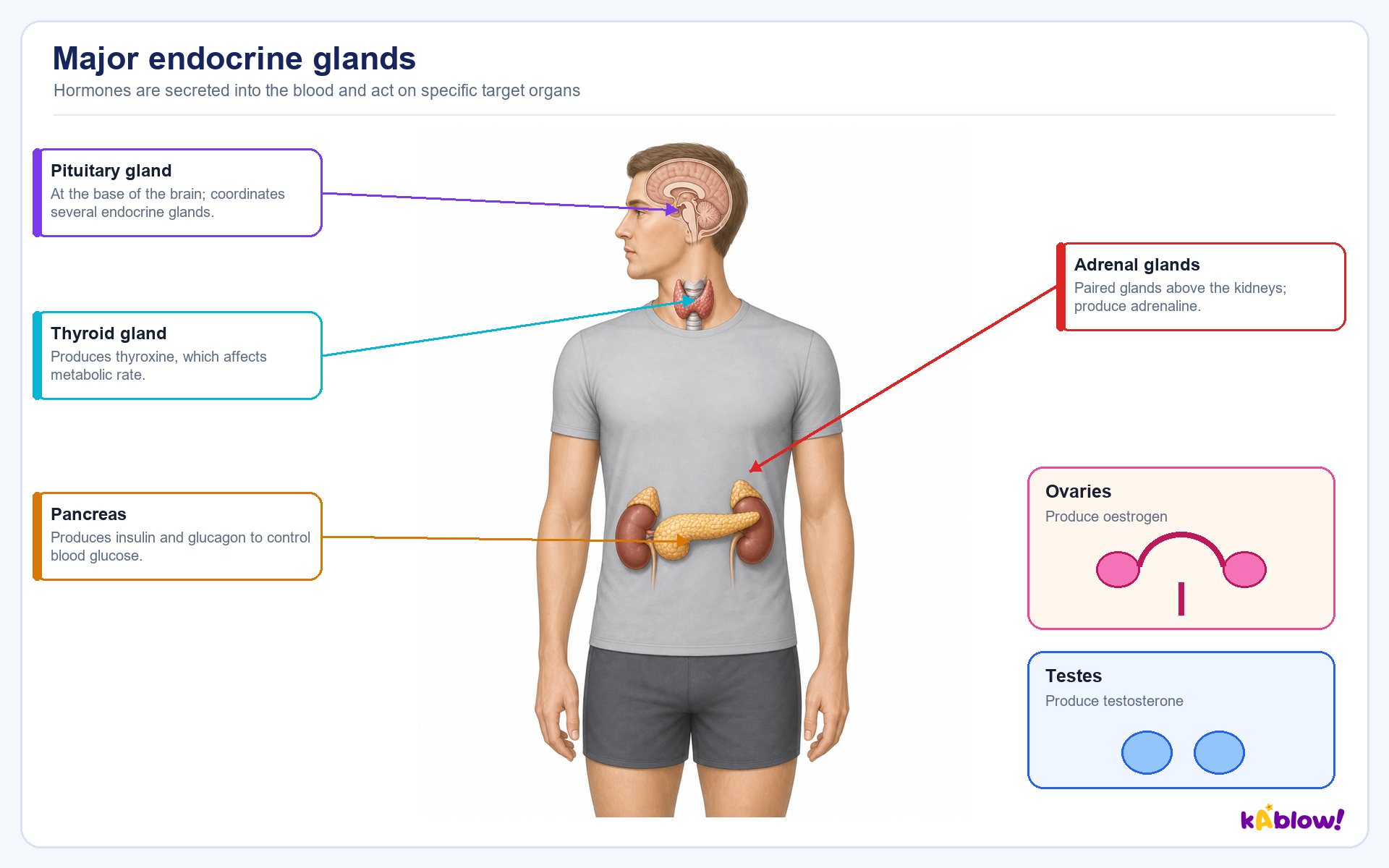
- The endocrine system uses hormones (chemical messengers) released into the blood to target cells.
- Hormones act more slowly than nerve impulses but have longer-lasting effects.
- Example: Adrenaline prepares the body for 'fight or flight' – increases heart rate, breathing rate, and blood glucose.
- Example: Insulin and glucagon regulate blood glucose levels via negative feedback.
Locations and roles of major endocrine glands
Coordination of Nervous and Endocrine Systems
- The hypothalamus links the nervous and endocrine systems; it controls the pituitary gland.
- The pituitary gland releases hormones that regulate other endocrine glands (e.g., thyroid, adrenal).
- Together, the two systems coordinate responses to internal and external stimuli to maintain homeostasis.
Examples of Homeostatic Regulation
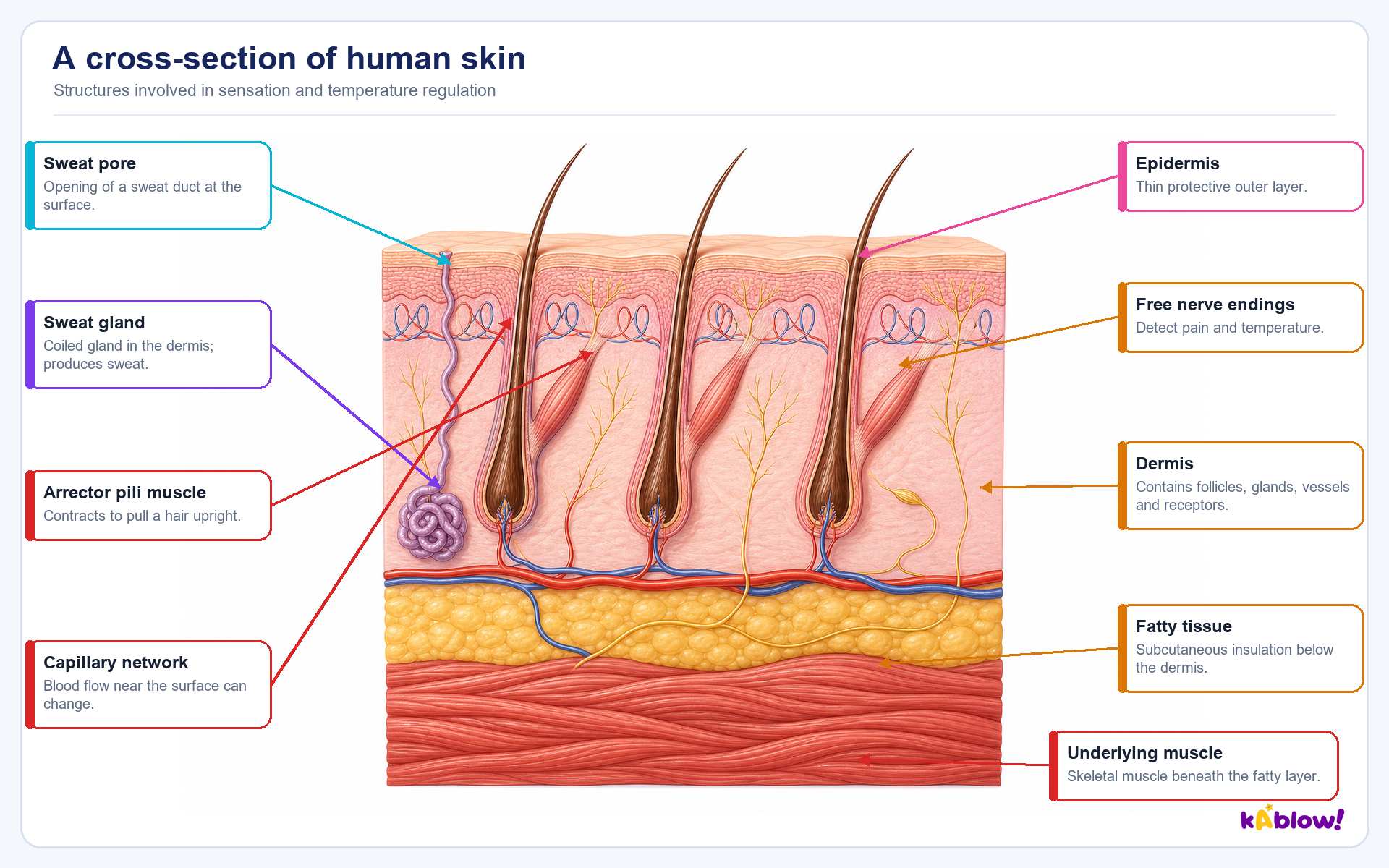
- Thermoregulation: Body temperature kept around 37°C via sweating, shivering, and blood vessel dilation/constriction.
- Osmoregulation: Water and salt balance maintained by the kidneys; antidiuretic hormone (ADH) controls water reabsorption.
- Blood glucose regulation: Insulin lowers glucose; glucagon raises glucose; both are produced by the pancreas.
- pH regulation: Buffers in blood and respiration control CO₂ levels to keep pH near 7.4.
Skin structures involved in thermoregulation
Stimuli and Receptors
- A stimulus is any change in the internal or external environment that triggers a response.
- Receptors are specialised to detect specific stimuli: thermoreceptors (temperature), mechanoreceptors (pressure), chemoreceptors (chemicals), photoreceptors (light).
- Receptors convert stimulus energy into electrical signals (action potentials) for the nervous system.
A spinal reflex arc showing the pathway: stimulus → receptor → sensory neurone → relay neurone → motor neurone → effector (muscle). This is an example of a rapid, involuntary response.
Structure of a motor neurone: dendrites, cell body, axon, myelin sheath, nodes of Ranvier, and axon terminals. Neurones transmit electrical impulses for rapid responses.
投影片
練習題
免費預覽——59 題中的 8 題。註冊即可查看全部。
1.What term describes the maintenance of a stable internal environment in living organisms?
Easy- AHomeostasis
- BMetabolism
- CEvolution
- DAdaptation
2.Which component of a homeostatic control mechanism detects changes in the environment?
Easy- AReceptor
- BControl center
- CEffector
- DStimulus
3.Which of the following is NOT a variable regulated by homeostasis in humans?
Easy- ABody temperature
- BBlood sugar level
- CHeight
- DpH of extracellular fluid
4.In the reflex arc, which type of neurone carries the action potential from the receptor to the spinal cord?
Easy- ASensory neurone
- BMotor neurone
- CRelay neurone
- DInterneurone
5.Homeostasis keeps the internal environment perfectly constant at all times.
EasyTrue or false?
6.Negative feedback mechanisms work to reverse a change and bring the variable back to its set point.
EasyTrue or false?
7.Match each component of a homeostatic control system with its correct description.
Medium- Receptor
- Control center
- Effector
- Detects changes in the environment
- Determines the appropriate response
- Carries out the response
8.Arrange the following events in the correct order for a homeostatic response:
Medium- Effector responds
- Receptor detects change
- Control center sends signal
- Variable returns to normal