Respiration
邊玩邊學
回答這些題目賺取能量,接著就能釣魚、探索。不需要帳號。
課程筆記
What is Respiration?
- Cellular respiration is an exothermic reaction that occurs continuously in all living cells.
- It releases the energy needed for living processes; this energy is transferred from glucose.
- Respiration is a chemical process and is not the same as breathing.
- Energy from respiration is used for: chemical reactions to build larger molecules, muscle contraction for movement, and keeping warm to maintain a constant temperature for enzyme activity.
Aerobic Respiration
- Aerobic respiration uses oxygen to break down glucose completely, releasing a relatively large amount of energy.
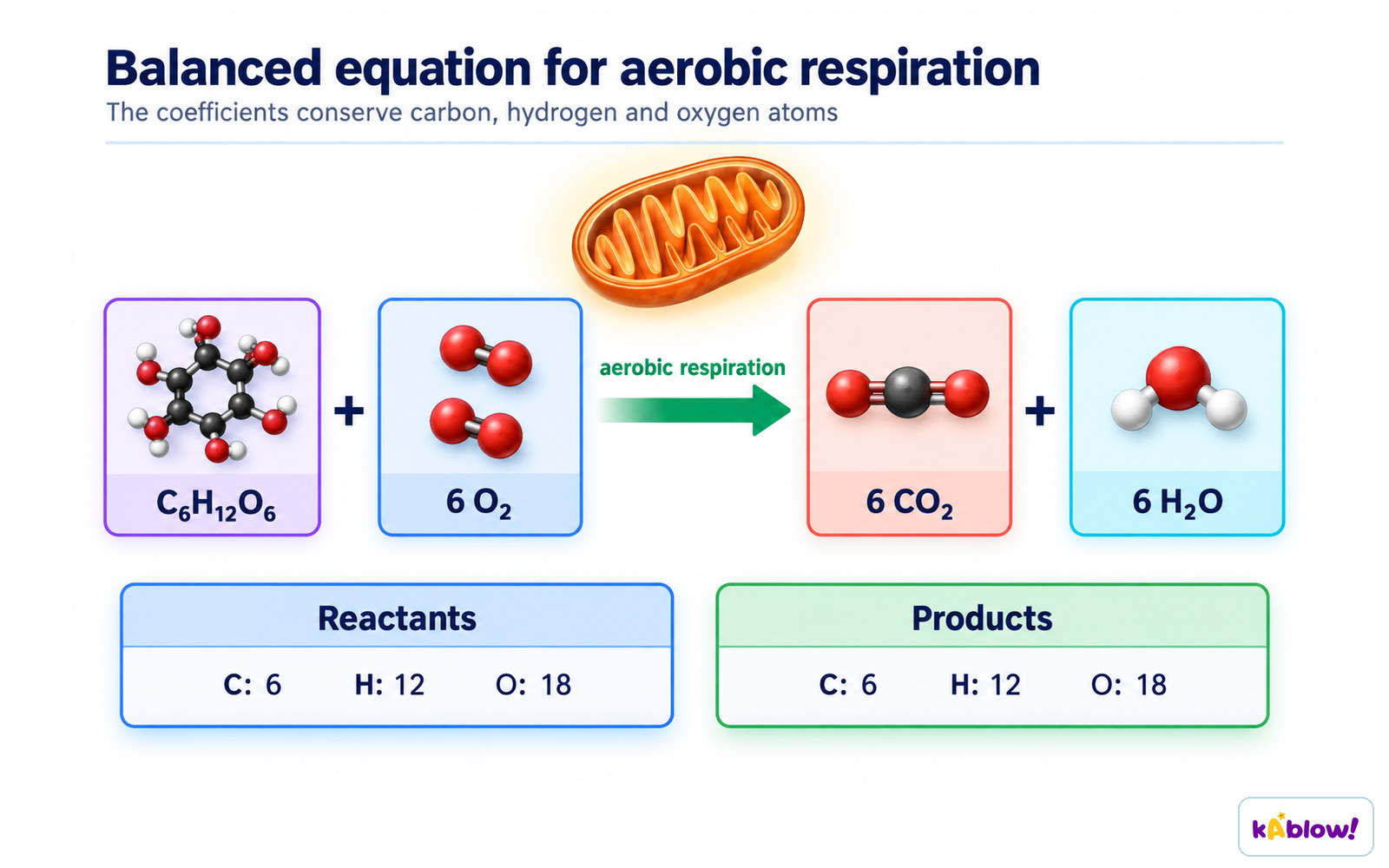
- Word equation: glucose + oxygen → carbon dioxide + water.
- Balanced symbol equation: C₆H₁₂O₆ + 6O₂ → 6CO₂ + 6H₂O.
- Most aerobic respiration takes place in the mitochondria of cells.
- The products carbon dioxide and water are waste products.
Balanced equation for aerobic respiration
Anaerobic Respiration in Animals
- Anaerobic respiration takes place without oxygen and involves the incomplete breakdown of glucose.
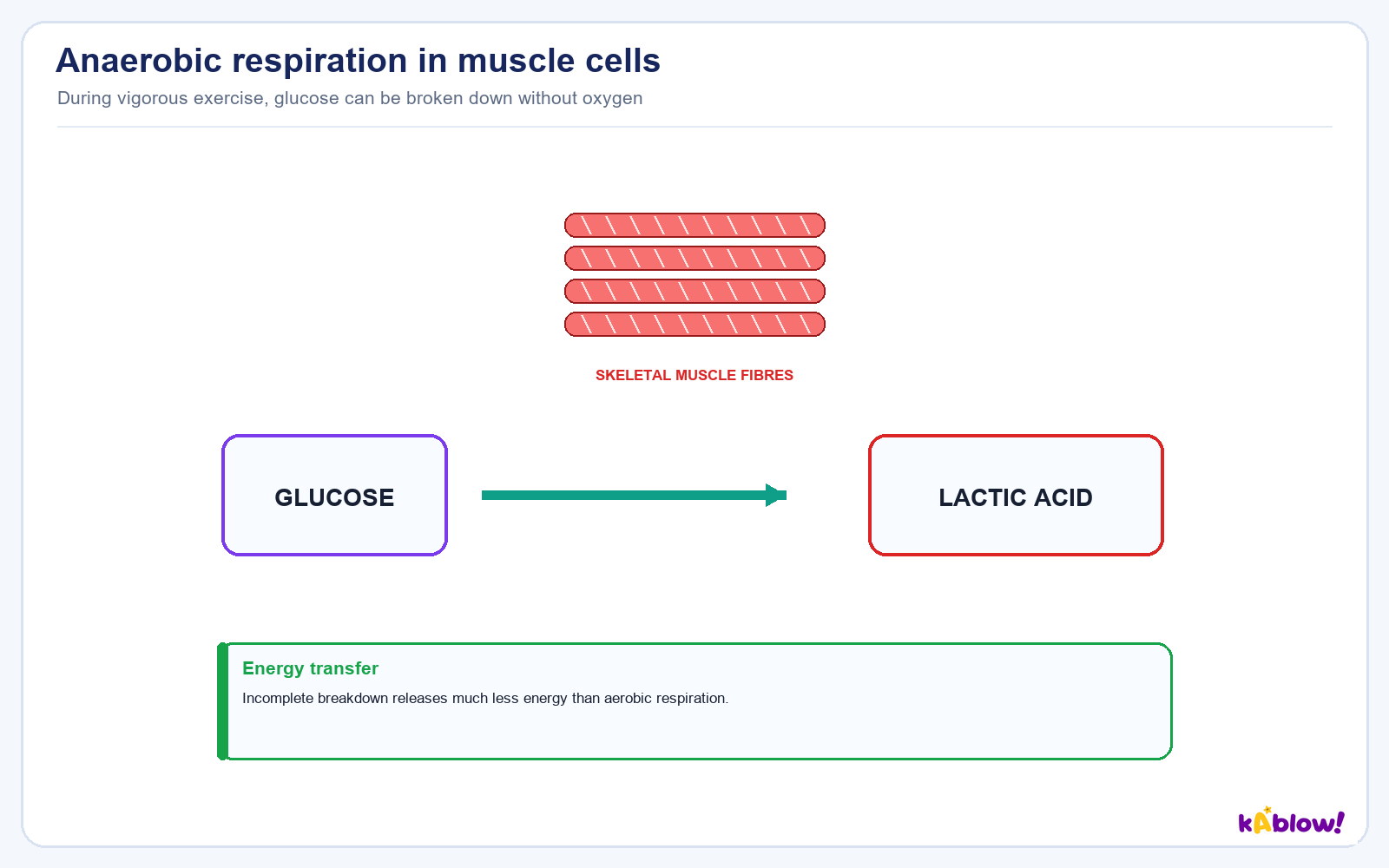
- In animals, glucose is broken down into lactic acid: glucose → lactic acid.
- It releases much less energy than aerobic respiration because glucose is not fully oxidised.
- It mainly occurs in muscle cells during vigorous exercise when oxygen supply cannot meet demand.
- Lactic acid builds up, lowering the pH of muscle tissue and causing fatigue, so muscles stop contracting efficiently.
Anaerobic respiration in muscles during vigorous exercise: glucose -> lactic acid.
Anaerobic Respiration in Plants and Yeast
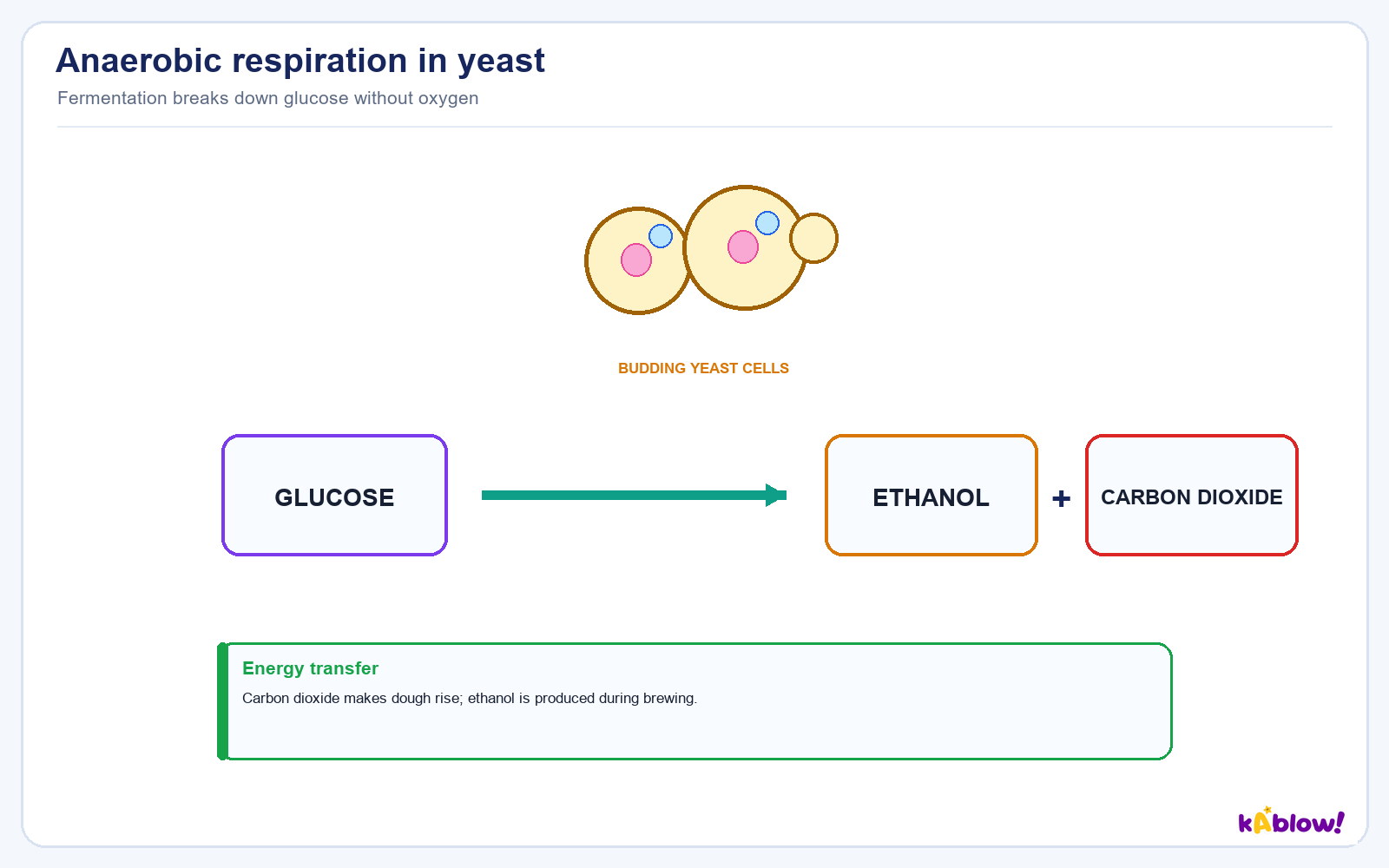
- In plants and yeast, glucose is broken down without oxygen to produce ethanol and carbon dioxide: glucose → ethanol + carbon dioxide.
- In yeast, this process is called fermentation.
- Fermentation is economically important in bread making (carbon dioxide makes dough rise) and in brewing (ethanol is the alcohol in drinks).
Anaerobic respiration in yeast: glucose -> alcohol + carbon dioxide.
Comparing Aerobic and Anaerobic Respiration
- Oxygen: aerobic requires oxygen; anaerobic does not.
- Products: aerobic produces carbon dioxide and water; anaerobic in animals produces lactic acid; anaerobic in plants and yeast produces ethanol and carbon dioxide.
- Energy transferred: aerobic releases much more energy than anaerobic.
- Location: aerobic mainly in mitochondria; anaerobic in the cytoplasm.
Response to Exercise
- During exercise, muscles contract more, increasing energy demand and the need for oxygen.
- The body responds by increasing breathing rate and breath volume to absorb more oxygen and remove more carbon dioxide.
- Heart rate also increases to supply more oxygenated blood to the muscles.
- If oxygen supply is insufficient, anaerobic respiration occurs, producing lactic acid and creating an oxygen debt.
- After vigorous exercise, breathing and heart rate remain elevated to deliver extra oxygen to break down lactic acid.
Oxygen Debt
- Oxygen debt is the extra oxygen needed after exercise to react with accumulated lactic acid and remove it from cells.
- Lactic acid can be oxidised to carbon dioxide and water, or transported in the blood to the liver where it is converted back into glucose.
- Repaying the oxygen debt explains why breathing and heart rate stay high after exercise.
Metabolism
- Metabolism is the sum of all reactions in a cell or the body.
- Energy from respiration drives enzyme-controlled metabolic reactions that synthesise new molecules.
- Carbohydrates: glucose is used to make starch (energy storage in plants), glycogen (energy storage in animals), and cellulose (strengthens plant cell walls).
- Lipids: synthesised from glycerol and three fatty acids; used for energy storage.
- Proteins: glucose and nitrate ions form amino acids, which are used to synthesise proteins; excess proteins are broken down to urea for excretion.
Practical: Investigating Respiration
- Respirometers measure the rate of oxygen consumption during aerobic respiration in organisms such as germinating seeds or invertebrates.
- Soda-lime pellets absorb carbon dioxide produced, so the volume change measured is due to oxygen consumption.
- The apparatus is placed in a temperature-controlled water bath to investigate the effect of temperature.
- The rate of oxygen consumption (cm³ min⁻¹) is calculated using the formula πr²h, where r is the radius of the capillary tube and h is the distance moved by the manometer fluid per minute.
- The respirometer cannot measure anaerobic respiration because no oxygen is consumed.
投影片
練習題
免費預覽——61 題中的 8 題。註冊即可查看全部。
1.Which of the following would allow the net diffusion of oxygen into Amoeba proteus?
Easy- Aconcentration of oxygen in water = 4 ppm, concentration of oxygen in Amoeba = 4 ppm
- Bconcentration of oxygen in water = 10 ppm, concentration of oxygen in Amoeba = 10 ppm
- Cconcentration of oxygen in water = 4 ppm, concentration of oxygen in Amoeba = 10 ppm
- Dconcentration of oxygen in water = 10 ppm, concentration of oxygen in Amoeba = 4 ppm
2.Which two changes allow the rate of respiration in the muscle to increase during exercise?
Medium- Aheart rate increases and amount of glucose delivered to the muscles increases
- Bheart rate increases and amount of glucose delivered to the muscles decreases
- Cheart rate decreases and amount of glucose delivered to the muscles increases
- Dheart rate decreases and amount of glucose delivered to the muscles decreases
3.Respiration is a life process carried out by all organisms to release energy for cellular processes. State two uses, in an animal cell, of the energy released during respiration.
Easy- AMuscle contraction and keeping warm
- BPhotosynthesis and transpiration
- CDigestion and excretion
- DBreathing and heart beating
4.Anaerobic respiration releases more energy per glucose molecule than aerobic respiration.
EasyTrue or false?
5.Which word equation represents anaerobic respiration in yeast?
Easy- Aglucose → lactic acid
- Bglucose → ethanol + carbon dioxide
- Cglucose + oxygen → carbon dioxide + water
- Dglucose → carbon dioxide + water
6.Which of the following statements about anaerobic respiration in animals are correct? (select all that apply)
Medium- AIt produces lactic acid.
- BIt occurs when oxygen is absent.
- CIt releases more energy than aerobic respiration.
- DIt occurs in muscle cells during vigorous exercise.
- EIt produces ethanol and carbon dioxide.
7.Match each term with its correct description.
Easy- Aerobic respiration
- Anaerobic respiration
- Oxygen debt
- Fermentation
- The amount of extra oxygen needed after exercise to break down lactic acid
- Respiration that uses oxygen
- Anaerobic respiration in yeast cells
- Respiration that occurs without oxygen
8.Place the following statements in the correct order to describe how oxygen debt is repaid after vigorous exercise.
Medium- Lactic acid is transported in the blood from the muscles to the liver.
- Breathing rate and heart rate remain elevated to supply extra oxygen.
- Lactic acid is broken down using oxygen to produce carbon dioxide and water.
- The oxygen debt is repaid.