Trophic levels in an ecosystem
邊玩邊學
回答這些題目賺取能量,接著就能釣魚、探索。不需要帳號。
給教育者: 為 Trophic levels in an ecosystem(Science、Biology)準備好可直接使用的課程投影片, 複習筆記——用於你的課程,或把這個主題當成互動班級活動,讓學習者以即時遊戲的方式進行。
課程筆記
Trophic Levels
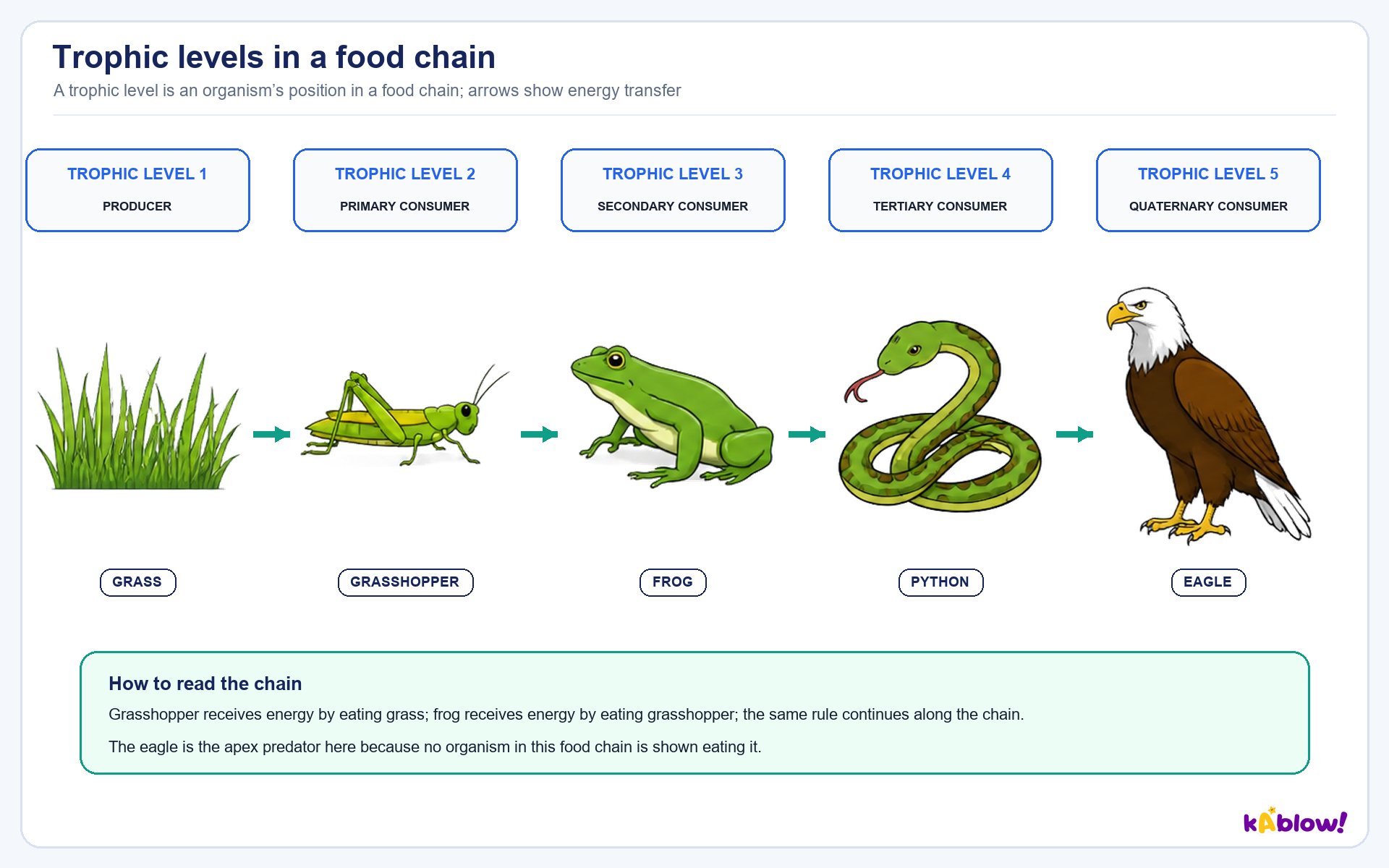
- Trophic levels describe the position of an organism in a food chain, food web or ecological pyramid.
- Trophic levels are numbered starting at level 1 with plants and algae, and increase as you move along the food chain.
- Level 1: Plants and algae make their own food and are called producers.
- Level 2: Herbivores that eat plants/algae are called primary consumers.
- Level 3: Carnivores that eat herbivores are called secondary consumers.
- Level 4: Carnivores that eat other carnivores are called tertiary consumers.
- Apex predators are carnivores with no predators and are at the top of the food chain.
- Some organisms can occupy more than one trophic level in a food web if they eat both plants and animals (omnivores) or eat organisms from different levels.
Trophic levels describe the position of organisms in a food chain
Food Chains and Food Webs
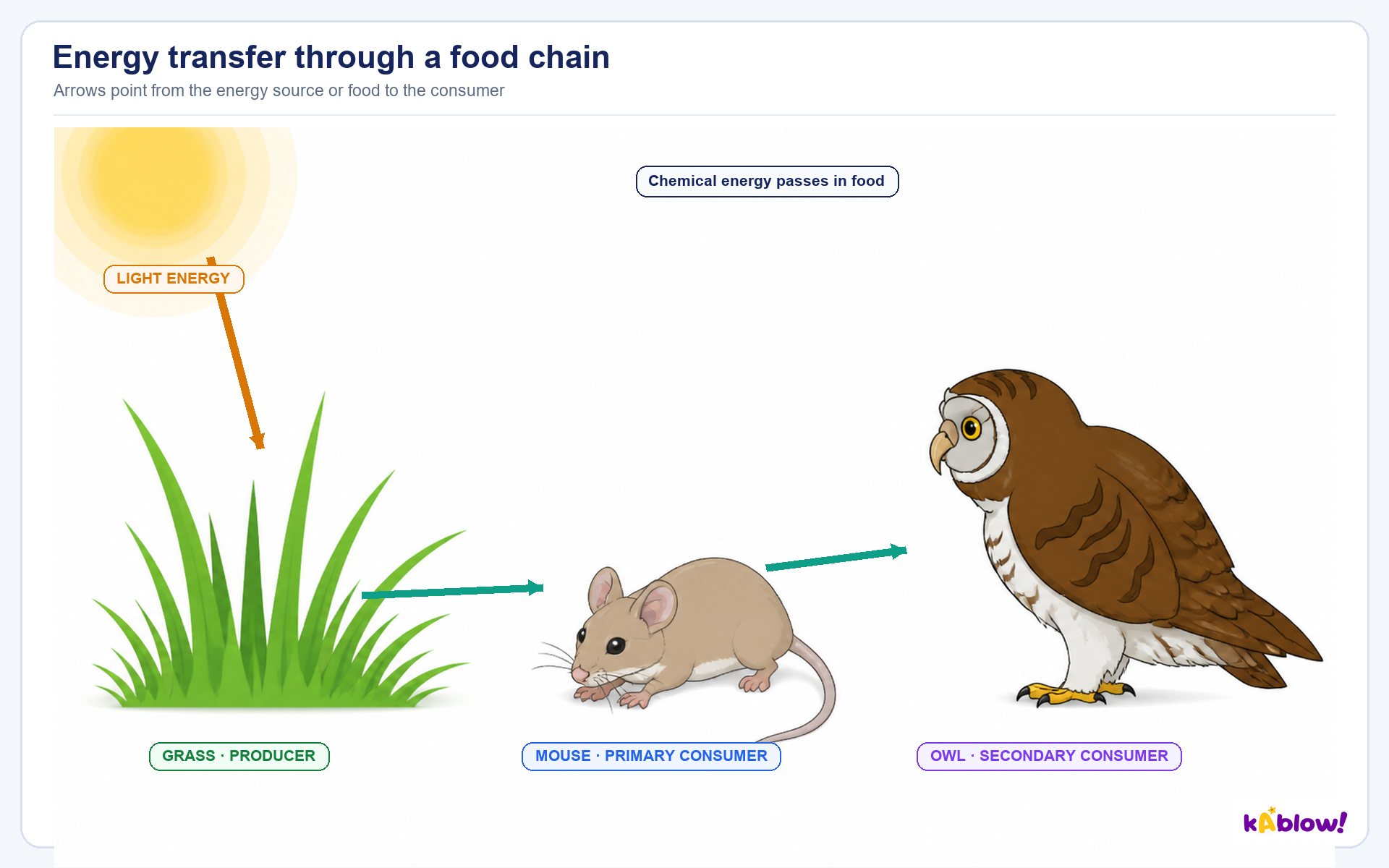
- A food chain shows the transfer of energy from one organism to the next, beginning with a producer.
- The arrows in a food chain show the direction of energy transfer from one trophic level to the next.
- A food web is a network of interconnected food chains and is a more realistic representation of feeding relationships in an ecosystem.
- Food webs show interdependence – a change in one population can affect others in the web.
- For example, if the population of earthworms decreases, the population of grass plants may increase (fewer are eaten), while populations of frogs and mice may decrease (they rely on earthworms as their only food source).
- Consumers can be classed as primary, secondary, tertiary or quaternary according to their position in a food chain.
Energy is transferred from the sun and through the food chain
Decomposers
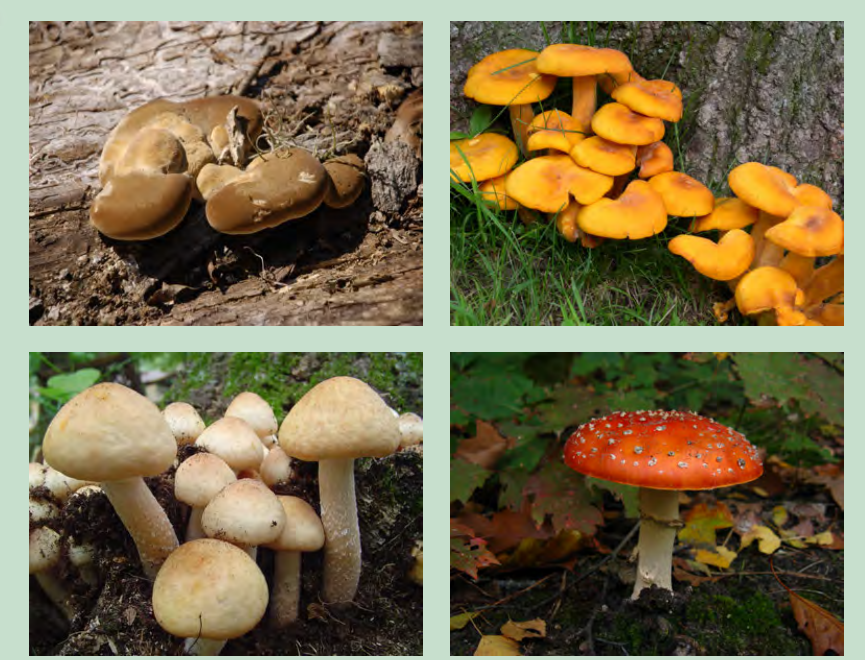
- Decomposers break down dead plant and animal matter.
- The two main groups of decomposers are bacteria and fungi.
- Decomposers secrete digestive enzymes onto the surface of dead organisms.
- These enzymes break down the dead matter into small soluble food molecules.
- The small soluble molecules are then absorbed by the decomposers.
- Decomposition releases organic nutrients back into the environment (e.g. soil), which are essential for the growth of plants (producers).
- Decomposers are not assigned to a single trophic level.
Photographs of four different fungi growing on dead wood
Pyramids of Biomass
- Biomass is the mass of living tissues (or recently dead tissues that have not yet been decomposed) that a plant or animal is made up of.
- It is the dry mass of the organism – the mass without including all the water in the organism.
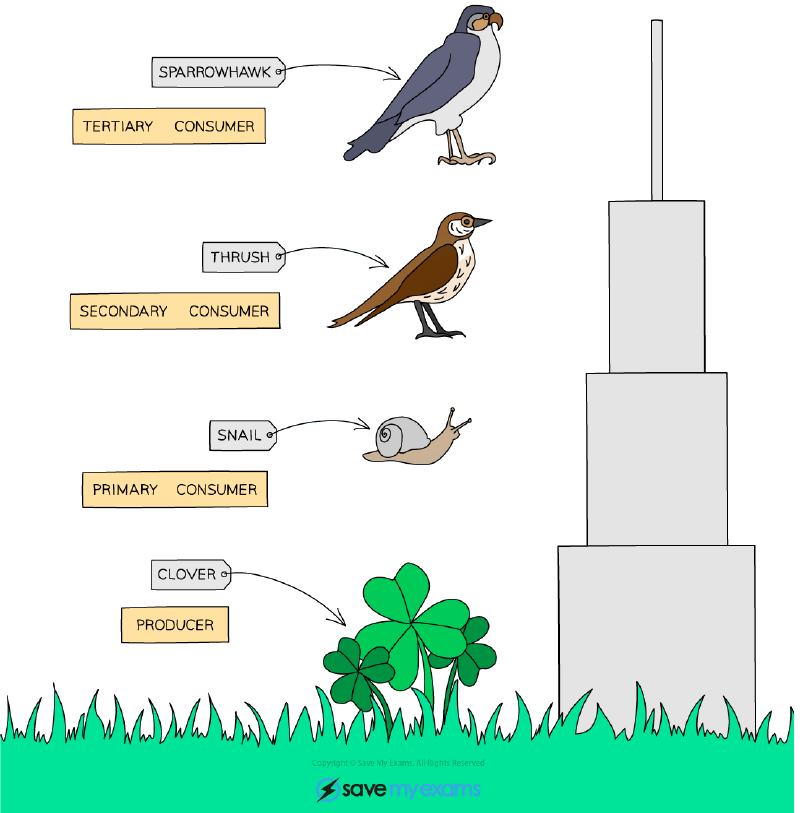
- A pyramid of biomass shows the relative biomass at each trophic level in a food chain.
- Trophic level 1 (producers) is always at the bottom of the pyramid, followed by primary consumers, then secondary consumers, and so on.
- Pyramids of biomass are always pyramid-shaped because biomass always decreases as you move up through the trophic levels.
- The width of each layer represents the relative biomass at that trophic level.
- Pyramids of biomass provide a better idea of the quantity of plant or animal material at each level than pyramids of numbers, and are a better way of representing interdependence.
Pyramid of biomass in a terrestrial food chain
Transfer of Biomass
- Energy flows from the Sun to the first trophic level (producers) in the form of light.
- Producers convert light energy into chemical energy during photosynthesis, when they convert carbon dioxide and water into glucose and oxygen.
- Producers use this glucose (during respiration) to produce their own biomass; biomass is a store of chemical energy.
- When primary consumers eat producers, they break down the biomass (digestion) and use the chemical energy to increase or sustain their own biomass.
- This transfer of chemical energy and biomass continues from one trophic level to the next as organisms eat one another.
- Approximately only 10% of the biomass from each trophic level is transferred to the level above it.
- This is why food chains rarely have more than five or six trophic levels – the total amount of biomass available eventually becomes too small to support another trophic level.
Losses of Biomass
- Organisms rarely eat every part of the organism they consume – some biological material may be inedible (e.g. bones).
- Not all ingested material is digested and absorbed; some is egested as faeces.
- Some absorbed material is lost as waste: carbon dioxide and water are waste products of respiration.
- Water and urea are waste products in urine, produced when proteins are broken down.
- Energy is used for movement and to generate heat, so less is available to produce new biomass.
- Energy is also used for metabolic processes.
- Plants do not produce urine or faeces, so these cannot be given as ways plants lose biomass.
Calculating Efficiency of Biomass Transfer
- The efficiency of biomass transfer between trophic levels can be calculated as a percentage or fraction of mass.
- Use the equation: efficiency = (biomass transferred to next level ÷ biomass at previous level) × 100.
- Divide the smaller number by the bigger one, then multiply by 100.
- For example, if the producer has 10 000 kg of biomass and 8% is passed to the primary consumer, the primary consumer gains 800 kg.
- If only 7% of that is passed to the secondary consumer, the secondary consumer gains 56 kg.
- The efficiency of transfer affects the number of organisms that can be supported at each trophic level.
Human Impact and Food Production
- Humans can affect food chains and food webs through overharvesting of food species and introducing foreign species to a habitat.
- For example, increased catching of lobsters could reduce their population, affecting other organisms in the food web.
- Modern farming methods such as keeping cattle indoors, limiting their movement, and controlling temperature improve the efficiency of biomass transfer from cattle to humans.
- This is because less energy is used for movement and maintaining body temperature, so more biomass is available for growth.
- Eating crops such as wheat and soya directly, rather than feeding them to cattle and then eating the cattle, is a more efficient way to feed the human population.
- This is because energy and biomass are lost at each trophic level, so fewer people can be supported if humans eat higher up the food chain.
投影片
練習題
免費預覽——61 題中的 8 題。註冊即可查看全部。
1.Which of the following statements best defines a secondary consumer in a food chain?
Easy- AA carnivore that eats a herbivore
- BA herbivore that eats a producer
- CA carnivore that also eats plants (an omnivore)
- DAn apex predator
2.Which of the following is the accepted way of demonstrating biomass in different trophic levels in an ecosystem?
Easy- AA pyramid of numbers
- BA pyramid of biomass
- CA food web
- DA food chain
3.In a pyramid of biomass, what quantity does the width of each layer represent?
Medium- AThe number of organisms at that trophic level
- BThe amount of energy at that trophic level
- CThe biomass at that trophic level
- DThe size of each individual organism
4.Which statement best explains why pyramids of biomass rarely contain more than five trophic levels?
Medium- ABecause five levels allows greater biodiversity than eight or ten levels.
- BBecause an apex predator isn't eaten by anything else.
- CThere is a large loss of biomass at each trophic level so the food chain can only sustain a few apex predators.
- DBecause consumers in a food chain are usually connected to other food chains in a food web.
5.Which of the following are ways in which biomass is lost between trophic levels? (select all that apply)
Medium- ANot all ingested material is absorbed; some is egested as faeces.
- BSome absorbed material is lost as carbon dioxide and water in respiration.
- CEnergy is used for movement and to generate heat.
- DBiomass is destroyed completely and leaves the ecosystem.
- EAll biomass is transferred to the next trophic level.
6.Decomposers occupy a single trophic level in a food chain.
EasyTrue or false?
7.Match each trophic level with the correct description.
Medium- Level 1
- Level 2
- Level 3
- Level 4
- Producers (plants and algae)
- Primary consumers (herbivores)
- Secondary consumers (carnivores that eat herbivores)
- Tertiary consumers (carnivores that eat other carnivores)
8.Place the following trophic levels in the correct order from bottom to top of a food chain.
Easy- Producers
- Primary consumers
- Secondary consumers
- Tertiary consumers
歷屆試題
這個主題的歷屆試題練習即將推出。
即將推出